Architect Machines is here to help you uncover processes and ideas that create opportunities for your business to experience an increase in digital tech culture
Be sure to check out the TRXL podcast with our friends at Allied BIM!
171: ‘From Model to Machine’, with Brian Nickel and Brett Settles https://t.co/f30eDBQRjR via @YouTube
@TheRevitKid Lifestyle + Age + generation can have an impact on selection. Although you could get a Gen Z who wants desktop so they do not "have" to work from home.
Roblox is about to onboard over 200M people to AI.
They just revealed a new AI chatbot called Roblox Assistant, allowing creators build virtual worlds just by typing prompts.
What's even more fascinating, is that over 43% of Roblox users are under the age of 13.
The next-gen of builders will be learning how to talk with AI revolution at a VERY young age.
We're headed into a new era.
My dad wrote this irreverent "Notes On Buying A House" 1-pager sometime in the 90s. He gave it to me as I was preparing to purchase my first investment property in 2008.
Literally nothing about this process has changed.
Midjourney-to-3D is now available!
(Indeed, you can convert any 2D image to 3D)
https://t.co/ii0y904taL
Please note that, for now, you'll need to manually set a depth map for your image in order to view its correct 3D version.
(You can use https://t.co/Lf17Q9hPOG to generate the depth map)
But... stay tuned! We'll soon be offering instant 3D conversion for any image.
*This is just an experimental version, and any feedback or videos of your results would be really interesting to see!
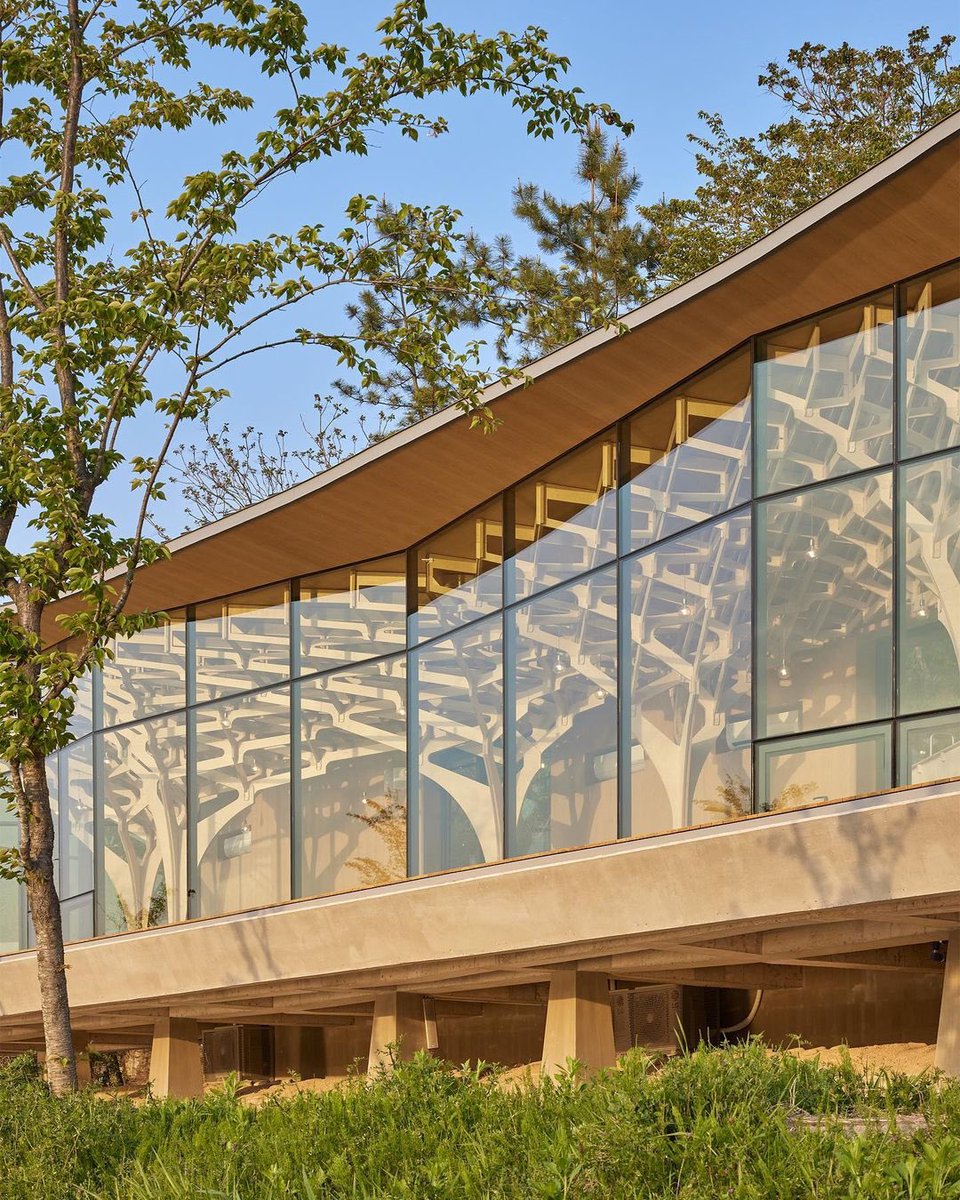
“The Pavilion of Floating Lights”, designed by @j.k_a.r in Jinju-South Korea, aims to reimagine East Asian timber architecture. Traditional assembling techniques and structural systems, such as wooden brackets, which are recreated in the project’s six tree-like columns are used to fulfill this aim. While avoiding the use of pins and adhesives to preserve the original carpentry, complex plywood members were assembled using Augmented Reality to form tree structures to improve construction productivity. 🔗 Tap the link to read more: https://t.co/c79x3bFZIz
📸 by @rohspace
#jinju #southkorea #timberstructure #traditionalarchitecture #parametricarchitecture
Prove you can do hard things
When a teenager asks why they need to learn calculus, what should you say?
You know they will never use it in adulthood, outside of certain career choices.
You could say, “It’ll help you get into college,” but then they’re left wondering why college cares if you know calculus.
And once they’re in college, maybe you could say, “To get a good job,” but why would a potential hirer care how you did in multivariate calculus if your job doesn’t require any knowledge of calculus?
But I recently realized there is a very good reason to take Calculus. It’s to prove you can do hard things.
The ability to do hard things is perhaps the most useful ability you can foster in yourself or your children. And proof that you are someone who can do them is one of the most useful assets you can have on your life resume.
Our self-image is composed of historical evidence of our abilities. The more hard things you push yourself to do, the more competent you will see yourself to be.
If you can run marathons or throw double your body weight over your head, the sleep deprivation from a newborn is only a mild irritant.
If you can excel at organic chemistry or econometrics, onboarding for a new finance job will be a breeze.
But if we avoid hard things, anything mildly challenging will seem insurmountable.
We’ll cry into TikTok over an errant period at the end of a text message. We’ll see ourselves as incapable of learning new skills, taking on new careers, and escaping bad situations.
The proof you can do hard things is one of the most powerful gifts you can give yourself.
My goal with our kids is to avoid lying to them as much as possible.
I won’t tell them that calculus is super important or even that grades are super important. The truth is, they aren’t, so long as you have other plans.
Calculus is a great way to prove you can do hard things if you have no other proof to show.
But if you’re learning programming and building apps in your free time, or winning soccer championships, or writing a novel, then you are doing hard things. Probably harder than Calculus.
This is also why there’s so much survivorship bias and bad advice in the “C students hire A students” trope. Most C students are not doing other hard things instead of school. They’re just goofing off, so they end up working for the A student.
But some C students are getting C’s because they’re obsessed with other projects. Hard projects. And that obsession with doing hard things lets them blow past their Excellent Sheep peers over time.
So if you have a C student who’s obsessed with something hard, you probably don’t have to worry. If they’re getting high and watching TikTok, well…
I don’t particularly care what grades my kids get once they start school. But I do care that they consistently prove to themselves they can do hard things. If Calculus is how they want to do it, fine, but there are many, many more options.
And if you’re not someone who knows they can do hard things, find a way to prove it to yourself.
Build a habit, learn a skill, create something, whatever it is that turns your default stance on challenges from “that seems hard” to “I can figure it out.”
Create proof you can do hard things.
Google has released an AI for generating music.
Simply describe the music you want and a track is created.
This music AI is available for free.
Here's how to access and use it: