Most chains treat liquidation as another transaction.
Arch treats it as the event the entire network must be designed around.
Priority, pricing, collateral seizure and settlement are built into the system from the start.
A few fixed parameters decide how fees can form.
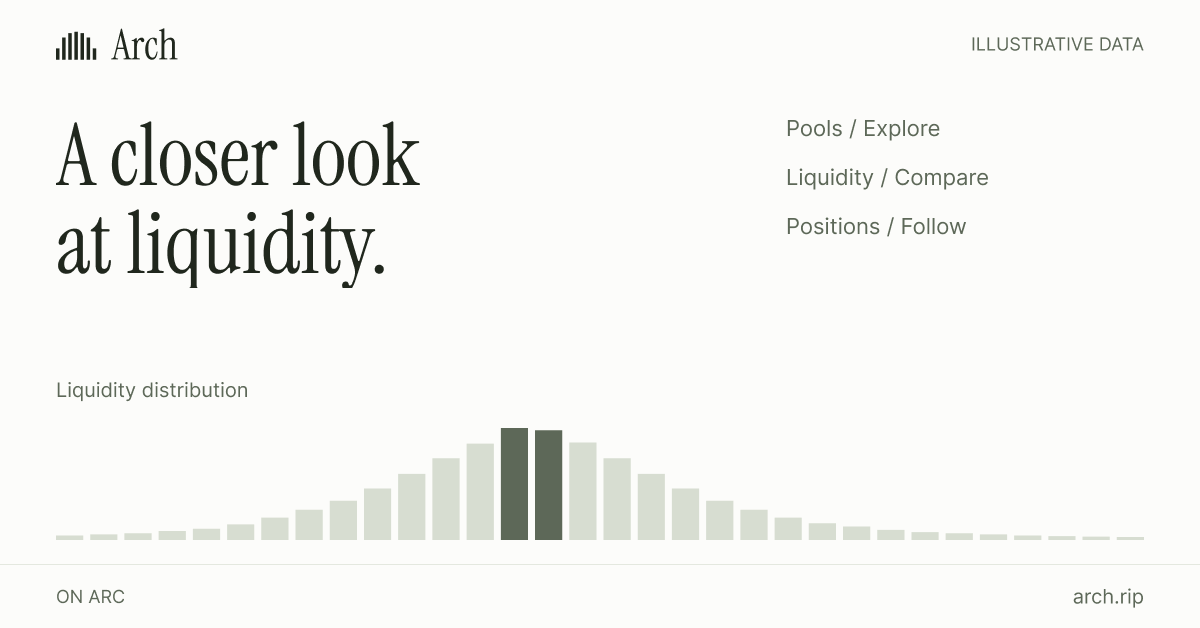
Bin step 50: each bin is 0.50% from the next. A fill inside one bin does not move price. Emptying it moves price one step.
Range cap: 120 bins. At a 0.50% step that is a finite band, not a full-range curve.
Pool create: 5 USDC. Every pool is TOKEN / USDC. Price on screen is a dollar price.
Fee tiers on the current books: 0.25%, 1.00%, 4.00%. Lower tier for tighter pairs. Higher tier when LPs need to be paid for inventory risk.
The router still compares ARCH bins with Uniswap v4 and Arcpools and takes the best output after each venue’s own fees.
ARCH is one venue. It wins when the bins are the cheaper fill.
The pool fee is not a static coupon.
Base fee is the floor you see on the pool card: 0.25%, 1.00%, or 4.00% on the books that are live.
Variable fee is the float. It rises when swaps empty bins and step the price. It decays when the active bin is quiet.
Quiet book, tight range, low variable: you earn close to base times the volume that hits you. Fast tape that walks the book: variable lifts the take, and the position can also leave the range.
Fee generation is volume on your bins, times that all-in rate, times your share. It is not TVL times a sticker rate.
@arc@circle ❣️
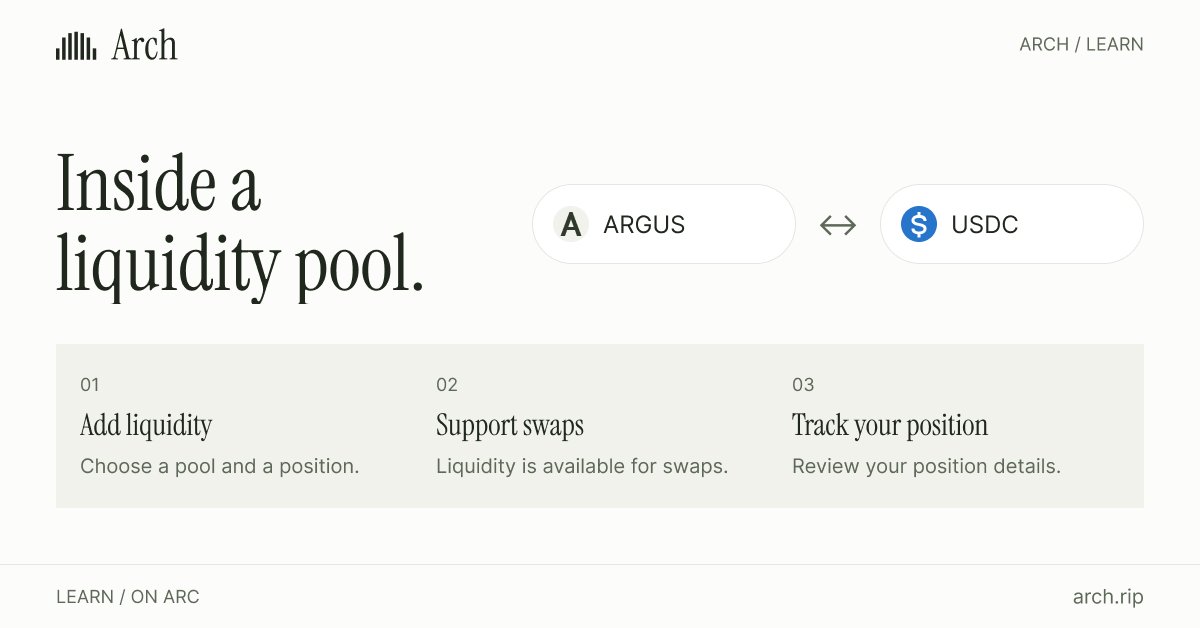
A position is a range, a shape, and shares in each bin.
In range: every trade that prices your bins pays you. Out of range: the position holds inventory and earns nothing until price returns.
That is the number that matters more than headline APR. Two positions with the same deposit can print very different fees if one sits on the active bin and the other sits ten steps away.
Claim takes fees only. Withdraw takes liquidity and fees together.
Check the active bin before you size the range.
@arc
Take a 1.00% pool and a 10,000 USDC swap that fills inside funded bins.
Base LP fee at 1.00% is 100 USDC before the variable add-on. If volatility is flat, that is the LP line. If the swap crosses bins, the variable piece stacks on top of the 100.
Protocol fee at 0.50% of input is 50 USDC, taken from the input, not from the LP line.
Your share of the LP line is your share of liquidity in the bins that actually traded. A 10% share of those bins is 10 USDC of the 100, not 10% of pool TVL.
Volume without overlap on your bins is not your fee.
@arc@circle ❣️
Take a 1.00% pool and a 10,000 USDC swap that fills inside funded bins.
Base LP fee at 1.00% is 100 USDC before the variable add-on. If volatility is flat, that is the LP line. If the swap crosses bins, the variable piece stacks on top of the 100.
Protocol fee at 0.50% of input is 50 USDC, taken from the input, not from the LP line.
Your share of the LP line is your share of liquidity in the bins that actually traded. A 10% share of those bins is 10 USDC of the 100, not 10% of pool TVL.
Volume without overlap on your bins is not your fee.
@arc@circle ❣️
A swap on ARCH pays two things: the pool LP fee, and a protocol fee.
The LP fee is the pool base fee plus a variable part. The variable part rises when price walks across bins and decays when the book is quiet.
The protocol fee is 0.50% of the input.
Fees do not sit inside the position and compound. They accrue to a separate claimable balance. A deposit does not pay a fee, except 0.50% on the slice that lands in the active bin at a different mix than that bin already holds.
You earn only if the trade prices a bin you own.
@arc
ARCH is live on @Arc because the chain is stablecoin-native. Pools are USDC-denominated without a wrapped-native adapter in the middle of the accounting.
Bins, shapes, and the locker are the product. Arc is the settlement layer those tools were built against.
Study the pools. Then place liquidity where you actually want it.
Pools earn when they trade. If a pair you care about has no CLLM book, you can create one.
Fee generation follows volume inside the bins you funded. Empty bins and out-of-range positions do not earn.
The supply that sits unused today is inventory for markets that have not been opened yet.
Pools earn when they trade. If a pair you care about has no CLLM book, you can create one.
Fee generation follows volume inside the bins you funded. Empty bins and out-of-range positions do not earn.
The supply that sits unused today is inventory for markets that have not been opened yet.
Pools earn when they trade. If a pair you care about has no CLLM book, you can create one.
Fee generation follows volume inside the bins you funded. Empty bins and out-of-range positions do not earn.
The supply that sits unused today is inventory for markets that have not been opened yet.
Three users, three jobs.
Trader: fill against a bin instead of a curve.
LP: place capital in a range and a shape, collect fees while the market is in that range.
Issuer: publish a pair, lock supply, and let the book form around a distribution you chose.
Same contracts. Different intent.
Three users, three jobs.
Trader: fill against a bin instead of a curve.
LP: place capital in a range and a shape, collect fees while the market is in that range.
Issuer: publish a pair, lock supply, and let the book form around a distribution you chose.
Same contracts. Different intent.
Three users, three jobs.
Trader: fill against a bin instead of a curve.
LP: place capital in a range and a shape, collect fees while the market is in that range.
Issuer: publish a pair, lock supply, and let the book form around a distribution you chose.
Same contracts. Different intent.
Three users, three jobs.
Trader: fill against a bin instead of a curve.
LP: place capital in a range and a shape, collect fees while the market is in that range.
Issuer: publish a pair, lock supply, and let the book form around a distribution you chose.
Same contracts. Different intent.
The locker exists because team wallets and circulating supply need a public, on-chain commitment.
It is not only for ARCH. Any token on @Arc can be locked through the same tool.
If you are launching or adding liquidity, lock first, then point the market at a CLLM pool. The sequence matters.
Three users, three jobs.
Trader: fill against a bin instead of a curve.
LP: place capital in a range and a shape, collect fees while the market is in that range.
Issuer: publish a pair, lock supply, and let the book form around a distribution you chose.
Same contracts. Different intent.