The security platform that ships with your code. Bot protection, rate limiting, email validation, attack detection, PII redaction. Developer first security.
We're at the AI Security Summit in San Francisco today. Stop by the Arcjet booth to see real-time threat analysis and session behavior analysis protecting coding agents. Your developers will keep choosing their own tools, and the policy should follow them.
Arcjet logs every coding agent call with the agent, the user, the prompt or tool call, the policies that ran and the decision, which is more context than an AI gateway can see. Send it to Splunk, Datadog, SentinelOne or Panther. https://t.co/zpXdkawCoS
Developers use Claude Code, Codex, Cursor, Muse Code, Copilot and more, often within a managed enterprise account, but not always. Arcjet detects shadow AI through coding agent hooks, OpenTelemetry and provider APIs, with an optional macOS agent. https://t.co/bG7HJPcJGB
Great fun building the @arcjet app using the native macOS network extensions to detect shadow AI for today's launch of runtime security for coding agents.
We use a decision model with the full session context to detect credential exfiltration, destructive commands, behavior drift, and other risk activity, all in real time.
Reach out for a demo or sign up to try it today!
All the details: https://t.co/QJTHcKS7A8
Today we're announcing Arcjet Runtime Security for Coding Agents. Security teams can now discover all the coding agents used across every developer endpoint and apply policies to secure those activities, whatever coding agent is being used. https://t.co/F96cF2pb0h
Read a ticket. Query the customer database. Send an email.
Each action is permitted. The sequence is an exfiltration path. Per-call checking cannot catch this no matter how good the individual checks are, because the earlier steps are out of scope by the time it matters.
Your agent is not waiting for someone to type into a chat box. It is set off by an inbox, a text message or a code commit, and it reads and writes to your database on the way through.
That is why we built enforcement that runs at the moment it acts.
https://t.co/oMfPWgCyZT
Agentic AI can now take real actions - its mistakes range from clumsy to harmful to malicious.
@Arcjet's new Agent Runtime Security gives engineering teams enforcement as soon as an agent acts, with sequence-aware checks so risky patterns get caught.
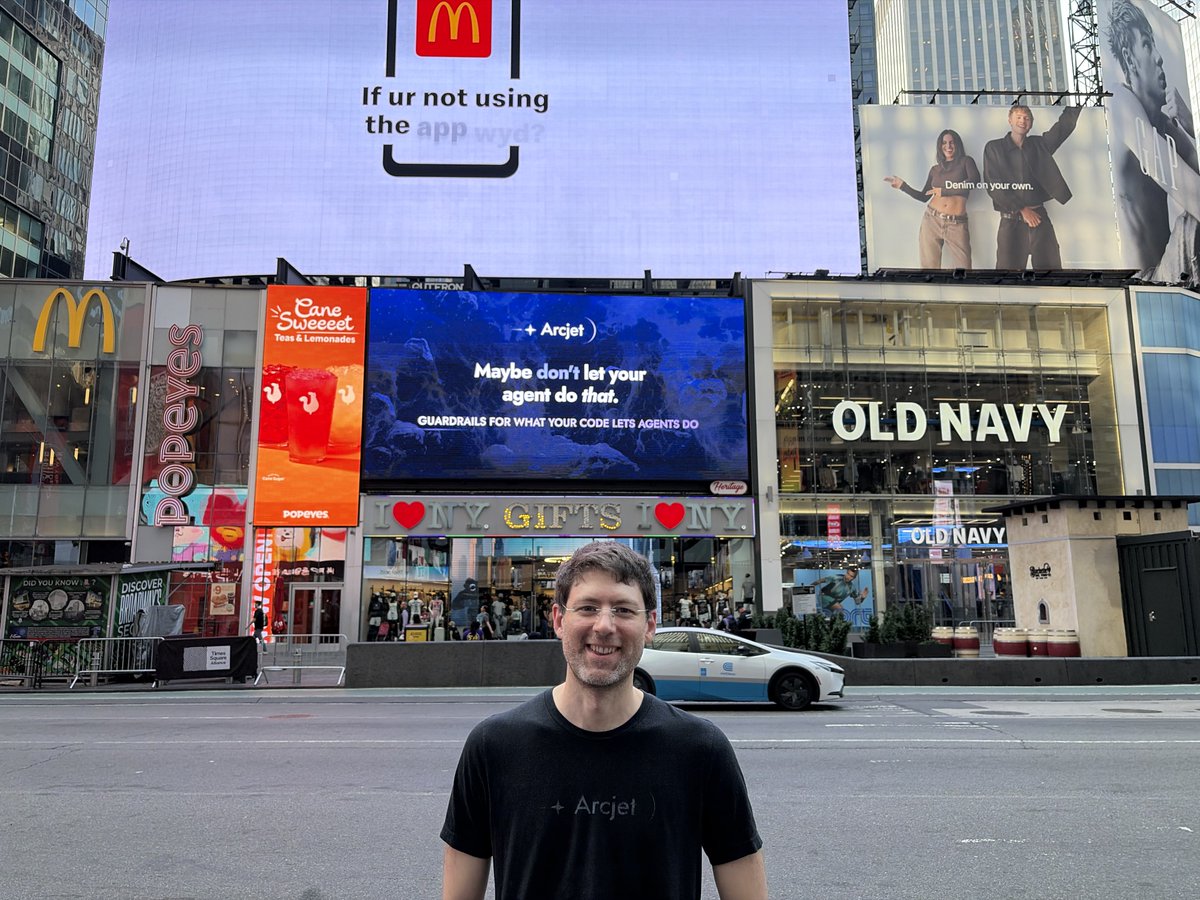
It's a year since I moved to NYC, so we're on Times Square for today's launch of @arcjet's new agent runtime security:
Three new capabilities, available now:
1. Observe: discover all your agents, wherever they're running, with no code changes and nothing to deploy
2. Enforce: apply controls before and after every action. Apply deterministic policies to tools, APIs, database calls, and other inputs/outputs. Detect prompt injection, wrap tools in safety guardrails, limit API access, and protect PII
3. Audit: collect the evidence for security reviews and compliance audits
Sign up for a free trial or reach out to schedule a demo!
@catidegla You'd do both! The goal is to prevent the model receiving PII, but you'd also run it after other actions like a database or API call - checking for unexpected data leaving the system
When AI was just a chatbot, the worst thing it could do was be wrong. That is no longer where the risk sits. Today we are announcing Agent Runtime Security.
Enforcement is also sequence aware, so a decision late in a workflow accounts for what happened in the earlier steps instead of judging each call on its own. Full write-up in the reply. https://t.co/rIVeELjLYW