This Anthropic MCP paper is f*cking gold
Anthropic's engineers cut an agent's tool context from 150,000 tokens to 2,000. Same tools, same task. And the model wasn't the upgrade.
The upgrade: the agent stops calling tools and starts writing code that calls them.
tools → files → code → filter → answer
The 6 parts of code mode:
Part 1 → tools as files
Every MCP tool becomes a .ts file in ./servers.
The agent lists the folder and opens only what it needs.
Part 2 → load on demand
150,000 tokens of tool definitions down to 2,000.
A 98.7% saving in time and cost.
Part 3 → filter in code
A 10,000-row sheet gets filtered in the sandbox.
The model sees 5 rows.
Part 4 → loops in code
Polling Slack for "deployment complete" runs as a while loop.
No round trip through the model on every check.
Part 5 → private by default
Emails and phones turn into [EMAIL_1] and [PHONE_1] before the model sees them.
The real data still lands in Salesforce.
Part 6 → skills
Working code gets saved to ./skills with a SKILL.md.
The agent builds its own toolbox.
An agent that loads every tool burns its context before you ask anything. An agent that writes code opens 2 files.
I packed all 6 parts into one prompt. Drop it into Claude Code and it sets code mode up for you.
6 parts. 1 prompt. 98.7% fewer tokens.
Then read the enhanced edition of agent engineering below ↓
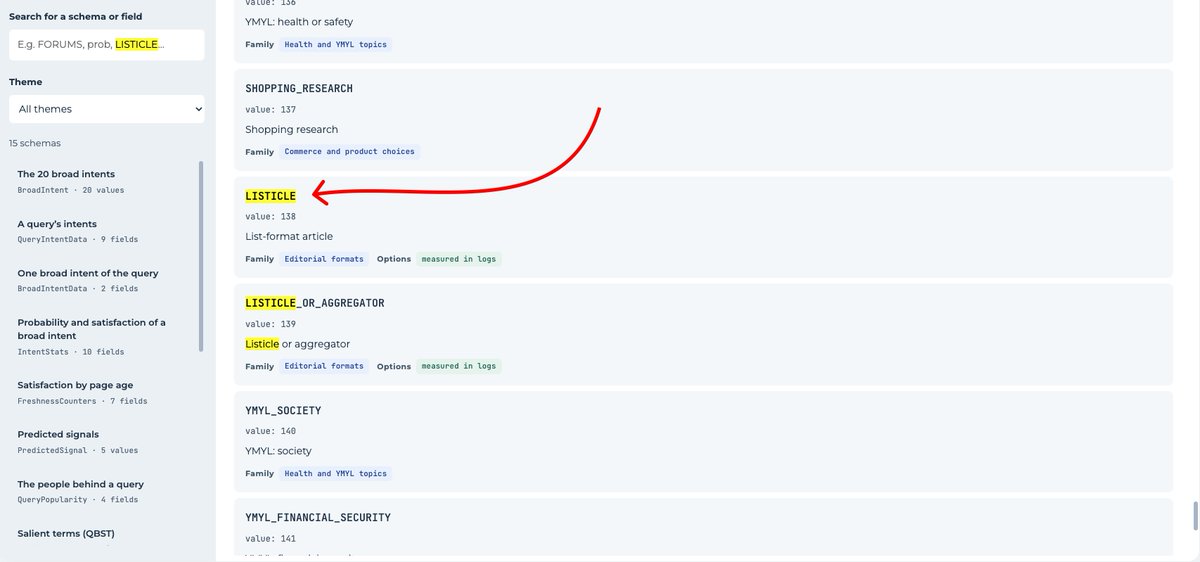
Google has an internal label for listicles 👀
Resoneo dug into Google's internal schemas and found that Google sorts every page into categories. One of them is literally called LISTICLE.
So Google knows when your page is a "best X tools" article, and it tracks how those pages perform.
But this isn't only coming from leaks. Google says it publicly too.
In their own guidelines for writing reviews, they have rules for ranked lists:
- if you call something "the best", you have to explain why, with first-hand evidence
- your list should have enough useful content to stand on its own
And this is why a bunch of SaaS blogs got hit this year. They published dozens of "best X tools" lists, put themselves at #1, and never explained how they picked the rest.
That said, listicles still work really well :)
You just wanna make sure yours:
- explains how you picked and ranked each tool
- shows you actually used or tested them
- gives each tool a clear "best for" use case
- doesn't put you at #1 without a real reason
More than ever it'll be important to get your business as lean as possible I think
Moving from expensive PaaS platforms to your own VPS is usually 100x to 1000x cheaper:
Vultr VPS is $2.50/month
AWS Lightsail VPS is $3.50/mo
DigitalOcean VPS starts at $4/month
Linode VPS starts at $5/month
Hetzner VPS starts at $7/month
Yes that's an entire server you can host your sites on!
Add free Tailscale + free Cloudflare Tunnel + close all firewall ports and you're safe too!
WOW! Got featured on There’s An AI For That!
I built an AI SEO Agent that can help schedule content for Wordpress, Shopify, Wix, even GoHighLevel etc. + LLM citation tracking to see if you show up in places like ChatGPT!
Check it out here: https://t.co/dXmaQSvzK0
holy sh*t, Google Research just open-sourced an agent that can improve its own harness
steal this blueprint for a self-improving agent
the prompts, memory, skills and tool guidance around your model can evolve as it works
it’s called Harness²
the loop:
→ propose changes to the agent’s setup
→ run candidate setups on the same task
→ compare what actually happened
→ compose a refined harness from that evidence
→ carry useful lessons into future tasks
the clever part:
it refines the harness on unfamiliar tasks without a ground-truth answer to guide those edits
the architecture:
propose → probe → compose → retain lessons → repeat
the part builders should steal:
treat your agent’s setup as something you can experiment on
pick a recurring failure
propose a specific harness change
compare execution traces on the same task
evaluate the result
keep the evidence with the change
the repo includes OpenCode and Codex executors, parallel and sequential refinement, and a local demo you can run without model credentials
save this, then read the full guide for Opus 5.5 Harness Engineering ↓
I spent 48 hours in SF hanging out with billionaires, data labs and AI founders and execs running $1B to $100B companies.
My observations:
1. Sooo MANY stories of data brokers making like $2M a WEEK selling company data to labs. I can't tell if it's the beginning or a bubble, and I kept wondering which niches are left. Digging into it actively.
2. At dinner, someone asked the table, "If a new model drops next month, does your company get better or worse?" HALF the table went quiet! I think that's the best question to ask about any AI startup right now.
3. The bar people talk about now is hitting $1B in revenue in 12 months (I guess that's the new unicorn?). What I didn't hear much about is retention. AI revenue can come in fast and leave fast, and I think we're going to see a lot of stories of AI companies with huge revenue and terrible retention.
4. It's pretty clear we're living through the reinvention of the computer. The model is the CPU, the harness is the operating system, and skills and plugins are the apps. Thinking about it that way makes it easier to see where the whitespace is.
5. We're maybe 12 months from an agent that can watch you work for a week and then do your job without any instructions. The screen recording plus agent memory plus local model combination makes this possible right now.
6. Agent harnesses feel like the new GPT wrappers, in a good way, especially vertical ones. The best teams I talked to treat the model as swappable. One founder walked me through routing different models to different jobs: one for taste and visuals, a cheaper one for the everyday stuff, another for text.
They use prompts they can move across models over fine-tuning, and A/B test the output on what users actually do with it: do they edit it, export it, share it? A vertical harness is basically four things: the connectors for that industry's data, evals written by people who know the work, rules for what the agent can and can't touch, and a clean screen for a human to review. The model is maybe 20% of it.
7. There's a lot of reverse engineering going on/cloning going on more than I've ever seen. People are decompiling software and rebuilding it with agents, and someone showed a suite of like 10 apps that are worth $5B+ each all that he cloned open source. Me and everyone are still thinking through what it means when software gets this easy to copy.
8. My guess is the value moves to data. If the software can be rebuilt quickly, what's worth paying for in a legacy SaaS company is the years of customer data and workflows inside it. Some SaaS companies are secretly data companies.
Gets me thinking about how do you truly value data for this saas companies? Like if we were buying these dying saas companies at 2x ARR before (as example), maybe there is a better metric. Idk, just thinking out loud here.
9. It feels like a good chunk of legacy software won't make it to the agentic era, especially anything built around people clicking through a lot of screens.
10. Every company I talked to wants to pipe its internal data into one place and expose it to agents through MCP. Then they look at the data and realize it's a mess: five versions of the same customer, old Slack channels, PDFs nobody can search. Cleaning that up feels like a big consulting opportunity!
11. A lot of founders are building the basic building blocks for agents: APIs, data layers and tools. Some of the companies I saw barely have a UI because the main user is an agent. I really believe the startups that build primitives to this agentic era will do extremely well. Building blocks is the best way to think about it.
12. Labs can get plenty of training data, but it's harder to get real examples of agents failing inside companies. Whoever has those logs has something valuable.
13. Someone running a big consumer company told me the next fight is over memory. The model that remembers the most about you wins, and the smartest model matters less than people think.
14. Physical AI came up a lot. Astra I think was the first model that got people into AI can actually do CAD, and I think a lot of people are thinking what does vibe manufacturing really look like. The line I keep thinking about came from a robotics founder: the hardest problems in AI are deployment problems now, not research problems. Their robots work on their own, call a human when they get stuck, and every one of those calls becomes training data.
15. Cybersecurity companies are having a moment and are actually cool companies to build now, especially the ones that clean up after a breach. Every agent with access to your systems is a new door into your company, and a lot of those doors were left open.
16. Some startups are worth more dead than alive now. A shutdown company with 5 years of Slack, email and code can get paid for licensing all of it. I wouldn't be surprised if founders start factoring that into when they shut down.
17. People are starting to talk about monetizing the agent web. It feels really early, but when the most popular user of the internet is an agent, what startups should you be building?
18. I think agent insurance is coming. Once an agent makes an expensive mistake, insurers will want audits before they cover anyone.
19. Several people said the hire they want most is someone with taste who can write evals. The models are getting good at generating ideas, so the hard part is judging which ones are good.
20. New trend I observed: startup raises VC, uses venture dollars to become a creator, startup fails, founder falls back on being a full-time creator and incubates other products bootstrapped.
21. Getting SIGNIFICANT distribution is HARD right now. Founders are sponsoring buses, buying billboards like crazy and throwing parties with famous DJs to get noticed. Kinda feels dotcom era in that sense.
Attention is what's scarce! The growth guy going viral sharing his UGC strategy from Wispr Flow is a good example. It's the sauce everyone wants, and I truly believe there are probably only 50 people on the planet who know how to scale these types of businesses efficiently in this era.
Always good to get that dose of SF. I felt sooo lucky to have such an incredible trip during such an incredible time in building businesses. Surreal in so many ways.
Happy to be home and locked in.
Until next time!
REA is most dangerous thing on the internet right now...
It lets your AI agent reverse engineer any app, down to the binary
If you use it correctly, you can rebuild any feature you pay for, for FREE
In this article, I show you how: https://t.co/3P1FNXiXzl
I can't believe I'm giving all this away...
The entire workflow, 13 prompts, and a full Claude skill to use for all the top video gen models
you're welcome https://t.co/kYP1fmIt4c
🎯𝗖𝗹𝗮𝘂𝗱𝗲 𝗖𝗼𝗱𝗲 𝗖𝗵𝗲𝗮𝘁 𝗦𝗵𝗲𝗲𝘁
𝗖𝗹𝗮𝘂𝗱𝗲 𝗖𝗼𝗱𝗲 𝗶𝘀 𝗺𝗼𝗿𝗲 𝗽𝗼𝘄𝗲𝗿𝗳𝘂𝗹 𝘄𝗵𝗲𝗻 𝘆𝗼𝘂 𝘀𝘁𝗼𝗽 𝘁𝗿𝗲𝗮𝘁𝗶𝗻𝗴 𝗶𝘁 𝗹𝗶𝗸𝗲 𝗷𝘂𝘀𝘁 𝗮𝗻 𝗔𝗜 𝗰𝗼𝗱𝗶𝗻𝗴 𝗰𝗵𝗮𝘁𝗯𝗼𝘁.
The real advantage comes from knowing 𝗵𝗶𝗰𝗵 𝗰𝗼𝗺𝗺𝗮𝗻𝗱 𝘁𝗼 𝘂𝘀𝗲, 𝘄𝗵𝗲𝗻 𝘁𝗼 𝘂𝘀𝗲 𝗶𝘁, 𝗮𝗻𝗱 𝗵𝗼𝘄 𝘁𝗼 𝘀𝘁𝗿𝘂𝗰𝘁𝘂𝗿𝗲 𝘆𝗼𝘂𝗿 𝗽𝗿𝗼𝗷𝗲𝗰𝘁 𝗮𝗿𝗼𝘂𝗻𝗱 𝗶𝘁.
Here’s a practical Claude Code cheat sheet worth saving 👇
𝗖𝗟𝗔𝗨𝗗𝗘.md
Project-specific rulebook Claude reads before every task.
/init first to auto-generate.
Focus on architecture, coding style, build commands, and review checklists.
Keep it under 150 lines.
𝗦𝗸𝗶𝗹𝗹𝘀
Reusable markdown prompt templates for standardized workflows.
Encode 𝗰𝗼𝗱𝗲 𝗿𝗲𝘃𝗶𝗲𝘄, 𝘀𝗲𝗰𝘂𝗿𝗶𝘁𝘆 𝘀𝗰𝗮𝗻𝘀, 𝗮𝗻𝗱 𝗱𝗲𝗽𝗹𝗼𝘆𝗺𝗲𝗻𝘁 𝗰𝗵𝗲𝗰𝗸𝗹𝗶𝘀𝘁𝘀 to align team standards.
𝗠𝗖𝗣
Connects Claude to local tools, databases, and external APIs.
Link MCP servers to query live databases or terminal logs during debugging.
𝗔𝗴𝗲𝗻𝘁𝘀
Spawns background sub-agents for parallel, isolated tasks.
Have 𝗮𝗴𝗲𝗻𝘁𝘀 𝘄𝗿𝗶𝘁𝗲 𝘂𝗻𝗶𝘁 𝘁𝗲𝘀𝘁𝘀 while you focus on core feature logic.
𝗣𝗹𝗮𝗻
Forces an architectural outline before any code is written.
Critique the plan first, then command Claude to “implement it.”
𝗖𝗼𝗺𝗽𝗮𝗰𝘁
Compresses history to maximize the context window.
Use when Claude feels sluggish to keep the context focused.
𝗔𝘂𝘁𝗼𝗱𝗿𝗲𝗮𝗺
AI “sleep cycle” that organizes and refines project memory.
Useful for reducing 𝗰𝗼𝗻𝘁𝗲𝘅𝘁 𝗽𝗼𝗹𝗹𝘂𝘁𝗶𝗼𝗻 in long-running workflows.
𝗥𝗮𝗹𝗽𝗵-𝗹𝗼𝗼𝗽
Autonomous iteration loop for persistent self-correction and testing.
Ideal for TDD. Always set safe limits for iterations.
---
𝗣𝗿𝗼 𝗧𝗶𝗽𝘀 𝗬𝗼𝘂 𝗖𝗮𝗻 𝗠𝗶𝘀𝘀
✅ /init → creates your CLAUDE.md starter instantly
✅ Use /context to check usage before things get heavy
✅ /memory → view and edit auto notes anytime
✅ Hooks can run auto-lint and formatting after edits
✅ Always 𝗿𝗲𝘃𝗶𝗲𝘄 𝗱𝗶𝗳𝗳𝘀 before accepting changes
✅ /plan mode = safer exploration before editing
✅ 𝗦𝗸𝗶𝗹𝗹𝘀 + 𝗮𝗴𝗲𝗻𝘁𝘀 = more consistency across workflows
✅ /compact at ~70% context = a useful trigger before conversations become unwieldy
---
𝗢𝗻𝗲 𝗺𝗼𝗿𝗲 𝘁𝗵𝗶𝗻𝗴 𝗜’𝗱 𝗮𝗱𝗱:
Don’t ask Claude Code to “build the feature” and hope for the best.
Try this workflow:
𝗣𝗹𝗮𝗻 → 𝗜𝗺𝗽𝗹𝗲𝗺𝗲𝗻𝘁 → 𝗧𝗲𝘀𝘁 → 𝗥𝗲𝘃𝗶𝗲𝘄 → 𝗖𝗼𝗺𝗽𝗮𝗰𝘁 → 𝗜𝘁𝗲𝗿𝗮𝘁𝗲
The goal isn’t to give Claude more instructions.
The goal is to give it 𝗯𝗲𝘁𝘁𝗲𝗿 𝘀𝘁𝗿𝘂𝗰𝘁𝘂𝗿𝗲.
That’s where AI coding starts feeling less like autocomplete and more like an engineering workflow.
𝗪𝗵𝗶𝗰𝗵 𝗖𝗹𝗮𝘂𝗱𝗲 𝗖𝗼𝗱𝗲 𝗰𝗼𝗺𝗺𝗮𝗻𝗱 𝗱𝗼 𝘆𝗼𝘂 𝘂𝘀𝗲 𝘁𝗵𝗲 𝗺𝗼𝘀𝘁? 👇
#ClaudeCode #AI #Coding #SoftwareEngineering #AITools
30 seconds. One pass. Audio included.
Not four 8-second clips stitched together and prayed over.
One continuous take, generated in a single shot, with the sound produced in the same pass as the picture — so the audio actually belongs to the footage instead of being dubbed on after.
Seedance 2.0 capped at 15 seconds. 2.5 doubles it.
And it doesn't stop there:
→ Multimodal references, so your character and your location hold steady across the entire clip
→ Region-level editing — one part of the frame missed? Fix that part. Stop re-rolling the whole video.
→ ~20% better prompt adherence
That third one is the quiet killer. Every creator on a metered plan knows the loop: generate, one thing is wrong, regenerate, something else breaks, watch your credits evaporate.
Region editing ends the loop.
I broke down exactly what this model can do, how to prompt it in beats instead of paragraphs, and whether OpenArt's unlimited plan is worth it 👇
Seedance 2.5 Review - Seedance Just Changed AI Video Forever 🚨#ai #seedance #seedance25
https://t.co/f1nCUQeoWH