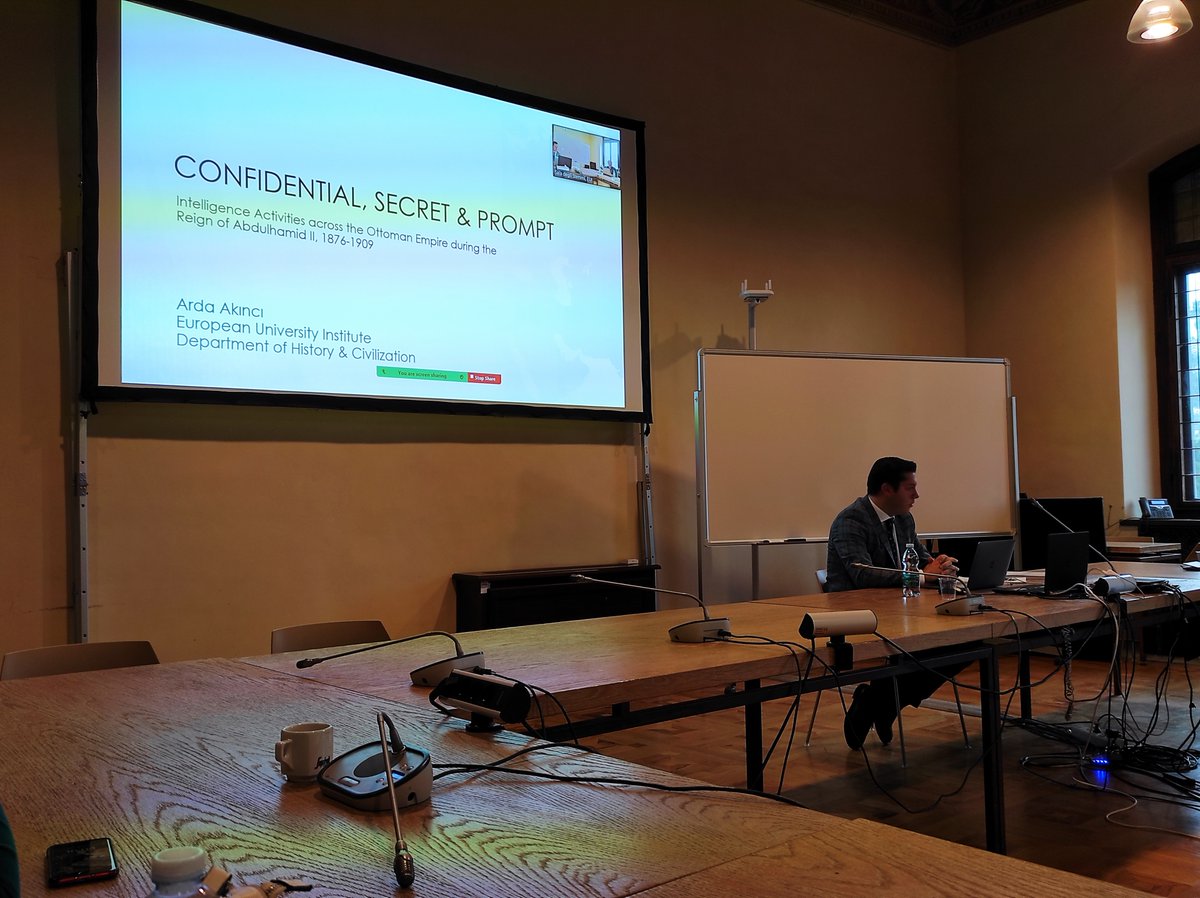
I'm obliged to share more news for those who supported me. I defended my PhD last week @EUI_History. Was an emotional day, after 5+ years working on my project "Confidential, Secret & Prompt: Intel Activities across the Ottoman Empire during the Reign of Abdulhamid II, 1876-1909"
Not every day one can work from 9 to 6. There are days when I was inspired & worked until morning, but that must be exception. Academia doesn’t work like that but also it doesn’t have to be 24/7 with no personal life left. A reasonable middle ground has to be found.
I don’t know how both sides managed to get it wrong but here’s my honest hard-learned opinion that no one asked for. Yes, getting paid to do a PhD is a privilege but one that only a few gets. Not everyone has a grant and not even those who have a grant “earns a living.”
I don’t agree. A PhD student should not prioritize work-life balance.
Getting to do a PhD is a privilege. You are paid to think. There is no pressure for you to be economically useful. It is a unique opportunity to push the boundaries of human knowledge and produce something ground breaking.
And nothing great ever happens without complete devotion. Look at everything that moved and shaped the world. Every single person who created anything meaningful, in science, in arts, in music, in movies, devoted their lives to their craft.
Extraordinary outcomes require extraordinary inputs and some degree of sacrifice. Sure, have work-life balance during your PhD. But be content a mediocre outcome.
Its been 7m since I was home. I know everyone sacrifices a lot and it doesn’t have to be like that. A better academia, where one works as much as any other job (sometimes extra hours and weekends and holidays) but most of the time with only a reasonable schedule.
El peor consejo académico que he visto en mucho tiempo. Los periódicos son fuentes primarias importantes y, al igual que cualquier otro documento, deben abordarse con cautela. Sin embargo, se puede escribir perfectamente una tesis basándose en periódicos.
Ayer tuvimos una estupenda edición del seminario Escalas, esta vez con @ardakinci presentando el borrador de un capítulo de su libro sobre el espionaje en el Imperio otomano tardío: revolucionarias búlgaros, gobernadores otomanos y unos espías "de confianza" contratados ad hoc.
One of the most comprehensive ongoing projects currently on Ottoman demographic, family and social history.
Their website is now live, take a look at it! I'm sure that it will make a huge impact on the scholarship.
https://t.co/tPIO50DsOL
Less than a month left, deadline on Feb. 15 to submit your abstracts for our "International Conference on the Circulation of Knowledge in the Ottoman World" Let's spread the word and meet in Madrid in September!!
Today in the class we were discussing the final presentations. I'm wondering what those who are working at the intersection of Modern/Contemporary History and IR. What is your opinion on research questions that begin with "To what an extent....?" - esp. for qualitative research?
@DarinaMarty@salvalima23 Les deseo a todos la misma suerte que tuvo Rasim Efendi, de Karahisar-i Sarki (la actual Sebinkarahisar), que fue exiliado a Bodrum 😎
https://t.co/SkZooQk0P0
Según dice el informe de la delegación de la Cruz Roja, los internados podían jugar al fútbol o a ajedrez, además de atender rezos si quisieran, y la War Office británica incluso consiguió un piano para los oficiales otomanos.
Esto es Sidi Bishr hoy. Tengo el privilegio de pasar horas debatiendo con 2 historiadores de pro, @ardakinci@salvalima23 , sobre los tiempos cuando allí había un campo de prisioneros de guerra (también turcos) durante la Primera Guerra Mundial. Qué bonita es nuestra profesión.