A current Anthropic engineer who used to work at OpenAI just leaked a 12-page PDF on the $2 model war.
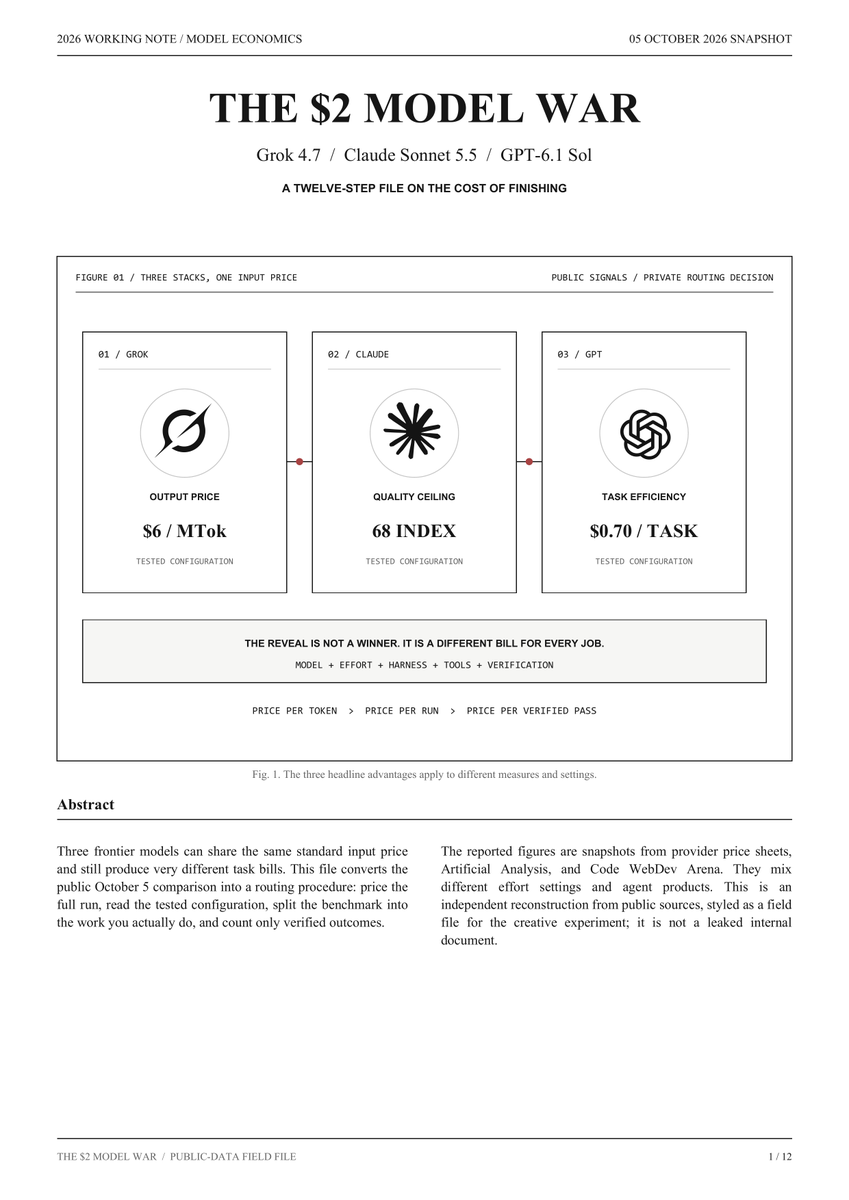
The part most teams will miss: Grok 4.7, Claude Sonnet 5.5 and GPT-6.1 Sol all start at the same $2 input price, but they do not finish the same work for the same money.
This is a 12-step operating file for choosing the stack that actually gets the job done:
step 1 → stop picking a model from its input-token price. Buy a verified result, not a cheap first message.
step 2 → price the entire run: fresh input, cached reads, output, tool calls, retries and the human cleanup nobody puts on a rate card.
step 3 → watch the context trap: Grok changes pricing above 200K; GPT's higher rates kick in above 272K input tokens for the whole request. A million-token window is capacity, not a dare.
step 4 → sweep effort before switching brands. Sonnet max reaches the highest broad score in this comparison, but its measured bill jumps hard. More thinking is a purchase decision.
step 5 → compare working agents, not naked models. Claude Code, Codex and Grok Build bring different tools, limits and loops to the same benchmark.
step 6 → split the coding score into its real jobs. Grok and GPT both hit 73% on long repository changes, but their terminal-task results are far apart.
step 7 → count the loop tax. The tested Grok Build row used about 163 turns and 14.3M tokens per task; the GPT xhigh Codex row used about 40 turns and 3.2M.
step 8 → keep web-design preference in a separate lane. A page people like is not proof that the form works, the patch passes, or the product is maintainable.
step 9 → name the clock. First chunk, full answer, active agent time and verified delivery are four different definitions of “fast.”
step 10 → route routine coding to the cheapest configuration that passes your check; escalate effort for the hard cases, then switch stacks only when the evidence says to.
step 11 → run a six-to-ten-task tournament on your own work. Freeze the brief and verifier first; log every failed attempt and calculate dollars per verified pass.
step 12 → launch the routing policy in shadow mode. Automate the narrow, checkable lane first and keep publishing, spending, deletion and deployment behind human approval.
The result: Sonnet can buy a higher ceiling, GPT can finish the tested coding queue with striking efficiency, and Grok can compete on long repository edits while its agent loop may cost far more than its token price suggests.
The secret metric is not dollars per million tokens. It is dollars and minutes per verified finish.
Save this. The full 12-page field file and the three-model diagram are below ↓
All three charge $2 per million input tokens
Their coding agents do not cost the same
Effort, output, cache use, and retries all change the bill
I broke down how Grok, Claude, and GPT compare on coding quality, speed, and cost ↓ https://t.co/Av7tQjpoiY
A current Anthropic engineer who used to work at OpenAI just leaked a 12-page PDF on the $2 model war.
The part most teams will miss: Grok 4.7, Claude Sonnet 5.5 and GPT-6.1 Sol all start at the same $2 input price, but they do not finish the same work for the same money.
This is a 12-step operating file for choosing the stack that actually gets the job done:
step 1 → stop picking a model from its input-token price. Buy a verified result, not a cheap first message.
step 2 → price the entire run: fresh input, cached reads, output, tool calls, retries and the human cleanup nobody puts on a rate card.
step 3 → watch the context trap: Grok changes pricing above 200K; GPT's higher rates kick in above 272K input tokens for the whole request. A million-token window is capacity, not a dare.
step 4 → sweep effort before switching brands. Sonnet max reaches the highest broad score in this comparison, but its measured bill jumps hard. More thinking is a purchase decision.
step 5 → compare working agents, not naked models. Claude Code, Codex and Grok Build bring different tools, limits and loops to the same benchmark.
step 6 → split the coding score into its real jobs. Grok and GPT both hit 73% on long repository changes, but their terminal-task results are far apart.
step 7 → count the loop tax. The tested Grok Build row used about 163 turns and 14.3M tokens per task; the GPT xhigh Codex row used about 40 turns and 3.2M.
step 8 → keep web-design preference in a separate lane. A page people like is not proof that the form works, the patch passes, or the product is maintainable.
step 9 → name the clock. First chunk, full answer, active agent time and verified delivery are four different definitions of “fast.”
step 10 → route routine coding to the cheapest configuration that passes your check; escalate effort for the hard cases, then switch stacks only when the evidence says to.
step 11 → run a six-to-ten-task tournament on your own work. Freeze the brief and verifier first; log every failed attempt and calculate dollars per verified pass.
step 12 → launch the routing policy in shadow mode. Automate the narrow, checkable lane first and keep publishing, spending, deletion and deployment behind human approval.
The result: Sonnet can buy a higher ceiling, GPT can finish the tested coding queue with striking efficiency, and Grok can compete on long repository edits while its agent loop may cost far more than its token price suggests.
The secret metric is not dollars per million tokens. It is dollars and minutes per verified finish.
Save this. The full 12-page field file and the three-model diagram are below ↓
A current Anthropic engineer who used to work at OpenAI just leaked a 12-page PDF on the $2 model war.
The part most teams will miss: Grok 4.7, Claude Sonnet 5.5 and GPT-6.1 Sol all start at the same $2 input price, but they do not finish the same work for the same money.
This is a 12-step operating file for choosing the stack that actually gets the job done:
step 1 → stop picking a model from its input-token price. Buy a verified result, not a cheap first message.
step 2 → price the entire run: fresh input, cached reads, output, tool calls, retries and the human cleanup nobody puts on a rate card.
step 3 → watch the context trap: Grok changes pricing above 200K; GPT's higher rates kick in above 272K input tokens for the whole request. A million-token window is capacity, not a dare.
step 4 → sweep effort before switching brands. Sonnet max reaches the highest broad score in this comparison, but its measured bill jumps hard. More thinking is a purchase decision.
step 5 → compare working agents, not naked models. Claude Code, Codex and Grok Build bring different tools, limits and loops to the same benchmark.
step 6 → split the coding score into its real jobs. Grok and GPT both hit 73% on long repository changes, but their terminal-task results are far apart.
step 7 → count the loop tax. The tested Grok Build row used about 163 turns and 14.3M tokens per task; the GPT xhigh Codex row used about 40 turns and 3.2M.
step 8 → keep web-design preference in a separate lane. A page people like is not proof that the form works, the patch passes, or the product is maintainable.
step 9 → name the clock. First chunk, full answer, active agent time and verified delivery are four different definitions of “fast.”
step 10 → route routine coding to the cheapest configuration that passes your check; escalate effort for the hard cases, then switch stacks only when the evidence says to.
step 11 → run a six-to-ten-task tournament on your own work. Freeze the brief and verifier first; log every failed attempt and calculate dollars per verified pass.
step 12 → launch the routing policy in shadow mode. Automate the narrow, checkable lane first and keep publishing, spending, deletion and deployment behind human approval.
The result: Sonnet can buy a higher ceiling, GPT can finish the tested coding queue with striking efficiency, and Grok can compete on long repository edits while its agent loop may cost far more than its token price suggests.
The secret metric is not dollars per million tokens. It is dollars and minutes per verified finish.
Save this. The full 12-page field file and the three-model diagram are below ↓
All three charge $2 per million input tokens
Their coding agents do not cost the same
Effort, output, cache use, and retries all change the bill
I broke down how Grok, Claude, and GPT compare on coding quality, speed, and cost ↓ https://t.co/Av7tQjpoiY
Elon Musk just wrote and published a 12-page PDF on how to use Grok Bot at 100%
It is more useful than most paid AI-agent courses:
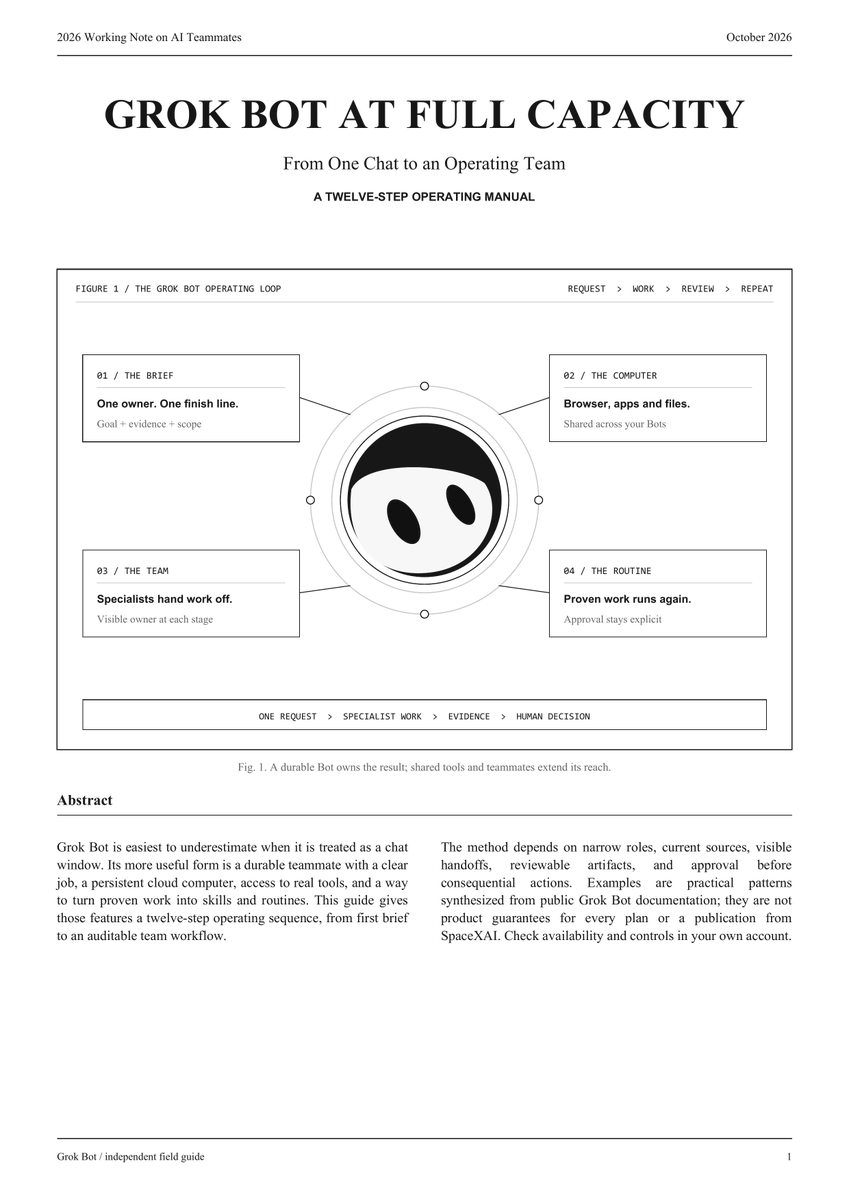
this is a 12-step blueprint for turning one Grok Bot chat into a team that actually finishes work in your tools:
step 1 → stop creating a generic “AI assistant”: give one Bot a named job, a source of truth, a repeatable output and a clear line it cannot cross
step 2 → write the finish line before the task: outcome + sources + constraints + deliverable + the exact point where the Bot must stop for your review
step 3 → use the persistent cloud computer properly: let the Bot work in real apps while your laptop is closed, but remember that every Bot on your account shares its files and logins
step 4 → give the Bot the right path into each tool: use connectors for structured work, the browser for visual workflows, and take over yourself for logins, 2FA and CAPTCHAs
step 5 → demand a real artifact: spreadsheet, report, deck, screenshots or draft — with source links, timestamps, completed actions and unresolved gaps
step 6 → let context compound around a role: save lasting preferences in the Bot, keep changing facts in the source system, and add a specialist only when it owns a distinct job
step 7 → connect the Bots with visible handoffs: one owns research, one produces the artifact, one reviews it, and one owner decides the next move
step 8 → turn the first successful run into a skill: capture inputs, decision rules, validation, output and approvals so other Bots can repeat the method
step 9 → schedule only what already works: test the skill on current data, then run it as a routine with a timezone, failure rule and a human stop point
step 10 → use Grok Bot from your phone like an operator: send the brief, let the cloud computer work, and get back one short decision packet instead of a wall of updates
step 11 → put approvals on the exact action: the Bot can prepare a message, purchase or production change, but you review the recipient, target and effect before it happens
step 12 → measure the system by accepted work: completed artifacts, time saved, human repair and failed handoffs — not by how many Bots you created
Most people use Grok Bot like another chat window. That leaves the computer, memory, team handoffs, skills and routines almost untouched.
The result: one clear request becomes specialist work, a reviewable artifact and a repeatable process — while you keep control of the decisions that matter.
Save this. Elon’s 12-page Grok Bot operating manual and the full-capacity diagram are below ↓
Elon Musk just wrote and published a 12-page PDF on how to use Grok Bot at 100%
It is more useful than most paid AI-agent courses:
this is a 12-step blueprint for turning one Grok Bot chat into a team that actually finishes work in your tools:
step 1 → stop creating a generic “AI assistant”: give one Bot a named job, a source of truth, a repeatable output and a clear line it cannot cross
step 2 → write the finish line before the task: outcome + sources + constraints + deliverable + the exact point where the Bot must stop for your review
step 3 → use the persistent cloud computer properly: let the Bot work in real apps while your laptop is closed, but remember that every Bot on your account shares its files and logins
step 4 → give the Bot the right path into each tool: use connectors for structured work, the browser for visual workflows, and take over yourself for logins, 2FA and CAPTCHAs
step 5 → demand a real artifact: spreadsheet, report, deck, screenshots or draft — with source links, timestamps, completed actions and unresolved gaps
step 6 → let context compound around a role: save lasting preferences in the Bot, keep changing facts in the source system, and add a specialist only when it owns a distinct job
step 7 → connect the Bots with visible handoffs: one owns research, one produces the artifact, one reviews it, and one owner decides the next move
step 8 → turn the first successful run into a skill: capture inputs, decision rules, validation, output and approvals so other Bots can repeat the method
step 9 → schedule only what already works: test the skill on current data, then run it as a routine with a timezone, failure rule and a human stop point
step 10 → use Grok Bot from your phone like an operator: send the brief, let the cloud computer work, and get back one short decision packet instead of a wall of updates
step 11 → put approvals on the exact action: the Bot can prepare a message, purchase or production change, but you review the recipient, target and effect before it happens
step 12 → measure the system by accepted work: completed artifacts, time saved, human repair and failed handoffs — not by how many Bots you created
Most people use Grok Bot like another chat window. That leaves the computer, memory, team handoffs, skills and routines almost untouched.
The result: one clear request becomes specialist work, a reviewable artifact and a repeatable process — while you keep control of the decisions that matter.
Save this. Elon’s 12-page Grok Bot operating manual and the full-capacity diagram are below ↓
Grok Bot can learn from your whole team
One bad memory can mislead everyone
What to save, what to keep private, and when to check the source
A practical guide to Grok Bot memory engineering
Bookmark and read below ↓ https://t.co/3SD7Ey9Q9N
Boris Cherny just dropped a 12-page PDF on the hidden controls inside Sonnet 5.5 and Opus 5.5
It is more useful than most paid Claude courses:
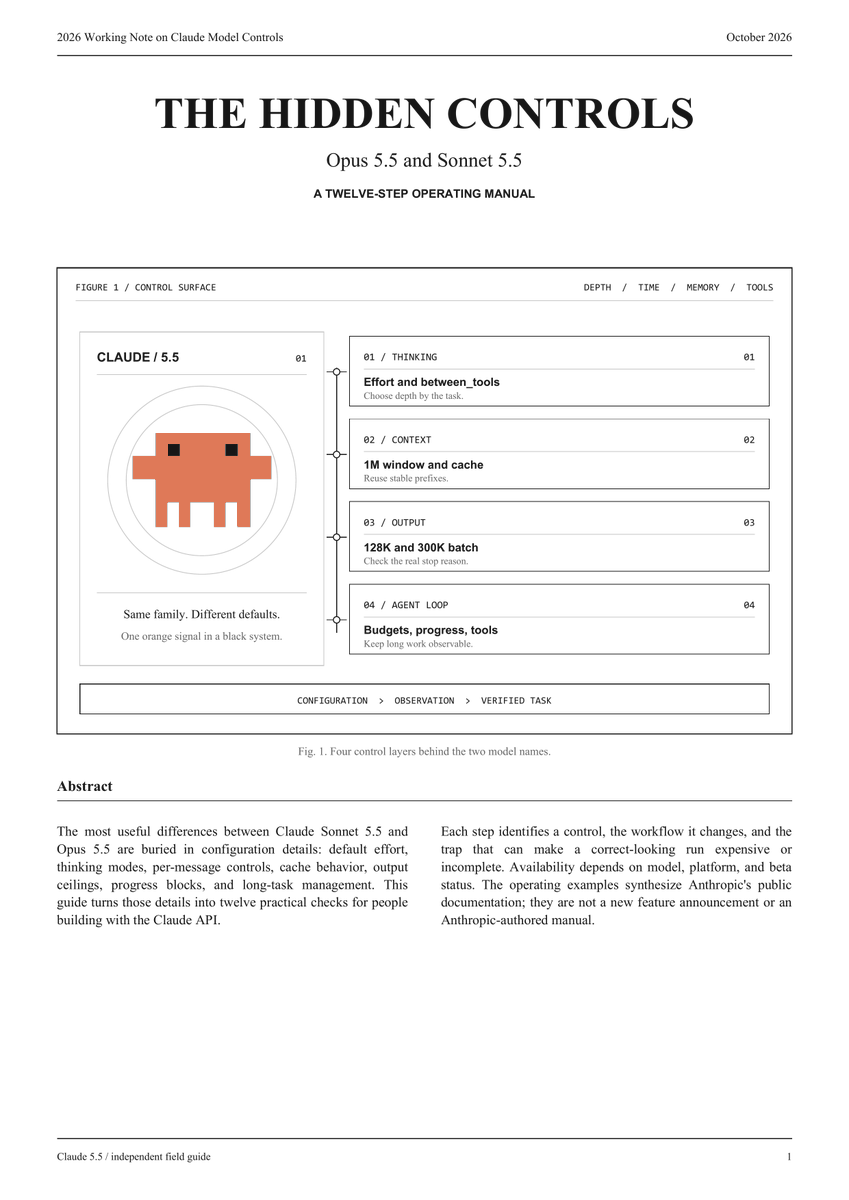
this is a 12-step blueprint for getting better results from the same models by changing the settings everyone leaves on default:
step 1 → stop comparing model names with default settings: Sonnet 5.5 starts at high effort, Opus 5.5 at medium, so your "fair test" may already be rigged
step 2 → use Sonnet’s between_tools mode when the task is clear and tool-driven: skip the long up-front think, keep the short reasoning between actions
step 3 → change effort inside a long conversation with per-message effort: go low for routine turns, high for the hard decision, and keep the cached prefix intact
step 4 → fix the "silent agent" illusion: 5.5 progress updates can live in thinking blocks, so a quiet UI does not mean the model stopped working
step 5 → treat the 1M-token window as room for evidence, not permission to dump every chat, file and outdated source into one request
step 6 → put stable instructions before changing task data: both models can cache from 512 tokens, and repeated work gets much cheaper when the prefix actually hits
step 7 → know the two output ceilings: both models support 128K in normal use, while Sonnet can reach 300K in the Batch API beta for jobs that can wait
step 8 → stop forcing a tool call to get JSON: the 5.5 models can reject forced tool_choice; use a strict schema, validate the result, and treat max_tokens as incomplete work
step 9 → use Opus fast mode only where latency changes the outcome; send large offline queues through batch instead of paying interactive prices for work nobody is watching
step 10 → give long agent loops a total task budget and deliberate compaction points, so they finish with an inspectable state instead of dying halfway through a tool chain
step 11 → add or update tools in the conversation without rebuilding the entire cached prefix, then keep permissions and tool versions explicit
step 12 → launch the whole policy in shadow mode first: compare verified completions, total spend, latency and human repair before automating the safest lane
Most people pay for a bigger model when the actual problem is an invisible default, a broken cache, or a missing completion check.
The result: Sonnet handles fast, checkable work; Opus handles the decisions that can change the project; the hidden controls make both routes cheaper to run and easier to verify.
Save this. Boris's 12-page field guide and the control-surface diagram are below ↓
Boris Cherny just dropped a 12-page PDF on the hidden controls inside Sonnet 5.5 and Opus 5.5
It is more useful than most paid Claude courses:
this is a 12-step blueprint for getting better results from the same models by changing the settings everyone leaves on default:
step 1 → stop comparing model names with default settings: Sonnet 5.5 starts at high effort, Opus 5.5 at medium, so your "fair test" may already be rigged
step 2 → use Sonnet’s between_tools mode when the task is clear and tool-driven: skip the long up-front think, keep the short reasoning between actions
step 3 → change effort inside a long conversation with per-message effort: go low for routine turns, high for the hard decision, and keep the cached prefix intact
step 4 → fix the "silent agent" illusion: 5.5 progress updates can live in thinking blocks, so a quiet UI does not mean the model stopped working
step 5 → treat the 1M-token window as room for evidence, not permission to dump every chat, file and outdated source into one request
step 6 → put stable instructions before changing task data: both models can cache from 512 tokens, and repeated work gets much cheaper when the prefix actually hits
step 7 → know the two output ceilings: both models support 128K in normal use, while Sonnet can reach 300K in the Batch API beta for jobs that can wait
step 8 → stop forcing a tool call to get JSON: the 5.5 models can reject forced tool_choice; use a strict schema, validate the result, and treat max_tokens as incomplete work
step 9 → use Opus fast mode only where latency changes the outcome; send large offline queues through batch instead of paying interactive prices for work nobody is watching
step 10 → give long agent loops a total task budget and deliberate compaction points, so they finish with an inspectable state instead of dying halfway through a tool chain
step 11 → add or update tools in the conversation without rebuilding the entire cached prefix, then keep permissions and tool versions explicit
step 12 → launch the whole policy in shadow mode first: compare verified completions, total spend, latency and human repair before automating the safest lane
Most people pay for a bigger model when the actual problem is an invisible default, a broken cache, or a missing completion check.
The result: Sonnet handles fast, checkable work; Opus handles the decisions that can change the project; the hidden controls make both routes cheaper to run and easier to verify.
Save this. Boris's 12-page field guide and the control-surface diagram are below ↓
Sonnet 5.5 is cheaper per run
Opus 5.5 can still be cheaper per finished task
The difference is in effort, cache misses and the retries you paid for but never shipped
I broke down when to use each model and how to measure what the job actually costs ↓ https://t.co/sPjFexZrZl
Dario Amodei, CEO of Anthropic, just released a 12-page PDF on how to use Sonnet 5.5 and Opus 5.5
It is more useful than most paid AI courses:
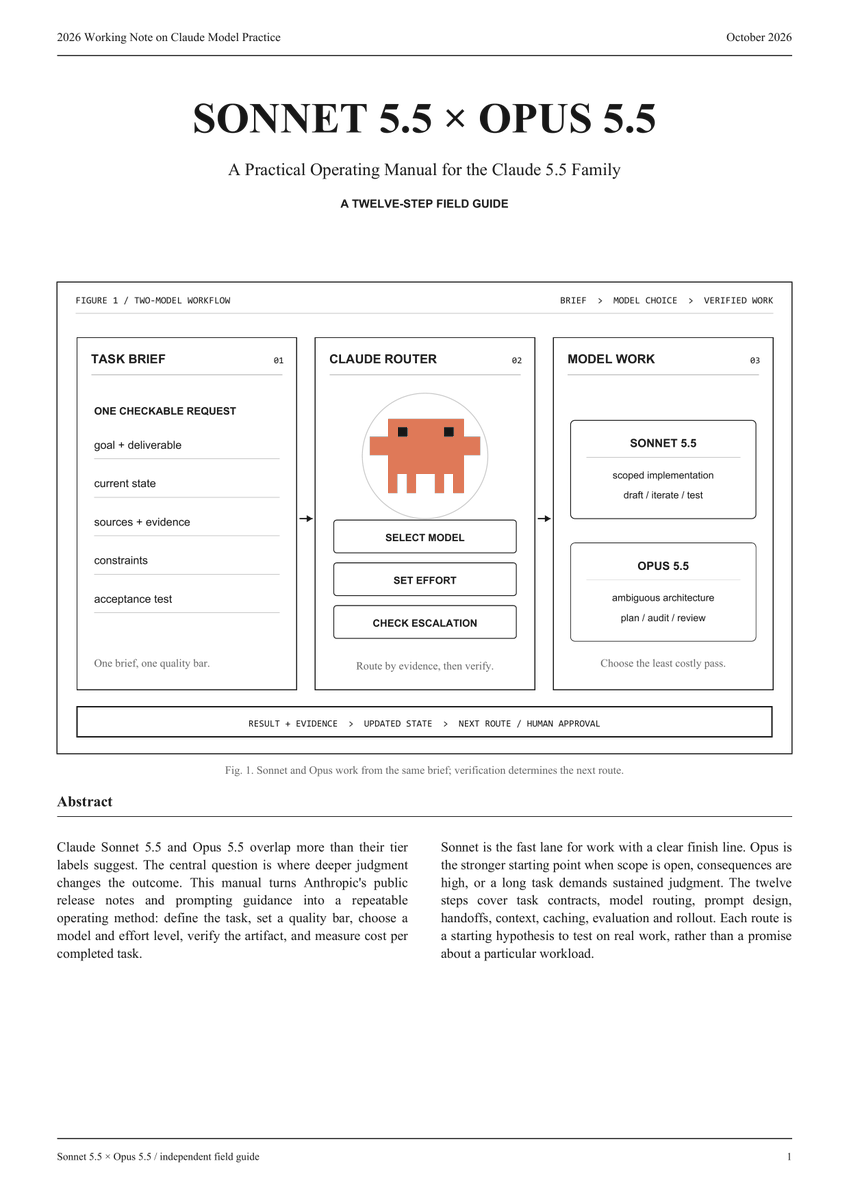
this is a 12-step blueprint for building a faster, cheaper and more capable Claude workflow:
step 1 → stop picking a model by prestige: pick it by how clearly the task is defined and how expensive a wrong answer would be
step 2 → write the finish line first: deliverable, constraints, evidence, allowed actions and the exact check that proves the work is done
step 3 → package the task into one clean brief: goal + current state + relevant sources + acceptance test, instead of dumping the entire chat
step 4 → send well-scoped execution to Sonnet 5.5; send ambiguous architecture, sprawling migrations and high-consequence judgment to Opus 5.5
step 5 → sweep effort before switching models: Sonnet-high and Opus-medium are different defaults, and the best setting is the cheapest one that clears your quality bar
step 6 → give each model a contract: what it can inspect, what it may change, what it must verify and where it has to stop
step 7 → let Sonnet move fast on code, docs, slides and repeatable workflows — but make every run end with a real test or rendered artifact
step 8 → use Opus where one better decision changes the whole project: scope the unknowns, map risks, set the plan and challenge the final result
step 9 → hand off evidence, not vibes: original brief, changed files, test output, unresolved gaps and the next safe action
step 10 → treat the 1M-token window as capacity, not an invitation to load everything; cache stable context and measure the full task cost
step 11 → verify outcomes instead of trusting fluent completion messages; keep publishing, spending, deleting and deployment behind explicit approval
step 12 → launch the routing policy in shadow mode, compare it on your own tasks, then automate the safest lane first
Sonnet 5.5 is $2/$10 per million input/output tokens. Opus 5.5 is $4/$20. The real question isn't which token is cheaper - it's which route finishes the job with the least repair.
the result: Sonnet handles the fast, checkable work; Opus handles the decisions that can change everything; you only pay for deeper judgment when it matters.
Save this, then read the full 12-page PDF and its two-model diagram below ↓
Dario Amodei, CEO of Anthropic, just released a 12-page PDF on how to use Sonnet 5.5 and Opus 5.5
It is more useful than most paid AI courses:
this is a 12-step blueprint for building a faster, cheaper and more capable Claude workflow:
step 1 → stop picking a model by prestige: pick it by how clearly the task is defined and how expensive a wrong answer would be
step 2 → write the finish line first: deliverable, constraints, evidence, allowed actions and the exact check that proves the work is done
step 3 → package the task into one clean brief: goal + current state + relevant sources + acceptance test, instead of dumping the entire chat
step 4 → send well-scoped execution to Sonnet 5.5; send ambiguous architecture, sprawling migrations and high-consequence judgment to Opus 5.5
step 5 → sweep effort before switching models: Sonnet-high and Opus-medium are different defaults, and the best setting is the cheapest one that clears your quality bar
step 6 → give each model a contract: what it can inspect, what it may change, what it must verify and where it has to stop
step 7 → let Sonnet move fast on code, docs, slides and repeatable workflows — but make every run end with a real test or rendered artifact
step 8 → use Opus where one better decision changes the whole project: scope the unknowns, map risks, set the plan and challenge the final result
step 9 → hand off evidence, not vibes: original brief, changed files, test output, unresolved gaps and the next safe action
step 10 → treat the 1M-token window as capacity, not an invitation to load everything; cache stable context and measure the full task cost
step 11 → verify outcomes instead of trusting fluent completion messages; keep publishing, spending, deleting and deployment behind explicit approval
step 12 → launch the routing policy in shadow mode, compare it on your own tasks, then automate the safest lane first
Sonnet 5.5 is $2/$10 per million input/output tokens. Opus 5.5 is $4/$20. The real question isn't which token is cheaper - it's which route finishes the job with the least repair.
the result: Sonnet handles the fast, checkable work; Opus handles the decisions that can change everything; you only pay for deeper judgment when it matters.
Save this, then read the full 12-page PDF and its two-model diagram below ↓
Sonnet 5.5 is cheaper per run
Opus 5.5 can still be cheaper per finished task
The difference is in effort, cache misses and the retries you paid for but never shipped
I broke down when to use each model and how to measure what the job actually costs ↓ https://t.co/sPjFexZrZl
Andrej Karpathy just dropped a 6-hour course on how to build LLMs from scratch:
• 00:00 - Deep dive into LLMs like ChatGPT
• 03:31:23 - Building ChatGPT from scratch in live
• 05:27:43 - How to use LLMs (Karpathy method)
This course will replace a $90K Stanford LLM master's degree
Start watching today, then read how to become an AI engineer in article below
Andrej Karpathy just dropped a 6-hour course on how to build LLMs from scratch:
• 00:00 - Deep dive into LLMs like ChatGPT
• 03:31:23 - Building ChatGPT from scratch in live
• 05:27:43 - How to use LLMs (Karpathy method)
This course will replace a $90K Stanford LLM master's degree
Start watching today, then read how to become an AI engineer in article below
Most people will use Dots like a smarter chat and miss the point
The real shift is AI that keeps working between prompts while the important decisions stay with you
I broke down how Dots, Space, Astra, Sol, and Codex fit together ↓ https://t.co/31fW4gHM5U
Andrew Ng:
"100% of my tasks now run through AI agents, the hype actually passed my expectations, graphs are the next step"
"In 3-6 months, everyone will be using self-improving graphs, prompting alone is over"
In a 30-minute talk, Andrew Ng breaks down how to build self-improving agentic systems with graphs
Agents → Feedback → Memory → Graphs → Self-Improving Systems
Worth more than most $3,500 graph engineering courses
Bookmark and watch the talk today
Then read the article below ↓
Andrew Ng:
"100% of my tasks now run through AI agents, the hype actually passed my expectations, graphs are the next step"
"In 3-6 months, everyone will be using self-improving graphs, prompting alone is over"
In a 30-minute talk, Andrew Ng breaks down how to build self-improving agentic systems with graphs
Agents → Feedback → Memory → Graphs → Self-Improving Systems
Worth more than most $3,500 graph engineering courses
Bookmark and watch the talk today
Then read the article below ↓
Opus 5.5 can make a video
The hard part is making the next one better
That takes a studio, not a prompt
I broke down how to build it ↓ https://t.co/EXinI060Cr
SpaceXAI engineer Lauren Tan:
"99% of people are using GrokBot with less than 1% of its actual power
They run one agent without loops or graphs"
"I'm running a fully autonomous team of 20+ GrokBot agents
One Chief of Staff, one PM, and 20+ workers
That's the new engineering stack"
GrokBot → Chief of Staff → PM → Workers → Autonomous Fleet
In this 1-hour session, a SpaceXAI engineer shows how to build a powerful AI agent team from scratch
This workshop is worth more than most $2,500 agent engineering courses
Bookmark it and watch today
Then read the full article below
SpaceXAI engineer Lauren Tan:
"99% of people are using GrokBot with less than 1% of its actual power
They run one agent without loops or graphs"
"I'm running a fully autonomous team of 20+ GrokBot agents
One Chief of Staff, one PM, and 20+ workers
That's the new engineering stack"
GrokBot → Chief of Staff → PM → Workers → Autonomous Fleet
In this 1-hour session, a SpaceXAI engineer shows how to build a powerful AI agent team from scratch
This workshop is worth more than most $2,500 agent engineering courses
Bookmark it and watch today
Then read the full article below
xAI quietly dropped 15 official grok bot guides and almost nobody is talking about it
Every single one written by the team that built grok
This section is free
Pick a guide, follow it, ship your bot
Most people are still guessing how to build one
15 official guides are already out and cost nothing
Bookmark this and check the guides below ⭣
Google Brain founder Andrew Ng:
"Prompting will be over in 6 months
Harnesses are what come next"
Prompts → Agents → Harness → Loops → Graphs → Self-Improving Systems
In 97 minutes, Andrew shows how to build a harness that lets agents plan, execute, verify, and improve on their own
A harness → Loads context → Routes tasks → Checks results → Triggers the next step
Most people are still refining prompts while the real engineering is moving into the harness
Watch it today
Then save the full harness engineering guide below ↓