How does OpenChoreo build on @Kubernetesio?
Yashod Perera walks through its platform-level custom resources - projects, environments, pipelines, component types, traits, workflows, and more.
Higher-level abstractions, same cloud-native flexibility ➡️ https://t.co/6yDw7kF6cf
Our first OpenChoreo community call since joining @CloudNativeFdn as a Sandbox project is happening this Thursday, June 25th!
Here's what's on the agenda:
• Project update - where we are and where we're headed
• Sneak peek - upcoming features in the works
• Technical deep dive - multi-plane architecture of OpenChoreo
• Q&A
🕓 Time: 4:00 PM CEST | 7:00 AM PDT | 7:30 PM IST
Register now → https://t.co/6JHvgod0OZ
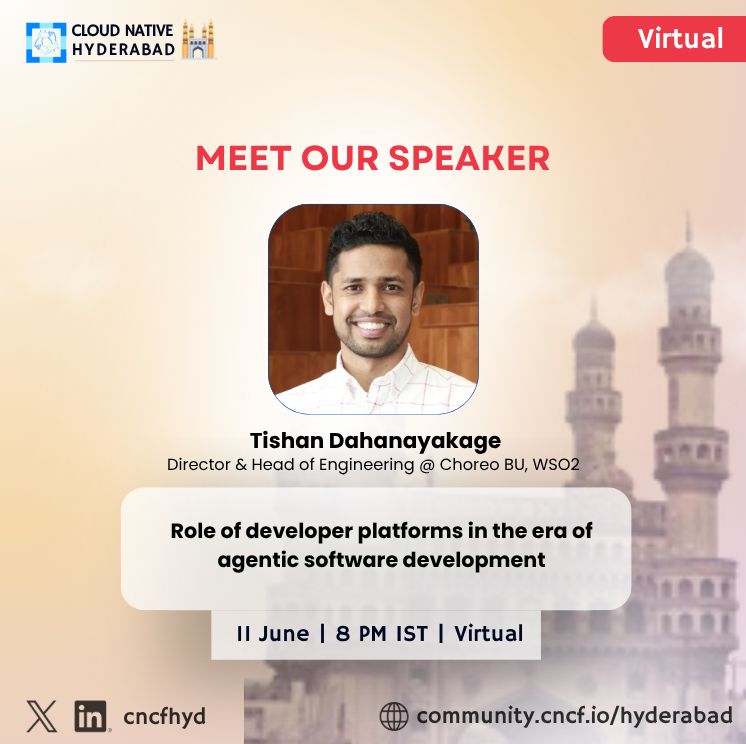
Join @tishan89 at @CloudNativeFdn Hyderabad for a session on the role of developer platforms in the era of agentic software development, featuring OpenChoreo.
June 11, 2026
08:00 PM IST
https://t.co/2T1W3pQ4iR
The first OpenChoreo Community Call is happening on June 25, 2026.
OpenChoreo recently joined the @CloudNativeFdn as a Sandbox project, and this call is the first chance to hear directly from the maintainers.
4:00 PM CEST | 7:00 AM PDT | 7:30 PM IST
Register here: https://t.co/6JHvgodyEx
Join @BretFisher live on June 4, for a deep dive into OpenChoreo!
Hear from core maintainers @lakwarus and @sameerajayasoma as they discuss day-one platform readiness, AI-native agentic capabilities, and answer your questions live.
June 4 | 1:00 PM ET
Watch here: https://t.co/JPZe7ml1mc
We just hit 1,000 ⭐s on @github and it's all thanks to you.
OpenChoreo is a complete, open-source developer platform for Kubernetes, ready to use from day one, built to integrate with your stack.
Star us, build with us, shape what comes next.
👉 https://t.co/ujnsq1MVIh
We just posted the OpenChoreo Quick Start Guide on YouTube.
Join Binura as he takes us through a step-by-step setup designed to get you from zero to "running" in less than 10 minutes. If you’ve been looking for a streamlined way to handle your Kubernetes environment, this is it.
Check out the full video: https://t.co/bS27W7znNz
Thanks for the shoutout in this Thursday’s @PacktPublishing session, “Building AI-Native Platform Engineering Systems.”
Excited for more conversations around AI-native platform engineering, developer self-service, and open cloud-native platforms.
Join the discussion ➡️ https://t.co/4aTk7bXJ8U
Thursday, June 11th | 11:30 AM EDT
After more than two decades of building, leading, and shaping WSO2 into a globally recognized technology company, today is Sanjiva Weerawarana's last day as CEO.
@sanjiva started WSO2 with a belief that world-class enterprise software could be built on the other side of the world and taken to the masses. What followed proved that belief right, many times over. He challenged assumptions about where great technology comes from, opened doors that didn't exist before, and built something that has genuinely changed how enterprises think about software development.
His impact goes well beyond WSO2. He helped define what's possible for the tech industry, and for the generations of engineers and leaders who came up through it.
Thank you, Sanjiva. It has been an extraordinary chapter.
Twenty years from now, someone will build something the world said was impossible. They'll be standing on your shoulders.
OpenChoreo v1.1 is now available.
Some highlights from this release:
• Resource Types for infrastructure provisioning
• eBPF networking + observability via Cilium
• Agentic skills and MCP improvements
• FinOps agent
• AWS observability modules
• DAG-based deployment pipelines
Read the full blog → https://t.co/hEB8IdrfNI
@kubernetesio has become the standard for cloud native platforms.
OpenChoreo is built natively on Kubernetes, using it as the system of record and orchestration engine.
Read about our architecture: https://t.co/HuAcQakU3t
Our logo started as an iPad sketch of a stilt above the waves, inspired by traditional Sri Lankan fishing.
The waves underneath are everything OpenChoreo sits on, @kubernetesio , @ciliumproject , #GitOps pipelines, and observability. The stilt is the platform that keeps a developer steady above it all.
@sameerajayasoma wrote up the full story: https://t.co/WFDyS0r9RA
Engineers shouldn't need to be cloud and security experts just to ship a feature.
The Internal Developer Platform (IDP) addresses that.
@nzicecool decodes the modern @CloudNativeFdn stack behind an IDP in Part 1 of this series.
Read the full article: https://t.co/e64Jq5vgtc
As teams, technology, and requirements evolve, internal developer platforms must adapt.
OpenChoreo uses a multi-plane architecture to keep control, data, workflow, and observability independent.
It exposes environments, workflows, deployment pipelines, and tooling modules as APIs, enabling platform topology to scale from a single cluster to a distributed fleet without re-architecting.
Great discussions with platform engineers and SREs are always a highlight.
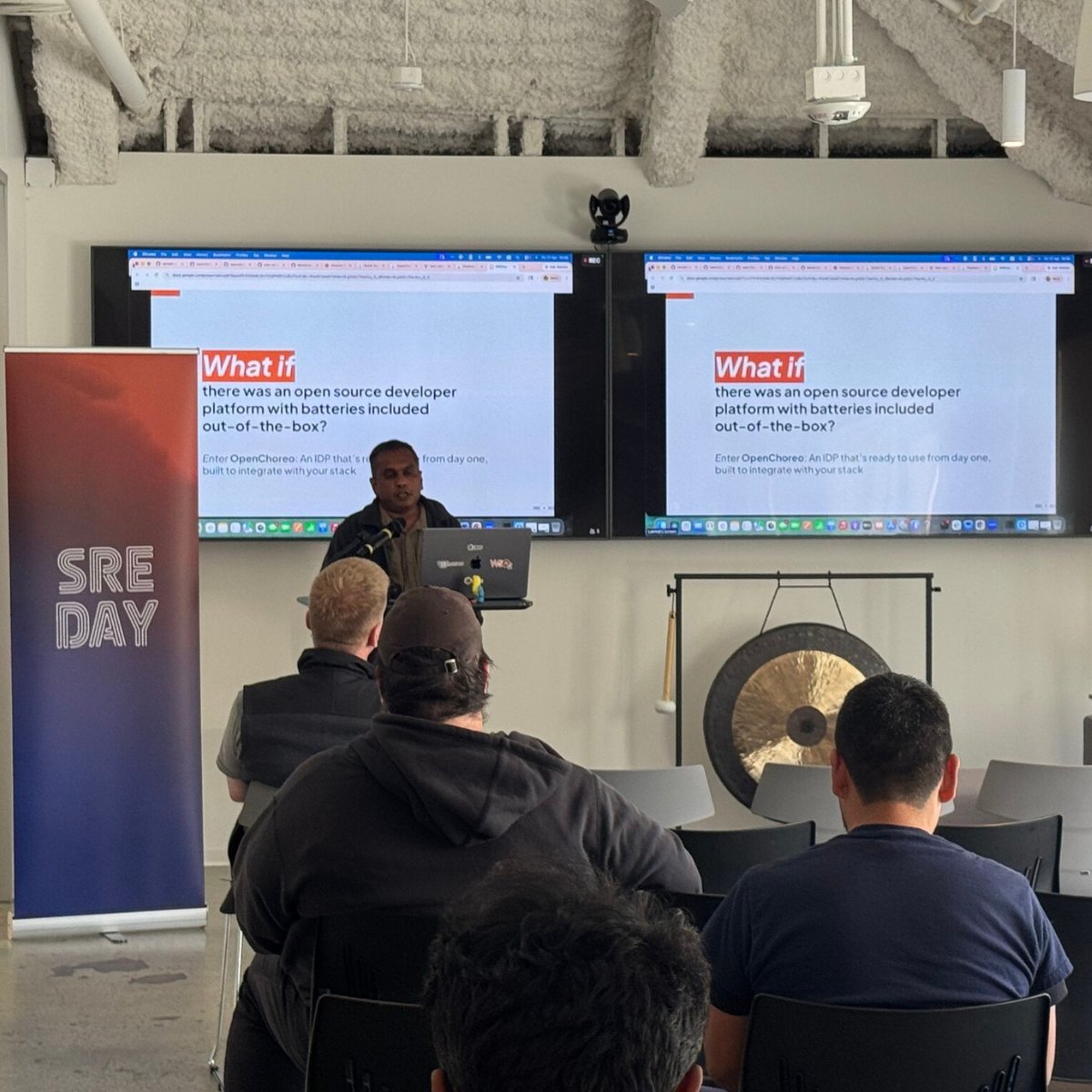
At @sreday_com Seattle, @lakwarus showcased OpenChoreo: developer workflows, #Kubernetes as the system of record, and a live AI SRE agent doing root-cause analysis.
Missed us at the meetup? Explore the project here:
🔗 https://t.co/W2lfHiFrTK
AI-native incident response is now a platform primitive in OpenChoreo.
The built-in SRE agent generates structured root cause analysis reports from telemetry, and MCP servers let AI assistants query observability data.
Read the docs: https://t.co/tGFHGUqB8x
Great deep-dive from @InfoQ on OpenChoreo by Matt Saunders (VP of DevOps & Platform Engineering at Adaptavist), covering our 1.0 release and CNCF Sandbox acceptance.
A must-read for anyone building internal developer platforms: https://t.co/Sa7duMB346
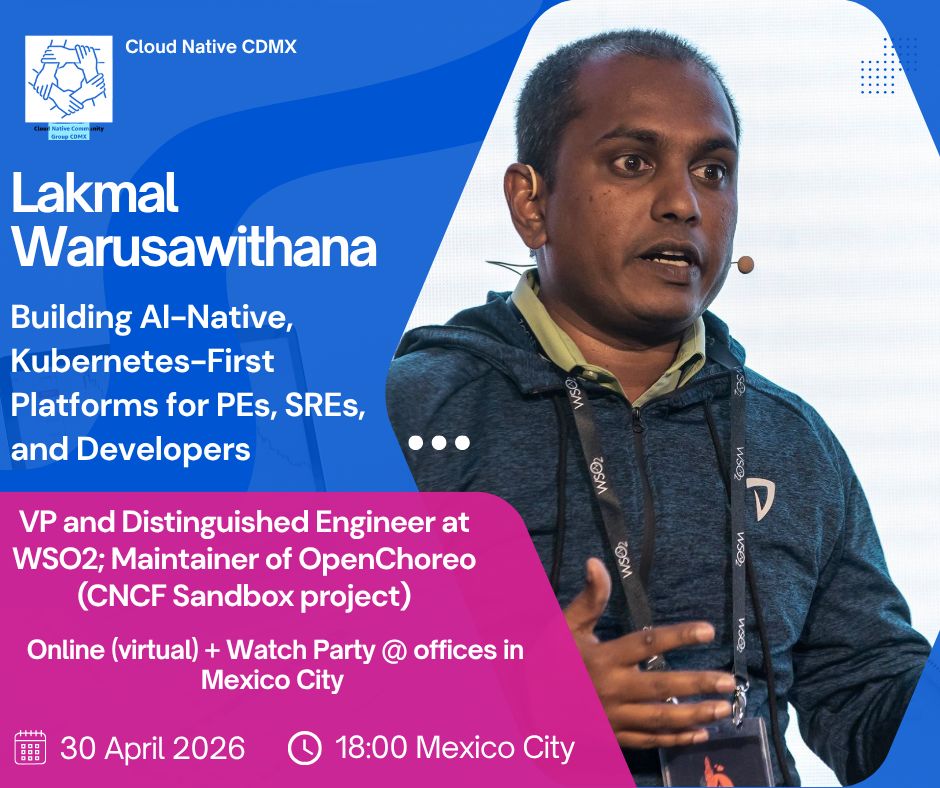
Cloud Native CDMX is hosting a live watch party where @lakwarus will be giving a deep dive into OpenChoreo.
He'll discuss how to streamline your platform stack for the AI era when building Kubernetes-first platforms in production.
🕕 6:00 PM Mexico City time.
📍 445 Calle Montes Urales, Ciudad de México, 11000
👉 Register: https://t.co/Cx3MIihsKq
At @sreday_com San Francisco, @lakwarus demonstrated how OpenChoreo delivers AI-assisted workflows for incident triage while keeping #Kubernetes primitives visible.
Head to the repo, explore the code, and give it a star: https://t.co/N7MJGjylBi