Will you be saying this if the Chinese were to be selling petrol for N500 to compete with Dangote and importers?
All of a sudden, poor Nigerians and minimum wage earners no longer matter.
“It is praiseworthy to be brave and fearless, my son, but sometimes it is better to be a coward. We often stand in the compound of a coward to point at the ruins where a brave man used to live.”
— Ezeulu in Chinua Achebe’s Arrow of God
Nigeria was removed from JP Morgan's flagship Government Bond Index (GBI-EM) in September 2015 due to severe foreign exchange illiquidity and strict capital controls.
The exit occurred because the Central Bank of Nigeria (CBN) introduced rigid currency trading restrictions to artificially defend the naira. This made it incredibly difficult and unpredictable for foreign investors to track the index, execute transactions, and repatriate their funds out of the country.
Pre 2015, the CBN maintained the same peg and artificial control heavily subsidising imports using the FX reserves. Investors did worry much as long as high oil prices kept the CBN flush with dollars. Post-2015, when oil prices crashed, the CBN continued to tighten capital controls and ration FX. FX scarcity and uncertainty became a problem and Nigeria started accumulating backlogs.
Later, in 2022, JP Morgan further cut its exposure by removing Nigeria from its "overweight" emerging market sovereign debt recommendations due to rising macroeconomic risks, petrol subsidies, and low oil revenue.
It took Asiwaju Bola Ahmed Tinubu to cut the bullsh`t and move away from the populist canckerworm. If he wanted to be popular and nice, Nigeria would have disappeared completely from the global investment radar.
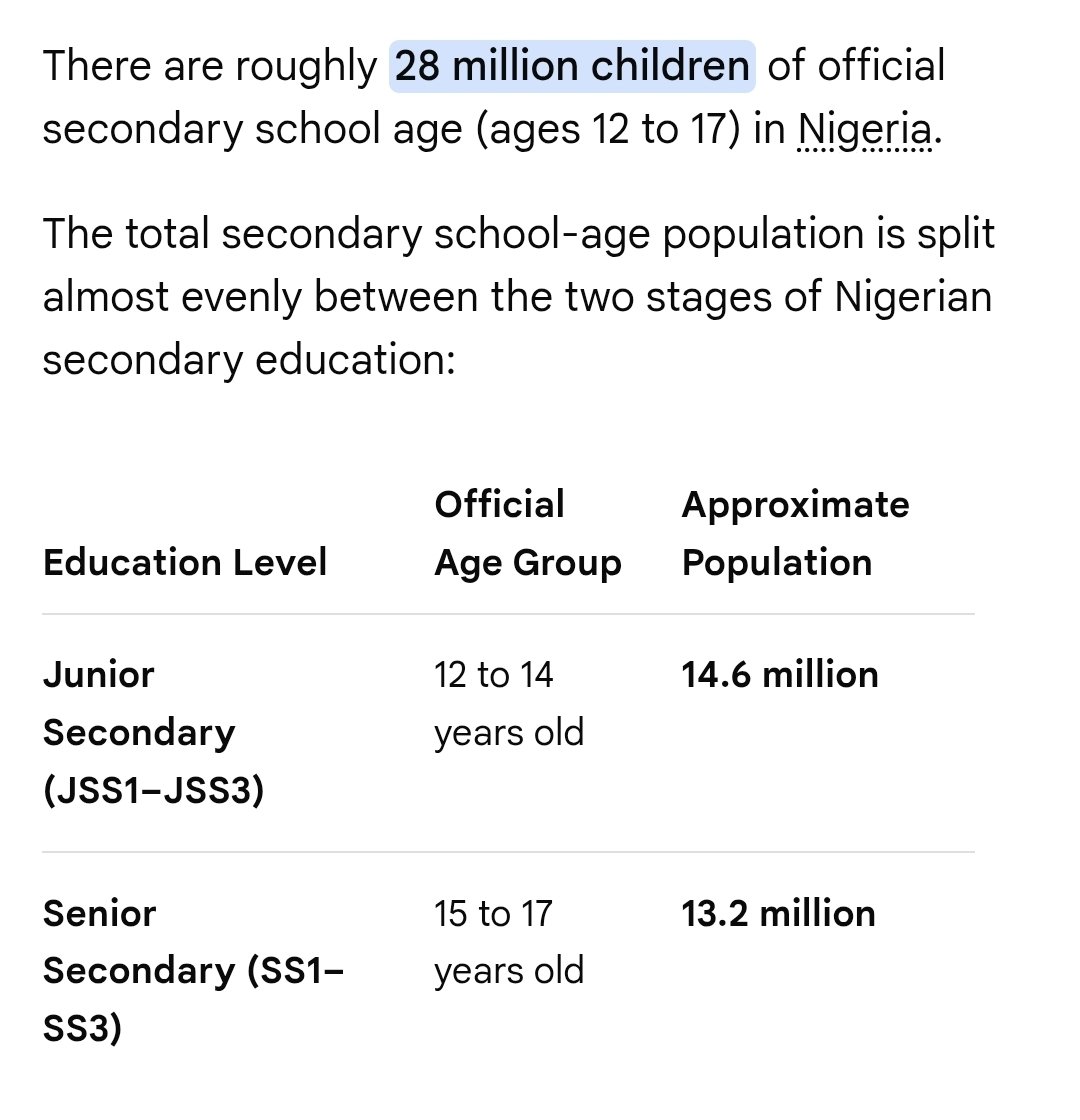
Nigeria has a very young school age population. Within the next 6 years we would have roughly 28m children who should be in the University, Polytechnics, technical colleges etc.
This is nearly 5 times the population of Norway, 8 times the population of Qatar, 2 times the population of UAE and almost at par with the population of Saudi Arabia that we need to educate.
Is it this 1.5m barrels of crude per day production that we will use to fund quality tertiary education for them? And we still want petrol subsidy and lower taxes.
Let's even assume that 25% of them make to tertiary level and technical colleges, which is a reasonable number we should target, that's roughly 8m young Nigerians. How much do we need to fund each person's education per annum for 6 - 12 years? At a modest 500k per person, we are looking at N4trn yearly cost for the next 6 years.
Oversimplifying some of these issues sounds silly to me. We still have health, security, infrastructure etc.
ON ATIKU'S FRAUDULENT CAMPAIGN TO RETURN PETROL SUBSIDIES:
FYI, Buhari's government didn't pay petrol subsidies to any fuel importer throughout his 8yrs government. The only subsidy he paid from 2015 into 2016 were the verified amounts owed to importers from GEJ's government.
The kind of subsidies in his government is akin to what the crooked and desperate Atiku is proposing today with the difference that the refineries were abroad and NNPC had to be receiving and solely importing the products from the refineries they sent the crude to in swap arrangements. This was christened DSDP and under recovery.
Still, the conversation around subsidies in terms of fraud and most importantly how it held up funds meant for the federation account never went away. It got to an extent that NNPC was no longer remitting any money to the account as all were used up as subsidies on petrol.
The real issue with subsidy in Buhari's government was less of subsidy fraud and more of unsustainability due to the fact that almost all revenues due from NNPC to the federation account were being expended on petrol subsidies.
There is no style of petroleum subsidy that will not be abused in Nigeria and which will not lead us into further unsustainable debts and another distortion in the oil and gas industry that's gradually coming back to full production as the IOCs have regained their lost confidence and have started investing massively again like they were doing several years ago. You know this, we all know this.
Lastly, the maxim that Nigeria is a rich country because of a 1.6m barrels of daily crude oil is grossly offensive as the opposite is absolutely the case due to our bloated population. Rich oil countries have far more barrels of daily oil production with very little population. You cannot be possibly calling yourself an oil rich country with 1.6mbbls/day and a 250m population. If an ignorant and uneducated Atiku can say that, you with your education should be able to know there's something called per capita oil production. Nigeria's total yearly oil and tax revenues is not even up to a third of South Africa's yearly revenues yet we're 4x the population of South Africa.
Atiku Abubakar is just a desperate crook and Nigerians cannot afford to gamble with him at this point of our lives.
It'll amount to one step forward and 100 steps backward.
Selah
Your comparison is flawed. This is what you compare
Scenario A - 2023 - 2027 without the reform
Scenario B - 2023 - 2027 with the reform.
Comparing a static 2023 baseline against a dynamic 2023 - 2027 trajectory, is wrong, a fantasy at best. A true evaluation requires comparing two active trajectories: Scenario A (The No Reform) versus Scenario B ( The Reform Path )
Assuming that the position in 2023 will remain static without any intervention is an economic fallacy. There is a reason why economists use dynamic and predictive models when evaluating policy shifts.
Without the reforms, we would have printed N80trn in addition to the N30trn printed.
What do you think would happen to the value of the Naira when CBN continues to print money?
What about FAAC and payment of salaries and wages by states? Most states would be bankrupt.
We would have defaulted on our debt obligations.
What about our foreign reserve and the ability to meet our import demands? Scarcity of common goods. More Naira chasing scarce imports? Hyperinflation. You think inflation would remain static?
What would happen to FX? FPI and FDI would have dried up. Remittances would not come in through official channels; black market speculators would have taken over the system.
Dangote and BUA were going to Abuja to queue for FX. What do you think would be the fate of other manufacturing firms who are unable to access FX to buy raw materials and machinery? Job losses?
Oh, you think petrol would be freely available? Where and how will NNPC get the product and pay for the subsidy? Or do you think Dangote will buy crude at $110 and sell petrol at N170?
How can you say reforms have not resulted in Job creation? Are you tracking the figures?
Point me to your data source please.
@Ojay_B 👌
Spot on
Comment was with respect to the blanket "when has privatisation evee fixed anything in Nigeria"
Of course resolving the power sector issues is not as simplistic as she put it
Even the downstream sector still has some govt input despite "deregulation"
Please take 13 minutes of your time this morning to watch this exchange between the Minister of Finance @taiwoyedele and the Senate Committee on Finance
A lot of the videos I saw before I searched cut out the minister's response and emphasized only the Senators' questions.
On the NNPCL N210 Trillion
When the issue of the 210trn broke the internet, I commented that its just and addition of multiple entries to obtain a vague figure for media trial.
@BalaWunti appeared before the committee to shed more light on the issue and he has done more than justice to the issue.
Based on the attached interview, here are the facts:
1. No any figure of N210 trillion appears in the NNPC 2023 Audited Financial Statements (AFS).
2. The N210 trillion figure was derived by adding N107 trillion in receivables to N103 trillion in payables.
3. The NNPCL after PIA began operating two accounts, the shareholders’ account and the commercial account with NAPIMS now NUIMS operating the stakeholders and NNPCL HQ operating the commercial account. And being NUIMS a subsidiary, both its inflows and outflows must reflect on NNPC’s main account.
Here is the full engagement:
Every time you see the news of yet another interim or final forfeiture of assets by @officialEFCC and others, remember the work that @pacacng did to make it possible.
PACAC was one of the very first institutions PMB created when he assumed office.
They developed comprehensive guidelines on asset forfeiture, trained judges, and helped lay groundwork for the NASS passage and presidential assent by PMB to the Proceeds of Crime (Recovery and Management) Act, 2022 (POCA).
The Non-Conviction Asset-based Forfeiture framework allows authorities to go after stolen assets even before a person is convicted.
The idea is that you shouldn’t need to wait for a conviction before you can go after stolen assets. Doesn’t mean you still won’t chase a conviction.
Asiwaju - To catch the rabbit, you have to give a bait.
This is the first deepwater production-sharing contract project to approach an FID in Nigeria since 2008. Emphasis on 2008!
- $20 Billion
- 150,000 barrels of crude oil per day.
- Supply roughly 140 million cubic feet of gas daily.
- Create more than 5,000 direct and indirect jobs for Nigerians.
Exactly what he said he was going to do at the NESG summit.