"Even with a perfect product, perfect pricing, and a perfect community, global payment companies still struggle to grow. Because the real product is money."
At the @IstanbulBlockWk, @alierhat spoke alongside Melchior de Villeneuve (@keyrock), Danny Bailey (@BlockdaemonHQ), and Marco Dal Lago (@tether) for the panel, Liquidity, Market Structure & Capital Formation in Fragmented Markets.
Together, they examined how market fragmentation impacts cross-border payments, how PayFi solves the problem of trapped capital, and what the future looks like for real-world adoption.
Tomorrow at @IstanbulBlockWk, @alierhat joins Melchior de Villeneuve from @keyrock, Danny Bailey from @BlockdaemonHQ, and Marco Dal Lago from @tether on stage.
The panel, Liquidity, Market Structure & Capital Formation in Fragmented Markets, will cover the real cost of fragmentation in cross-border payments, how stablecoins are reshaping settlement and liquidity infrastructure, and what capital formation in digital assets actually looks like from here.
Date: Tuesday, June 2 | 5:05–5:45pm Istanbul Time
We're in Amsterdam tomorrow for @money2020 Europe.
Capital locked in prefunding. Settlement that takes days. Liquidity that doesn't move with the transaction. These aren't new problem, but they're finally being solved.
Giray Hasanali and @DonatoGiarnera are on the floor June 2–4. See you there!
J.P. Morgan’s 2026 Payments Outlook Report reinforces a shift that has been building across financial infrastructure for some time: Liquidity is becoming a core design layer of modern payments.
Access to liquidity, instantly, across currencies, geographies, and market conditions, is increasingly central to how institutions think about resilience, capital efficiency, and operational continuity.
This is reflected in evolving treasury priorities:
• Real-time liquidity visibility and access
• More distributed, cross-border liquidity structures
• Greater automation in treasury decisioning
• Continuous working capital optimization
At a structural level, this reflects a simple change in constraint: It is no longer just about moving money efficiently. It is about ensuring liquidity is available where and when it is needed.
This is where the PayFi lens becomes useful. PayFi describes the convergence of payments and liquidity infrastructure, where funding, settlement, and optimization begin to operate in a more continuous system rather than fragmented cycles across intermediaries, time zones, and balance sheets. Within this shift, new infrastructure approaches are emerging that reduce friction between liquidity availability and liquidity movement.
Arf operates in this evolving landscape, focused on improving how cross-border liquidity is accessed and managed between financial institutions, as part of a broader transition toward more real-time, connected financial systems.
The direction of travel is clear:Payments infrastructure is moving beyond transaction execution toward liquidity orchestration, how capital is accessed, deployed, and optimized globally in real time.
For institutions building in this direction, liquidity is becoming the defining constraint and opportunity of the next phase of financial infrastructure.
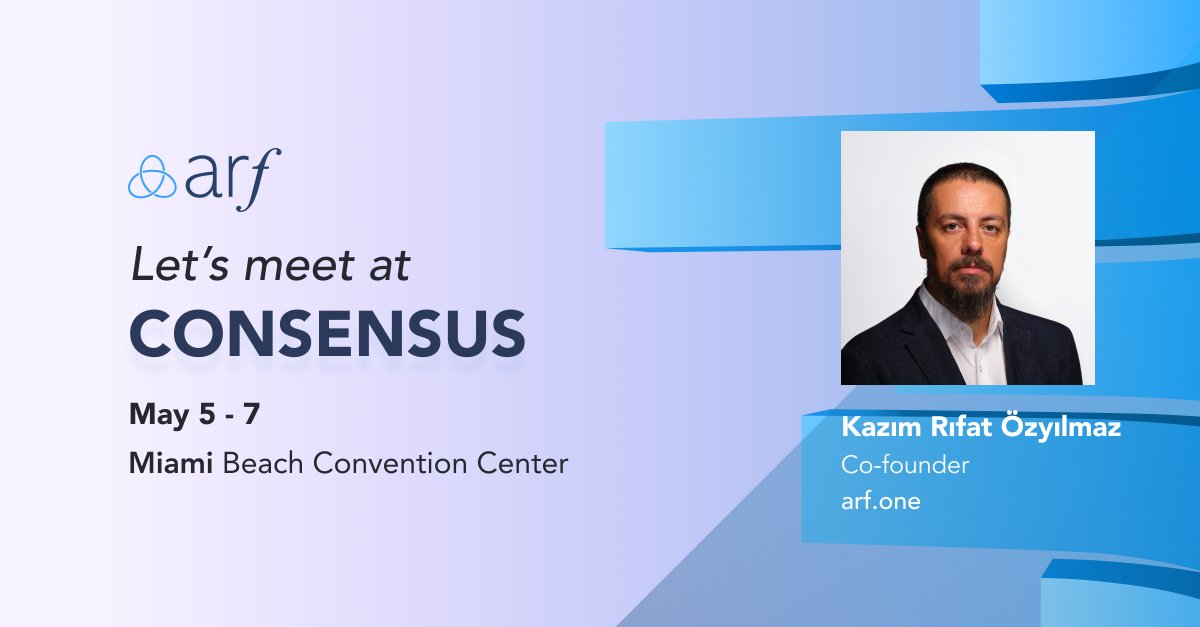
We're heading to Miami for @consensus2026!
@ozyilmazkazim will be in Miami from May 5-7 to connect with industry leaders, partners, and innovators.
Let's discuss the future of cross-border payments and liquidity solutions. See you there! 🌍
Proud to announce that Arf has been featured in the 11th edition of the CV VC Crypto Valley Top 50 & Ecosystem Report. Out of over 1,700 active blockchain entities in Switzerland, Arf has been recognized as one of the Top 25 Private Valuation Leaders.
As a Swiss-regulated global liquidity and settlement platform we’re the main builder of PayFi. By providing blockchain-based working capital credit lines to licensed financial institutions, we are addressing a critical $4 trillion liquidity gap in global cross-border payments.
Also features an article by @alierhat, titled "The $4 Trillion Gap: A New Asset Class For Institutional Capital”. Ali explores how the cross-border payments industry moves $156 trillion per year, yet an estimated $4 trillion in working capital remains frozen in prefunded accounts at any given moment and how address this inefficiency through short-term fixed and on-demand credit lines, creating a new short-duration, receivables-backed asset class for institutional capital.
Read the full CV VC 2025 Report to see how Arf is building the new infrastructure of global payments. 👉 https://t.co/vkKzERGPT9
Arf will be at @ParisBlockWeek 🇫🇷
@alierhat , @ozyilmazkazim and the Arf team will be in Paris on April 15–16 at Carrousel du Louvre.
We will discuss how global liquidity and settlement infrastructure is evolving to unlock more capital-efficient, scalable cross-border payments for financial institutions.
1/ Institutional yield meets institutional-grade transparency.
$PST is now independently verified by @AccountableData, providing third party assurance on asset exposure and performance, with near real-time visibility.
Underlying Arf receivables are now verified on a monthly basis by Swiss audit firm Wadsack.
“Cross-border payments are entering a phase where capital management and payment execution move within a single programmable flow. By aligning funding and settlement in real time via PayFi, this model improves cash visibility, reduces trapped capital, and simplifies global liquidity management.”
@alierhat contributed to @ThePAssoc ’s report, “Cross-border payments in 2026: Friction and reform.” The article provides a holistic overview of the structural challenges shaping global money movement, covering liquidity bottlenecks, correspondent banking friction and the emerging technologies addressing them.
Read more here: https://t.co/SMRb5FzdBu
Following last week’s discussions at Davos, one thing became clear: PayFi and global payments are moving from future vision to real-world execution.
Across sessions, there was strong alignment around real-time payment infrastructure, the growing role of stablecoins in live payment flows, and the shift toward programmable liquidity and compliance operating directly inside transactions. Agentic payment models are also beginning to shape how next-generation payment networks will operate.
We break down the key PayFi takeaways and what they mean for payment providers, banks, and financial institutions.
Read the full analysis here: https://t.co/wZzp54rA9u
PayFi is no longer a concept—it is the new financial layer for global payments.
At Davos, together with LuLu Financial Holdings and the @StellarOrg, we discussed how PayFi is already redefining the movement of value at a global scale.
By embedding liquidity, compliance, and settlement directly into the payment flow, we move beyond legacy models toward a live, on-chain execution layer built for institutional use.
With our partners, we are proving that global payments can finally be autonomous and real-time. This isn’t a conversation about the future of financial infrastructure — it’s infrastructure that’s already being deployed.
Full announcement from Davos: https://t.co/R0EriDwX6L
“Global payments are being rebuilt around real-time liquidity, agentic execution, and embedded compliance. When these capabilities are natively integrated into the transaction, payments can fund, execute, and settle autonomously. This model is live today through PayFi.”
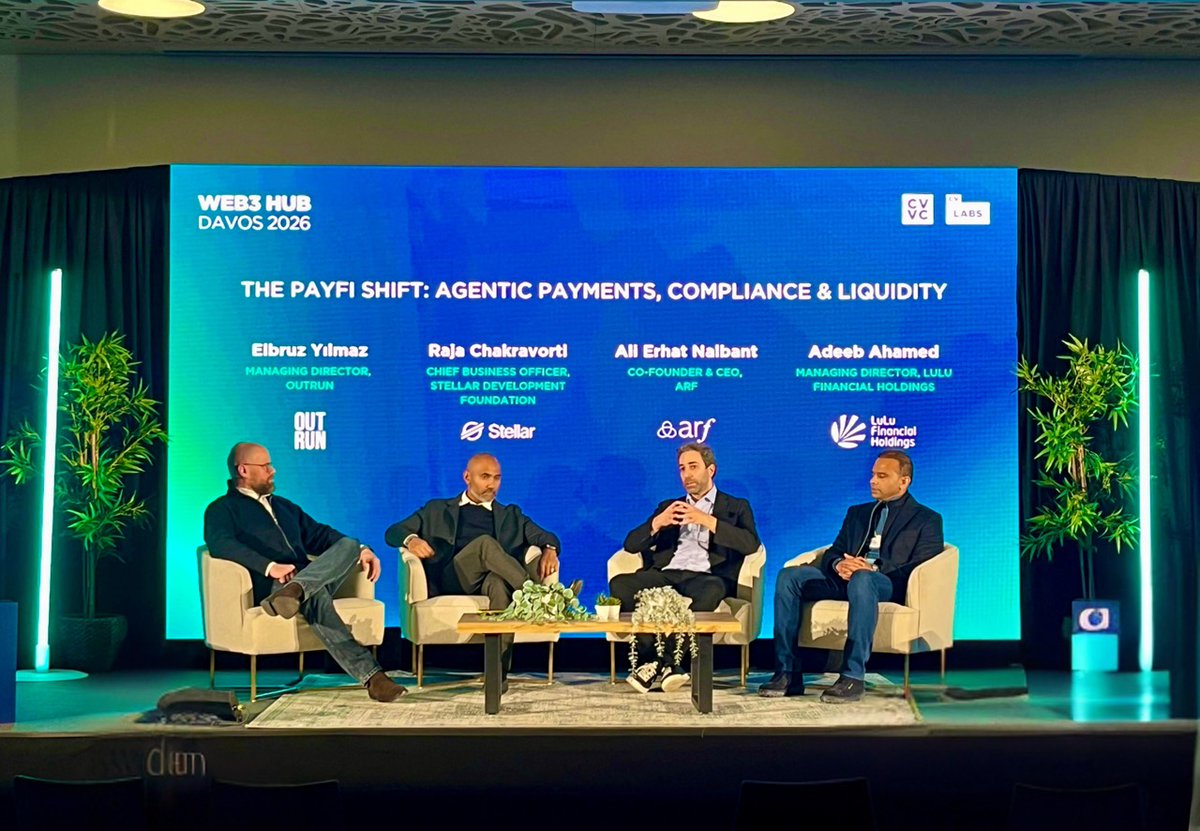
Today, @alierhat spoke at Davos on the panel we hosted, “The PayFi Shift: Agentic Payments, Compliance & Liquidity,” alongside @adeeb_ahamed (LuLu Financial Holdings) and @rajachak75 (@StellarOrg), with @elbruzyilmaz (Outrun) as moderator.
The discussion focused on how global payments are moving beyond pilots and proofs of concept, with programmable liquidity, embedded compliance, and on-chain settlement already operating inside live payment networks through PayFi—a finance and execution layer co-developed by Arf and its partners.
#Web3HubDavos
At Web3 Hub Davos, we are bringing together leaders from LuLu Financial Holdings and the @StellarOrg to unpack a major shift in global payments: PayFi. The panel will explore programmable liquidity, embedded compliance, and agentic payments, taking place during World Economic Forum week.
Date: January 19, 2026, 12:00 pm CET
Speakers:
• @alierhat, Co-founder & CEO, Arf
• @adeeb_ahamed, Managing Director, LuLu Financial Holdings
• @rajachak75, Chief Business Officer, Stellar Development Foundation
• @elbruzyilmaz, Managing Partner, Outrun (Moderator)
👉 Sign up: https://t.co/9ASBHwfPi6
@CV_Labs@thecryptovalley
#Web3HubDavos
Last week at @crosstech_ World 2025, Giray joined the panel “The Next Era of Fintech Payments: Breaking Barriers | Powering Growth” alongside Adam Swartzbaugh, Nicolas Ochoa Di Iorio and Karlo Torres.
The session highlighted how technological innovation, regulatory changes and evolving consumer expectations are transforming global fintech payments. Through discussions on digital-first banking, real-time cross-border movement and financial inclusion efforts, the panel outlined how these trends are driving new opportunities for global growth.