I spent 3 months making Instagram reels.
Filming. Re-filming. Editing. 4 hours per video for 200 views.
I burned out.
So I started building something different. 🧵
First $1000 from an AI model x Part 1
Starting an experiment: build my own AI model, give it social accounts, and funnel that traffic straight to my apps.
First I planned to generate through Higgsfield, but I went with Weavy AI instead - the tool Figma just acquired. Clean interface, and it runs canvas-based workflows, kind of like n8n (see the screenshot above).
The nice part: you don't rebuild every process from scratch. You wire it once as a chain of nodes, then run it like a pipeline and only swap what you need.
Liking it so far. Now I'm watching two things: how fast it burns tokens, and what kind of characters actually come out.
No idea where this ends up. But I'll document the whole thing here, part by part.
OpenClaw or Hermes: which one do you actually trust to run your agents?
I read the 25 busiest r/openclaw threads and 1,300+ comments, because I am trying to decide which tool to go deeper with for my own work.
Spoiler: nobody wins cleanly. The community split into 4 camps.
The full breakdown is on the blog:
1. How the two really differ (gateway-first vs agent-first).
2. What people love them for, and what they curse.
3. Why experienced users quietly run both.
4. What it actually costs in tokens, and which models hold up.
Read it, then tell me: what has your experience been with either one?
A vibecoder @the2ndfloorguy compiled a list of his most annoying coworkers using Whoop
The guy exported heart rate data from his Whoop band and fed it into Claude Fable 5. The AI matched stress spikes with meetings in his work calendar and built a ranking of coworkers who trigger the most stress.
Looks like now I finally know why I’ll need a Whoop.
Anthropic released Claude Fable 5.
Same base model as Mythos, with extra safety filters. Benchmarks put it at the top across coding, knowledge work, scientific tasks, and vision.
But the more interesting part is qualitative.
Fable 5 is being described as the biggest jump since Opus 4.5 in November. After 4.5, some people were already doing nearly all of their coding from the terminal. With Fable, Claude feels less like a coding agent and more like a thinking, design, and product-building partner.
The debugging behavior is the tell: instead of rushing to a plausible fix, it adds logs, takes measurements, checks hypotheses, and verifies the issue is actually fixed.
Caveat: safety filters may be too sensitive at launch, and AI-written code still needs review and tests before production.
Real step change.
How I used to build apps vs how I build them now:
Then: ship a new app almost every week and hope one of them randomly takes off.
Now: build 1-2 apps a year and spend the rest of the time on what actually moves the product: marketing, onboarding, screenshots, retention, paywalls, ASO, and distribution.
Traffic and marketing are the most valuable skills right now.
Apple Design Awards 2026 just happened.
3 apps stood out to me. Not only because they look good, but because they make complex data feel usable.
1. The Outsiders: Athlete Tracker
Fitness without the usual "push harder" default. Training Readiness Score turns sleep, resting heart rate, and training load into a clear signal: go harder today or recover.
2. Tide Guide: Charts & Tables
A niche tide tracker, but the interface is great. Forecasts, water temperature, swell, weather, widgets - a lot of data, but no mess. The palette even follows the color of the sky throughout the day.
3. Harvee
Turns Apple Watch data into recovery guidance. The small character at the center makes health data feel less dry and more human.
Good design is not just "looks expensive."
It removes noise and helps you decide what to do next.
What apps do you enjoy using because of the design?
Claude Opus 4.8 is out.
The model got better at coding. Anthropic is clearly making a huge bet on AI coding workflows and autonomous software development.
Claude now hallucinates less and is more likely to acknowledge uncertainty instead of confidently making things up.
You can now control how much “effort” the model puts into a task.
The most interesting part is dynamic workflows and subagents. Claude can coordinate multiple AI agents in parallel for large-scale tasks.
If you’re not addicted to vibe coding yet, now’s the time. It’s probably the most fun and leverage-rich thing you can be doing right now.
Creators, help
Where do you make translations of your videos into other languages with lip sync? Important that it doesn’t cost a fortune.
So far, I’ve found a setup that works quality-wise: voice generation in @ElevenLabs and lipsync in @synclabs
But damn, the lip-sync pricing on the latter is absolutely brutal.
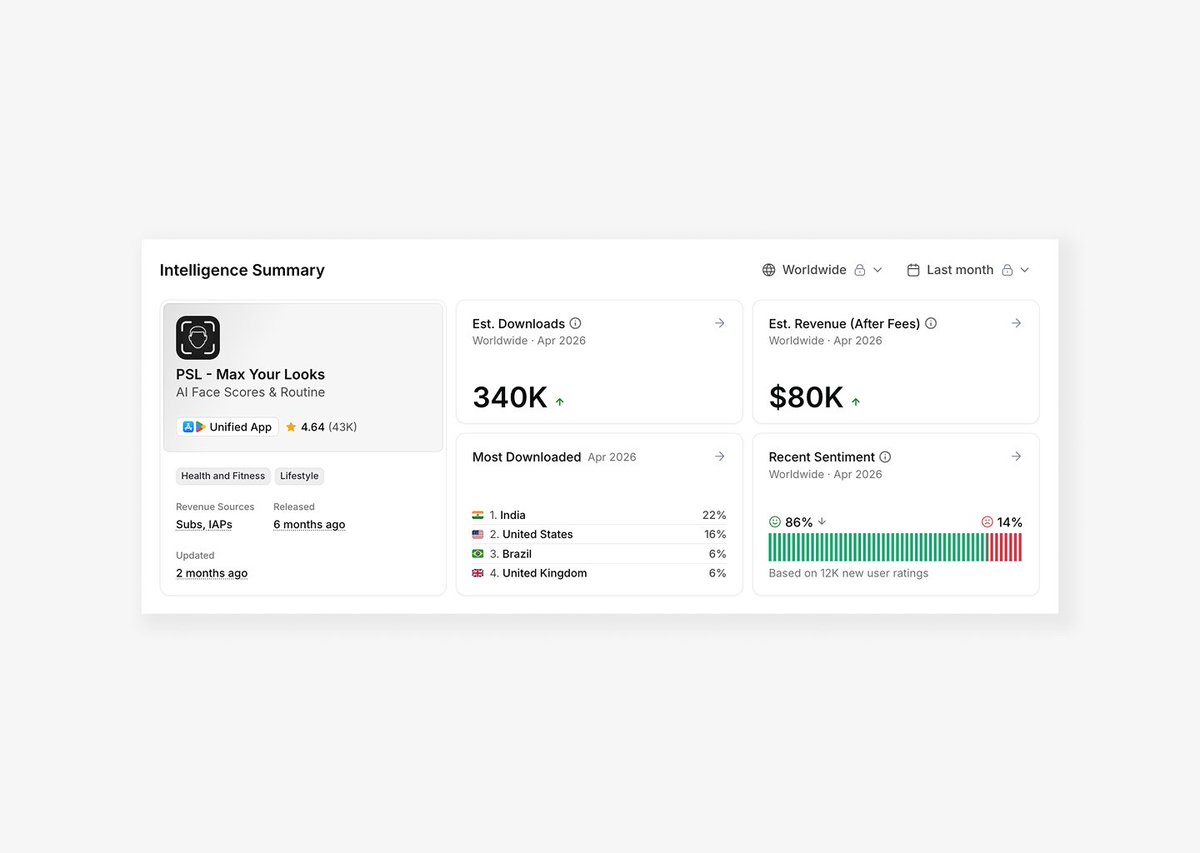
PSL, a looksmaxxing app focused on facial ratings, pulled in around $80K in April.
The app scans your face, gives you a “score,” then turns that insecurity into a personalized plan to “improve” your appearance.
And what’s driving the growth?
TikTok, obviously: 340K downloads and 2.3M views.
Looks like the self-improvement wave isn’t going anywhere. For anyone out of the loop, looksmaxxing is basically an online movement of guys trying to optimize their appearance.
Google “Clavicular” if you want to see the rabbit hole for yourself.
YAZIO made $6.1M in the last 30 days with a calorie tracking app.
What they sell:
1. Snap your food
2. AI counts calories
3. Track macros easily
4. Understand food quality
5. See daily progress
6. Look and feel better
Not features. Benefits.