🚨 “I’m going to shoot all of you!” Canada Must Treat a Death Threat on a Toronto Sidewalk as a Crime
A free country is judged by what it allows on an ordinary street. Circulating video from Toronto shows a man wearing a People’s Republic of China flag patch confronting Falun Gong practitioners at a public display, grabbing banners that read “Stop Persecution of Falun Gong” and “Stop CCP Transnational Repression,” and leaving poles and signs on the ground. On the original audio, he can be heard saying: “The Ethnic Unity Law is now in effect. I’m going to shoot all of you.”
That is not political argument. It is an alleged death threat, delivered in Canada, against people exercising a Charter right to worship and to protest. A Chinese statute has no force on a Toronto sidewalk. A man invoking Beijing’s law as a license to execute believers in Truthfulness, Compassion, and Forbearance is importing a police-state slogan onto Canadian soil.
Toronto Police Service should preserve every second of the original audio, identify the speaker, and determine whether the words meet the Criminal Code test for uttering threats, alongside possible assault and mischief. The Ontario Attorney General and federal public-safety officials should not treat this as a noisy quarrel between “community groups.” If the speaker is linked to United Front work or consular direction, that belongs in an RCMP and CSIS file.
Canada already knows the pattern: harassment of Falun Gong practitioners, pressure on families, and hoax bomb threats that disrupted Shen Yun in Toronto this year. A filmed threat to have people shot is the moment when “awareness” must become enforcement.
Investigate the video. Transcribe the audio. Charge whoever broke the law. Give the targeted practitioners a public accounting. A democracy does not prove its values by lecturing Beijing. It proves them by making clear that “I’m going to shoot all of you” is a crime in Canada, not a talking point from another country’s statute book.
Nvidia's CEO Confessed an Affair. U.S. Intelligence Says She Worked for Beijing.
Jensen Huang runs the world's most valuable chipmaker and sells the hardware behind America's AI race. On Sunday he sent his staff a confession: "I was unfaithful to my wife."
He never named the woman. Washington already had. A classified memo drafted under Secretary of State Marco Rubio, first reported by The New York Times, identifies Alice Huang (no relation), a Chinese executive, as an asset recruited by China's Ministry of State Security (MSS) to gather intelligence on him and nudge Nvidia to lobby for chip sales to China.
Five questions explain why this matters.
Who is she? A Chinese citizen from Hunan who studied at Hong Kong Baptist University and later gained Hong Kong residency. CNN reports she has entered the U.S. ten times on a Chinese passport since 2017. Her claimed career at state broadcasters CCTV and Hunan TV has not been verified. Even her age is disputed.
What is her company? Megaspeed, a Singapore cloud firm carved out of Chinese gaming group 7Road in 2023, became the largest buyer of Nvidia chips in Southeast Asia, with Alibaba as its anchor customer. When AFP dialed the number on its website, the person who answered said it was a residential line.
Who was investigating? U.S. officials have examined since 2024 whether Megaspeed funneled Nvidia chips into China. Singapore police have an open case on the company, though Singapore says it never probed her alleged spy ties.
Why wasn't it blacklisted? The Financial Times reports that State, Defense, Energy and Treasury all pushed to put Megaspeed on the Entity List, Washington's trade blacklist. Commerce stalled for two months. The Times reports a separate Commerce probe was shifted to the Justice Department after Nvidia's top lawyer contacted an official. Nvidia says it cut Megaspeed off internally in June 2025.
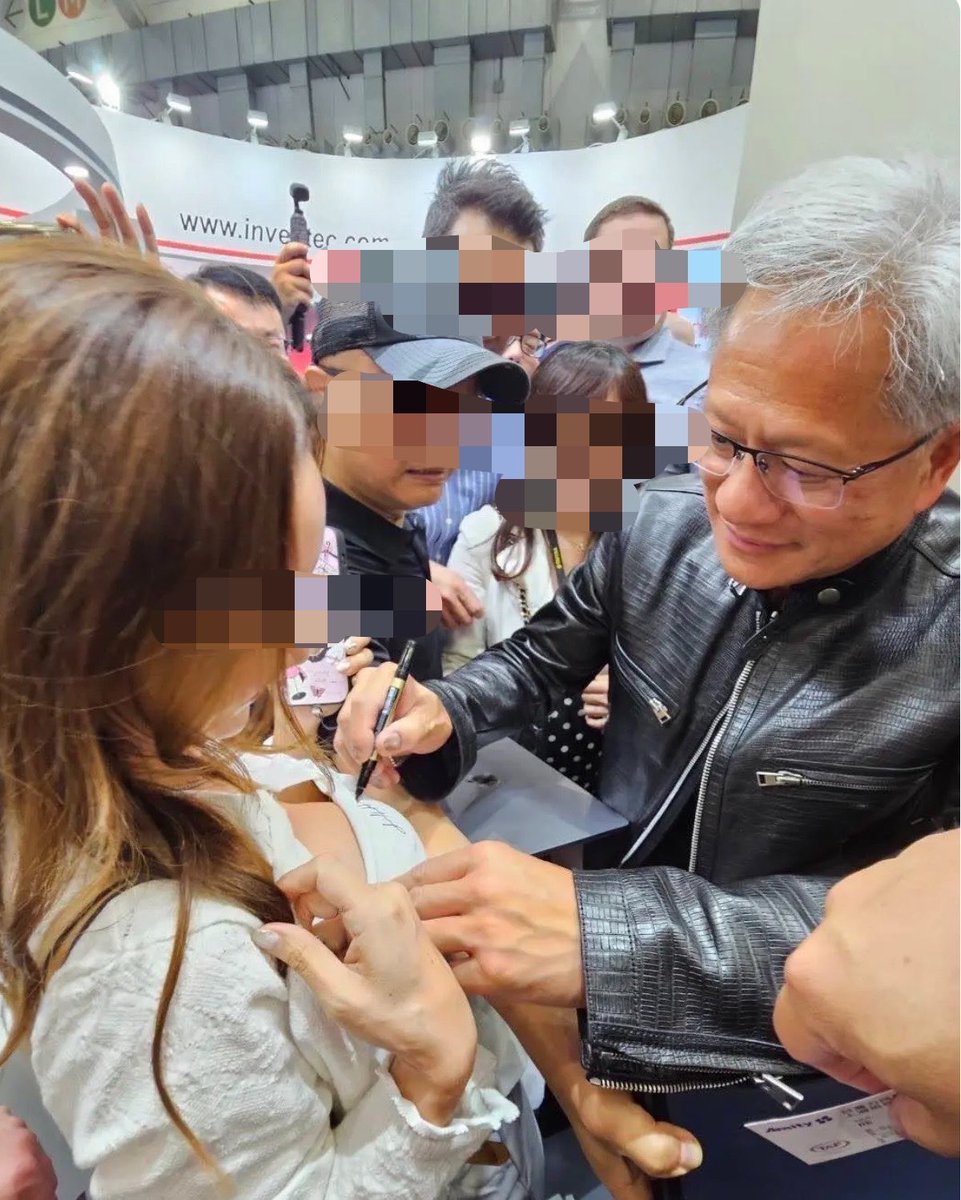
Why would a famously guarded CEO be photographed with her in Taipei, in 2024 and again in 2025? The visibility may have been the point. The FT reports that in 2025 she and a partner told Chinese investors they had "no problem securing GPUs."
Nothing has been proven in court. Nvidia's board says it has no reason to believe secrets leaked. Beijing calls it a smear. Alice Huang has not spoken. Taiwan has now revoked her visa and barred her return.
The shape is familiar. In 2004, a Japanese consulate cipher officer in Shanghai killed himself; Tokyo says Chinese security officers used his ties to a karaoke hostess to press him for codes. Christine Fang, who U.S. officials say cultivated rising California politicians, left for China in 2015 after FBI agents questioned her. The method has not changed in two decades: find whoever sits closest to the codes, the votes or the chips, and get close to them.
ACI — Aric Chen | Insights
Jensen Huang's Affair Has a Third Man. Shanghai Police Got to Him First.
The world's most valuable chipmaker is now investigating its own founder.
On Sunday, Nvidia CEO Jensen Huang told his staff: "I was unfaithful to my wife." He never named the woman. Everyone else already had.
Her name is Alice Huang, also known as Huang Le. No relation. She is a Chinese citizen, a former TV reporter turned financier. In 2023 she took control of Megaspeed, a Singapore cloud company that The New York Times says bought about $4.8 billion of Nvidia equipment. U.S. authorities are now probing whether Megaspeed diverted advanced chips to China.
According to the Times, U.S. counterintelligence concluded she had been recruited by China's Ministry of State Security (MSS). A classified memo overseen by Secretary of State Marco Rubio warned senior officials this spring. She has not been charged. Beijing calls the story a smear.
Now the part most people missed.
This week, the Beijing financial outlet Caixin reported, citing multiple insiders, that Alice Huang is married to Kang Wei, founder of Shanghai Hexi Investment. Kang ran a mutual fund company at 32 and later handed her a 25% stake in his firm. In 2018, China's securities regulator fined Hexi 17.7 million yuan, and Kang personally 400,000 yuan, for breaking disclosure and trading rules on a listed stock. In early 2025, the Financial Times reported, the pair pitched investors on a Southeast Asian data center and promised they had "no problem securing GPUs."
Then, Caixin's sources say, Shanghai police placed Kang under criminal coercive measures shortly before this year's Lunar New Year, over alleged stock manipulation. No official notice has been published.
So the woman U.S. intelligence links to the MSS has a husband whose freedom now rests with the Chinese state. In counterintelligence, that is what leverage looks like.
None of this is new. In 2004, a Japanese consulate cipher officer in Shanghai took his own life after Chinese security officers used his ties to a karaoke hostess to press him for codebook data. In 2008, Britain's MI5 warned hundreds of companies that Chinese intelligence exploits sexual relationships to pressure targets. Beijing's own MSS still lectures officials about honey traps, always as a weapon foreigners use against China.
Two decades on, the target is no longer a codebook. It is the supply line for the chips that will decide the AI race.
Nvidia's board says it has no reason to believe secrets were compromised. Three House committee chairs want Huang in a closed-door briefing on November 18. Their first question writes itself: when did he learn whose wife she was?
ACI — Aric Chen | Insights
Lately, a lot of people have been following the scandal, but don’t forget one thing: the Chinese Communist Party is very likely the mastermind behind it all, it’s a case of “sacrificing the pawn to save the king.” Don’t be fooled. We must keep a close eye on the CCP and the CCP factors behind it.
Jensen Huang Admits Affair With Suspected Chinese Spy. Beijing Has Run This Play for Decades.
Less than two weeks ago, Jensen Huang called his dealings with Alice Huang "completely normal and not unusual." On Sunday, the head of the world's most valuable company told his staff, "I was unfaithful to my wife."
Anyone who has studied Beijing's playbook should be appalled and not remotely surprised.
His note never names her. The New York Times reports he told Nvidia's board the woman was Alice Huang (no relation), a former Chinese television reporter turned senior executive at Megaspeed, a Singapore data center firm and major Nvidia customer. American intelligence believes China's Ministry of State Security (MSS), the main civilian spy service of the Chinese Communist Party (CCP), recruited her to gather information on him. A government memo overseen by Secretary of State Marco Rubio reached policymakers last spring and described the romance.
The reported objective was the prize of this century: details on American artificial intelligence chips, and possibly a push to get Nvidia's most advanced semiconductors into China. Huang has long pressed Washington to loosen chip limits on China, arguing they speed Beijing's own development. Nothing public shows she shaped those views. The MSS would still struggle to find a better-placed man to get close to.
Alice Huang faces no publicly reported charges and has not answered reporters. Megaspeed denies breaking export rules. Nvidia's board says it has "no reason to believe" secrets or national security were compromised, an assurance issued the same day it announced its investigation.
So far, no public evidence shows the MSS ordered the romance. But Chinese intelligence has never needed to stage an affair to make use of one. A leaked document from Britain's Security Service (MI5), prepared in 2008, warned hundreds of companies that Chinese services "exploit vulnerabilities such as sexual relationships" to force cooperation.
Japan buried a man over it. In May 2004, the officer running encrypted communications at its Shanghai consulate killed himself, leaving notes that described blackmail over his relationship with a karaoke hostess. Tokyo blamed threats and intimidation by Chinese intelligence officers. Beijing blamed work stress.
Taiwan lost a general. Maj. Gen. Lo Hsien-che fell into what the Control Yuan, Taiwan's government watchdog, called a sex trap set by Chinese agents while posted in Thailand. He spied for seven years, collecting top performance scores along the way, and drew a life sentence.
Beijing's response to the Huang reporting arrived on schedule: "groundless speculation." Yet the MSS knows this craft well enough to teach it. On May 10, it warned Chinese personnel holding state secrets to beware the sudden approach of a "perfect" admirer. In the ministry's telling, the seducer works for foreigners.
Chinese Americans have paid dearly for careless spy accusations, so aim this one where it belongs: at the MSS and the CCP that commands it.
Three House committee chairmen have asked Huang to a closed-door briefing on November 18. They should start with what he told her about chips, customers and Washington. Then they should ask whether the MSS has tried this on other American chip executives.
ACI — Aric Chen | Insights
Reports are now circulating that Alice Huang is a female spy who takes direct orders from Chen Yixin, Minister of the Chinese Communist Party’s Ministry of State Security, and is by no means an innocent person.
Six Companies and a Detained Husband: The Shanghai Paper Trail Behind Jensen Huang's Scandal
Alice Huang's WeChat signature is a line from Steve Jobs: "Stay hungry, stay foolish."
Caixin, the Beijing financial magazine, notes it near the top of a ten-page investigation it published on Tuesday. It is a fitting motto. In less than a decade, she rose from a mid-level job at a Chinese brokerage to control of a Singapore company that bought billions of dollars of Nvidia hardware. U.S. counterintelligence believes China's Ministry of State Security (MSS) recruited her.
Caixin leaves the spy question to Washington. It does something more useful: it follows the money. The trail runs through six companies, two regulatory penalties, a Ponzi scheme and Tencent's AI supercomputing hub. It ends with a husband whom, according to Caixin's sources, Shanghai police have held since before Lunar New Year.
Here is the trail, link by link.
LINK ONE: A DESK AT CITIC SECURITIES
Huang Le, now about 42, studied media management at Hong Kong Baptist University around 2006. She has said she worked as a reporter for China Central Television (CCTV) and Hunan TV. People who knew her early told Caixin the CCTV job was probably an internship. One Shanghai fund manager who met her back then said she left no particular impression. Later colleagues describe her as outgoing, talkative and commanding.
She entered finance in 2008, at HSBC's private bank in Hong Kong. She then moved to CITIC Securities, China's largest brokerage, and rose to vice president on a desk that lent to and sold products for private funds. Caixin calls her career there unremarkable.
One of that desk's clients was Shanghai Hexi Investment. In the first half of 2015, CITIC sold more than 1 billion yuan of a Hexi fund to investors. It also wrote a total return swap, a contract that lets a fund trade stocks with borrowed money, giving another Hexi fund roughly three times leverage. Soon after that business closed, she joined Hexi.
LINK TWO: SHANGHAI YUNXI INVESTMENT MANAGEMENT CONSULTING
In November 2015 she became Hexi's deputy general manager, an executive director and a member of its investment committee. Hexi's ownership was reshuffled to make room for her: founder Kang Wei kept 48.75 percent, partner Zhu Xiaoming 26.25 percent, and Huang 25 percent. Every share of her stake came from Kang. It was held through a small Shanghai consulting firm, Shanghai Yunxi.
Kang Wei was a star. He was born in 1975, trained at Shanghai Jiao Tong University and made his name as a strategist at the brokerage Shenyin Wanguo. In 2007, at 32, he became the youngest mutual fund chief in China when he took over Zhonghai Fund. He helped launch Sichuan Trust, served as its first president, and founded Hexi in 2010. He told one interviewer his rule was "never gamble."
Several Shanghai fund managers told Caixin that he and Huang Le are married. When they became a couple is not known.
LINK THREE: SHANGHAI LONGTENG ZHISUAN DATA GROUP
Look at who owns Hexi today. A Kang-linked company, Shanghai Yaoying, holds 51.81 percent. An individual named Huang Yu holds 30.79 percent, and a Shanghai partnership holds 17.05 percent. The last 0.35 percent belongs to Shanghai Longteng Zhisuan Data Group.
Huang Le founded Longteng Zhisuan and transferred her stake in it to Huang Yu in July 2017. Caixin says it could not confirm whether Huang Yu is a relative or holds the shares on her behalf.
The name Longteng surfaces again elsewhere in the network. Shanghai Shiji Longteng, a joint venture between Century Huatong and a Hexi affiliate, built a 5G data center in Shenzhen. It then announced an AI computing park in Wuhu budgeted at 8.2 billion yuan. Caixin does not say whether the two Longtengs are connected.
LINK FOUR: CENTURY HUATONG AND TENCENT'S SUPERCOMPUTER
Century Huatong is where Hexi made its fortune. In 2014 the auto-parts maker added a gaming business and sold new shares to outside investors. A Hexi fund put in 20 million yuan. Behind that fund were three people: Kang, Zhu's wife, and a man Caixin identifies only as Wang. By September 2017 the stake was worth about 1.9 billion yuan, a paper profit of 1.71 billion. Caixin says the fight over how to split that windfall is what later drove Kang and Zhu apart.
Hexi soon became the company's capital wingman, Caixin writes. In 2017 a Kang-controlled vehicle paid 500 million yuan for a Century Huatong game studio, Hangzhou Shengfeng. The deal handed the listed company 413 million yuan in after-tax profit when it needed it.
In 2020 Century Huatong moved into data centers. It raised more than 9 billion yuan through convertible bonds and bought into Shanghai Longjing, the operator of Tencent's Yangtze River Delta AI supercomputing center. That project is budgeted at 45 billion yuan and billed as one of China's three largest AI computing hubs. In 2021 Century Huatong, together with a Hexi affiliate and 7Road, sold control of Shanghai Longjing to the logistics investor GLP at a 4 billion yuan valuation.
A Shanghai fund executive gave Caixin the line that matters most to Washington. Century Huatong, he said, is now a major importer of AI chips through Southeast Asian channels.
LINK FIVE: MAPLE VALE LIMITED
7Road, a game developer, was carved out of Sohu's Changyou unit in 2015. A Hexi affiliate was among its new investors, and it listed in Hong Kong in 2018. A year after the listing, 7Road agreed to pay 1 billion yuan in cash for Osmanthus Vale Holdings, a British Virgin Islands company that owned 12 Chinese game studios.
The seller on paper was Huang Le, through her wholly owned Maple Vale Limited. Caixin's reading of the deal documents is that Hexi was the real owner. One of the 12 studios was Hangzhou Shengfeng, the same studio Hexi had bought from Century Huatong two years earlier. The network sold the same asset into two listed companies.
After that, Caixin says, Huang Le dropped out of public view for four years.
LINK SIX: HUANG LE LIMITED, THEN SWIFTDATA
She resurfaced in Singapore. In March 2023, 7Road's Singapore subsidiary, Megaspeed International, was transferred to Huang Le Limited, and she became its managing director. About eight months later the shares moved again, to a Singapore company called Swiftdata, and she left the register. Caixin, citing The Wall Street Journal, says she kept running Swiftdata from behind the curtain.
The New York Times reports that Megaspeed went on to buy about $4.8 billion of Nvidia equipment. U.S. authorities are investigating whether restricted chips were diverted to China. Megaspeed says it is investigating too and will cooperate.
THE HUSBAND'S FALL
While she was moving offshore, Kang was running out of road at home.
The first problem was Huiqiu Technology. In 2014 Hexi built a fund for Gu Guoping, who was trying to seize control of the listed company. Through that fund, a swap with CITIC Securities and several other funds, Hexi raised more than 1.8 billion yuan and kept buying. By March 2015 the combined accounts held 8.3 percent, well past the 5 percent at which the law requires disclosure. Hexi stayed silent. Regulators fined Hexi 17.7 million yuan and Kang 400,000 yuan in 2018.
Gu turned out to be running Lianbi Finance, an illegal fundraising scheme that cost more than 1.1 million people over 12.5 billion yuan; he was sentenced to life at first instance. Hexi had also bought, for 450 million yuan, the income rights to a 24 percent stake in another Gu company, on Gu's promise to buy them back at a 35 percent annual premium. When his empire collapsed in 2018, the buyback never came.
The second problem was Haoli Technology. In 2020 and 2021, Kang quietly gathered control of the company through affiliates and nominees. He also financed a second buyer, Tang Qiqing, so that the market would see Tang as the sole controller. Regulators ruled that Kang was the hidden co-controller and fined him 2.5 million yuan in August 2025. Xiamen regulators added a warning letter in June 2026.
Then, according to Caixin's sources, Shanghai police placed him under criminal coercive measures, which usually means detention or arrest, on suspicion of stock manipulation. There has been no official announcement. Hexi, once a fund industry darling, is down to 11 employees, and some of its funds are frozen in liquidation.
WHAT THE TRAIL SHOWS
The romance came last. By the time Huang Le was photographed with Jensen Huang, the structure under her was a decade old. It included a fund manager, a chain of listed gaming and data-center companies, offshore shells and a Singapore cloud provider. Her value, if U.S. officials are right about her, came from being a customer. A buyer of billions in Nvidia gear gets a seat at the CEO's table by right. China intelligence analyst Peter Mattis told Congress in 2016 that businesspeople are one of the main channels Beijing's spy services use to place and run sources.
Every link hides an owner: a consulting firm holding a quarter of a fund manager, a stake Huang Le handed to a woman whose relationship to her no one can confirm, a seller in the British Virgin Islands who was not the real seller, a Singapore company passed to another Singapore company. For export-control investigators, that structure is the obstacle. For an intelligence service, it is deniability built in from the start.
The Communist Party holds the keys at both ends. For years Chinese regulators met Hexi's violations with fines. Now the police hold its founder, and his fate rests with prosecutors and courts the Party controls. China's 2017 National Intelligence Law obliges every citizen and organization to cooperate with state intelligence work when asked. In that system, a husband in custody is a fact of power, whatever anyone intends to do with it.
Then there is the question of why this story ran at all. Caixin is among the most aggressive outlets Beijing allows, and it still publishes under the censors. Its investigation describes Huang Le in forensic detail as a player in a Shanghai financial network that ended in police custody. It does not explore who else she might have worked for. Whether or not that is the intent, the effect is to turn a story about the MSS into a story about a Shanghai finance scandal.
Lawmakers will question Jensen Huang behind closed doors on November 18 about what he told her. The more useful question is who built the companies that put her across the table from him.
ACI — Aric Chen | Insights
President of the Population Research Institute @StevenWMosher has a warning for politicians and tech CEOs after the Nvidia scandal:
“Do not fall for this kind of bait, because it always ends badly, not just for you personally, but for the United States of America.”
Six Companies and a Detained Husband: The Shanghai Paper Trail Behind Jensen Huang's Scandal
Alice Huang's WeChat signature is a line from Steve Jobs: "Stay hungry, stay foolish."
Caixin, the Beijing financial magazine, notes it near the top of a ten-page investigation it published on Tuesday. It is a fitting motto. In less than a decade, she rose from a mid-level job at a Chinese brokerage to control of a Singapore company that bought billions of dollars of Nvidia hardware. U.S. counterintelligence believes China's Ministry of State Security (MSS) recruited her.
Caixin leaves the spy question to Washington. It does something more useful: it follows the money. The trail runs through six companies, two regulatory penalties, a Ponzi scheme and Tencent's AI supercomputing hub. It ends with a husband whom, according to Caixin's sources, Shanghai police have held since before Lunar New Year.
Here is the trail, link by link.
LINK ONE: A DESK AT CITIC SECURITIES
Huang Le, now about 42, studied media management at Hong Kong Baptist University around 2006. She has said she worked as a reporter for China Central Television (CCTV) and Hunan TV. People who knew her early told Caixin the CCTV job was probably an internship. One Shanghai fund manager who met her back then said she left no particular impression. Later colleagues describe her as outgoing, talkative and commanding.
She entered finance in 2008, at HSBC's private bank in Hong Kong. She then moved to CITIC Securities, China's largest brokerage, and rose to vice president on a desk that lent to and sold products for private funds. Caixin calls her career there unremarkable.
One of that desk's clients was Shanghai Hexi Investment. In the first half of 2015, CITIC sold more than 1 billion yuan of a Hexi fund to investors. It also wrote a total return swap, a contract that lets a fund trade stocks with borrowed money, giving another Hexi fund roughly three times leverage. Soon after that business closed, she joined Hexi.
LINK TWO: SHANGHAI YUNXI INVESTMENT MANAGEMENT CONSULTING
In November 2015 she became Hexi's deputy general manager, an executive director and a member of its investment committee. Hexi's ownership was reshuffled to make room for her: founder Kang Wei kept 48.75 percent, partner Zhu Xiaoming 26.25 percent, and Huang 25 percent. Every share of her stake came from Kang. It was held through a small Shanghai consulting firm, Shanghai Yunxi.
Kang Wei was a star. He was born in 1975, trained at Shanghai Jiao Tong University and made his name as a strategist at the brokerage Shenyin Wanguo. In 2007, at 32, he became the youngest mutual fund chief in China when he took over Zhonghai Fund. He helped launch Sichuan Trust, served as its first president, and founded Hexi in 2010. He told one interviewer his rule was "never gamble."
Several Shanghai fund managers told Caixin that he and Huang Le are married. When they became a couple is not known.
LINK THREE: SHANGHAI LONGTENG ZHISUAN DATA GROUP
Look at who owns Hexi today. A Kang-linked company, Shanghai Yaoying, holds 51.81 percent. An individual named Huang Yu holds 30.79 percent, and a Shanghai partnership holds 17.05 percent. The last 0.35 percent belongs to Shanghai Longteng Zhisuan Data Group.
Huang Le founded Longteng Zhisuan and transferred her stake in it to Huang Yu in July 2017. Caixin says it could not confirm whether Huang Yu is a relative or holds the shares on her behalf.
The name Longteng surfaces again elsewhere in the network. Shanghai Shiji Longteng, a joint venture between Century Huatong and a Hexi affiliate, built a 5G data center in Shenzhen. It then announced an AI computing park in Wuhu budgeted at 8.2 billion yuan. Caixin does not say whether the two Longtengs are connected.
LINK FOUR: CENTURY HUATONG AND TENCENT'S SUPERCOMPUTER
Century Huatong is where Hexi made its fortune. In 2014 the auto-parts maker added a gaming business and sold new shares to outside investors. A Hexi fund put in 20 million yuan. Behind that fund were three people: Kang, Zhu's wife, and a man Caixin identifies only as Wang. By September 2017 the stake was worth about 1.9 billion yuan, a paper profit of 1.71 billion. Caixin says the fight over how to split that windfall is what later drove Kang and Zhu apart.
Hexi soon became the company's capital wingman, Caixin writes. In 2017 a Kang-controlled vehicle paid 500 million yuan for a Century Huatong game studio, Hangzhou Shengfeng. The deal handed the listed company 413 million yuan in after-tax profit when it needed it.
In 2020 Century Huatong moved into data centers. It raised more than 9 billion yuan through convertible bonds and bought into Shanghai Longjing, the operator of Tencent's Yangtze River Delta AI supercomputing center. That project is budgeted at 45 billion yuan and billed as one of China's three largest AI computing hubs. In 2021 Century Huatong, together with a Hexi affiliate and 7Road, sold control of Shanghai Longjing to the logistics investor GLP at a 4 billion yuan valuation.
A Shanghai fund executive gave Caixin the line that matters most to Washington. Century Huatong, he said, is now a major importer of AI chips through Southeast Asian channels.
LINK FIVE: MAPLE VALE LIMITED
7Road, a game developer, was carved out of Sohu's Changyou unit in 2015. A Hexi affiliate was among its new investors, and it listed in Hong Kong in 2018. A year after the listing, 7Road agreed to pay 1 billion yuan in cash for Osmanthus Vale Holdings, a British Virgin Islands company that owned 12 Chinese game studios.
The seller on paper was Huang Le, through her wholly owned Maple Vale Limited. Caixin's reading of the deal documents is that Hexi was the real owner. One of the 12 studios was Hangzhou Shengfeng, the same studio Hexi had bought from Century Huatong two years earlier. The network sold the same asset into two listed companies.
After that, Caixin says, Huang Le dropped out of public view for four years.
LINK SIX: HUANG LE LIMITED, THEN SWIFTDATA
She resurfaced in Singapore. In March 2023, 7Road's Singapore subsidiary, Megaspeed International, was transferred to Huang Le Limited, and she became its managing director. About eight months later the shares moved again, to a Singapore company called Swiftdata, and she left the register. Caixin, citing The Wall Street Journal, says she kept running Swiftdata from behind the curtain.
The New York Times reports that Megaspeed went on to buy about $4.8 billion of Nvidia equipment. U.S. authorities are investigating whether restricted chips were diverted to China. Megaspeed says it is investigating too and will cooperate.
THE HUSBAND'S FALL
While she was moving offshore, Kang was running out of road at home.
The first problem was Huiqiu Technology. In 2014 Hexi built a fund for Gu Guoping, who was trying to seize control of the listed company. Through that fund, a swap with CITIC Securities and several other funds, Hexi raised more than 1.8 billion yuan and kept buying. By March 2015 the combined accounts held 8.3 percent, well past the 5 percent at which the law requires disclosure. Hexi stayed silent. Regulators fined Hexi 17.7 million yuan and Kang 400,000 yuan in 2018.
Gu turned out to be running Lianbi Finance, an illegal fundraising scheme that cost more than 1.1 million people over 12.5 billion yuan; he was sentenced to life at first instance. Hexi had also bought, for 450 million yuan, the income rights to a 24 percent stake in another Gu company, on Gu's promise to buy them back at a 35 percent annual premium. When his empire collapsed in 2018, the buyback never came.
The second problem was Haoli Technology. In 2020 and 2021, Kang quietly gathered control of the company through affiliates and nominees. He also financed a second buyer, Tang Qiqing, so that the market would see Tang as the sole controller. Regulators ruled that Kang was the hidden co-controller and fined him 2.5 million yuan in August 2025. Xiamen regulators added a warning letter in June 2026.
Then, according to Caixin's sources, Shanghai police placed him under criminal coercive measures, which usually means detention or arrest, on suspicion of stock manipulation. There has been no official announcement. Hexi, once a fund industry darling, is down to 11 employees, and some of its funds are frozen in liquidation.
WHAT THE TRAIL SHOWS
The romance came last. By the time Huang Le was photographed with Jensen Huang, the structure under her was a decade old. It included a fund manager, a chain of listed gaming and data-center companies, offshore shells and a Singapore cloud provider. Her value, if U.S. officials are right about her, came from being a customer. A buyer of billions in Nvidia gear gets a seat at the CEO's table by right. China intelligence analyst Peter Mattis told Congress in 2016 that businesspeople are one of the main channels Beijing's spy services use to place and run sources.
Every link hides an owner: a consulting firm holding a quarter of a fund manager, a stake Huang Le handed to a woman whose relationship to her no one can confirm, a seller in the British Virgin Islands who was not the real seller, a Singapore company passed to another Singapore company. For export-control investigators, that structure is the obstacle. For an intelligence service, it is deniability built in from the start.
The Communist Party holds the keys at both ends. For years Chinese regulators met Hexi's violations with fines. Now the police hold its founder, and his fate rests with prosecutors and courts the Party controls. China's 2017 National Intelligence Law obliges every citizen and organization to cooperate with state intelligence work when asked. In that system, a husband in custody is a fact of power, whatever anyone intends to do with it.
Then there is the question of why this story ran at all. Caixin is among the most aggressive outlets Beijing allows, and it still publishes under the censors. Its investigation describes Huang Le in forensic detail as a player in a Shanghai financial network that ended in police custody. It does not explore who else she might have worked for. Whether or not that is the intent, the effect is to turn a story about the MSS into a story about a Shanghai finance scandal.
Lawmakers will question Jensen Huang behind closed doors on November 18 about what he told her. The more useful question is who built the companies that put her across the table from him.
ACI — Aric Chen | Insights
Jensen Huang's Affair Has a Third Man. Shanghai Police Got to Him First.
The world's most valuable chipmaker is now investigating its own founder.
On Sunday, Nvidia CEO Jensen Huang told his staff: "I was unfaithful to my wife." He never named the woman. Everyone else already had.
Her name is Alice Huang, also known as Huang Le. No relation. She is a Chinese citizen, a former TV reporter turned financier. In 2023 she took control of Megaspeed, a Singapore cloud company that The New York Times says bought about $4.8 billion of Nvidia equipment. U.S. authorities are now probing whether Megaspeed diverted advanced chips to China.
According to the Times, U.S. counterintelligence concluded she had been recruited by China's Ministry of State Security (MSS). A classified memo overseen by Secretary of State Marco Rubio warned senior officials this spring. She has not been charged. Beijing calls the story a smear.
Now the part most people missed.
This week, the Beijing financial outlet Caixin reported, citing multiple insiders, that Alice Huang is married to Kang Wei, founder of Shanghai Hexi Investment. Kang ran a mutual fund company at 32 and later handed her a 25% stake in his firm. In 2018, China's securities regulator fined Hexi 17.7 million yuan, and Kang personally 400,000 yuan, for breaking disclosure and trading rules on a listed stock. In early 2025, the Financial Times reported, the pair pitched investors on a Southeast Asian data center and promised they had "no problem securing GPUs."
Then, Caixin's sources say, Shanghai police placed Kang under criminal coercive measures shortly before this year's Lunar New Year, over alleged stock manipulation. No official notice has been published.
So the woman U.S. intelligence links to the MSS has a husband whose freedom now rests with the Chinese state. In counterintelligence, that is what leverage looks like.
None of this is new. In 2004, a Japanese consulate cipher officer in Shanghai took his own life after Chinese security officers used his ties to a karaoke hostess to press him for codebook data. In 2008, Britain's MI5 warned hundreds of companies that Chinese intelligence exploits sexual relationships to pressure targets. Beijing's own MSS still lectures officials about honey traps, always as a weapon foreigners use against China.
Two decades on, the target is no longer a codebook. It is the supply line for the chips that will decide the AI race.
Nvidia's board says it has no reason to believe secrets were compromised. Three House committee chairs want Huang in a closed-door briefing on November 18. Their first question writes itself: when did he learn whose wife she was?
ACI — Aric Chen | Insights
Jensen Huang Admits Affair With Suspected Chinese Spy. Beijing Has Run This Play for Decades.
Less than two weeks ago, Jensen Huang called his dealings with Alice Huang "completely normal and not unusual." On Sunday, the head of the world's most valuable company told his staff, "I was unfaithful to my wife."
Anyone who has studied Beijing's playbook should be appalled and not remotely surprised.
His note never names her. The New York Times reports he told Nvidia's board the woman was Alice Huang (no relation), a former Chinese television reporter turned senior executive at Megaspeed, a Singapore data center firm and major Nvidia customer. American intelligence believes China's Ministry of State Security (MSS), the main civilian spy service of the Chinese Communist Party (CCP), recruited her to gather information on him. A government memo overseen by Secretary of State Marco Rubio reached policymakers last spring and described the romance.
The reported objective was the prize of this century: details on American artificial intelligence chips, and possibly a push to get Nvidia's most advanced semiconductors into China. Huang has long pressed Washington to loosen chip limits on China, arguing they speed Beijing's own development. Nothing public shows she shaped those views. The MSS would still struggle to find a better-placed man to get close to.
Alice Huang faces no publicly reported charges and has not answered reporters. Megaspeed denies breaking export rules. Nvidia's board says it has "no reason to believe" secrets or national security were compromised, an assurance issued the same day it announced its investigation.
So far, no public evidence shows the MSS ordered the romance. But Chinese intelligence has never needed to stage an affair to make use of one. A leaked document from Britain's Security Service (MI5), prepared in 2008, warned hundreds of companies that Chinese services "exploit vulnerabilities such as sexual relationships" to force cooperation.
Japan buried a man over it. In May 2004, the officer running encrypted communications at its Shanghai consulate killed himself, leaving notes that described blackmail over his relationship with a karaoke hostess. Tokyo blamed threats and intimidation by Chinese intelligence officers. Beijing blamed work stress.
Taiwan lost a general. Maj. Gen. Lo Hsien-che fell into what the Control Yuan, Taiwan's government watchdog, called a sex trap set by Chinese agents while posted in Thailand. He spied for seven years, collecting top performance scores along the way, and drew a life sentence.
Beijing's response to the Huang reporting arrived on schedule: "groundless speculation." Yet the MSS knows this craft well enough to teach it. On May 10, it warned Chinese personnel holding state secrets to beware the sudden approach of a "perfect" admirer. In the ministry's telling, the seducer works for foreigners.
Chinese Americans have paid dearly for careless spy accusations, so aim this one where it belongs: at the MSS and the CCP that commands it.
Three House committee chairmen have asked Huang to a closed-door briefing on November 18. They should start with what he told her about chips, customers and Washington. Then they should ask whether the MSS has tried this on other American chip executives.
ACI — Aric Chen | Insights
Six Companies and a Detained Husband: The Shanghai Paper Trail Behind Jensen Huang's Scandal
Alice Huang's WeChat signature is a line from Steve Jobs: "Stay hungry, stay foolish."
Caixin, the Beijing financial magazine, notes it near the top of a ten-page investigation it published on Tuesday. It is a fitting motto. In less than a decade, she rose from a mid-level job at a Chinese brokerage to control of a Singapore company that bought billions of dollars of Nvidia hardware. U.S. counterintelligence believes China's Ministry of State Security (MSS) recruited her.
Caixin leaves the spy question to Washington. It does something more useful: it follows the money. The trail runs through six companies, two regulatory penalties, a Ponzi scheme and Tencent's AI supercomputing hub. It ends with a husband whom, according to Caixin's sources, Shanghai police have held since before Lunar New Year.
Here is the trail, link by link.
LINK ONE: A DESK AT CITIC SECURITIES
Huang Le, now about 42, studied media management at Hong Kong Baptist University around 2006. She has said she worked as a reporter for China Central Television (CCTV) and Hunan TV. People who knew her early told Caixin the CCTV job was probably an internship. One Shanghai fund manager who met her back then said she left no particular impression. Later colleagues describe her as outgoing, talkative and commanding.
She entered finance in 2008, at HSBC's private bank in Hong Kong. She then moved to CITIC Securities, China's largest brokerage, and rose to vice president on a desk that lent to and sold products for private funds. Caixin calls her career there unremarkable.
One of that desk's clients was Shanghai Hexi Investment. In the first half of 2015, CITIC sold more than 1 billion yuan of a Hexi fund to investors. It also wrote a total return swap, a contract that lets a fund trade stocks with borrowed money, giving another Hexi fund roughly three times leverage. Soon after that business closed, she joined Hexi.
LINK TWO: SHANGHAI YUNXI INVESTMENT MANAGEMENT CONSULTING
In November 2015 she became Hexi's deputy general manager, an executive director and a member of its investment committee. Hexi's ownership was reshuffled to make room for her: founder Kang Wei kept 48.75 percent, partner Zhu Xiaoming 26.25 percent, and Huang 25 percent. Every share of her stake came from Kang. It was held through a small Shanghai consulting firm, Shanghai Yunxi.
Kang Wei was a star. He was born in 1975, trained at Shanghai Jiao Tong University and made his name as a strategist at the brokerage Shenyin Wanguo. In 2007, at 32, he became the youngest mutual fund chief in China when he took over Zhonghai Fund. He helped launch Sichuan Trust, served as its first president, and founded Hexi in 2010. He told one interviewer his rule was "never gamble."
Several Shanghai fund managers told Caixin that he and Huang Le are married. When they became a couple is not known.
LINK THREE: SHANGHAI LONGTENG ZHISUAN DATA GROUP
Look at who owns Hexi today. A Kang-linked company, Shanghai Yaoying, holds 51.81 percent. An individual named Huang Yu holds 30.79 percent, and a Shanghai partnership holds 17.05 percent. The last 0.35 percent belongs to Shanghai Longteng Zhisuan Data Group.
Huang Le founded Longteng Zhisuan and transferred her stake in it to Huang Yu in July 2017. Caixin says it could not confirm whether Huang Yu is a relative or holds the shares on her behalf.
The name Longteng surfaces again elsewhere in the network. Shanghai Shiji Longteng, a joint venture between Century Huatong and a Hexi affiliate, built a 5G data center in Shenzhen. It then announced an AI computing park in Wuhu budgeted at 8.2 billion yuan. Caixin does not say whether the two Longtengs are connected.
LINK FOUR: CENTURY HUATONG AND TENCENT'S SUPERCOMPUTER
Century Huatong is where Hexi made its fortune. In 2014 the auto-parts maker added a gaming business and sold new shares to outside investors. A Hexi fund put in 20 million yuan. Behind that fund were three people: Kang, Zhu's wife, and a man Caixin identifies only as Wang. By September 2017 the stake was worth about 1.9 billion yuan, a paper profit of 1.71 billion. Caixin says the fight over how to split that windfall is what later drove Kang and Zhu apart.
Hexi soon became the company's capital wingman, Caixin writes. In 2017 a Kang-controlled vehicle paid 500 million yuan for a Century Huatong game studio, Hangzhou Shengfeng. The deal handed the listed company 413 million yuan in after-tax profit when it needed it.
In 2020 Century Huatong moved into data centers. It raised more than 9 billion yuan through convertible bonds and bought into Shanghai Longjing, the operator of Tencent's Yangtze River Delta AI supercomputing center. That project is budgeted at 45 billion yuan and billed as one of China's three largest AI computing hubs. In 2021 Century Huatong, together with a Hexi affiliate and 7Road, sold control of Shanghai Longjing to the logistics investor GLP at a 4 billion yuan valuation.
A Shanghai fund executive gave Caixin the line that matters most to Washington. Century Huatong, he said, is now a major importer of AI chips through Southeast Asian channels.
LINK FIVE: MAPLE VALE LIMITED
7Road, a game developer, was carved out of Sohu's Changyou unit in 2015. A Hexi affiliate was among its new investors, and it listed in Hong Kong in 2018. A year after the listing, 7Road agreed to pay 1 billion yuan in cash for Osmanthus Vale Holdings, a British Virgin Islands company that owned 12 Chinese game studios.
The seller on paper was Huang Le, through her wholly owned Maple Vale Limited. Caixin's reading of the deal documents is that Hexi was the real owner. One of the 12 studios was Hangzhou Shengfeng, the same studio Hexi had bought from Century Huatong two years earlier. The network sold the same asset into two listed companies.
After that, Caixin says, Huang Le dropped out of public view for four years.
LINK SIX: HUANG LE LIMITED, THEN SWIFTDATA
She resurfaced in Singapore. In March 2023, 7Road's Singapore subsidiary, Megaspeed International, was transferred to Huang Le Limited, and she became its managing director. About eight months later the shares moved again, to a Singapore company called Swiftdata, and she left the register. Caixin, citing The Wall Street Journal, says she kept running Swiftdata from behind the curtain.
The New York Times reports that Megaspeed went on to buy about $4.8 billion of Nvidia equipment. U.S. authorities are investigating whether restricted chips were diverted to China. Megaspeed says it is investigating too and will cooperate.
THE HUSBAND'S FALL
While she was moving offshore, Kang was running out of road at home.
The first problem was Huiqiu Technology. In 2014 Hexi built a fund for Gu Guoping, who was trying to seize control of the listed company. Through that fund, a swap with CITIC Securities and several other funds, Hexi raised more than 1.8 billion yuan and kept buying. By March 2015 the combined accounts held 8.3 percent, well past the 5 percent at which the law requires disclosure. Hexi stayed silent. Regulators fined Hexi 17.7 million yuan and Kang 400,000 yuan in 2018.
Gu turned out to be running Lianbi Finance, an illegal fundraising scheme that cost more than 1.1 million people over 12.5 billion yuan; he was sentenced to life at first instance. Hexi had also bought, for 450 million yuan, the income rights to a 24 percent stake in another Gu company, on Gu's promise to buy them back at a 35 percent annual premium. When his empire collapsed in 2018, the buyback never came.
The second problem was Haoli Technology. In 2020 and 2021, Kang quietly gathered control of the company through affiliates and nominees. He also financed a second buyer, Tang Qiqing, so that the market would see Tang as the sole controller. Regulators ruled that Kang was the hidden co-controller and fined him 2.5 million yuan in August 2025. Xiamen regulators added a warning letter in June 2026.
Then, according to Caixin's sources, Shanghai police placed him under criminal coercive measures, which usually means detention or arrest, on suspicion of stock manipulation. There has been no official announcement. Hexi, once a fund industry darling, is down to 11 employees, and some of its funds are frozen in liquidation.
WHAT THE TRAIL SHOWS
The romance came last. By the time Huang Le was photographed with Jensen Huang, the structure under her was a decade old. It included a fund manager, a chain of listed gaming and data-center companies, offshore shells and a Singapore cloud provider. Her value, if U.S. officials are right about her, came from being a customer. A buyer of billions in Nvidia gear gets a seat at the CEO's table by right. China intelligence analyst Peter Mattis told Congress in 2016 that businesspeople are one of the main channels Beijing's spy services use to place and run sources.
Every link hides an owner: a consulting firm holding a quarter of a fund manager, a stake Huang Le handed to a woman whose relationship to her no one can confirm, a seller in the British Virgin Islands who was not the real seller, a Singapore company passed to another Singapore company. For export-control investigators, that structure is the obstacle. For an intelligence service, it is deniability built in from the start.
The Communist Party holds the keys at both ends. For years Chinese regulators met Hexi's violations with fines. Now the police hold its founder, and his fate rests with prosecutors and courts the Party controls. China's 2017 National Intelligence Law obliges every citizen and organization to cooperate with state intelligence work when asked. In that system, a husband in custody is a fact of power, whatever anyone intends to do with it.
Then there is the question of why this story ran at all. Caixin is among the most aggressive outlets Beijing allows, and it still publishes under the censors. Its investigation describes Huang Le in forensic detail as a player in a Shanghai financial network that ended in police custody. It does not explore who else she might have worked for. Whether or not that is the intent, the effect is to turn a story about the MSS into a story about a Shanghai finance scandal.
Lawmakers will question Jensen Huang behind closed doors on November 18 about what he told her. The more useful question is who built the companies that put her across the table from him.
ACI — Aric Chen | Insights
Jensen Huang Admits Affair With Suspected Chinese Spy. Beijing Has Run This Play for Decades.
Less than two weeks ago, Jensen Huang called his dealings with Alice Huang "completely normal and not unusual." On Sunday, the head of the world's most valuable company told his staff, "I was unfaithful to my wife."
Anyone who has studied Beijing's playbook should be appalled and not remotely surprised.
His note never names her. The New York Times reports he told Nvidia's board the woman was Alice Huang (no relation), a former Chinese television reporter turned senior executive at Megaspeed, a Singapore data center firm and major Nvidia customer. American intelligence believes China's Ministry of State Security (MSS), the main civilian spy service of the Chinese Communist Party (CCP), recruited her to gather information on him. A government memo overseen by Secretary of State Marco Rubio reached policymakers last spring and described the romance.
The reported objective was the prize of this century: details on American artificial intelligence chips, and possibly a push to get Nvidia's most advanced semiconductors into China. Huang has long pressed Washington to loosen chip limits on China, arguing they speed Beijing's own development. Nothing public shows she shaped those views. The MSS would still struggle to find a better-placed man to get close to.
Alice Huang faces no publicly reported charges and has not answered reporters. Megaspeed denies breaking export rules. Nvidia's board says it has "no reason to believe" secrets or national security were compromised, an assurance issued the same day it announced its investigation.
So far, no public evidence shows the MSS ordered the romance. But Chinese intelligence has never needed to stage an affair to make use of one. A leaked document from Britain's Security Service (MI5), prepared in 2008, warned hundreds of companies that Chinese services "exploit vulnerabilities such as sexual relationships" to force cooperation.
Japan buried a man over it. In May 2004, the officer running encrypted communications at its Shanghai consulate killed himself, leaving notes that described blackmail over his relationship with a karaoke hostess. Tokyo blamed threats and intimidation by Chinese intelligence officers. Beijing blamed work stress.
Taiwan lost a general. Maj. Gen. Lo Hsien-che fell into what the Control Yuan, Taiwan's government watchdog, called a sex trap set by Chinese agents while posted in Thailand. He spied for seven years, collecting top performance scores along the way, and drew a life sentence.
Beijing's response to the Huang reporting arrived on schedule: "groundless speculation." Yet the MSS knows this craft well enough to teach it. On May 10, it warned Chinese personnel holding state secrets to beware the sudden approach of a "perfect" admirer. In the ministry's telling, the seducer works for foreigners.
Chinese Americans have paid dearly for careless spy accusations, so aim this one where it belongs: at the MSS and the CCP that commands it.
Three House committee chairmen have asked Huang to a closed-door briefing on November 18. They should start with what he told her about chips, customers and Washington. Then they should ask whether the MSS has tried this on other American chip executives.
ACI — Aric Chen | Insights
Thirty espionage and influence cases across eight countries. Sex is the actual mechanism in two of them. The Fang Fang file is not the honeytrap story everyone is posting this week. It is a price list for a congressional internship. https://t.co/FM0iEhc19q
Six Companies and a Detained Husband: The Shanghai Paper Trail Behind Jensen Huang's Scandal
Alice Huang's WeChat signature is a line from Steve Jobs: "Stay hungry, stay foolish."
Caixin, the Beijing financial magazine, notes it near the top of a ten-page investigation it published on Tuesday. It is a fitting motto. In less than a decade, she rose from a mid-level job at a Chinese brokerage to control of a Singapore company that bought billions of dollars of Nvidia hardware. U.S. counterintelligence believes China's Ministry of State Security (MSS) recruited her.
Caixin leaves the spy question to Washington. It does something more useful: it follows the money. The trail runs through six companies, two regulatory penalties, a Ponzi scheme and Tencent's AI supercomputing hub. It ends with a husband whom, according to Caixin's sources, Shanghai police have held since before Lunar New Year.
Here is the trail, link by link.
LINK ONE: A DESK AT CITIC SECURITIES
Huang Le, now about 42, studied media management at Hong Kong Baptist University around 2006. She has said she worked as a reporter for China Central Television (CCTV) and Hunan TV. People who knew her early told Caixin the CCTV job was probably an internship. One Shanghai fund manager who met her back then said she left no particular impression. Later colleagues describe her as outgoing, talkative and commanding.
She entered finance in 2008, at HSBC's private bank in Hong Kong. She then moved to CITIC Securities, China's largest brokerage, and rose to vice president on a desk that lent to and sold products for private funds. Caixin calls her career there unremarkable.
One of that desk's clients was Shanghai Hexi Investment. In the first half of 2015, CITIC sold more than 1 billion yuan of a Hexi fund to investors. It also wrote a total return swap, a contract that lets a fund trade stocks with borrowed money, giving another Hexi fund roughly three times leverage. Soon after that business closed, she joined Hexi.
LINK TWO: SHANGHAI YUNXI INVESTMENT MANAGEMENT CONSULTING
In November 2015 she became Hexi's deputy general manager, an executive director and a member of its investment committee. Hexi's ownership was reshuffled to make room for her: founder Kang Wei kept 48.75 percent, partner Zhu Xiaoming 26.25 percent, and Huang 25 percent. Every share of her stake came from Kang. It was held through a small Shanghai consulting firm, Shanghai Yunxi.
Kang Wei was a star. He was born in 1975, trained at Shanghai Jiao Tong University and made his name as a strategist at the brokerage Shenyin Wanguo. In 2007, at 32, he became the youngest mutual fund chief in China when he took over Zhonghai Fund. He helped launch Sichuan Trust, served as its first president, and founded Hexi in 2010. He told one interviewer his rule was "never gamble."
Several Shanghai fund managers told Caixin that he and Huang Le are married. When they became a couple is not known.
LINK THREE: SHANGHAI LONGTENG ZHISUAN DATA GROUP
Look at who owns Hexi today. A Kang-linked company, Shanghai Yaoying, holds 51.81 percent. An individual named Huang Yu holds 30.79 percent, and a Shanghai partnership holds 17.05 percent. The last 0.35 percent belongs to Shanghai Longteng Zhisuan Data Group.
Huang Le founded Longteng Zhisuan and transferred her stake in it to Huang Yu in July 2017. Caixin says it could not confirm whether Huang Yu is a relative or holds the shares on her behalf.
The name Longteng surfaces again elsewhere in the network. Shanghai Shiji Longteng, a joint venture between Century Huatong and a Hexi affiliate, built a 5G data center in Shenzhen. It then announced an AI computing park in Wuhu budgeted at 8.2 billion yuan. Caixin does not say whether the two Longtengs are connected.
LINK FOUR: CENTURY HUATONG AND TENCENT'S SUPERCOMPUTER
Century Huatong is where Hexi made its fortune. In 2014 the auto-parts maker added a gaming business and sold new shares to outside investors. A Hexi fund put in 20 million yuan. Behind that fund were three people: Kang, Zhu's wife, and a man Caixin identifies only as Wang. By September 2017 the stake was worth about 1.9 billion yuan, a paper profit of 1.71 billion. Caixin says the fight over how to split that windfall is what later drove Kang and Zhu apart.
Hexi soon became the company's capital wingman, Caixin writes. In 2017 a Kang-controlled vehicle paid 500 million yuan for a Century Huatong game studio, Hangzhou Shengfeng. The deal handed the listed company 413 million yuan in after-tax profit when it needed it.
In 2020 Century Huatong moved into data centers. It raised more than 9 billion yuan through convertible bonds and bought into Shanghai Longjing, the operator of Tencent's Yangtze River Delta AI supercomputing center. That project is budgeted at 45 billion yuan and billed as one of China's three largest AI computing hubs. In 2021 Century Huatong, together with a Hexi affiliate and 7Road, sold control of Shanghai Longjing to the logistics investor GLP at a 4 billion yuan valuation.
A Shanghai fund executive gave Caixin the line that matters most to Washington. Century Huatong, he said, is now a major importer of AI chips through Southeast Asian channels.
LINK FIVE: MAPLE VALE LIMITED
7Road, a game developer, was carved out of Sohu's Changyou unit in 2015. A Hexi affiliate was among its new investors, and it listed in Hong Kong in 2018. A year after the listing, 7Road agreed to pay 1 billion yuan in cash for Osmanthus Vale Holdings, a British Virgin Islands company that owned 12 Chinese game studios.
The seller on paper was Huang Le, through her wholly owned Maple Vale Limited. Caixin's reading of the deal documents is that Hexi was the real owner. One of the 12 studios was Hangzhou Shengfeng, the same studio Hexi had bought from Century Huatong two years earlier. The network sold the same asset into two listed companies.
After that, Caixin says, Huang Le dropped out of public view for four years.
LINK SIX: HUANG LE LIMITED, THEN SWIFTDATA
She resurfaced in Singapore. In March 2023, 7Road's Singapore subsidiary, Megaspeed International, was transferred to Huang Le Limited, and she became its managing director. About eight months later the shares moved again, to a Singapore company called Swiftdata, and she left the register. Caixin, citing The Wall Street Journal, says she kept running Swiftdata from behind the curtain.
The New York Times reports that Megaspeed went on to buy about $4.8 billion of Nvidia equipment. U.S. authorities are investigating whether restricted chips were diverted to China. Megaspeed says it is investigating too and will cooperate.
THE HUSBAND'S FALL
While she was moving offshore, Kang was running out of road at home.
The first problem was Huiqiu Technology. In 2014 Hexi built a fund for Gu Guoping, who was trying to seize control of the listed company. Through that fund, a swap with CITIC Securities and several other funds, Hexi raised more than 1.8 billion yuan and kept buying. By March 2015 the combined accounts held 8.3 percent, well past the 5 percent at which the law requires disclosure. Hexi stayed silent. Regulators fined Hexi 17.7 million yuan and Kang 400,000 yuan in 2018.
Gu turned out to be running Lianbi Finance, an illegal fundraising scheme that cost more than 1.1 million people over 12.5 billion yuan; he was sentenced to life at first instance. Hexi had also bought, for 450 million yuan, the income rights to a 24 percent stake in another Gu company, on Gu's promise to buy them back at a 35 percent annual premium. When his empire collapsed in 2018, the buyback never came.
The second problem was Haoli Technology. In 2020 and 2021, Kang quietly gathered control of the company through affiliates and nominees. He also financed a second buyer, Tang Qiqing, so that the market would see Tang as the sole controller. Regulators ruled that Kang was the hidden co-controller and fined him 2.5 million yuan in August 2025. Xiamen regulators added a warning letter in June 2026.
Then, according to Caixin's sources, Shanghai police placed him under criminal coercive measures, which usually means detention or arrest, on suspicion of stock manipulation. There has been no official announcement. Hexi, once a fund industry darling, is down to 11 employees, and some of its funds are frozen in liquidation.
WHAT THE TRAIL SHOWS
The romance came last. By the time Huang Le was photographed with Jensen Huang, the structure under her was a decade old. It included a fund manager, a chain of listed gaming and data-center companies, offshore shells and a Singapore cloud provider. Her value, if U.S. officials are right about her, came from being a customer. A buyer of billions in Nvidia gear gets a seat at the CEO's table by right. China intelligence analyst Peter Mattis told Congress in 2016 that businesspeople are one of the main channels Beijing's spy services use to place and run sources.
Every link hides an owner: a consulting firm holding a quarter of a fund manager, a stake Huang Le handed to a woman whose relationship to her no one can confirm, a seller in the British Virgin Islands who was not the real seller, a Singapore company passed to another Singapore company. For export-control investigators, that structure is the obstacle. For an intelligence service, it is deniability built in from the start.
The Communist Party holds the keys at both ends. For years Chinese regulators met Hexi's violations with fines. Now the police hold its founder, and his fate rests with prosecutors and courts the Party controls. China's 2017 National Intelligence Law obliges every citizen and organization to cooperate with state intelligence work when asked. In that system, a husband in custody is a fact of power, whatever anyone intends to do with it.
Then there is the question of why this story ran at all. Caixin is among the most aggressive outlets Beijing allows, and it still publishes under the censors. Its investigation describes Huang Le in forensic detail as a player in a Shanghai financial network that ended in police custody. It does not explore who else she might have worked for. Whether or not that is the intent, the effect is to turn a story about the MSS into a story about a Shanghai finance scandal.
Lawmakers will question Jensen Huang behind closed doors on November 18 about what he told her. The more useful question is who built the companies that put her across the table from him.
ACI — Aric Chen | Insights
Jensen Huang's Affair Has a Third Man. Shanghai Police Got to Him First.
The world's most valuable chipmaker is now investigating its own founder.
On Sunday, Nvidia CEO Jensen Huang told his staff: "I was unfaithful to my wife." He never named the woman. Everyone else already had.
Her name is Alice Huang, also known as Huang Le. No relation. She is a Chinese citizen, a former TV reporter turned financier. In 2023 she took control of Megaspeed, a Singapore cloud company that The New York Times says bought about $4.8 billion of Nvidia equipment. U.S. authorities are now probing whether Megaspeed diverted advanced chips to China.
According to the Times, U.S. counterintelligence concluded she had been recruited by China's Ministry of State Security (MSS). A classified memo overseen by Secretary of State Marco Rubio warned senior officials this spring. She has not been charged. Beijing calls the story a smear.
Now the part most people missed.
This week, the Beijing financial outlet Caixin reported, citing multiple insiders, that Alice Huang is married to Kang Wei, founder of Shanghai Hexi Investment. Kang ran a mutual fund company at 32 and later handed her a 25% stake in his firm. In 2018, China's securities regulator fined Hexi 17.7 million yuan, and Kang personally 400,000 yuan, for breaking disclosure and trading rules on a listed stock. In early 2025, the Financial Times reported, the pair pitched investors on a Southeast Asian data center and promised they had "no problem securing GPUs."
Then, Caixin's sources say, Shanghai police placed Kang under criminal coercive measures shortly before this year's Lunar New Year, over alleged stock manipulation. No official notice has been published.
So the woman U.S. intelligence links to the MSS has a husband whose freedom now rests with the Chinese state. In counterintelligence, that is what leverage looks like.
None of this is new. In 2004, a Japanese consulate cipher officer in Shanghai took his own life after Chinese security officers used his ties to a karaoke hostess to press him for codebook data. In 2008, Britain's MI5 warned hundreds of companies that Chinese intelligence exploits sexual relationships to pressure targets. Beijing's own MSS still lectures officials about honey traps, always as a weapon foreigners use against China.
Two decades on, the target is no longer a codebook. It is the supply line for the chips that will decide the AI race.
Nvidia's board says it has no reason to believe secrets were compromised. Three House committee chairs want Huang in a closed-door briefing on November 18. Their first question writes itself: when did he learn whose wife she was?
ACI — Aric Chen | Insights
Jensen Huang Admits Affair With Suspected Chinese Spy. Beijing Has Run This Play for Decades.
Less than two weeks ago, Jensen Huang called his dealings with Alice Huang "completely normal and not unusual." On Sunday, the head of the world's most valuable company told his staff, "I was unfaithful to my wife."
Anyone who has studied Beijing's playbook should be appalled and not remotely surprised.
His note never names her. The New York Times reports he told Nvidia's board the woman was Alice Huang (no relation), a former Chinese television reporter turned senior executive at Megaspeed, a Singapore data center firm and major Nvidia customer. American intelligence believes China's Ministry of State Security (MSS), the main civilian spy service of the Chinese Communist Party (CCP), recruited her to gather information on him. A government memo overseen by Secretary of State Marco Rubio reached policymakers last spring and described the romance.
The reported objective was the prize of this century: details on American artificial intelligence chips, and possibly a push to get Nvidia's most advanced semiconductors into China. Huang has long pressed Washington to loosen chip limits on China, arguing they speed Beijing's own development. Nothing public shows she shaped those views. The MSS would still struggle to find a better-placed man to get close to.
Alice Huang faces no publicly reported charges and has not answered reporters. Megaspeed denies breaking export rules. Nvidia's board says it has "no reason to believe" secrets or national security were compromised, an assurance issued the same day it announced its investigation.
So far, no public evidence shows the MSS ordered the romance. But Chinese intelligence has never needed to stage an affair to make use of one. A leaked document from Britain's Security Service (MI5), prepared in 2008, warned hundreds of companies that Chinese services "exploit vulnerabilities such as sexual relationships" to force cooperation.
Japan buried a man over it. In May 2004, the officer running encrypted communications at its Shanghai consulate killed himself, leaving notes that described blackmail over his relationship with a karaoke hostess. Tokyo blamed threats and intimidation by Chinese intelligence officers. Beijing blamed work stress.
Taiwan lost a general. Maj. Gen. Lo Hsien-che fell into what the Control Yuan, Taiwan's government watchdog, called a sex trap set by Chinese agents while posted in Thailand. He spied for seven years, collecting top performance scores along the way, and drew a life sentence.
Beijing's response to the Huang reporting arrived on schedule: "groundless speculation." Yet the MSS knows this craft well enough to teach it. On May 10, it warned Chinese personnel holding state secrets to beware the sudden approach of a "perfect" admirer. In the ministry's telling, the seducer works for foreigners.
Chinese Americans have paid dearly for careless spy accusations, so aim this one where it belongs: at the MSS and the CCP that commands it.
Three House committee chairmen have asked Huang to a closed-door briefing on November 18. They should start with what he told her about chips, customers and Washington. Then they should ask whether the MSS has tried this on other American chip executives.
ACI — Aric Chen | Insights
Scenes from Prosperous China in 2026: Guangdong bridge tunnels: the hottest new “luxury housing” for young people. A scene you’ll never see on Chinese television or in pro-Communist Party international propaganda.
Just landed in Taipei, where I’m holding the Chinese edition of Killed to Order for the first time.
Pretty incredible to see this book reach a new audience here!
Taiwan has become the first to prosecute people involved in China organ trafficking, and I’m here to meet with folks who want to build on that progress.
There’s still a long way to go, but being here with this book in my hands makes this moment feel especially meaningful.
Excited for the conversations ahead.
From tariffs to national monuments, President Trump tells NTD he has “a lot of things cooking” to protect his legacy, and warns democratic socialist mayors will hurt their cities.
@NTDNews White House correspondent @IrisTaoTV has more.
🚨 They're not hiding anymore. This was stapled to a public pole in Arizona.
A friend in Arizona sent us this. Not a back-alley flyer. Not a locked forum. A utility pole on a public street — bright red, Karl Marx pointing at you Uncle-Sam style: "ARE YOU A COMMUNIST? THEN GET ORGANIZED!" Complete with a QR code and a recruitment link.
Let that sink in. In 2026, in the American Southwest, a communist organization is openly canvassing for members in broad daylight — and nobody blinked.
The group behind it, the Revolutionary Communists of America, says hundreds have already signed up since launching this "Are You a Communist?" campaign. They are recruiting on campuses, at protests, and now on the corner where you buy your coffee.
Here's what the cheerful red poster won't tell you. Every regime that actually built the "workers' paradise" delivered the same product: gulags, famine, secret police, and mass graves. The Black Book of Communism counts victims in the tens of millions. That is not a smear — it is the historical record, written in the blood of Ukraine, Cambodia, and China.
An ideology with that body count doesn't deserve a friendly QR code. It deserves scrutiny.
This isn't about silencing anyone. It's about paying attention. When radical organizing goes mainstream and normalized, the time to notice is before it takes root — not after.
America, wake up. They are literally advertising.
ACI — Aric Chen | Insights
A movement can be technically correct, but what brings it to life?
Shen Yun principal dancer Piotr Huang shares how classical Chinese dance goes beyond mastering physical movements. It requires a deeper understanding of Chinese culture, history, and inner bearing, allowing dancers to express the spirit and character behind every movement.