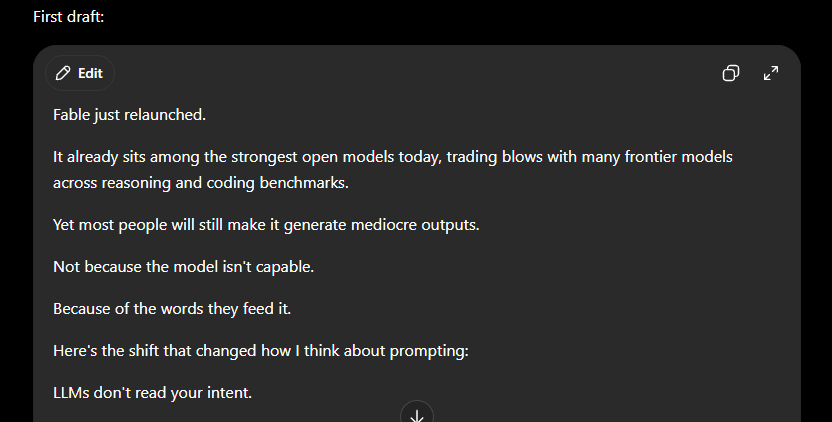
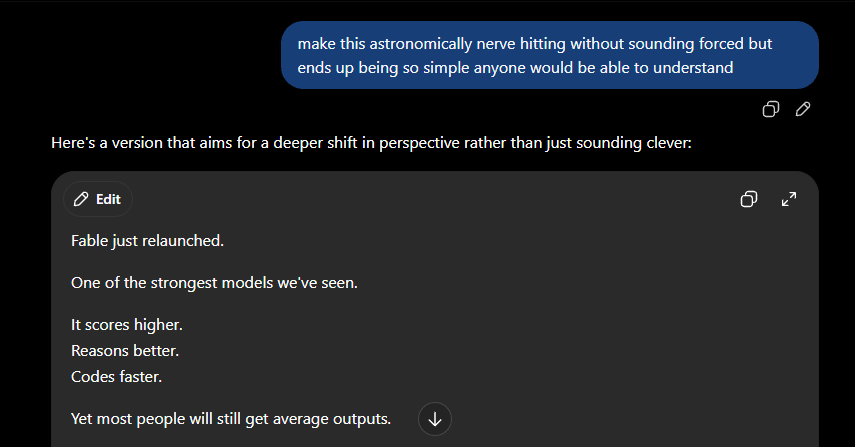
Fable just relaunched.
One of the strongest models we've seen.
It scores higher. Reasons better. Codes faster.
Yet most people will still get average outputs, not because the model lacks intelligence.
Because they're speaking the wrong language, everyone says LLMs understand intent. They don't.
They infer intent from words.
That's a very different thing.
Every word you write changes what the model believes you're asking.
Replace one adjective.
Swap one verb.
Add one sentence.
The entire answer can take a different path.
That's not randomness.
That's prediction.
Once you understand this, prompting stops feeling like trial and error.
It becomes engineering.
The goal isn't to "write a good prompt."
The goal is to leave the model with only one reasonable interpretation.
Here's the framework.
1. Be brutally clear.
The model can't execute what exists in your head.
Only what exists in your words.
2. Build the world before asking the question.
Context isn't decoration.
It's the environment the model thinks inside.
Change the environment, and you change the answer.
3. Kill ambiguity.
Every vague word creates another possible future.
"Better."
"Simple."
"Professional."
Those aren't instructions.
They're guesses.
Turn every guess into something observable.
4. Reinforce what matters.
Most people treat this as repetition.
It isn't.
You're reinforcing the same constraint from multiple angles.
Instead of saying:
Write for beginners.
Say:
Write for beginners. Assume no prior knowledge. Avoid jargon. Explain every technical term.
Each sentence points the model toward the same interpretation.
Not repetition.
Reinforcement.
Think of it like denormalization in databases.
Duplicate what matters.
Not for storage.
For reliability.
Prompting in production isn't about clever prompts.
It's about deterministic prompts.
Good engineering reduces ambiguity.
Good prompting does the same.
Separation of concerns.
Clear constraints.
One interpretation.
Karpathy once said English is becoming the hottest new programming language.
I think we're missing the second half.
The bugs aren't in the code anymore.
They're in the words.
Prompting isn't magic.
It's software engineering with plain English.
Fable just relaunched.
One of the strongest models we've seen.
It scores higher. Reasons better. Codes faster.
Yet most people will still get average outputs, not because the model lacks intelligence.
Because they're speaking the wrong language, everyone says LLMs understand intent. They don't.
They infer intent from words.
That's a very different thing.
Every word you write changes what the model believes you're asking.
Replace one adjective.
Swap one verb.
Add one sentence.
The entire answer can take a different path.
That's not randomness.
That's prediction.
Once you understand this, prompting stops feeling like trial and error.
It becomes engineering.
The goal isn't to "write a good prompt."
The goal is to leave the model with only one reasonable interpretation.
Here's the framework.
1. Be brutally clear.
The model can't execute what exists in your head.
Only what exists in your words.
2. Build the world before asking the question.
Context isn't decoration.
It's the environment the model thinks inside.
Change the environment, and you change the answer.
3. Kill ambiguity.
Every vague word creates another possible future.
"Better."
"Simple."
"Professional."
Those aren't instructions.
They're guesses.
Turn every guess into something observable.
4. Reinforce what matters.
Most people treat this as repetition.
It isn't.
You're reinforcing the same constraint from multiple angles.
Instead of saying:
Write for beginners.
Say:
Write for beginners. Assume no prior knowledge. Avoid jargon. Explain every technical term.
Each sentence points the model toward the same interpretation.
Not repetition.
Reinforcement.
Think of it like denormalization in databases.
Duplicate what matters.
Not for storage.
For reliability.
Prompting in production isn't about clever prompts.
It's about deterministic prompts.
Good engineering reduces ambiguity.
Good prompting does the same.
Separation of concerns.
Clear constraints.
One interpretation.
Karpathy once said English is becoming the hottest new programming language.
I think we're missing the second half.
The bugs aren't in the code anymore.
They're in the words.
Prompting isn't magic.
It's software engineering with plain English.