Your gut has a circadian rhythm, and when you break it, everything downstream gets louder.
When your sleep, light exposure, and meal timing are misaligned, your GI tract doesn’t just get upset, it can shift into a different operating mode:
🔴 Barrier weakens
Claudin and occludin drop, permeability rises, and the gut becomes more reactive.
🔴 Digestion derails
Transporters, enzymes, and gastric acid lose their normal rhythm: carbs, proteins, and fats are absorbed differently.
🔴 Microbes flip behavior
Anti-inflammatory species fall, endotoxins rise, and host–microbiome communication breaks.
🔴 Motility goes off-cycle creating constipation, irregularity, or hypersensitivity.
On the other side of the graphic:
🟢 Aligned circadian rhythms restore stability: smoother motility, stronger barrier function, normal acid cycles, synchronized enzyme release, and a microbiome that behaves like it should.
This isn’t “sleep more, stress less.”
It’s biology: light, timing, and behavior controlling tight junctions, immune signaling, gastric motility, hormone rhythms, and microbial metabolites.
If you want better digestion, mood, immunity, and metabolic health…
you don’t just fix what you eat.
You fix when you live.
PMID: 40588189.
A recent analysis updates the 80/20 principle: not two zones, but six physiological intensity domains.
It distinguishes aerobic, threshold, VO₂max, lactate-heavy, and maximal alactic work, while recognizing that most of the weekly load should still come from low-intensity volume.
The model unifies daily movement and structured training under one metabolic framework.
https://t.co/GnaCTfD8TR
⚠️ Can the menstrual cycle impact sports performance? 🤷♀️
NEW #BJSMBlog summarises the current evidence and highlights trends across the different phases 📈
➡️ https://t.co/9v57hHGWw7
Energy bars, drinks, or gels for endurance performance? There are many sports nutrition products that provide fuel during exercise, is one better than the other? Read the blog to find out: https://t.co/8ZMl30dJjA
⚠️ What is the role of exercise in atrial fibrillation management? ❤️
Why is moderation important and what are the apparent sex differences?
Find out more in this NEW #BJSMEditorial ✅
Article 👉 https://t.co/7cfbFw6L0f
Do exercised muscles steal nutrients from non-exercised muscles?
1️⃣Glucose uptake in exercised vs non-exercised muscle
2️⃣The surprising impact of one legged exercise on whole-body glucose uptake
Let’s break it down⬇️!
1/x
Is Lifting Technique Related to Pain and Functional Limitation? A Replicated Single-Case Design Study of Five People With Lifting-Related Chronic Low Back Pain
https://t.co/dWlDGf57Tb
Creatine - therapeutic applications beyond athletic performance
Creatine, a well-established ergogenic aid in sports, is now being investigated for its potential therapeutic applications in various medical domains, including neuropsychiatric disorders, heart failure, etc.
Current and “forward-looking” insights:
🧠 Mental health - recent evidence suggests that creatine supplementation may exert antidepressant effects by enhancing brain energy metabolism and modulating neurotransmitter systems. Some studies suggest it may (*key word) have potential as an adjunctive treatment for major depressive disorder, particularly in cases resistant to a single therapy.
🧠🩸Stroke Management - in preclinical models, creatine has demonstrated neuroprotective properties, including the reduction of infarct size and the preservation of mitochondrial function during ischemic events (i.e., an event in which an organ or body part is not getting enough blood/oxygen). preclinical findings to date suggest that creatine could be used to mitigate occurrence and damage of ischemic events, by stabilizing ATP levels and lowering oxidative damage.
🫀Heart Failure - heart failure is characterized by a mismatch between ATP supply and demand in cells of the heart. Creatine's role in the Cr/PCr/ATP shuttle offers a targeted approach to restoring cellular energetics in failing cells. Although clinical studies present mixed results, the mechanistic rationale supports further investigation into creatine as a complementary therapy in heart failure management.
As the body of evidence grows, creatine's transition from a sports supplement to a therapeutic agent in clinical practice appears increasingly plausible.
A hot tub for bigger muscles? Hot-water immersion following exercise will increase muscle temperature and blood flow, but what does this mean for muscle growth? Read the blog to find out: https://t.co/87ooa1Yjlw
Beta alanine supplementation. Beta-alanine has become a “must-have” supplement for many athletes, but does the science support the hype? Read the blog for more: https://t.co/LRnLrEh7qV
What's the key to a fast marathon? A lot of "slow" miles.
According to a new study analyzing 151,813 marathon performances, how runners distribute their training intensity is a key predictor of race-day performance.
The study examined training logs from runners of all levels, grouping them by marathon finish time.
Using a three-zone intensity model, researchers categorized workouts as:
- low-intensity (Zone 1; below lactate threshold)
- moderate-intensity (Zone 2; between lactate threshold and critical speed)
- high-intensity (Zone 3; above critical speed)
They analyzed how much time runners spent in each zone in the 16 weeks leading up to the race and how that related to their marathon performance.
Here’s what they found:
- Faster runners (finishing in 2–2.5 hours) trained three times more than slower runners, averaging 107 km (66 miles) per week.
- The top performers spent ~67% of their training time in Zone 1 (easy effort), while slower runners spent less time in this zone.
- The faster runners also followed a pyramidal training intensity distribution (Z1 > Z2 > Z3). This strategy, emphasizing high volume in Zone 1 with decreasing time in higher zones, was most common among the fastest athletes.
What hurts performance?
- Spending too much time in Zone 2 or Zone 3 was linked to slower marathon times.
The findings align with broader endurance research, showing that elite athletes rely on high training volumes (the “80/20 approach") combined with strategic high-intensity efforts to reach their peak.
IOC Consensus Statement: Dietary Supplements and the High-Performance Athlete
✅Supplements play a minor relative to overall nutrition
✅Be aware of variability in individual responses
✅Be aware of the risk of inadvertent doping.
https://t.co/81X7n2Gzph
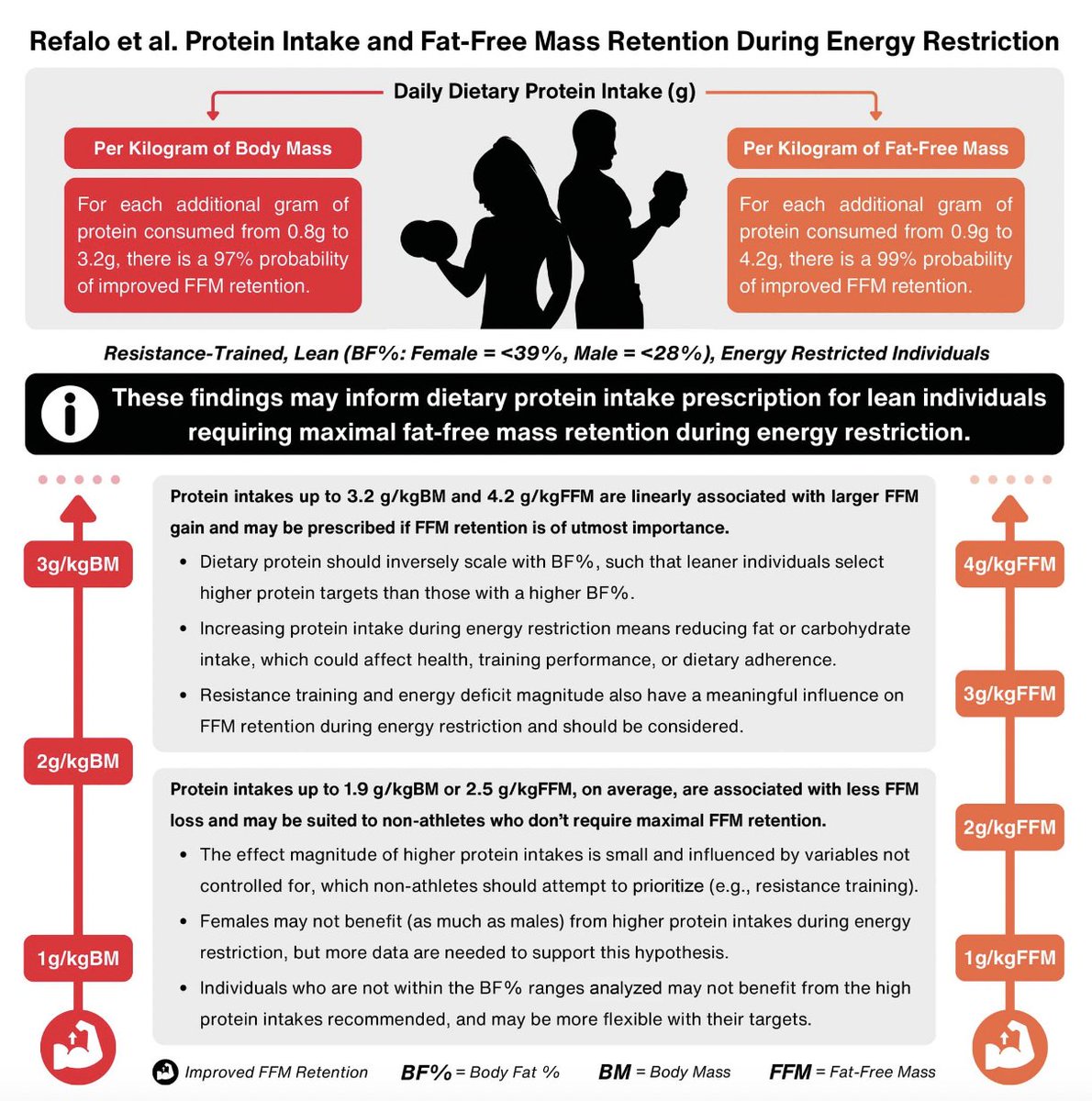
New meta indicates protein requirements may be as high as ~3 g/kg/d to optimize FFM retention during energy restriction. Note that FFM doesn't necessary = muscle mass. Also, protein intake from self-report may not be accurate. Interesting nonetheless...
https://t.co/7qeuLFiYFI