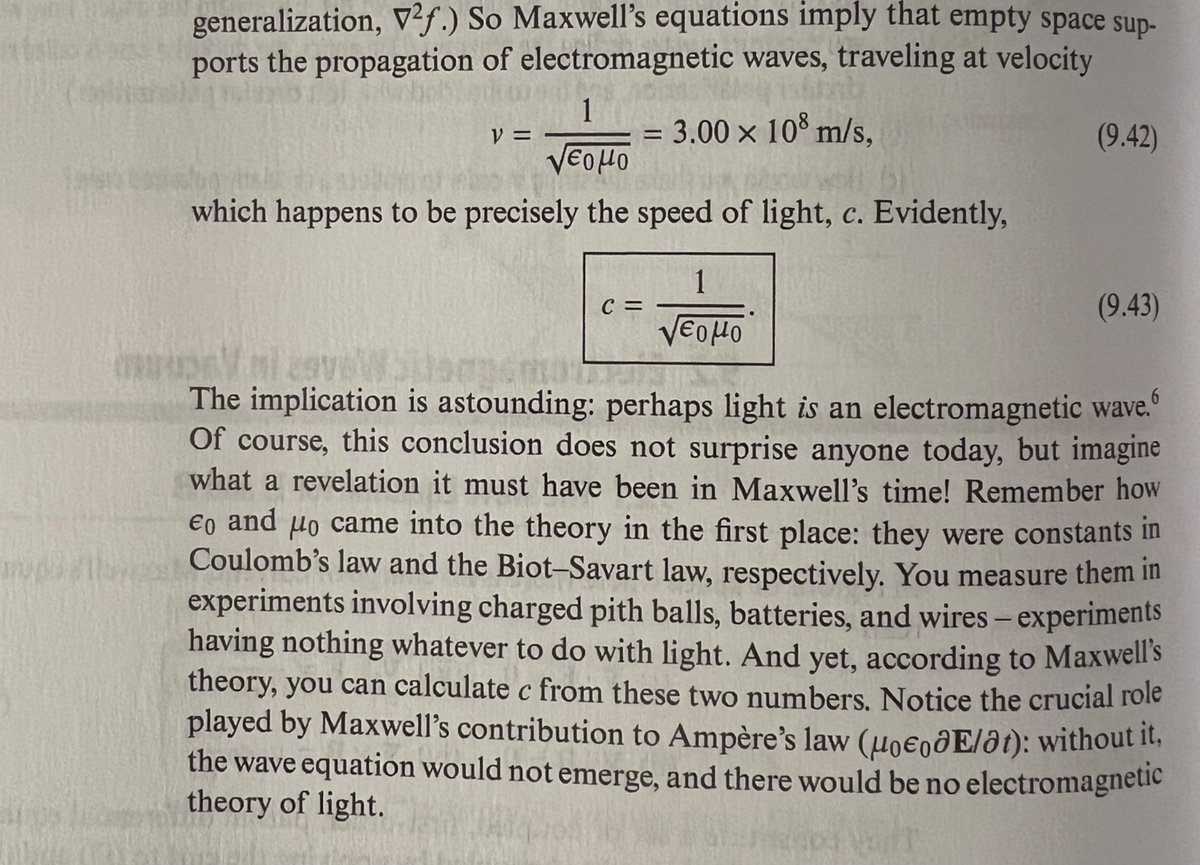
Maxwell's equations have been the most beautiful aspect of electromagnetism. Imagine doing the math and finding out the velocity of electromagnetic waves equals exactly the speed of light!
Studying physics makes me even more optimistic about what humans can discover and achieve
Today, I visited the Åsgård Psychiatric Hospital in Tromso, Norway, to learn about its medication-free inpatient treatment program for patients with severe mental health conditions. Here are my initial impressions. 1/n
We’ve advanced AMIE, our research medical AI system, to support real-time video consultations. Our latest study demonstrates expert-level performance in a randomized, controlled trial with 300 simulated consultations. Read the blog to learn more: https://t.co/mYczy0EWhs
https://t.co/yn2ehIo9Kk
the kind of empathy that stops you from harming someone involves mirroring their states within your own body.
what happens when that ability is broken, within human or artificial intelligence?
https://t.co/hRoueFJkik
The Feeling of What Happens
Ordinary human emotions - grief, sadness, anxiety, trauma, and disorientation - are often reframed as medical pathologies (e.g., "major depressive disorder" or "chemical imbalances").
Framing misery as an internal illness, society shifts the blame onto the individual’s biology or brain chemistry concealing real-world drivers of suffering such as trauma and abuse, poverty, economic insecurity, isolation and alienation.
Systemic social problems are seen as personal medical failures effectively neutralising societal awareness and proactive intervention.
Task Cost = (Tokens per Task) × (Price per Token)
Efficient AI stacks minimize both tokens per task and the electricity required to generate them.
https://t.co/hfmMIjwoNr
Is Real-Time Grid Stability Possible?
If you cannot simulate every microscopic differential equation of a multi-vendor grid in real time you can infer its stability in real time by listening to high-speed sensors.
PoW stream live high-frequency data as in context for an EMT foundation model in inference mode.
@ChrisPalmerMD Confronting a field that’s been stagnant for over 50 years, corrupted by big pharma and causing millions to suffer their entire lives takes a lot of courage - and it needs to be done.
Weather Men
“During a journey through the New England countryside shortly after the storm of 1821, Redfield happened to observe an interesting detail about the ravaged forests and fields across the landscape. It was there for anyone to see, of course, but it was not something that anybody had ever noticed before about the wreckage of such storms. In the apparent chaos was a large-scale pattern in the orientation of the trees blown down on September 3. Near his home in Middletown, Connecticut, the fallen trees were generally facing one direction, toward the northwest, and in western Massachusetts, less than 70 miles distant, the trees were facing the opposite way, toward the southeast. Only someone of an especially astute and open frame of mind was likely ever to see it: in the pattern of debris was an imprint of the shape of the storm. In his mind's eye, a mystery was unfolding, as if some ancient nighttime marauder had finally left behind a set of distinct footprints. What Redfield envisioned was an enormous progressive whirlwind, a violent flow of air rotating counterclockwise around the axis of a center that was traveling from the southwest to the northeast with the prevailing winds.”
Storm Watchers: The Turbulent History of Weather Prediction; John D. Cox
Software Chasing Hardware
In utility-scale solar power plants panels are mounted on trackers - long metal rows that slowly rotate throughout the day to follow the sun. Historically these trackers were rigid straight steel beams.
If a developer wanted to build on a hilly site they had to pay millions of dollars to bulldoze the land flat or construct towering expensive support legs.
To avoid heavy land grading hardware manufacturers developed flexible systems. Instead of one rigid steel beam the tracker acts like a human spine or a train.
Even though the hardware exists design software historically didn't understand how it worked. CAD software treated tracker rows as perfectly straight lines.
Designers had to guess or manually calculate whether a hill was too steep for the physical joints.
Native architectural support now understands the exact mechanical rules and physical limits of these jointed trackers as you draw them on a 3D terrain map.
Today, we take drugs without knowing what they do to us. We solve disease without knowing what it really is.
Never again.
AI helps us understand high dimensional spectral tokens of cell state. We happen to have built a factory to manufacture them.
Until now, the field lacked a way to systematically ask what can a detailed neuron model compute.
These models can't be solved analytically, and with thousands of synaptic weights to tune, manual search is intractable.
How do we overcome these optimization challenges? (3/15)
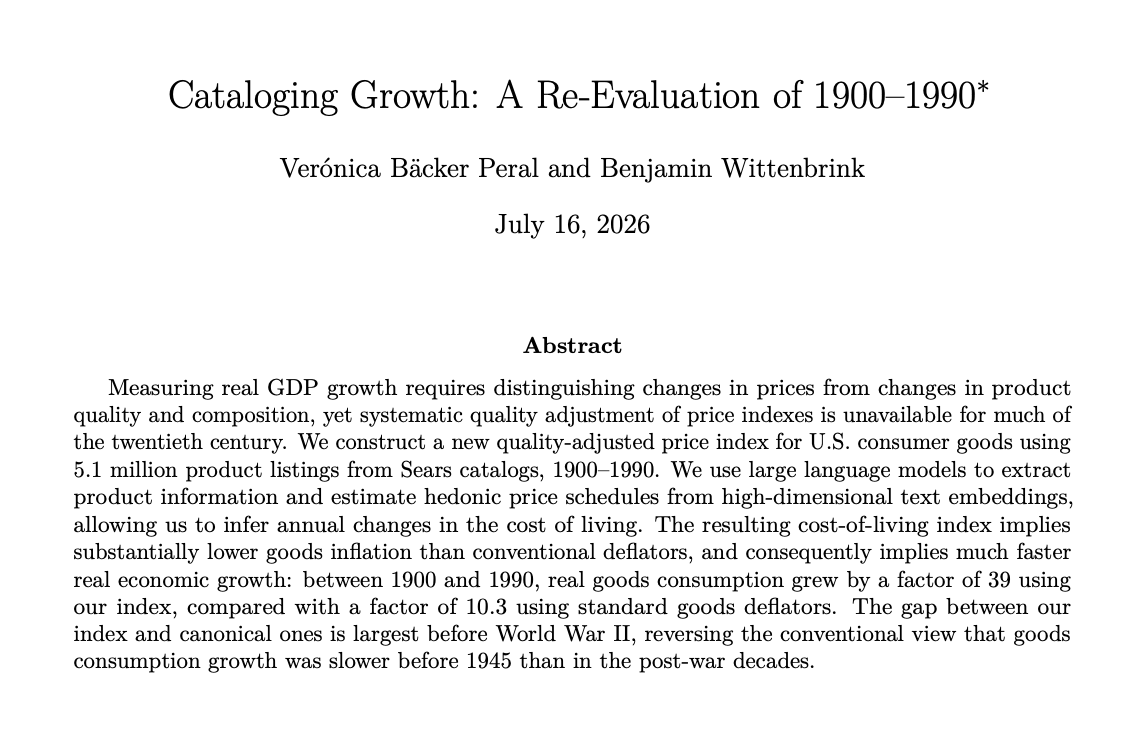
Excited to share our new working paper: how much did the US standard of living really rise over the twentieth century — and when? With @bhwittenbrink
Using 5.1 million Sears catalog listings, we build a quality-adjusted price index for consumer goods, 1900–1990. Two headline findings: growth was much larger than official statistics imply, and its peak came before WWII, not after. (1/9)