When I went to Bangkok couple of months ago, we were at some famous Michelin star restaurant to eat mango sticky rice. We sat down to eat, place was silent, everyone was enjoying the taste. Suddenly one family entered and the lady called someone on facetime and start speaking on top of her voice "hum pohch gaye didi bohot maza aa raha hai" phone audio was on full android volume as well.
Next we had to look down because tourist from other countries started judging all of us, thanks to that sister. Too awkward.
Now I cannot blame her for her behavior, she was harmless, but because of her other people her country, like us, had to feel that awkwardness. And it is not even her fault, because no one ever told her that what it feels like when you talk or dance loudly at place where you shouldn't. Somethings should be taught at airport.
"you can outsource your thinking, but you can’t outsource your understanding"
easy to forget in todays AI era, worth remembering everyday as we all wield more intelligence!
In the 1970s, David Premack wondered if a chimpanzee could be taught to ask a question. He taught Sarah 130 plastic word-tokens. She answered his questions easily. After years of work, she had never asked one of her own. Sixty years later, no signing ape has.
A four-year-old human asks about 25 questions an hour. Paul Harris at Harvard counted them: kids ask their parents around 40,000 questions between ages two and five.
Premack even worked out a method for teaching an ape to ask. Hide a snack the chimp expects. Wait for her to sign "where is it." He never bothered running it on Sarah. She spent her sessions answering his questions, never asking her own. A normal kid, he pointed out, asks "what that? who making noise? when Daddy come home?" on a loop.
Washoe the chimpanzee, the first one taught American Sign Language, knew 250 signs. She could request food. She could sign her name. She once saw a swan and called it "water bird," a sharp invention for an animal she had no sign for. She never asked what the swan was, or where it came from, or anything else.
Koko the gorilla knew about 1,000 signs. Kanzi the bonobo understands more than 3,000 spoken English words. Nim Chimpsky, Herbert Terrace's chimp at Columbia (named to mock the linguist Noam Chomsky), strung 125 signs into more than 20,000 combinations. His longest stretch was "give orange me give eat orange me eat orange give me eat orange give me you." He never asked a thing.
Joseph Jordania, a researcher in Melbourne, thinks this is the line between us and them. To ask a question, you first have to know that the person across from you knows something you don't. Apes do not seem to get to that step, even after a lifetime of being talked at by humans.
Human kids cross that line around their fourth birthday. Apes never do.
There was no award when Newton discovered three laws of forces, nor when da Vinci painted the Mona Lisa.
There was no Grammy for Beethoven or Chopin, nor a Nobel Prize in Literature for Homer.
Masterpieces do not seek transient trophies but aim to be timeless.
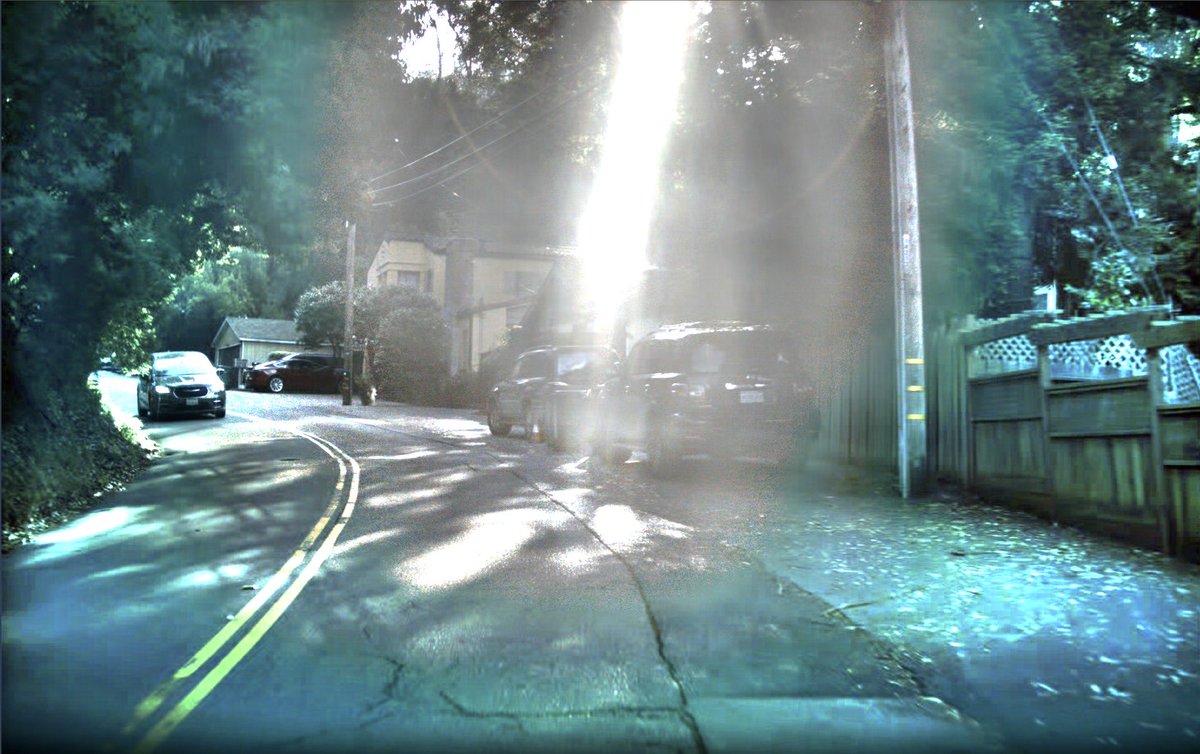
The human-perceived RGB is image 1 and the Tesla AI photon count reconstruction is image 2.
This is why Tesla FSD can see so well at night or through extreme glare.
I borrowed an umbrella from my Airbnb host in Kyoto. I forgot to return it when I checked out, and realized when I was already on the train to Osaka.
I felt terrible. It was a nice umbrella, not a cheap one. I messaged the host apologizing.
She responded: "No problem! Enjoy the umbrella. It's yours now."
I said I'd mail it back. She said "please don't. Postage costs more than an umbrella. Just use it and think of Kyoto when it rains."
I insisted I wanted to return it. She said "okay, but I have a different idea. Next time you see someone who needs an umbrella and doesn't have one, give them this umbrella. Tell them to do the same when they are finished with it. Maybe an umbrella travels all around Japan helping people."
That idea was so beautiful I agreed.
Two weeks later I was in Hiroshima and it started pouring. A woman with a baby was standing under an awning looking stressed. No umbrella, the baby was crying.
I walked over and gave her the umbrella. Told her the story in broken Japanese. She understood enough.
She tried to refuse but I insisted. Told her "when you're done with it, give it to someone else who needs it."
She nodded, said thank you about ten times, and hurried off with her baby.
I got soaked walking back to my hotel but felt good about it.
Sometimes I wonder where that umbrella is now. Hope it's still traveling, still helping people.
Thinking yeh hai kisi bhi field mai . Soch lo samaj lo clear ho jao decision lo aur sab bhool ke aage badho and topi se yaad aaya topi khud pehno kisi ko pehnao nahi na kisi ko pehnane do.