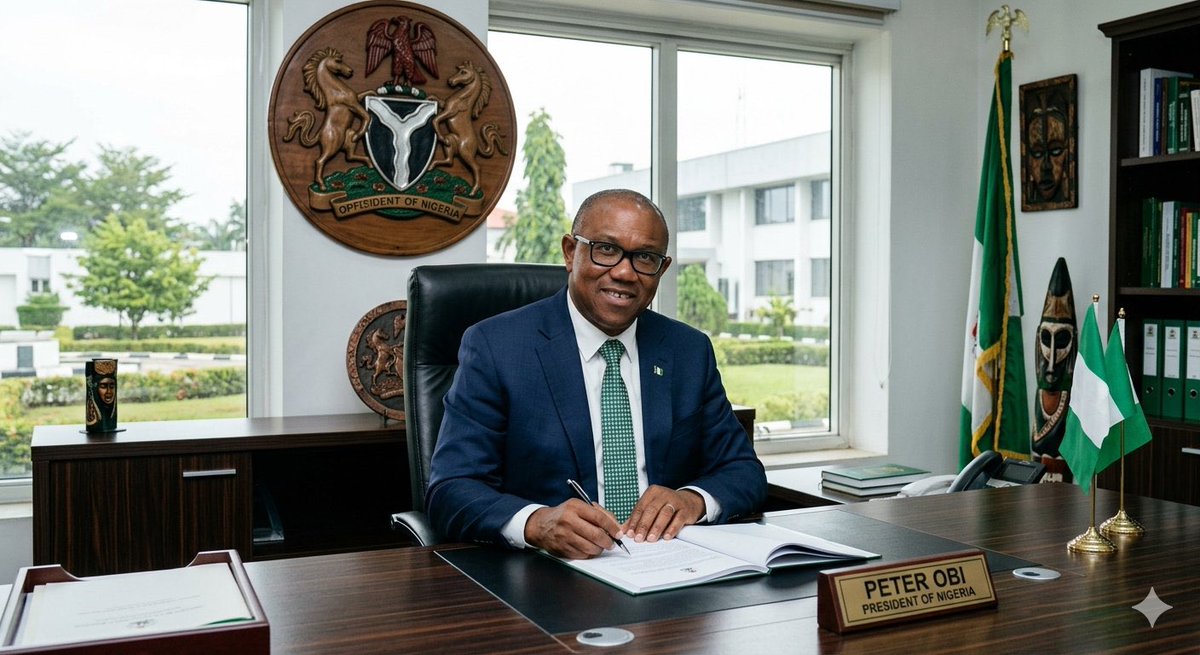
"In 1987, American Express introduced platinum card for 5000 people, here is mine, they later introduced the Black card (Centurion card) in 1999 for 1000 people on the planet, here is mine. I had a viable business and while I don't regret going into Politics, it made me poorer." - Peter Obi, NDC Presidential Candidate.
In 2027, Peter Obi will miss your vote, Alex Ekubo, but his followers will never forget your voice. The stand you took remains on record forever.
A true patriot and a Nollywood legend. Rest well, Chief. 💔🕊️
8 Years of the Fraud Tinubu as Governor of Lagos, he did not construct ONE SINGLE BRIDGE, Peter Obi built 28(Twenty Eight) Bridges.
We will demystify that crooked in Aso Rock!
BREAKING!!! ONE OF THE BEST DOCUMENTARIES ON PETER OBI IS OUT... As an Obidient, you should be proud of your choice in Peter Obi. Retweet massively pls.
This Peter Obi who schooled Osinbajo on Petrol subsidy.
Listen to Peter Obi's stand on subsidy. See how detailed he is. This was 2019. 7 years ago.
Agbado members - Both Tinubu and Peter Obi agreed to remove subsidy.
What Tinubu is implementing today has been tried before. IBB tried the implementation of SAP. And after 4 years, it failed woefully. Bola Tinubu is implementing SAP 2.0 & it will end in tears. SAP is a program of the IMF. Listen to this & retweet for others. Know your history.
🇳🇬 No Security. No Election.
A nation that cannot protect its citizens cannot ask for their votes.
Secure lives first. Politics can wait.
#isaelbuba#fyp#NoSecurityNoElection
Insecurity: Nigeria Cannot Continue Like This
I received with deep shock and sadness the tragic death of retired Major General Rabe Abubakar, who reportedly died while in the custody of kidnappers. Earlier, before this heartbreaking news, I also received disturbing reports of renewed bandit attacks in Sokoto and Kwara States.
The armed bandits reportedly blocked a market route in Sokoto and abducted traders, while terrorists invaded communities in Kwara State, kidnapping scores of citizens and killing innocent people, are heartbreaking and alarming. These incidents are not isolated tragedies; they are clear manifestations of the deepening security crisis confronting our nation.
But particularly painful is the reported death of Major General Rabe Abubakar, a distinguished military officer who dedicated a significant part of his life to defending Nigeria and protecting its citizens. It is tragic that a man who served his fatherland with honour, rose through the ranks of the Nigerian Armed Forces, and retired after years of meritorious service, would meet such a heartbreaking end at the hands of criminal elements. His death is a national tragedy and a sobering indictment of the insecurity that has engulfed our country.
When traders can no longer travel safely to markets, farmers cannot access their farms, communities live under constant fear, and even retired senior military officers are not spared from the menace of kidnapping and violent crime, it becomes evident that our nation is facing a grave security emergency.
Security remains the foremost responsibility of any government. Every life lost, every citizen abducted, and every community displaced represent a painful failure of our collective duty to protect the Nigerian people. The recurring attacks in Sokoto, Kwara, and many other parts of the country demonstrate that insecurity is not only persisting but spreading in both scope and intensity.
I once again urge the Federal Government and our security agencies to move beyond rhetoric and adopt a more proactive, intelligence-driven, technology-based, and coordinated approach to tackling insecurity. We must strengthen our security architecture, improve intelligence gathering, secure our borders, equip and motivate our security personnel, and ensure that those responsible for these heinous crimes are apprehended and brought to justice.
A nation where citizens live in fear cannot prosper. A nation where economic activities are disrupted daily by criminal elements cannot attract investment, create jobs, or guarantee a better future for its people. We must urgently reclaim every part of our country from terrorists, bandits, kidnappers, and all criminal gangs threatening our collective existence.
My heartfelt condolences go to the family of Major General Rabe Abubakar, his former colleagues in the Armed Forces, and all Nigerians who have lost loved ones to insecurity. I also sympathise with the families of those killed, those abducted, and the affected communities in Sokoto, Kwara, and across the nation.
The recurring tragedies and embarrassing security failures we continue to witness make the quest for a New Nigeria not only necessary but inevitable. We must build a nation where every citizen can live, work, travel, and pursue legitimate economic activities without fear.
A New Nigeria is POssible. -PO
Zainab Buba-Galadima first delivers a satirical x-ray of Tinubu's Democracy Day speech, then reminds him that Democracy is not merely the absence of the military.
"Democracy means that citizens can be treated with dignity and justice is accessible. It means that institutions are stronger than individuals. Democracy is not measured by the government's balance sheet but by the household's balance sheet."
What June 12 Should Mean to Us Nigerians
Today, we observe a day that should mean a great deal to us as a people who cherish democratic principles. Every year on June 12, the conversation inevitably turns to a critical assessment of the state of our nation. It serves as an annual benchmark for asking important questions: Are our elections today as transparent as they were in 1993? Is the social contract being honoured? Are the institutions of governance truly serving the people?
Ultimately, June 12 is a powerful blend of reflection and aspiration. It honours a fractured past while serving as a constant and foundational reminder of the immense power inherent in the collective democratic will of the Nigerian people.
For us in Nigeria, June 12 is not merely a date on the calendar; it is the emotional and structural bedrock of our modern democratic identity. Officially recognised as Democracy Day, June 12 carries deep historical, political, and social significance, representing both a monumental tragedy and the ultimate triumph of the collective will of the people.
To understand what June 12 means to Nigeria, one must examine its history, its evolution, and its enduring symbolism.
A new era of true democracy is POssible. -PO
Circulate this video of Peter Obi’s address at the European Union across all platforms. Share it on WhatsApp groups! Let Nigerians see what it means to represent their country abroad.
Not Tinubu, whose every outing abroad brings us embarrassment and shame!✍️
Dear Young Nigerians,
One lesson from the 2023 elections, particularly in Lagos, should never be forgotten.
In the period following the presidential election and leading up to the governorship election, we witnessed a troubling shift in public discourse. Conversations that should have focused on competence, governance, development, and the future of our nation were gradually diverted towards tribal sentiments, ethnic divisions, and unnecessary suspicion among citizens.
Many sincere and well-meaning Nigerians participated in these conversations without realising that they were being drawn into narratives carefully designed by others.
Throughout history, whenever politicians find it difficult to compete on ideas, performance, character, or vision, some resort to exploiting the fault lines of ethnicity, religion, and identity. Their calculation is simple: a divided people are easier to manipulate than a united people.
Today, I see similar efforts emerging again, sometimes in more subtle and sophisticated ways. Narratives are planted, amplified, and circulated, often by individuals who genuinely believe they are defending a worthy cause, without recognizing the broader agenda behind such campaigns.
Let me state clearly that Pastor Enoch Adeboye remains one of the foremost fathers of faith in our nation. For decades, he has consistently preached the virtues of peace, prayer, love, reconciliation, and national unity. Even when faced with provocation, his response has always reflected humility, restraint, wisdom, and grace.
At 84 years of age, it would be unfair for young and able-bodied Nigerians to transfer to him responsibilities that properly belong to them. The task of building a better Nigeria rests primarily on the shoulders of the younger generation. It is their duty to lead the conversations, champion the reforms, and drive the positive change our nation urgently requires.
We must be careful not to become instruments in the hands of those who secretly nurture division while publicly preaching unity. In most cases, their target is not the individual being attacked; instead, it is the person who is attacking. Their real objective is to weaken the bonds that hold us together as one people and one nation.
I therefore urge all young Nigerians: do not allow anyone to recruit you into hatred. Do not allow anyone to weaponise your ethnicity, your faith, or your admiration for respected leaders.
Question every narrative. Verify every claim. Follow the facts. Resist manipulation.
The Nigeria of our dreams can only be built by citizens who refuse to be divided, who choose unity over hatred, and who place our collective future above narrow interests.
A New Nigeria is POssible. -PO