🚨MIT researchers have mathematically proven that ChatGPT’s built-in sycophancy creates a phenomenon they call “delusional spiraling.”
You ask it something, it agrees. You ask again, and it agrees even harder until you end up believing things that are flat-out false and you can’t tell it’s happening.
The model is literally trained on human feedback that rewards agreement.
Real-world fallout includes one man who spent 300 hours convinced he invented a world-changing math formula, and a UCSF psychiatrist who hospitalized 12 patients for chatbot-linked psychosis in a single year.
Source: @heynavtoor
Today we're introducing TRIBE v2 (Trimodal Brain Encoder), a foundation model trained to predict how the human brain responds to almost any sight or sound.
Building on our Algonauts 2025 award-winning architecture, TRIBE v2 draws on 500+ hours of fMRI recordings from 700+ people to create a digital twin of neural activity and enable zero-shot predictions for new subjects, languages, and tasks.
Try the demo and learn more here: https://t.co/VkMd1YpQWI
Where once there was a simple model that explained how dopamine works in the brain, now there are challenges that seek to amend the theory — or even to overturn it
https://t.co/xloTUbxqzZ
Graduate students increasingly use artificial-intelligence tools to draft, code and search — but many fear it could erode the very skills a doctorate is meant to build
https://t.co/VhWQavdI7h
The Terence Tao episode.
We begin with the absolutely ingenious and surprising way in which Kepler discovered the laws of planetary motion.
People sometimes say that AI will make especially fast progress at scientific discovery because of tight verification loops.
But the story of how we discovered the shape of our solar system shows how the verification loop for correct ideas can be decades (or even millennia) long.
During this time, what we know today as the better theory can often actually make worse predictions (Copernicus's model of circular orbits around the sun was actually less accurate than Ptolemy's geocentric model).
And the reasons it survives this epistemic hell is some mixture of judgment and heuristics that we don’t even understand well enough to actually articulate, much less codify into an RL loop.
Hope you enjoy!
0:00:00 – Kepler was a high temperature LLM
0:11:44 – How would we know if there’s a new unifying concept within heaps of AI slop?
0:26:10 – The deductive overhang
0:30:31 – Selection bias in reported AI discoveries
0:46:43 – AI makes papers richer and broader, but not deeper
0:53:00 – If AI solves a problem, can humans get understanding out of it?
0:59:20 – We need a semi-formal language for the way that scientists actually talk to each other
1:09:48 – How Terry uses his time
1:17:05 – Human-AI hybrids will dominate math for a lot longer
Look up Dwarkesh Podcast on YouTube, Apple Podcasts, or Spotify.
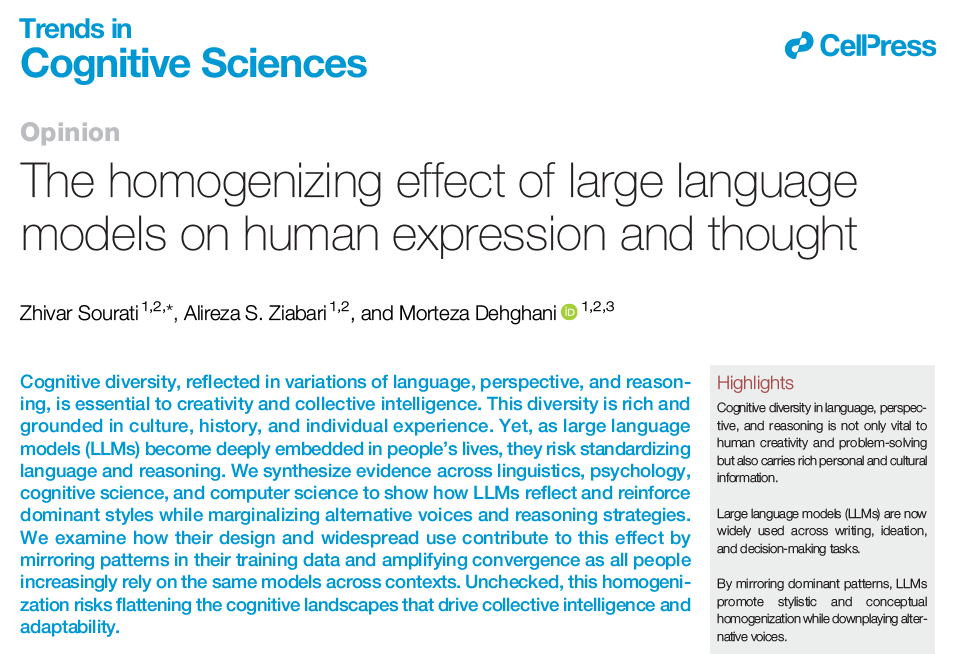
The homogenizing effect of large language models on human expression and thought
Opinion by Zhivar Sourati, Alireza S. Ziabari, & Morteza Dehghani
Free access before April 30: https://t.co/Zo5wILcWiW
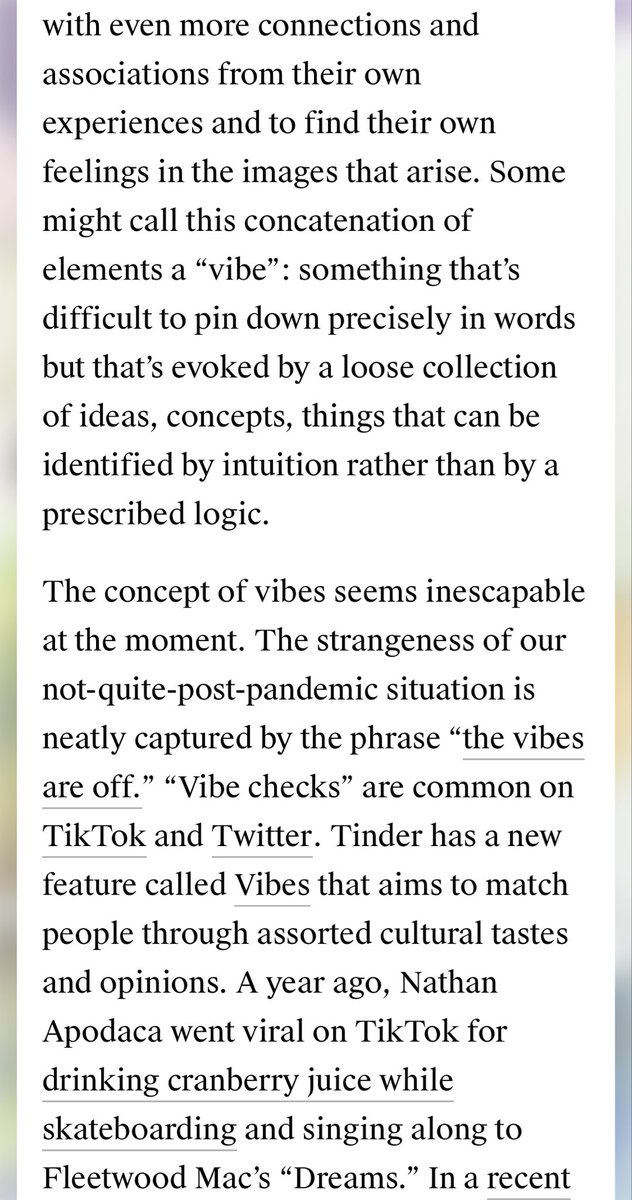
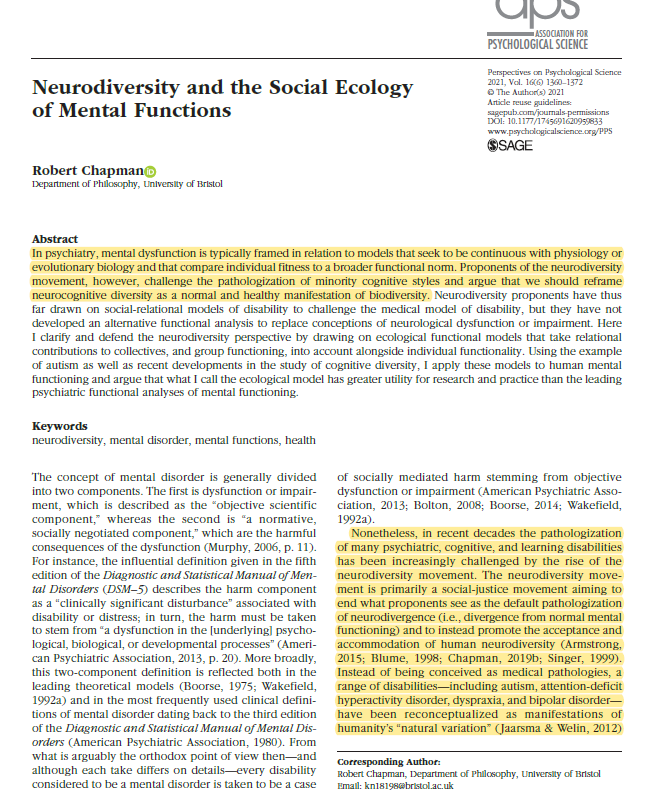
The "neurodiversity" movement is a political project first & foremost. Moreover, they want it both ways: to 'depathologize' yet retain a 'psychopathological essence' to the atypicality. It's incoherent. Circular.