Finally Submitted my project for the @lingodotdev Hackathon. 💯
PaperSwarm end to end. Let's wait for the results😁.
Special mention to @sumitsaurabh927 for awesome management of this hackathon.
Other things that shipped:
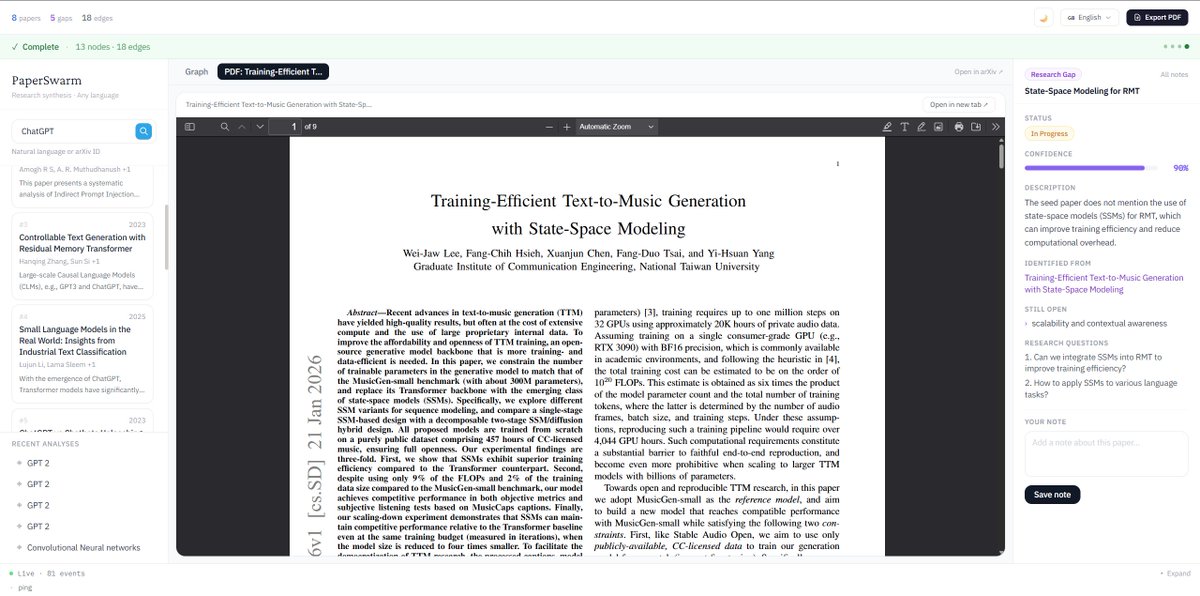
→ Graphs auto-save to library when switching papers → Gap tiles show which paper each gap came from
Huge thanks to @lingodotdev — saved us from some truly cursed translations of "attention head"
Day 5 & 6 of building PaperSwarm in public 🧵
(I think I slept 8 hours in 48 — two hackathons running simultaneously, one interesting and one for the boss)
Here's what shipped anyway 👇
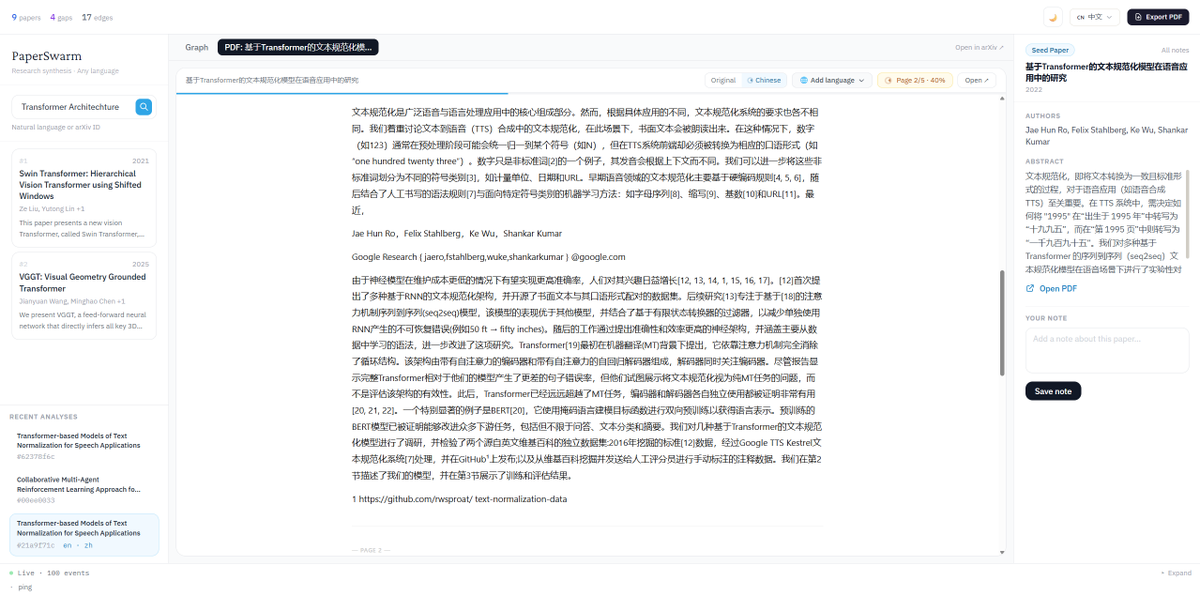
Click "View PDF" → we parse the arXiv paper. Every arXiv paper is 2-column.
We built a column detector
Left column first, full-width headers at their exact position, right column after. Matches how humans actually read papers.
Hardest problem so far: gap deduplication.
Day 5 tomorrow: PDF export, citation lineage, full UI translation.
Following along? Drop a research topic 👇
Do checkout https://t.co/9lNFMfmEZQ
Day 4 of building PaperSwarm in public 🧵
A multi-agent research synthesis tool that reads papers, finds gaps, and translates everything to your language.
Today the dashboard came alive. Here's what shipped 👇
Natural language search now works end-to-end.
Type in any language → system detects it → LLM generates 5 targeted queries → Semantic Scholar → results in your language → click a paper → graph builds.
No arXiv ID needed. Powered by @lingodotdev
@mshenshz We solve this with an LLM dedup pass in the reconciler before the graph is built. But the real trick is doing it after collecting all parallel results, not during so you have the full picture before you collapse anything.
Day 3 of building for @lingodotdev 🔨
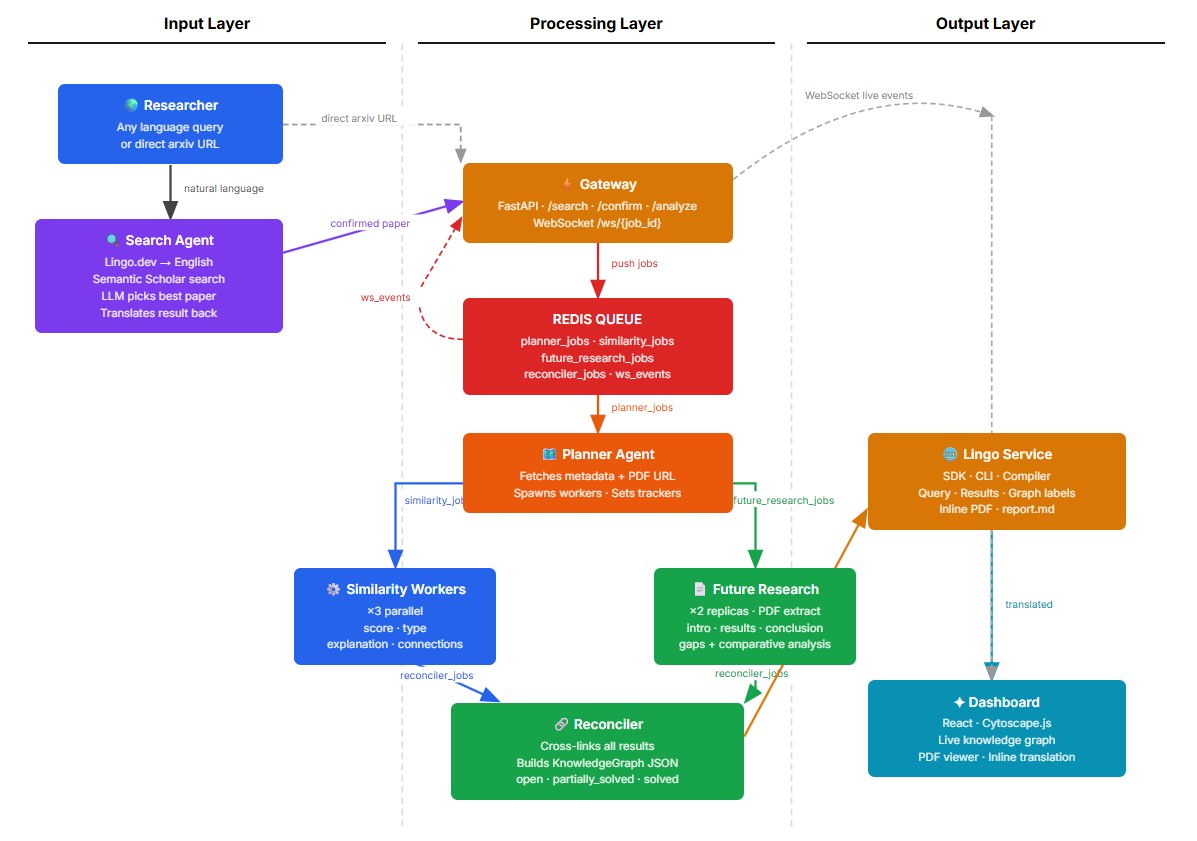
Architecture drop.
PaperSwarm is built as a swarm of specialized agents — each doing one job, independently.
No giant monolith.
No single LLM prompt.
Just small workers collaborating through queues.
Here’s the system design 👇
@mshenshz A naive system gives you 40 redundant gaps. A good system merges them into 5 meaningful ones and knows which papers are solving each, which are making progress, and which haven't touched it at all.
@mshenshz When you analyze 8 papers simultaneously, every agent independently finds gaps in the research. But "limited scalability of attention mechanisms", "quadratic complexity of self-attention", and "computational cost at inference" are all the same problem described differently.
The goal isn't summarizing papers.
It's mapping the research landscape around a paper:
• Similar work
• Method differences
• Unsolved problems
• Future research directions
More updates tomorrow 👀
#buildinpublic#hackathon