An LLM-generated paper is in the top 17% of ICLR submissions in terms of average reviewer score, having received two 8's. The paper has tons of BS jargon and hallucinated references. Fortunately, one reviewer actually looked at the paper and gave it a zero. 1/3
I am an AC for ICLR 2026. One of the papers in my batch was just withdrawn. The authors wrote a brief response, explaining why the reviewers failed at their job. I agree with most of their comments. The authors gave up. They are fed up. Just like many of us. I understand. We pretend the emperor has clothes, but he is naked.
Here is the final part of their withdrawal notice. I took the liberty to make it public, to highlight that what we are doing with AI conference reviews these last few years is, basically, madness.
---
Comment: We thank the reviewers for their time.
However, upon reading the reviews for our paper, it became immediately apparent that the four "reject" ratings are not based on good-faith academic disagreement, but on a critical failure to read the submitted paper.
The reviews are rife with demonstrably false claims that are directly contradicted by the text. The core justifications for rejection rely on asserting that key components are "missing" when they are explicitly detailed in the manuscript. Some specific examples are (and many are even fake claims).
Claim: Harder tasks like GSM8K are missing.
Fact: GSM8K results are in many tables, like Table 2 (Section 4.2) and Appendix G.
Claim: The method does not use per-layer ranks.
Fact: This is the entire point of our method. The reviewer clearly mistook our method for the baselines. (Section 2, Table 1).
Claim: The GP kernel is not specified.
Fact: It is specified in Appendix E (Table 6).
Claim: There is no ablation of the method's three stages.
Fact: Section 4.4 ("Ablation Study") and Appendix J are dedicated to this.
Reviewers have a fundamental responsibility to read and evaluate the work they are assigned. The nature of these errors is so fundamental, so systemic in overlooking explicit content, that it goes far beyond what "limited time" or "oversight" can explain. This work has gone through several rounds of revision over the last year. In earlier submissions, the paper usually received borderline or weak-accept scores.
Numerous signs strongly suggest that some reviewers are relying entirely on AI tools to automatically generate peer reviews, rather than fulfilling their fundamental responsibility of personally reading and evaluating manuscripts.
We strongly protest this.
This is a gross disrespect to the authors. It is a flagrant desecration of the reviewer's sacred duty. It fundamentally undermines the integrity of the entire peer-review process.
Given that the reviews are not based on the actual content of our paper, we have decided to withdraw the submission.
We leave this comment so that future readers of the OpenReview page are aware that the items described as "missing" are already present in the submitted manuscript. These negative reviews for this submission are factually unsound and do not reflect the content of the paper. We cannot and will not accept an assessment that is not based on the work we actually submitted.
🏏 25 days. 5 battles. Scores tied 2-2.
This isn’t just a game — it’s Test Cricket in all its timeless glory.
A series for the ages. Hats off to IND & ENG for the drama, grit, and greatness.
📢After a long painful wait, excited to share I’ve been awarded NSF CRII on understanding the dynamics of conversations with AI companion apps. Feeling encouraged the panel rated my proposal highly competitive! So grateful given how rough funding has been lately🎉#NSF#AI
Introducing soarXiv ✈️, the most beautiful way to explore human knowledge
Take any paper's URL and replace arxiv with soarxiv (show in video) to teleport to its place in the universe
I've embedded all 2.8M papers up until April 2025
Try it at: soarxiv dot org
NSF budgets slashed by 50%, ongoing grants cancelled, NSF staff drastically reduced, all 37 divisions abolished, and grants will now be reviewed by a political kommissar.
How will that help technological leadership?
https://t.co/f9b4yOXdZk
Do swing by our #ICLR2025 poster on jointly solving forward & inverse problems in geophysics! 🌍
Presented by @AnujKarpatne!
🗓️ Sat, Apr 26 | 10:00–12:30 +08
📍 Poster #195 | Hall 3 + Hall 2B
🔗https://t.co/cWOUgN6k1p
I won’t be there😞, but glad to chat anytime!!
#AI4Science
I understand the shortage of reviewers, but this strict requirement of *all authors must review* and *anyone missing deadline results in all their papers desk rejected* is absurd. @ICCVConference
It's not respecting authors being humans in lives full of accidents and afflictions
Meet the recipients of the 2024 ACM A.M. Turing Award, Andrew G. Barto and Richard S. Sutton! They are recognized for developing the conceptual and algorithmic foundations of reinforcement learning. Please join us in congratulating the two recipients! https://t.co/GrDfgzW1fL
🌟Thrilled to share our paper, “A Unified Framework for Forward and Inverse Problems in Subsurface Imaging using Latent Space Translations”, has been accepted at #ICLR2025 ! 🎉
Grateful to my co-authors, Naveen Gupta, @arkadaw_ , @YouzuoLin1 and @anujkarpatne, for their support.
We are continuing to accept paper submissions (deadline: Jan. 20th AoE) for the AAAI-25 Bridge Program on Knowledge-Guided Machine Learning (KGML) to be held on Feb. 25 - 26 in Philadelphia, PA. EasyChair Submission Link: https://t.co/evQKBJdKFz . (1/4)
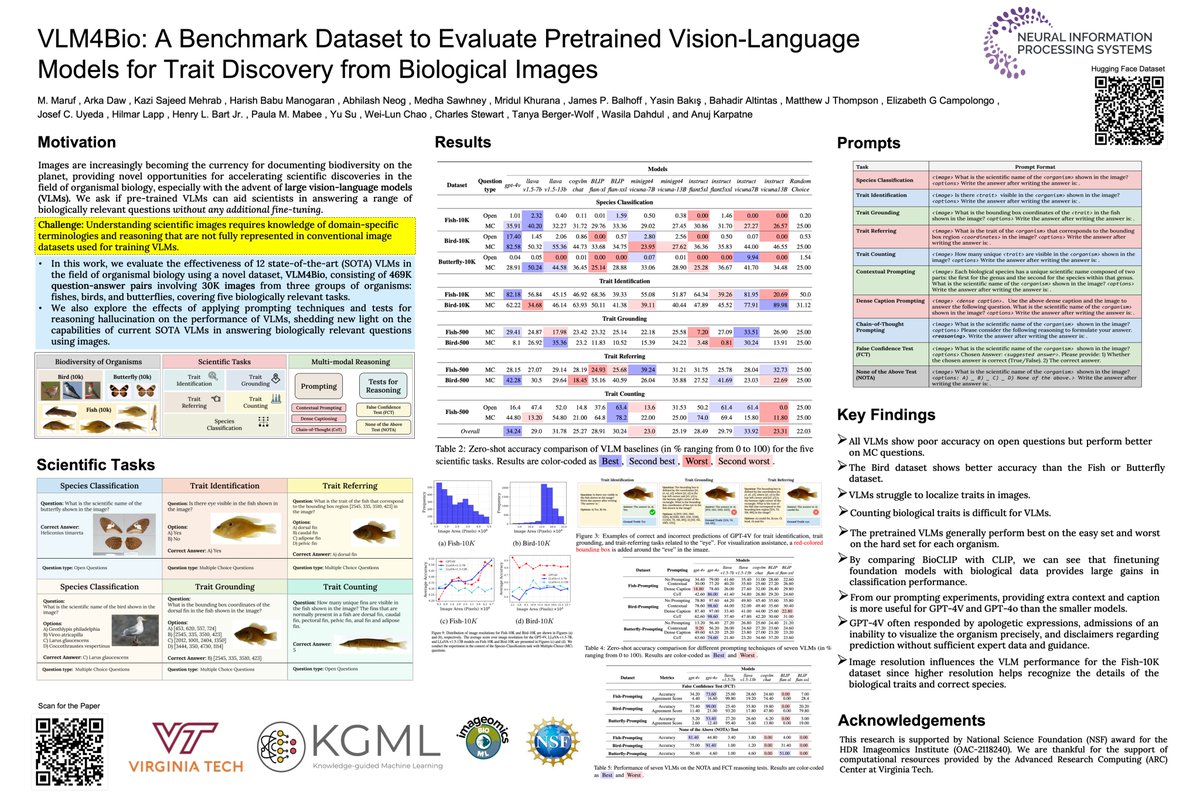
✨ We are presenting VLM4Bio at #NeurIPS2024 today.✨
Project Page: https://t.co/7GnvMH8pgR
Paper: https://t.co/jYZhTtf8Kd
Come chat with us! Poster # 97668
📍West Ballroom A-D #5201
🗓️ Thu 12 Dec 4.30 PM
✨ We are presenting VLM4Bio at #NeurIPS2024 today.✨
Project Page: https://t.co/7GnvMH8pgR
Paper: https://t.co/jYZhTtf8Kd
Come chat with us! Poster # 97668
📍West Ballroom A-D #5201
🗓️ Thu 12 Dec 4.30 PM