Freelance Professional Project Management Services and Security - Clarity, Control, and Confidence in Complex Operations
#projectmanagement#security#freelance
What critical decisions must the team make in minutes during an incident and who actually has authority?
Clear that first, then identifying the best PSIM for your operation becomes more easy.
Overview of how I help: https://t.co/c2G9JNPBqG
What's one decision-making gap you've seen kill a control room project?
#ProjectManagement #Security #ControlRoom
Define closeout and record.
Every procedure must end with: Time of closeout
Final decision taken
Handover details (who, what, when)
This creates the audit trail and allows the next shift to start with full context. Full guide with practical examples here:
https://t.co/qd8uoenVNi (6/6)
#IncidentResponse #SOP #IncidentResponseProcedure
Define escalation criteria plus a timer.
Criteria without a time limit turns into debate.
Example: “If no containment achieved within 3 minutes → escalate to duty lead.”
A hard timer removes hesitation and forces decisive action when it matters. (5/6)
#IncidentResponse#SOP #IncidentResponseProcedure
Define verification evidence.
Before anyone escalates, what must actually be seen or measured?
List it clearly: “Visual confirmation of smoke” or “Temperature reading above X°C” or “Two independent alarms triggered.”
Clear evidence stops emotional escalation and keeps decisions fact-based. (4/6)
#IncidentResponse #SOP #IncidentResponseProcedure
Define the first 60 seconds with four simple actions:
Confirm → Classify → Contain → Communicate.
Every operator must know exactly what to do in that window. No thinking, no debating. When the first 60 seconds are crystal clear, the entire response stays calm and on track. (3/6)
#IncidentResponse #SOP #IncidentResponseProcedure
Define the trigger in one clear sentence.
No vague labels like “abnormal condition.”
Use observable facts only.
Example: “Fire alarm activates on panel 3 + smoke detector in zone B reports activation.”
Specific triggers remove all guesswork in the first critical seconds. (2/6)
#IncidentResponse #SOP #IncidentResponseProcedure
Thursday reality check for control room teams:
Most response procedures fail for one simple reason. They are not written for real operator behavior under pressure.
Here is a simple, practical structure that actually works when it matters most. (1/6)
#IncidentResponse#SOP #IncidentResponseProcedure
A clean 5-element template for any response procedure:
- Trigger
- Operator action in the first 60 seconds
- Evidence to verify
- Escalation criteria
- Closeout record
Try to fit important elements that must be acted upon on the first single page.
Want a real example? Just reply “Procedure” and follow.
#SOP #ControlRoom #IncidentResponseProcedure
Starting the week with a timely reminder after recent incidents:
The same gap keeps showing up: unclear decision rights between security, facilities management, and others.
When an alert crosses domains, who takes final ownership?
- Security,
- FM, or
- A dedicated duty lead?
Time to define clear roles for smoother control room operations.
What’s your experience? Share below! #SecurityGovernance #ControlRoom
Sharing this again because it is still one of the highest-impact changes I see in control rooms.
A ConOps is not about tools first.
It starts with roles, authority, escalation, and comms. Technology simply supports it.
If you want one improvement this month, define authority clearly by role.
What is the one thing you are focusing on in your control room right now?
#ControlRoom
6/6 Validation
Run one short tabletop exercise per month.
Log the actual decisions and timestamps.
You will quickly see where your ConOps works and where it needs fixing.
Full C4I framework here: https://t.co/xOP5tEYvG4
Which of the 5 points is most valuable or challenging for you? Reply below.
#ConOps #ControlRoom
5/6 Communications
One dedicated internal channel per incident.
And enforce a maximum two-sentence SITREP on every update.
Short, fast, and consistent updates save minutes when it matters most.
4/6 Escalation
Create objective trigger-plus-timer rules, not opinions.
Example: “If X happens, escalate within Y minutes to Z role.”
Keep it role-based, written down, and practised.
3/6 Authority
List your top 10 critical decisions.
Then assign one clear role owner to each decision.
No shared ownership. One name per decision.
This single step removes hesitation when seconds count.
2/6 Operating modes
Clearly define routine, degraded, and incident mode.
And most importantly: decide exactly who is authorised to switch between them.
Without this clarity, even the best team hesitates when the situation changes.
ConOps is not a document for the shelf.
It is how your control room makes decisions when minutes matter.
Here is a simple 5-point ConOps check you can run today.
1/6
Reply with the one point you find most valuable (or most challenging) in your setup.
#ConOps#ControlRoom
Practical tip for your control room: build an authority map.
For every key decision, define clearly: the role that owns it, the time limit, and the exact evidence required.
If any decision has no owner, operators will hesitate when seconds count.
What decision causes the most delay in your setup today: escalation, dispatch, or shutdown?
Reply with your answer.
#IncidentResponse #ControlRoom
Sunday check: Can your team describe normal operations in one page for CCTV, access, alarms, and fire?
If you cannot define normal, you cannot detect abnormal.
Does your site have a written normal definition? Yes or no?
#SecurityOperations#ControlRoom
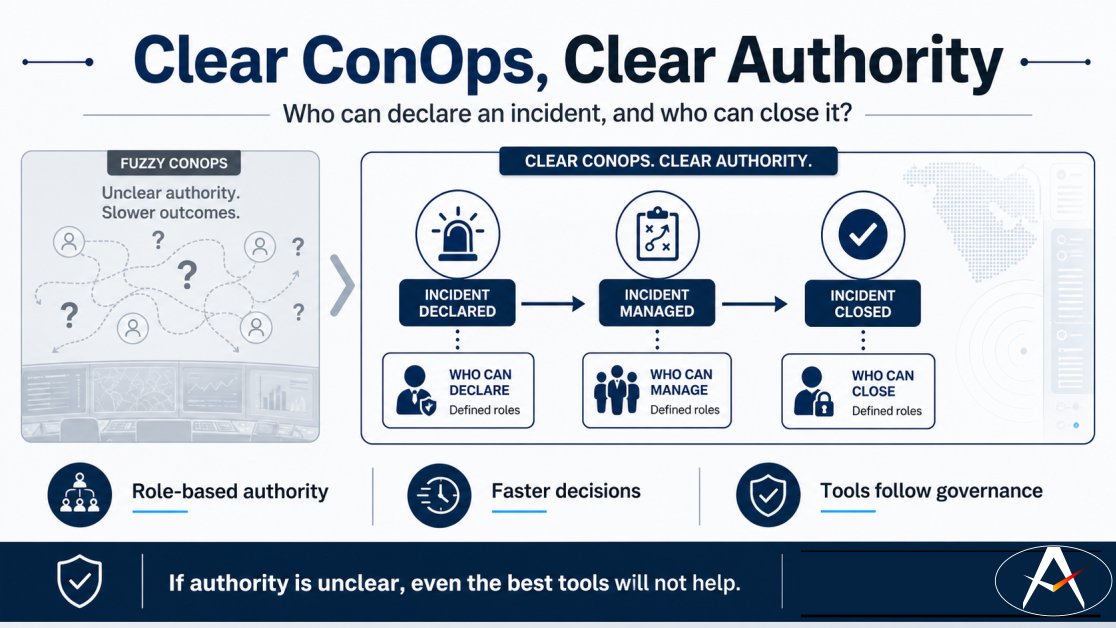
New control rooms fail when the ConOps is fuzzy.
One question stands out:
Who can declare an incident, and who can close it?
If that is unclear, even the best tools will not help.
What role holds that authority in your setup?
Reply with the role name.
#ControlRoom#ConOp
If your organization is building a new control room or reviewing response procedures and SOPs, start here: define decisions, define authority, define escalation timers. Tools follow.
What are you working on right now, new build or review? Share in the replies.
https://t.co/c2G9JNPBqG
#ControlRoom #SecurityOperations
🚨 SOPs that actually get followed fit on ONE PAGE.
Trigger → First 30 seconds → Evidence required → Escalation criteria → Closeout & record.
If it doesn’t fit on a single page… it’s not operational.
Real-world example that works:
https://t.co/t3xWXDr1k3
What’s the longest SOP you’ve seen that people actually use?
Drop it below 📷
#SOP #ControlRoom #SecurityOperations