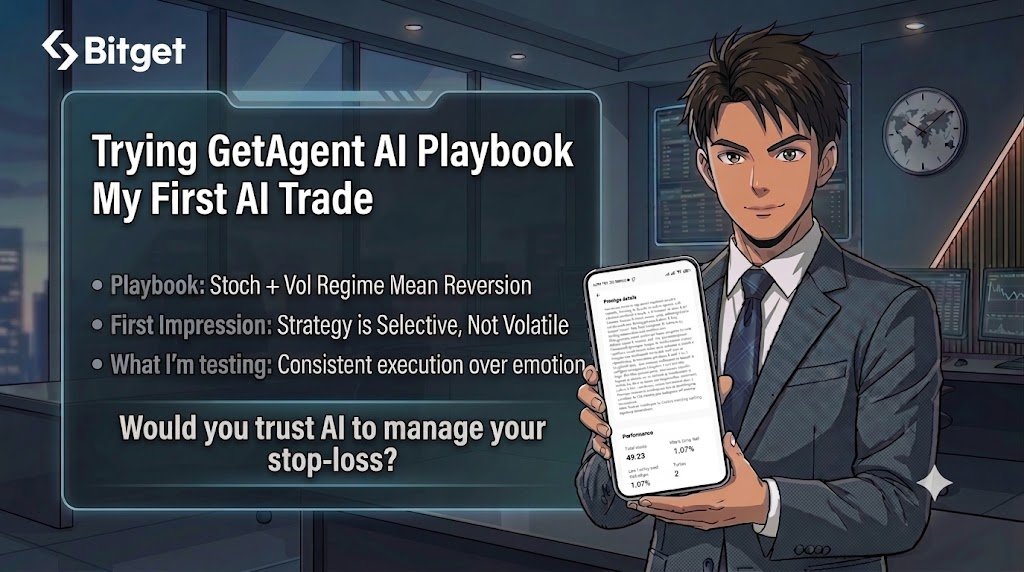
Yesterday I started testing GetAgent AI Playbook with the Stoch + Vol Regime Mean Reversion strategy.
I was curious to see how quickly the strategy would find its first setup. So far, it's still waiting.
After looking deeper into the strategy, I realized it's designed to be selective. It waits for specific volatility and reversal conditions before entering a position, and until then, it stays on the sidelines.
What I find interesting is that the waiting itself is part of the strategy.
In normal trading, there's often a temptation to keep searching for opportunities just because the market is moving. Here, the Playbook seems perfectly comfortable sitting on the sidelines until its conditions are met.
My goal with this test was never to see instant results. I'm more interested in seeing how AI behaves in live market conditions and whether it can stick to its process when there isn't an obvious opportunity.
So for now, I'm just watching and learning how the strategy reacts to different market environments.
Now I'm curious to see what happens when market volatility finally reaches the conditions this Playbook is looking for.
If you could test one AI trading strategy for a week, which would you choose?
Trend, Reversal, Momentum, or Mean Reversion?
AI is slowly making its way into every part of trading, so there was always one question on mind:
How good AI is when real money and real trade execution are involved?
Since @bitget recently launched GetAgent AI Playbook, I decided to give it a trial and see what the experience is actually like.
For my first test, I picked the playbook named: Stoch + Vol Regime Mean Reversion.
I actually liked the strategy that it is not trying to catch every move in the market. From what I understood, it waits for specific conditions and looks for reversal opportunities rather than constantly jumping into trades.
My first impression was pretty positive. The interface was easy to navigate, and I could quickly check things like historical performance, drawdown, win rate, and the logic behind the strategy before subscribing.
As for expectations, I'm not looking for some magical money printer. I'm more interested in seeing whether AI can consistently follow a trading plan without the hesitation, overthinking, or second-guessing that often comes with manual trading.
It's only Day 1, but the concept is interesting enough that I want to keep following the results and see how it performs over time.
Would you trust AI to manage your entries, take-profits, and stoplosses?
Today is one of those days where several major narratives are colliding at once.
First, Oracle ($ORCL) reports earnings after the bell. Expectations are fairly high, especially after OCI cloud infrastructure revenue grew 84% YoY.
Then there's SpaceX. IPO reportedly coming in at a $1.8T valuation, it has the potential to become one of the biggest market stories of the year. Even traders who aren't interested in the IPO directly will probably be paying attention to how capital flows around it.
The third theme is AI memory.
Demand for HBM chips continues to rise as data center buildouts accelerate, while supply remains tight. That's one reason I'm keeping an eye on names like $rMU and $rSTX.
Interesting part is that all three catalysts tie back to the same theme: the continued buildout of AI infrastructure.
As the CPI and PPI data also coming up, volatility could pick up quickly.
That's one reason I like using @bitget Stock 2.0 for these events. The 24/5 trading hours make it easier to position before the market opens, and the platform currently offers free rNVDA for stock buyers, 0.04% fees, and access to real stock liquidity.
Which catalyst are you watching most: Oracle earnings, SpaceX, or the AI memory trade?
#BitgetStocksUpgrade
Today is one of those days where several major narratives are colliding at once.
First, Oracle ($ORCL) reports earnings after the bell. Expectations are fairly high, especially after OCI cloud infrastructure revenue grew 84% YoY.
Then there's SpaceX. IPO reportedly coming in at a $1.8T valuation, it has the potential to become one of the biggest market stories of the year. Even traders who aren't interested in the IPO directly will probably be paying attention to how capital flows around it.
The third theme is AI memory.
Demand for HBM chips continues to rise as data center buildouts accelerate, while supply remains tight. That's one reason I'm keeping an eye on names like $rMU and $rSTX.
Interesting part is that all three catalysts tie back to the same theme: the continued buildout of AI infrastructure.
As the CPI and PPI data also coming up, volatility could pick up quickly.
That's one reason I like using @bitget Stock 2.0 for these events. The 24/5 trading hours make it easier to position before the market opens, and the platform currently offers free rNVDA for stock buyers, 0.04% fees, and access to real stock liquidity.
Which catalyst are you watching most: Oracle earnings, SpaceX, or the AI memory trade?
#BitgetStocksUpgrade
Reached 3K followers today! 🎉
Big thanks to everyone who decided to stick around and read my random thoughts, market takes, and occasional wins and losses.
Appreciate every like, reply, and conversation. Thankful to all of you.