It’s not just World Cups ⚽️ that Spain 🇪🇸 excels at!
In the High North ❄️, our Spanish Allies are demonstrating their versatile capabilities as part of #NeptuneStrike 🔱.
#WeAreNATO 🛡️
#StrongerTogether 💪
#ArcticSentry ❄️
I asked pro-Palestine Hollywood star Javier Bardem about the recent reporting and speculation that pro-Israel Paramount studios boss David Ellison has put him on a 'blacklist'.
Watch his response below.
Full interview: https://t.co/tdIq8nwP0Z
Éxito en el lanzamiento de los dos satélites Galileo en su primer vuelo a bordo del Ariane 6: "Cubrimos todo lo que necesitamos en Europa y somos totalmente autónomos y soberanos" https://t.co/rO6NwOAduz
iSTARMOD: A Python Code to Quantify Chromospheric Activity by Using the Spectral Subtraction Technique https://t.co/F28FBP4ELP a través de @AAS_Publishing
El artículo de don Xabier Fortes publicado hoy en El País plantea un serio problema ético. Un periodista de RTVE tiene el deber de preservar la neutralidad y abstenerse de realizar pronunciamientos tan partidistas. Al expresar opiniones políticas desde un medio privado, se confunden los límites entre su función institucional y su criterio personal. Su tono de enfrentamiento a la oposición perjudica la credibilidad de RTVE, refuerza la percepción de sesgo y debilita la confianza en la independencia del servicio público. Además, incurre en un error de concepto al equiparar las reglas éticas de los medios públicos con las de los privados, que no están sujetos a la misma obligación de neutralidad en su línea editorial.
Voy a añadir una última cosa. Es mi opinión, totalmente subjetiva y no aplicable al uso de los datos que intento hacer imperar aquí siempre, pero la voy a compartir.
Que un incendio de un pastor que sin maldad alguna y por hacer un uso tradicional del fuego sea calificado como intencionado dentro del mismo saco que un vándalo, produce en la sociedad una respuesta que no nos conviene para poder abordar el problema.
Dudo mucho que ese pastor o agricultor de verdad quiera que ese incendio se extienda 20000ha y arrase con todo lo que vea. Debemos educar desde la asertividad a esta gente que, por A o por B, no es capaz de entender que el fuego ya no se puede usar como se ha hecho siempre. Pero hay que darle alternativas y apoyo para que acuda a nosotros a por ellas y no actúe por libre.
🚀 Ya está disponible la GMV News n.º 94
Hablamos del futuro del sector espacial: sostenibilidad, seguridad y resiliencia
Y conversamos con Juan Carlos Cortés, director de la Agencia Espacial Española (AEE)
👉 No te lo pierdas → https://t.co/Cb7EjBn83T
#GMVNews#TecnBeyondLimits
🛰️ #GUC25 wrapped up in Segovia with 70+ international experts exploring the future of satellite control.
🤖 AI, 🔐 cybersecurity & 🌱 space sustainability led the conversation.
https://t.co/i7DBZONjnU
#PressRelease
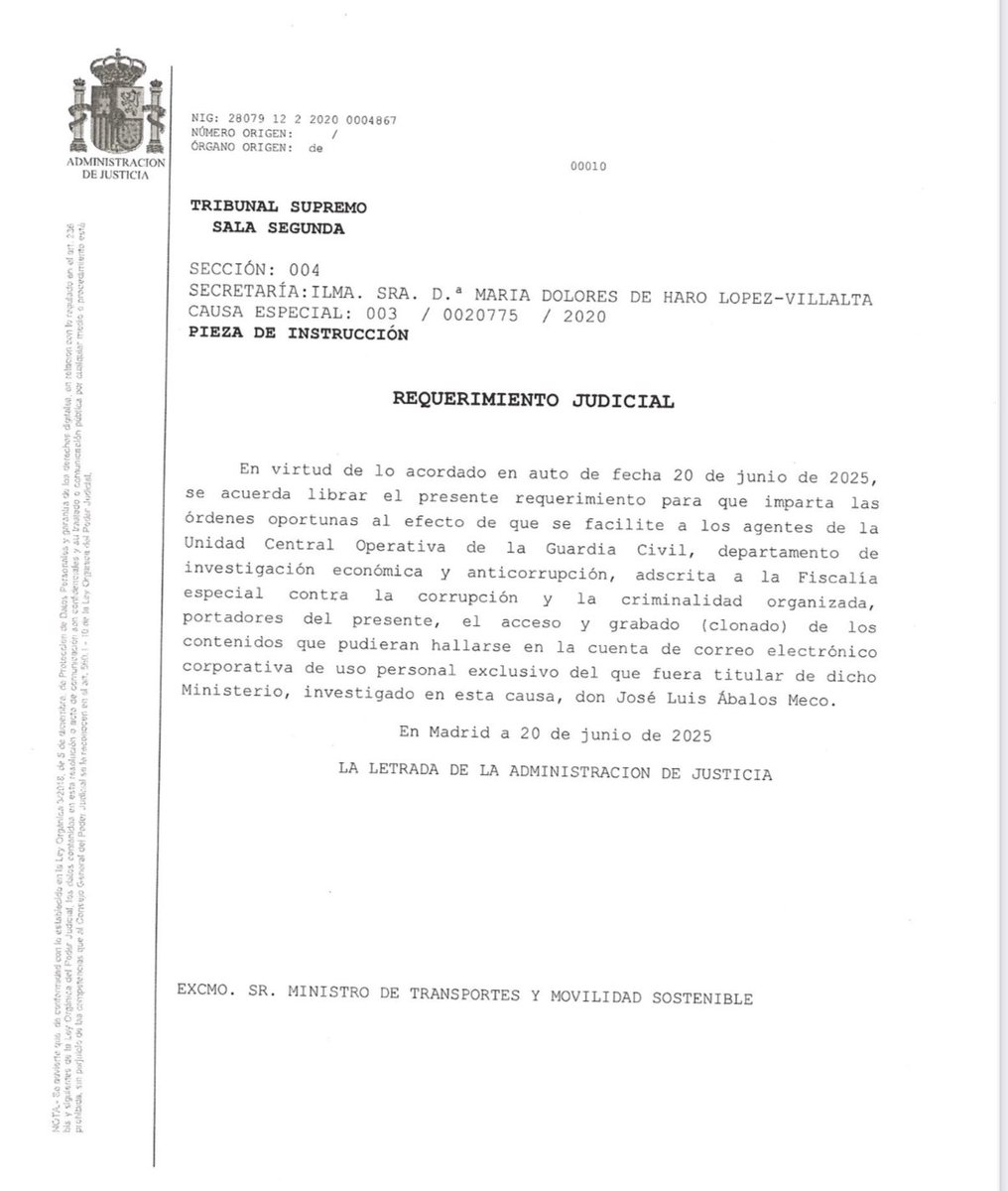
Nadie ha registrado el Ministerio, ni Adif, ni Ferraz ni la dirección general de carreteras. Han pedido un email para copiarlo, los expedientes de 5 contratos en Adif y de 6 contratos en la DGC. Y no es la primera vez. Las entradas y registros son otra cosa.
Hay que poner el documento judicial para ilustrar a los buleros y a la caterva de fachas ignorantes que entran aquí a insultar. No ha habido ninguna entrada y registro. Ha habido un requerimiento a través de la UCO para el clonado de un email. Y a lo largo de la instrucción esto ha sucedido varias veces.
I am alarmed by the proposed cuts to U.S. funding for basic research, and the impact this would have for U.S. competitiveness in AI and other areas. Funding research that is openly shared benefits the whole world, but the nation it benefits most is the one where the research is done.
If not for funding for my early work in deep learning from the National Science Foundation (NSF) and Defense Advanced Research Projects Agency (DARPA), which disburse a good deal of U.S. research funding, I would not have discovered lessons about scaling that led me to pitch starting Google Brain to scale up deep learning. I am worried that cuts to funding for basic science will lead the U.S. — and also the world — to miss out on the next set of ideas.
In fact, such funding benefits the U.S. more than any other nation. Scientific research brings the greatest benefit to the country where the work happens because (i) the new knowledge diffuses fastest within that country, and (ii) the process of doing research creates new talent for that nation.
Why does most innovation in generative AI still happen in Silicon Valley? Because two teams based in this area — Google Brain, which invented the transformer network, and OpenAI, which scaled it up — did a lot of the early work. Subsequently, team members moved to other nearby businesses, started competitors, or worked with local universities. Further, local social networks rapidly diffused the knowledge through casual coffee meetings, local conferences, and even children’s play dates, where parents of like-aged kids meet and discuss technical ideas. In this way, the knowledge spread faster within Silicon Valley than to other geographies.
In a similar vein, research done in the U.S. diffuses to others in the U.S. much faster than to other geographic areas. This is particularly true when the research is openly shared through papers and/or open source: If researchers have permission to talk about an idea, they can share much more information, such as tips and tricks for how to really make an algorithm work, more quickly. It also lets others figure out faster who can answer their questions. Diffusion of knowledge created in academic environments is especially fast. Academia tends to be completely open, and students and professors, unlike employees of many companies, have full permission to talk about their work.
Thus funding basic research in the U.S. benefits the U.S. most, and also benefits our allies. It is true that openness benefits our adversaries, too. But as a subcommittee of the U.S. House of Representatives committee on science, space, and technology points out, “... open sharing of fundamental research is [not] without risk. Rather, ... openness in research is so important to competitiveness and security that it warrants the risk that adversaries may benefit from scientific openness as well.”
Further, generative AI is evolving so rapidly that staying on the cutting edge is what’s really critical. For example, the fact that many teams can now train a model with GPT-3.5- or even GPT-4-level capability does not seem to be hurting OpenAI much, which is busy growing its business by developing the cutting-edge o4, Codex, GPT-4.1, and so on. Those who invent a technology get to commercialize it first, and in a fast-moving world, the cutting-edge technology is what’s most valuable. Some studies (link in original post, below) also show how knowledge diffuses locally much faster than globally.
China was decisively behind the U.S. in generative AI when ChatGPT was first launched in 2022. However, China’s tech ecosystem is very open internally, and this has helped it to catch up over the past two years:
- There is ample funding for open academic research in China.
- China’s businesses such as DeepSeek and Alibaba have released cutting-edge, open-weights models. This openness at the corporate level accelerates diffusion of knowledge.
- China’s labor laws make non-compete agreements (which stop an employee from jumping ship to a competitor) relatively hard to enforce, and the work culture supports significant idea sharing among employees of different companies; this has made circulation of ideas relatively efficient.
While there’s also much about China that I would not want the U.S. to emulate, the openness of its tech ecosystem has helped it accelerate.
In 1945, Vannevar Bush’s landmark report “Science, The Endless Frontier” laid down key principles for public funding of U.S. research and talent development. Those principles enabled the U.S. to dominate scientific progress for decades. U.S. federal funding for science created numerous breakthroughs that have benefited the U.S. tremendously, and also the world, while training generations of domestic scientists, as well as immigrants who likewise benefit the U.S.
The good news is that this playbook is now well known. I hope many more nations will imitate it and invest heavily in science and talent. And I hope that, having pioneered this very successful model, the U.S. will not pull back from it by enacting drastic cuts to funding scientific research.
[Original post, with links: https://t.co/JR3x4O1iVr ]
Al fin lo podemos decir: ha ganado la comedia.
Escuchad a @HectordeComer tras conocerse que se ha archivado la causa de Abogados Cristianos contra él.
Gracias a todxs, veintipiquers, por apoyarnos 💙
https://t.co/DJEPVep0g4