I’ve hosted 465+ episodes of The Armen Show since 2017, including 250+ long-form interviews with scientists, authors, scholars, researchers, and other thinkers.
Conversations span human behavior, science, technology, culture, learning, decision-making, and ideas.
Guests have included Temple Grandin, David Sinclair, Nicholas Christakis, Steven Strogatz, James Nestor, Derek Sivers, Rebecca Newberger Goldstein, Robin Hanson, and many others.
Explore the show:
https://t.co/WW2upoCJVw
The same technology can help institutions listen to people, or surveil them.
The difference often lies in purpose, transparency, and public trust.
Eric Gordon discusses this distinction and the future of AI in government on The Armen Show #473.
@mitpress
"Williams and Ceci sent fake job applications to more than 800 faculty members in engineering, economics, biology, and psychology... As shown in the graph below, faculty expressed a strong preference for the female candidates - a 2:1 preference overall."
https://t.co/20bCRoT7js
Not every bad outcome has a villain.
In my 3rd conversation with Yale sociologist Emily Erikson, we explored how conflict emerges from circumstances and social structures rather than malicious intentions.
A central idea from "Lessons in Tragedy"
Ep. 472 https://t.co/UqdcEZrDe4
It was said to write like I talk and I do that at times and this is one of those times. I didn't have a full post in mind but now this is a post of sorts. We are well on our way.
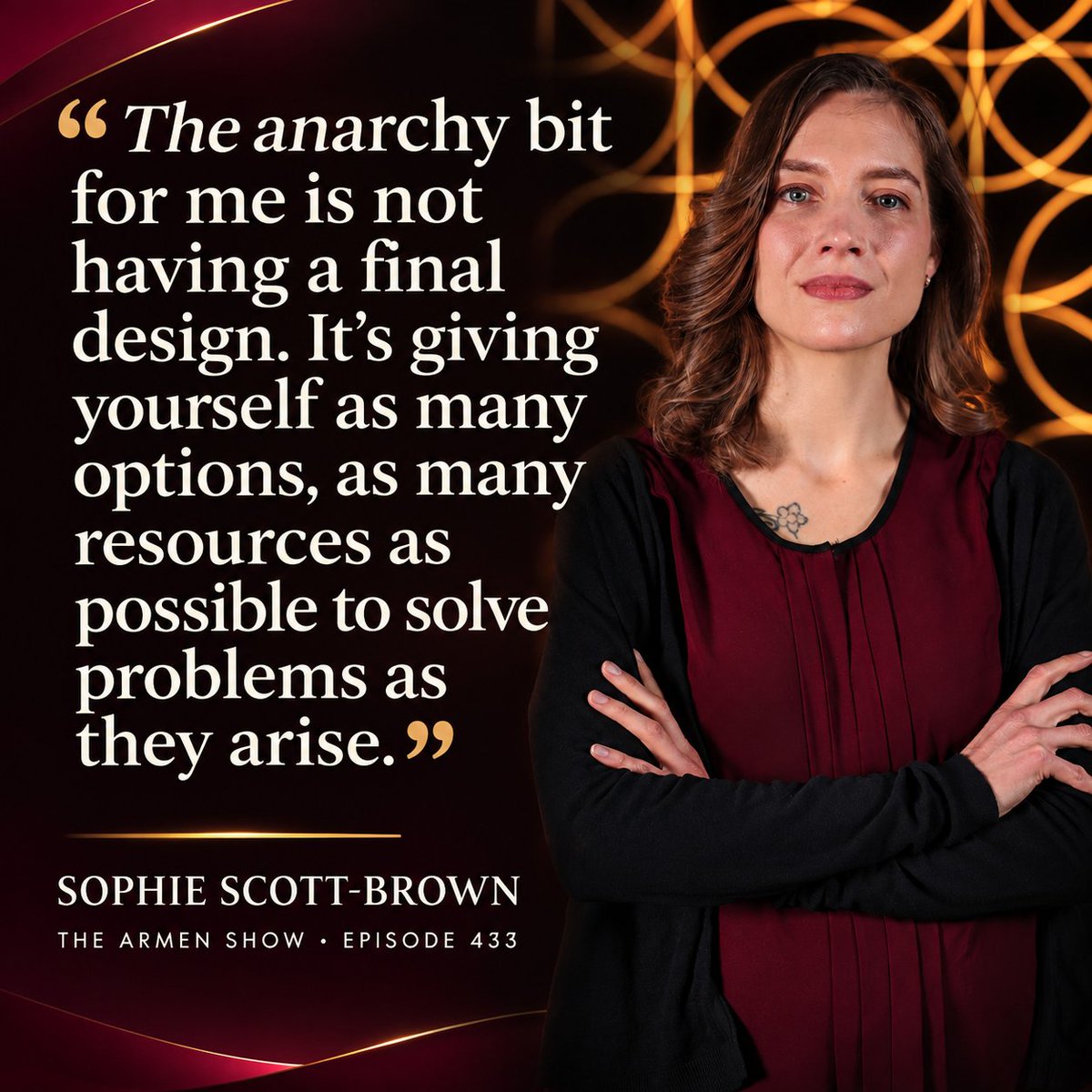
What if the strength of a society comes not from having the perfect system, but from allowing people the freedom to adapt, cooperate, and solve problems as they arise?
Dr. Sophie Scott-Brown explores anarchy, hierarchy, and the limits of authority on The Armen Show.
Episode 433.
It's true - the phone has been viewed by people as all-encompassing and could be anything of relevance so it has so much acceptability, and then reading a book is such an alteration of the default and not connected to the social sphere.
Then, it also shows attention span, which is uncommon, and likely ability to understand with more thought in place, which is also reducing. If it is more intellectual material, it is like the FAA calls a possible pilot deviation but more like a possible cultural deviation.
Looking back, resist making every interest a stepping stone toward your current work. Some experiments taught you something; others mattered while they lasted. Ask what remains useful now. You can carry that forward without continuing the whole project.
Before judging your progress, account for the work your goals leave out: earning money, helping family, maintaining a household, and caring for your health. Those demands use real capacity. A plan that ignores them will keep producing misleading evidence about your discipline.
When designing a project, ask what will supply the second and third pieces. A conversation, a reader’s question, or something learned while making the first can create a path forward. Small units help you finish; a source for the next unit helps you continue.
When a project stalls, locate the difficulty: choosing a direction, finishing a piece, continuing the practice, reaching people, or getting a worthwhile return. Each calls for a different response. “I need more discipline” is often too broad to help.
Who knows what content on here or elsewhere is the person actually versus a created form representing the person. Illusion level has gone up in recent time.
It's important to go where you are requited and distance where you are unrequited, provided that you have the self-esteem to see that where you are requited is the only area where the good is.
Life is odd because there is a seriousness among many and then at the same time changes every few years that make the seriousness seem questionable in retrospect. You would think the same outcomes could have come through with a lighter nature among all the people.