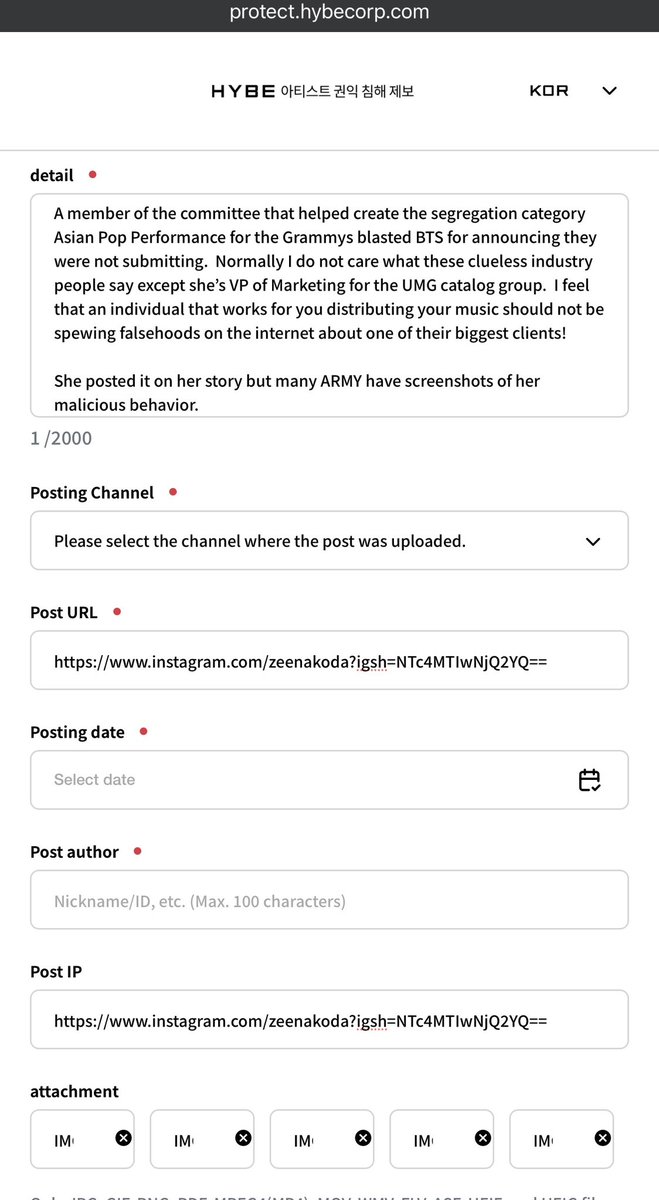
Pannchoa's blog has been removed by Google as spam 🎉🎉🎉 although the reporting system on X is messed up, Blogger has stricter guidelines against bullying & misconduct.
If they ever re-appear you'll know exactly what to do : https://t.co/iXDu3psAc8
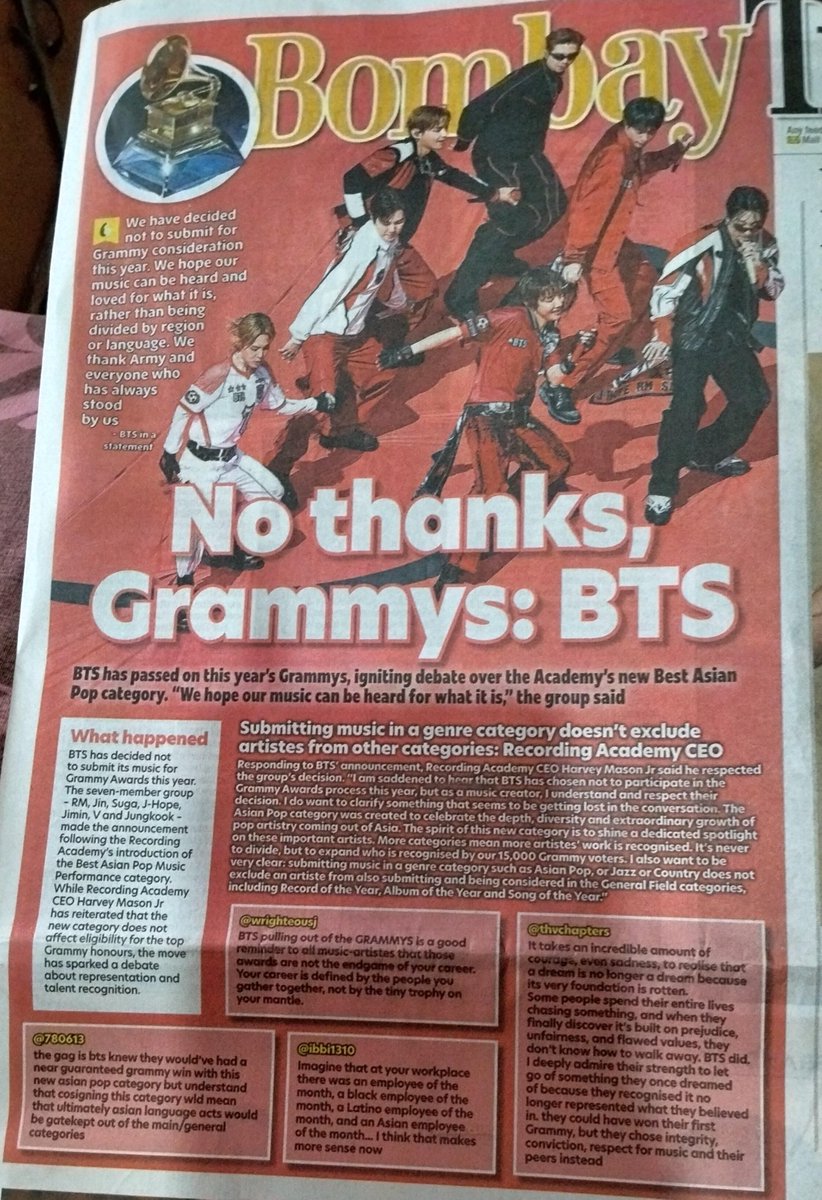
ARMYs, this is one of the most interesting and trenchant takes on BTS's Grammys decision, even digging into America's history of "Separate but Equal."
Kim Ou-joon, one of Korea's most influential public figures and its most prominent progressive voice (I recently wrote a seven-part article about him in the Articles section), devoted a lengthy segment to the BTS-Grammys controversy on his program, Gyeomson News Factory. It is the most-watched live political and current affairs program on YouTube in Korea (and in the world), drawing more than 200,000 live viewers and averaging around 1.2 million views per day.
Kim was sick last Friday, so he wasn't there to host the show when three music critics appeared and made the most misguided arguments about BTS's decision:
1. This is just a Korean inferiority complex. It may feel emotionally satisfying, but it wasn't the right decision.
2. HYBE probably realized BTS had little chance of winning a major Grammy category anyway, so they made a calculated business move before the Grammys could reject them. This is basically a power game.
3. Now that the Grammys have created an Asian Pop category, future artists may dream of winning in that category. So we can't say BTS's decision was entirely the right one.
4. Didn't BTS work so hard to learn English and Japanese in order to break into the U.S. and Japanese markets? Now that there's an Asian Pop category, artists might not have to do that anymore. They could stay in their own language and still be nominated in the Asian Pop category. Isn't that actually a good thing?
Here is Kim Ou-joon's commentary from today's show. I translated them as faithfully as possible. Because of his short, conversational style of speaking, I added a few words here and there for context so that his intended meaning would come across accurately. And I omitted the exchanges between Kim and the announcer during Kim’s commentary.
—----------------------------
“I think the Grammys created the new Asian Pop Music category because they were planning to give that award to BTS. But then BTS refused to submit their music, and it became a global controversy.
Media outlets around the world started pouring out articles. From The New York Times onward, pretty much every major international media outlet we know covered it. And, for the most part, they viewed BTS's boycott positively.
They called it "a gentle but powerful criticism" (The Guardian). “Refusing was the right thing to do” (Cosmopolitan). "A declaration of independence" (Sportal Korea). “BTS had captured the spirit of the times" (The Economic Times)
Now, last Friday, the music critics who appeared on our program seemed to say that this new category could have become a stepping stone for Asian-language music to succeed in the global market, so they felt a little disappointed by BTS's decision.
Yes, I understand that point of view. There's some validity to it. But I think differently.
If I had been there, I probably would have argued against them pretty strongly. Since I wasn't, let me add my thoughts now, even if it's a little late.
Because I don't think this is something we should just let pass. I think this is a significant event, one that deserves to be recorded not only in Korean cultural history but also in the history of world culture.
Let me briefly explain why. To understand this, we have to look at it not from our perspective, but from the Western perspective. Using their way of thinking. Because it's a Western award show. It was their decision. We have to understand why they did it from their point of view. That's how you understand their intention.
Now, there's a precedent for this. I think it was 2019. MTV became the first major music award show to create a Best K-Pop category. It should have just been called Pop. Instead, they created a separate Best K-Pop category.
At the time, The Washington Post used a particular expression. They said this was America's "separate but equal" rule in music awards.
That phrase is extremely important in the history of the American civil rights movement. For Americans, just hearing those three words is enough. They immediately understand what's being implied.
This goes back to around 1890. Louisiana was one of the places where racial discrimination was especially severe. The state passed a law requiring separate railroad cars for white people and Black people. Black and white passengers had to ride in different train cars. Civil rights activists wanted to challenge that law as unconstitutional, as racial discrimination.
At that time, there was a man named Plessy. By appearance, he looked white. But he was one-eighth Black. His great-grandmother was Black.
At the time, America had what was called the one-drop rule. If you had even one drop of Black blood, no matter how white you looked, you were legally classified as Black.
So this man boarded a whites-only train car. Then he deliberately announced that he was Black. He wanted to be arrested.
That's how the lawsuit began. The case eventually reached the U.S. Supreme Court. The Louisiana judge's name was Ferguson, so in America it's known as “Plessy v. Ferguson.”
It's a very famous case. One of the most famous rulings in American history came out of that case. That's where the phrase "separate but equal" comes from.
The Court ruled that separating railroad cars was constitutional because, although they were separated, they were supposedly equal. In the end, it was a ruling that justified racial discrimination. This was at the end of the nineteenth century.
After that decision, segregation spread far beyond railroad cars. Because racial segregation had now been accepted under the Constitution, separation spread into every part of society. Schools. Hospitals. Parks. Buses. Theaters. Restrooms. Eventually even cemeteries. People were separated from birth until death.
But the facilities for Black people received less than one-tenth of the funding that white facilities received. Because the people making those decisions were all white. So the facilities for Black people were in terrible condition.
That's why the phrase "separate but equal" really meant separation, inequality, and exclusion. But those words were used to hide racial discrimination. That system continued for nearly seventy years.
That's exactly what The Washington Post meant when it described MTV's decision as "separate but equal." By creating a K-pop category, it looked as though K-pop was being treated equally. But in reality, it excluded K-pop from competing in the main categories while hiding that exclusion.
At the time, there was another expression people in the West used to describe MTV's decision. Ghettoization. During Nazi Germany, Jews were confined to ghettos. So people said K-pop had been ghettoized. It had been placed in its own separate space.
That expression also has a precedent. When Black music began to rise in America, award shows grouped Black artists into R&B and Rap categories. Black artists would receive those awards, while the major awards continued to go to the mainstream. People called that the ghettoization of Black music.
So MTV received that criticism. After that, MTV nominated BTS in the regular Pop category. And BTS won.
At the time, Billboard wrote that BTS had entered through the side door, and that it had taken a long time before they were finally allowed to use the front door like everyone else. After MTV, the other award shows adapted to that criticism.
The Grammys were the last one left. The Grammys see themselves as the most prestigious music awards because, unlike other shows, there is no fan voting. Like the Academy Awards, only industry professionals vote.
So they created a side door, just like MTV. This was basically saying, "Asia, come in through the side door. Separate but equal."
When MTV did this, BTS still attended despite the controversy. But this time, BTS declared to the American mainstream music industry, "We're not using the side door anymore." And they refused.
That's why Western media, who understand this context exactly, praised BTS. They said, "Well done." They called it the spirit of the times.
That's how I see it too. I think this will remain a landmark in world cultural history for a long time.
An artist from outside the mainstream boycotted the most prestigious award in the mainstream and declared, "You are out of step with the times."
It's contextually similar to Black Americans demanding racial equality and human equality.
That's why western media call it the spirit of the times. Some in Korea don't immediately understand why it's being called that. They think, "Wouldn't this have been a good opportunity for Asian artists?"
That Friday's comment comes from not seeing how people in America think about this issue. That's all I wanted to add.”
—--------------------------
For those who understand Korean, you can watch the video of his commentary here. (I wish I knew how to add English subtitles, but unfortunately I don't.)
https://t.co/bsgO5X8KwA
accusing THEEEE bts of doing anything for “press” is actually hilarious, mam do you know who you’re talking about, they could sneeze and it would make headlines, lets not be silly
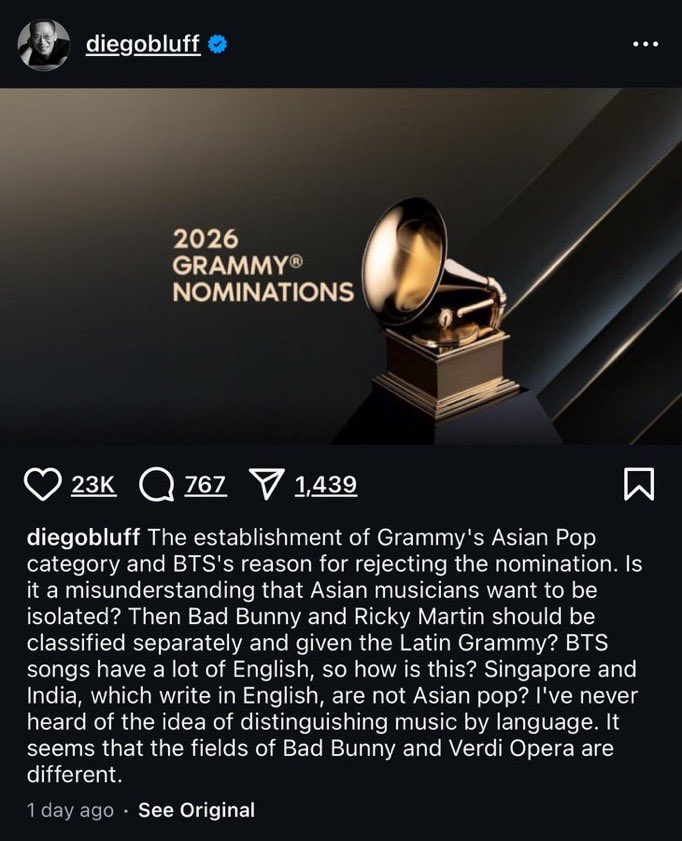
Diego Bluff’s critique cuts straight through the Recording Academy's administrative smoke and mirrors to expose the sheer logical collapse of the new "Asian Pop" category.
When a prominent corporate leader from outside the music industry can look at a major institution's framework and immediately identify its structural absurdity, it proves that the gatekeeping mechanics have become too obvious to ignore. Bluff’s breakdown brilliantly weaponizes basic musicology and geography to validate exactly why BTS was entirely right to reject the nomination.
Dismantling the Arbitrary Boundaries
The Geopolitical Blindspot: Bluff’s mention of Singapore and India is a devastating critique of the Academy's cultural illiteracy. By attempting to bundle the massive, entirely distinct sonic landscapes of K-pop, J-pop, C-pop, and South Asian music under a single geographical banner, the Grammys are treating the largest continent on earth as a monolithic novelty act.
The Language Paradox: Pointing out the high volume of English lyrics in BTS’s catalog blows the Academy’s criteria wide open. If music is being classified by language, global chart-toppers like "Dynamite" or tracks from Arirang belong squarely in Mainstream Pop. By creating an "Asian Pop" bucket anyway, the Grammys are admitting that they aren't segregating the music by language they are segregating the artists by ethnicity.
The Latin Grammy Double Standard: His comparison to Bad Bunny and Ricky Martin highlights a historical hypocrisy. The industry already built an entirely independent, prestigious entity—the Latin Grammys—to properly honor the immense depth and regional genres of Spanish-language music. Yet the domestic US Grammys routinely use the main "Latin" categories as a containment zone to prevent streaming giants like Bad Bunny from sweeping the general Big Four fields.
Sonic Realism vs. Corporate Containment
Bluff’s concluding remark that “the fields of Bad Bunny and Verdi Opera are different” hits on the fundamental rule of music criticism: music should be categorized by its sonic genre and artistic form, never by the passport or native language of the person making it. An opera is an opera whether it is sung in Italian or Korean; a pop song is a pop song whether it is produced in Los Angeles or Seoul.
By drawing a fence around Asian creators, the Recording Academy is trying to hide behind a facade of progressive representation. In reality, they are running a classic protectionist racket to shield Western artists from being completely out-streamed and out-performed by global powerhouses.
BTS did not misunderstand the assignment they understood it perfectly. They refused to validate a category that rewards diversity by practicing isolation.
Bluff's intervention shows that the corporate world is openly noticing the Grammys' decline in credibility.
see, bertapa besarnya BTS di industry musik, cuma bikin igs bahasa korea bikin CEO grammy klarif, bikin media major hubungi grammy, bikin media global beritain BTS grammy wkwk.
si grammy tu banyak kali di komplain artist lain, baru kali ini juga trigger 😭




![btschartsxdaily's tweet photo. [INFO] The Actress Charlize Theron used the song #BTS’s “NORMAL” Korean Version in her Instagram Post! 🫶
https://t.co/ndcyoj4cU7 https://t.co/i0FOhpUMXI](https://pbs.twimg.com/media/HO5j0ckWAAA22J1.jpg)