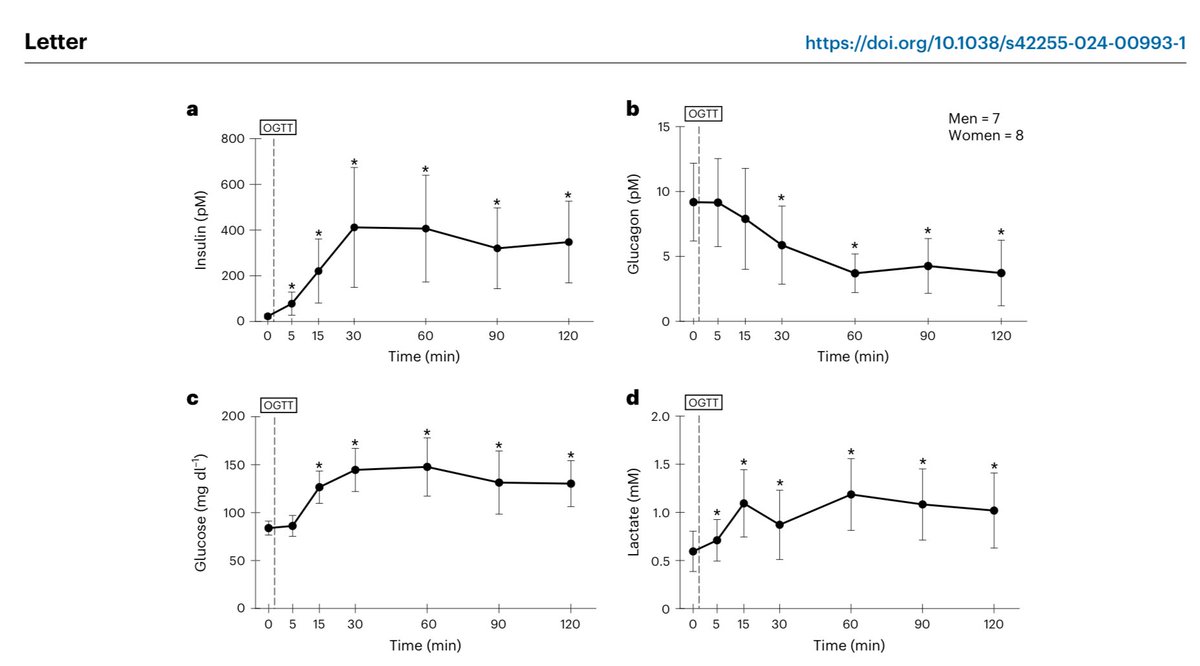
“Our study proposes that, in humans, lactate is a major vehicle for carbohydrate carbon distribution and metabolism.”
Leija RG, et al., Nature Metabolism. 2024.
https://t.co/P2d3p4BDqm
Per no mencionar que el múscul mai té un estat d'absència d'oxigen. Manual de com cagar-se a sobre de la bioquímica i fisiologia de l'exercici en un sol paràgraf!
Quan evolucionarà el contingut impartit per les Universitats respecte el paper del lactat (i no àcid làctic) a la fisiologia del cos humà? Cansat de llegir aquestes coses quan se sap que el lactat NO causa la fatiga ni el dolor muscular... I és contingut d'una Universitat.
🤕⚽️Futbolista amb dolor púbic?
🔍Sembla ser que les alteracions estructurals a la símfisi púbica deriven de l'activitat futbolística, independentment de si hi ha dolor o no.
❓Quin és el valor diagnòstic de les proves d'imatge?
Estudi molt interessant de @Physiomathias
No differences in prevalences of pubic-related radiographic findings between football players with and without groin pain!
Great to see another online paper from my PhD🤩
It is open access! 🆓 ⬇️
https://t.co/sN6mLmE1fN
@SORC_C
Muscle acidosis is real and it decreases performance significantly. However, Lactate is NOTthe reason for muscle acidosis.
Free thread depicting the role of lactate during hgh intensity exercise: 🧵😉 👇
Final PhD study is out
🦶 Slow, high-load eccentric calf training leads to the greatest acute Achilles tendon thinning (↓8.9%) & stiffening (↑54.5%)—suggesting more fluid exudation & lower intratendinous pressure.
🏋️ Loading speed & intensity matter!
🔗 https://t.co/yfBqaJzZzm
🚨 New study 🚨
The biggest project of my PhD is out in @MSSEonline.
🔑 findings: Strength training improves running economy durability & high-intensity performance following prolonged running.
🙏🏼 @rich_blagrove for the SUPERvision on this
🔗 https://t.co/WfWWwyY9oW
🧵 1/10
Lactate, historically viewed as a waste product, is now emerging as a critical marker of metabolic health. Efficient mitochondrial function allows lactate to be reused as an energy source rather than accumulating in the blood. Elevated lactate levels at low intensities of exercise can indicate poor mitochondrial efficiency, while well-trained individuals exhibit superior lactate clearance and utilization...
More on lactate and the lactate shuttle in reply.
8 setmanes d’entrenament amb un protocol d’hipertròfia tradicional o de clúster igualant el volum i l’esforç induiria una hipertròfia similar. El volum i l'esforç serien claus per la hipertròfia, independentment del protocol d'entrenament. https://t.co/EPvf3586Ty
Many think osteoarthritis (OA) is a 'wear and tear' problem.
While the instigator may be traumatic (think ACL injury), framing it as wear-and-tear can cause patients to think exercise will make things worse.
So understanding why cartilage loves load is important...🧵👇 1/7
Alerta 🚨 artículo
La atleta y médico @MartaGGMA publica su primer artículo científico ¡Felicidades!
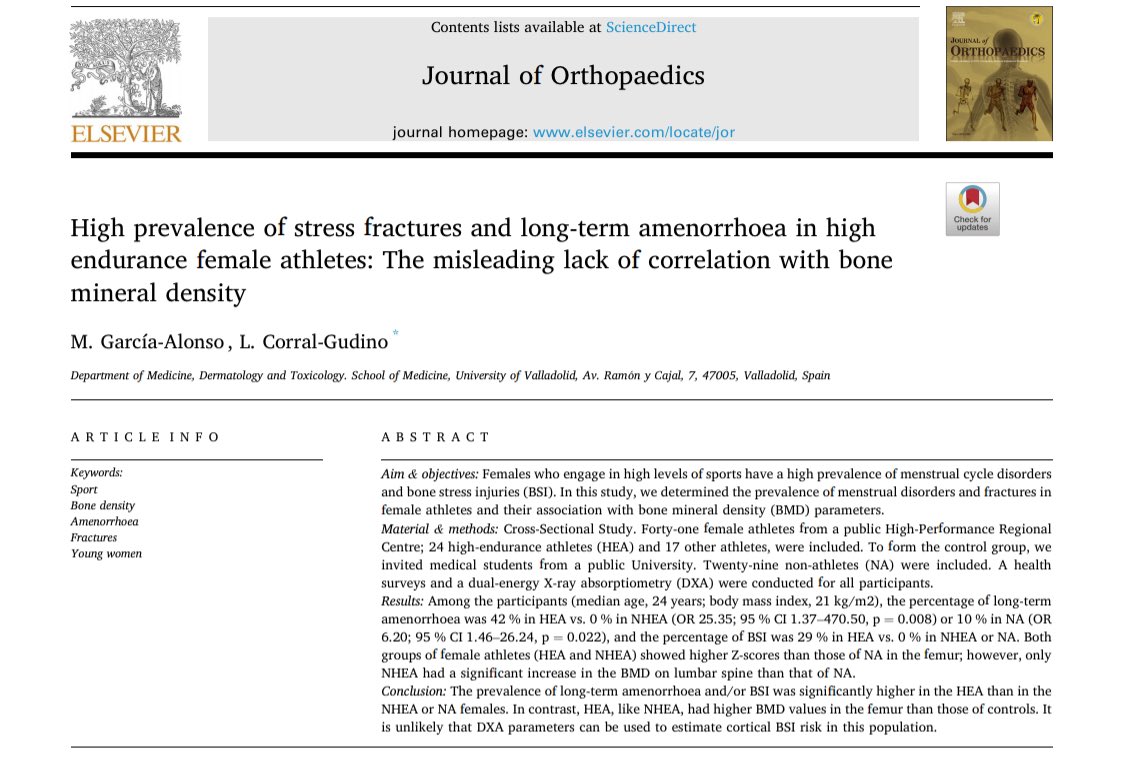
Elevada incidencia de 🦴 fracturas de fatiga y amenorrea de larga duración en atletas femeninas 🏃🏾♀️ de resistencia
Y con buena densitometria osea ! 🤔
https://t.co/i9iQPlwN4y
Post-exercise hot water immersion enhances muscular blood flow. Conceivably, this may augment muscle protein synthesis and thus enhance hypertrophy (in contrast to CWI, which impairs blood flow and blunts hypertrophy) https://t.co/khpTRWOIAB
IMHO, 150min/week of “aerobic” exercise are insufficient for long-term longevity and metabolic health gains/maintenance…I would say that ~300min/week should be the goal.
Furthermore (and very important), the concept of Zone 2 training is NOT about cardiorespiratory improvements (aka VO2max) but about metabolic improvements at the cellular and bioenergetic level, driven by an improvement of mitochondrial function. At least this is how I have seen it since I “coined” my definition of Zone 2 almost 30 years ago and have always used it the same way.
Also, I encourage people to start talking more about metabolic training instead of “cardio” training. We have been doing it already for at least 2 decades in the world of high sports performance.
All exercise intensities improve cardiorespiratory adaptations. However different training zones stimulate different bioenergetic systems leading to different cellular and metabolic adaptations. Targeting the right metabolic adaptations can have significant improvements in longevity and metabolic health.
#drillsilike Lumbopelvic control ⚡️
Some exercises seem to bring challenge-control but do not 🤔
Others do not seem to but 🥵🔥
Try this series, ⚠️ hold long enough (5-10s if needed) to induce challenge and prove control ✅
Master the basics first 👊⚖️
👇👇👇
Not only is this completely wrong, but it’s negligent and potentially harmful.
An isokinetic dynamometer is the gold standard for assessing force production and how quickly you can produce that force, which is vital for reducing the risk of injury.
A single leg squat doesn’t come close to reproducing the forces experienced during sport, which is why knee valgus during a single leg squat is NOT a risk factor for injury (Nilstad 2021, Petushek 2021).
Many clinicians are using the traditional hop tests less (at least in isolation) because research consistently shows that patients may demonstrate symmetry by compensating or unintentionally performing worse on their uninvolved leg (Wren 2018).
And the forward reach is 100% not an appropriate substitute.
There’s only so much information that can be put into a 60 second video. Check out these resources to learn more:
PCHO vs. a HCHO diet during five weeks of supervised exercise training in well-trained athletes does not influence MLSS and does not change substrate oxidation during a TTE test at MLSS intensity. https://t.co/T0BxqbdRn0
Can someone explain ”lactate tolerance” & its relevance to endurance performance to me? I see a bunch of training sessions (eg. over/unders, VO2max intervals) that supposedly increase lactate tolerance, but fail to understand the rationale.