10 books recommended by Nassim Taleb:
1) Scale by Geoffrey West
“Scaling is the most important yet most hidden and rarely discussed attribute—without understanding it one cannot possibly understand the world.”
not everyone thinks primarily in words.
some people think in pictures.
others in patterns, geometry, systems, and spatial relationships.
visual thinking by temple grandin explores how different minds represent problems differently.
→ object visualizers think in detailed images
→ spatial visualizers think in patterns and relationships
→ verbal thinkers reason primarily through language
engineering needs all three.
• the mechanical engineer who can rotate an assembly in their head.
• the programmer who sees the architecture before writing code.
• the mathematician who sees structure before proving it.
• the designer who can imagine the finished object before it exists.
intelligence is not one-dimensional.
sometimes the person struggling to explain an idea in words can already see the entire system in their head.
System Design Case Study:
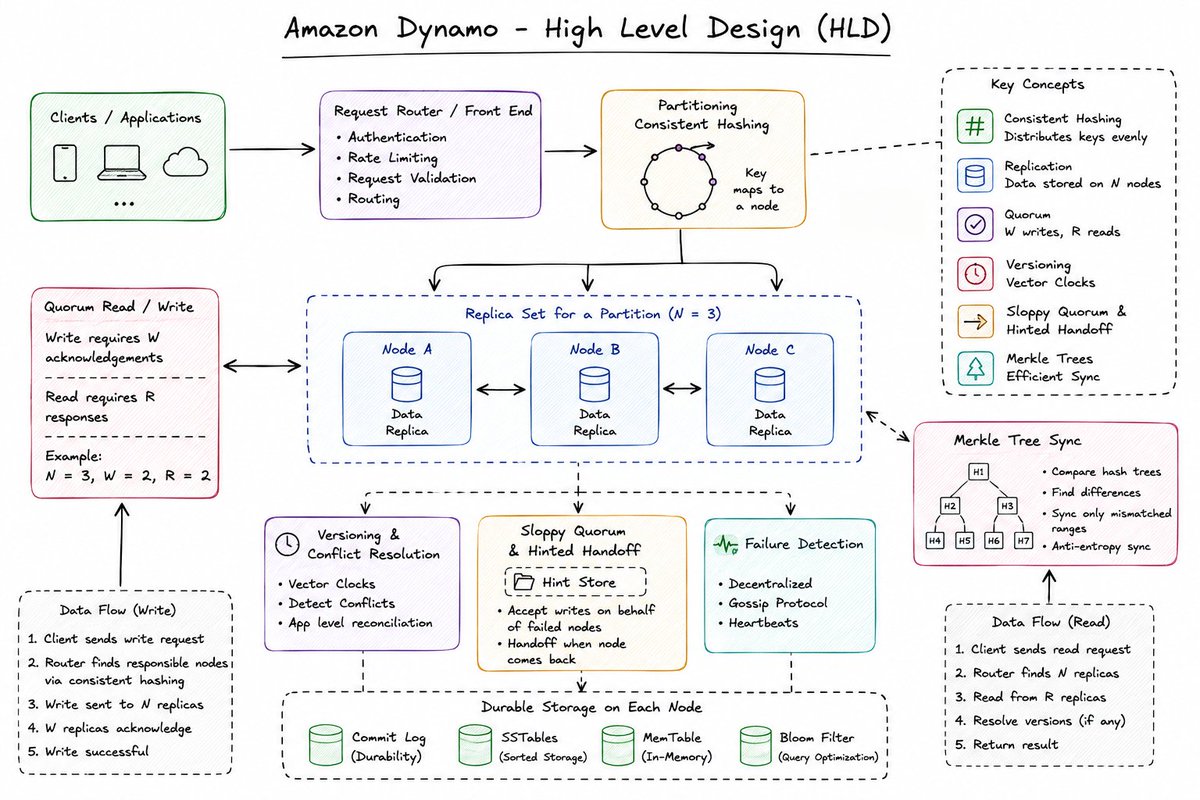
Dynamo: The Amazon paper that changed distributed databases
What happens when your database goes down while millions of users are shopping?
Amazon didn't want the answer to be:
"Everything stops."
That's why Dynamo was designed around a different idea:
Failures are inevitable. The system should keep working anyway.
1. Partition the data
Dynamo uses consistent hashing to distribute keys across nodes.
"user:101 → Node A"
"user:102 → Node B"
"user:103 → Node C"
Adding or removing nodes doesn't require reshuffling everything.
2. Replicate everything important
"user:101 → A + B + C"
If Node A fails, another replica can still serve the data.
3. Use quorum reads/writes
"N = replicas"
"W = write acknowledgements"
"R = read acknowledgements"
Example: "N=3, W=2, R=2"
The system can continue operating even when a replica is unavailable.
4. Expect conflicts
Two replicas can have different versions.
Dynamo used vector clocks to detect conflicting versions and supported application-level reconciliation.
5. Survive node failures
With sloppy quorum + hinted handoff, another healthy node can temporarily accept data for a failed node.
When it recovers, the data can be handed back.
6. Keep replicas synchronized
Dynamo used Merkle trees to efficiently identify differences between replicas instead of comparing every key.
The bigger lesson:
Dynamo wasn't just another database.
It changed how engineers think about distributed systems:
Don't design for a world where nothing fails.
Design for:
• Node failures
• Network failures
• Conflicting data
• Partial outages
• Recovery
And always ask:
When something fails, what are we willing to sacrifice consistency, availability, latency, or durability?
The Mathematics of Large Language Models — A Readable Guide to LLMs, Transformers, Diffusion, Neural Networks, and Generative AI: https://t.co/LpHsnlyQme
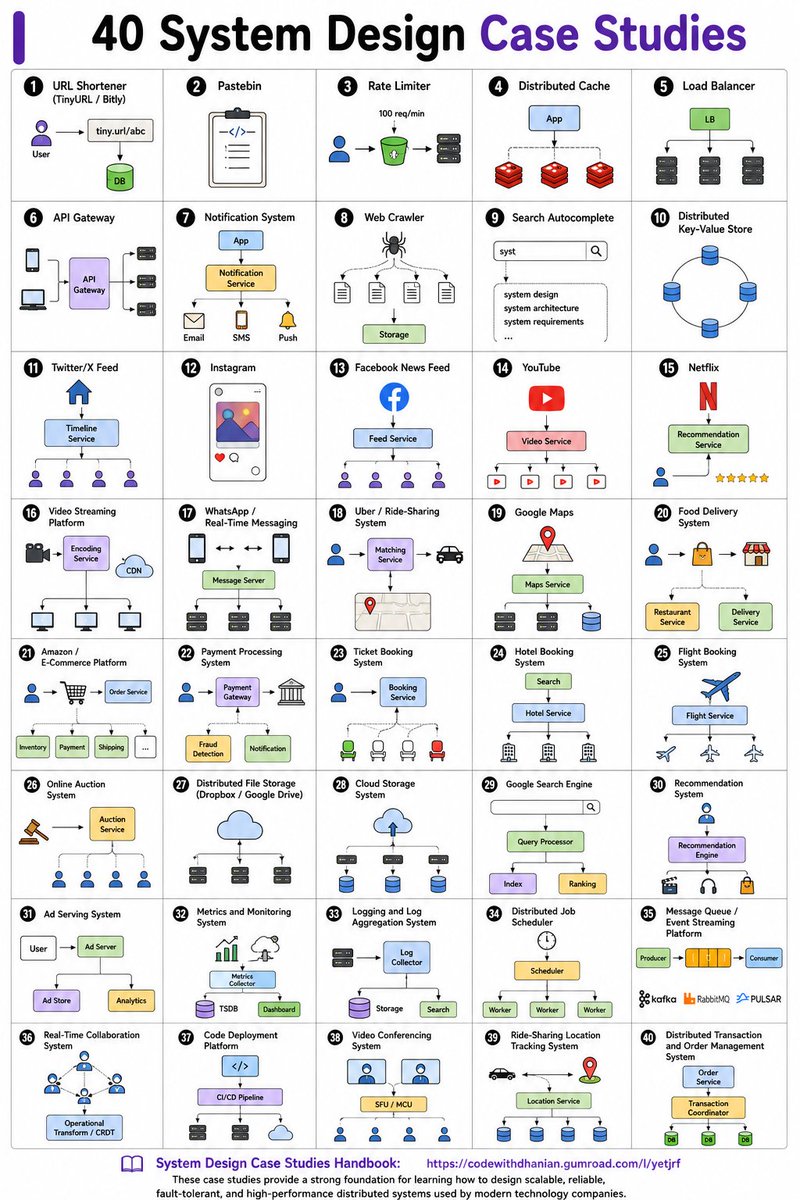
As a System Design Engineer,
It will be good if you have an understanding of the below 40 System Design Case Studies👇
1. URL Shortener (TinyURL / Bitly)
2. Pastebin
3. Rate Limiter
4. Distributed Cache
5. Load Balancer
6. API Gateway
7. Notification System
8. Web Crawler
9. Search Autocomplete
10. Distributed Key-Value Store
11. Twitter/X Feed
12. Instagram
13. Facebook News Feed
14. YouTube
15. Netflix
16. Video Streaming Platform
17. WhatsApp / Real-Time Messaging
18. Uber / Ride-Sharing System
19. Google Maps
20. Food Delivery System
21. Amazon / E-Commerce Platform
22. Payment Processing System
23. Ticket Booking System
24. Hotel Booking System
25. Flight Booking System
26. Online Auction System
27. Distributed File Storage (Dropbox / Google Drive)
28. Cloud Storage System
29. Google Search Engine
30. Recommendation System
31. Ad Serving System
32. Metrics and Monitoring System
33. Logging and Log Aggregation System
34. Distributed Job Scheduler
35. Message Queue / Event Streaming Platform
36. Real-Time Collaboration System
37. Code Deployment Platform
38. Video Conferencing System
39. Ride-Sharing Location Tracking System
40. Distributed Transaction and Order Management System
📘 Grab System Design Case Studies Handbook:
https://t.co/ec73poyTBr
These case studies provide a strong foundation for learning how to design scalable, reliable, fault-tolerant, and high-performance distributed systems used by modern technology companies.
This very practical math book is for anyone who wants to develop their powers to think mathematically, especially anyone who has always wondered what lies at the core of mathematics.
"Thinking Mathematically" at https://t.co/UrpyZ8F5TH
The ultimate AI/ML learning stack.
From fundamentals to production systems.
20 books. 5 categories.
📚 Fundamentals:
→ Hands-On ML with Scikit-Learn, Keras & TensorFlow (Géron)
→ Data Engineering with Python
→ Storytelling with Data (Knaflic)
📚 Time Series:
→ Modern Time Series Forecasting with Python
→ Applied Time Series Analysis and Forecasting
📚 System Design:
→ Designing Machine Learning Systems (Huyen)
→ AI Engineering (Huyen)
→ Solutions Architect's Handbook
→ Practical ML for Computer Vision
📚 GenAI:
→ LLM Design Patterns (Ken Huang)
→ Generative AI with LangChain
→ Generative Deep Learning (O'Reilly)
→ AI Agents in Practice
→ Architecting AI Software Systems
📚 Product/Strategy:
→ The Profitable AI Advantage
→ Your AI Survival Guide
→ Reimagined: Building Products with Generative AI
Bookmark this stack.
The Thinker's [Short] Guide to Analytic Thinking — How to Take Thinking Apart and What to Look for When You Do (from the Thinker's Guide Library): https://t.co/f24INIVh0F [2nd Edition]










![KirkDBorne's tweet photo. The Thinker's [Short] Guide to Analytic Thinking — How to Take Thinking Apart and What to Look for When You Do (from the Thinker's Guide Library): https://t.co/f24INIVh0F [2nd Edition] https://t.co/gQsyj9xkpS](https://pbs.twimg.com/media/HPLbhfNW4AAuLMT.jpg)


