I break it down into 30+ separate prompts for all companies in my universe in parallel. The final prompt not only ingests outputs on the specific company, but also its direct peers.
Pipeline is something like this:
i) Separately assess biz overview, key debates, and then biz quality (itself broken into mission criticality, barriers to entry & switching, pricing power, end market quality, mgmt quality etc.)
ii) Now that we know what the biz quality is like, the next set of prompts ingests the output from these previous steps and focuses on a) unit economics, b) economics vs. peers, c) market dominance and sustainability, d) competitive intensity, etc.
iii) Finally, I feed all of these outputs + key debates into a master synthesizer that i) identifies what's important over the next 3 years, ii) does incremental research, and iii) takes a view
iv) I do this in parallel for 3k+ stocks in my universe so that outputs can be compared with consistency. Separately, I also ask it to tag interesting situations such as recent biz model pivots, new groundbreaking products (cant miss the next $APP), etc.
I've connected all these outputs via an MCP into my Claude so I can ask it questions like:
- What are the highest quality stocks in my universe with most interesting setups where there is >50% 12month upside if I can take a certain qualitative view
- Stocks with low barriers to switching and high AGI disintermediation risk (short ideas)
The MCP is a pretty big unlock because now it doesnt need to research each stock from scratch every time I ask it a question - it can just pull the pre-processed outputs from my database and start doing incremental work immediately. This avoids a lot of classic LLM issues
Best outputs are when I ask it to compare direct peers in a subsector (e.g. gambling licensors, Japanese water infra upgrade cycle winners, etc.)
I'm sure you've already done this, but my biggest unlocks for vibe-screening were:
1) never wait for prints - we have to invest based on info available today
2) Statistically there is a >80% chance that >25% of all stocks (somewhat filtered universe, no shitty sectors or <$1B market cap) return >30% in a year. So don't be conservative for the sake of it - 1/4 ideas *have* to work
3) Don't focus on trailing numbers but focus on what's inevitable / likely.
4) There is no information asymmetry; hunt for interpretation asymmetry.
This fixed a lot of the basic problems for me
@taobanker lmao. but tbh to be consistent you need to run each name through all 3 passes. Otherwise you're actively selecting for false negatives
If lots of pass 1 longs can end up failing the 3rd gate, then vice-versa must also be true
The difference between HK and Singapore is that Hong Kong is the Anglo spirit with Chinese characteristics, while Singapore is the Chinese spirit with Anglo characteristics.
$WK already taking share
Dataroom market is exceedingly crowded with lots of new adjacent startups that will eventually make this a feature
And generally their reporting product NPS isnt great. AI makes it much easier to create an equivalent product and you bet we'll seem some startups further attack this profit pool in the future
@Arnavagarwal_@LaughingH20Cap@atelicinvest this assessment seems spot on in hindsight. Good call. I have been on the sidelines watching this stock for years, crazy to see how far it has tumbled.
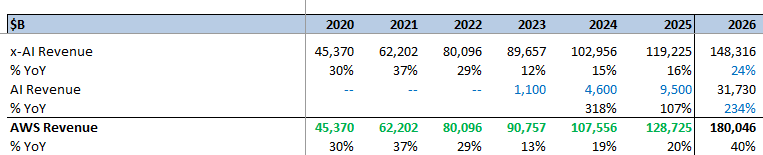
If you put together the various breadcrumbs given by $AMZN mgmt, AWS ex-AI was growing mid-teens in '25. And if you look at this Q run-rate rev, they're on track to do $180B of AWS revenue & $32B of AWS AI revenue in '26 (they disclosed $25B AI run-rate this call). Together, this implies $148B of ex-AI revenue in '26...and an impressive acceleration from mid-teens to 24% growth for the ex-AI AWS piece (!)
@Larryjamieson_ I think everyone knows that which is why it’s so cheap. Debate is what theyre going to do now. Theyve finally agreed to cap the discretionary spend now - how much value does that create at today’s market cap? Or will they not stick to this guidance?
@ContrarianCurse You don't need Caterpillar to build a replacement. Thousands of enterpreneurs will, commoditizing those sweet 40% EBITDA marigns, 5% annual price hikes, and 10% annual feature upsells
@JerryCap Now 7x EBITDA https://t.co/O13v0RJgwj…growing 10% at 40% margins! Probably the cheapest resilient AI-fear name if you believe their https://t.co/tBf6m5uNKz burn guide?
@BluthCapital Company will do $1B in EBITDA in 27/28. 22x is pretty cheap for a biz that serves as the chokepoint for TV content distribution, esp. at a time when content is becoming more commoditized.