Soy ignorante de todo lo que me rodea. Por ser ignorante, soy curioso. Por ser curioso, intento informarme. Por ende, preguntó, leo, observo y trato de ser objetivo
!Ser ignorante te da la virtud de ser curioso y las ganas de querer aprender!
Agentic attacks have been running since 2024 — chaining exploits in hours while most teams remediate in days.
That speed gap is the real kill chain.
Yochai Corem (@CheckPointSW) shares how one tertiary hospital slashed MTTR to 0.87 hours with zero IPS bypasses.
Why remediation is now the bottleneck → https://t.co/S75izwaERL
🚨 فيديو إثبات (PoC) يُظهر استغلال ثغرة جديدة باسم "YellowKey" تتجاوز حماية BitLocker كاملةً على نظام Windows.
🔹 الفيديو يوضّح خطوة بخطوة طريقة الاستغلال:
1- نسخ مجلد FsTx إلى ذاكرة USB
2- الدخول إلى وضع Windows Recovery Environment
3- تنفيذ تركيبة مفاتيح (SHIFT + CTRL) للحصول على Shell بصلاحيات كاملة على القرص المشفّر
دون الحاجة لكلمة مرور أو مفتاح استرداد
Credit: @DarkWebInformer
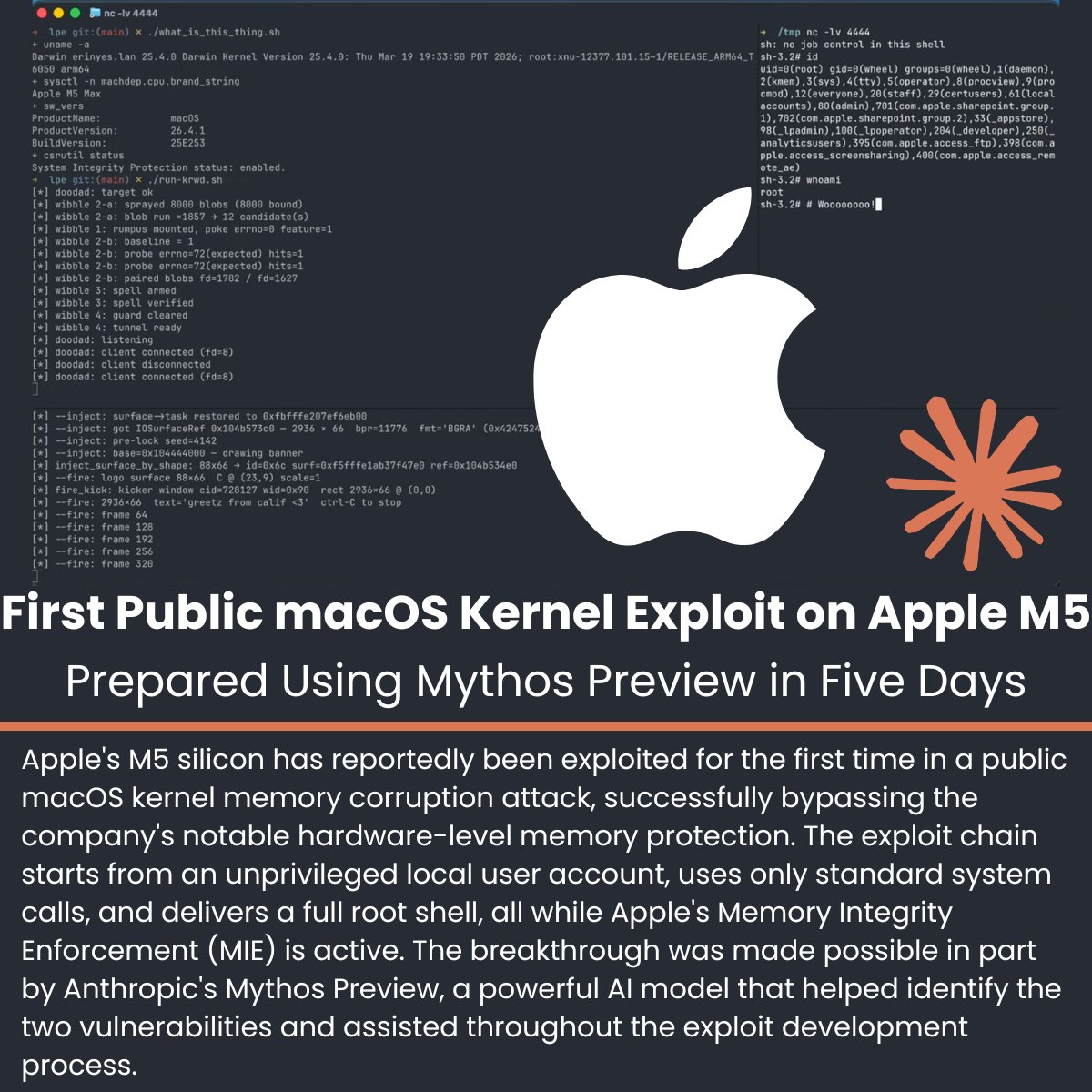
⚠️First Public macOS Kernel Exploit on Apple M5 Prepared Using Mythos Preview in Five Days
Source: https://t.co/CDD1VZTlbv
Apple's M5 silicon has reportedly been exploited for the first time in a public macOS kernel memory corruption attack, successfully bypassing the company's notable hardware-level memory protection.
The exploit chain starts from an unprivileged local user account, uses only standard system calls, and delivers a full root shell, all while Apple's Memory Integrity Enforcement (MIE) is active.
The breakthrough was made possible in part by Anthropic's Mythos Preview, a powerful AI model that helped identify the two vulnerabilities and assisted throughout the exploit development process.
#cybersecuritynews
Me hice un jueguito tipo point and click, de leer y tomar decisiones con puro vibe coding a ver si les gusta:
https://t.co/sdGqIJpawa
La historia me hizo reír un par de veces 🤣 Happy hacking 💻 🏴☠️
🚨 Blue Team Alert: Dirty Frag (LPE Linux)
Identificada vulnerabilidad crítica de escalada de privilegios (LPE) en el kernel. Explotación altamente estable (sin *race conditions* ni *crashes*).
Alcance:** Ubuntu, RHEL, Fedora, openSUSE.
🚨 Arkadaşlar, web scraping dünyasında çok ciddi bir kırılma noktası yaşandı.
OpenClaw (Scrapling), artık herhangi bir web sitesini **engellenmeden** scrape edebiliyor.
- Sıfır robot tespiti
- Cloudflare’ı doğal yollarla bypass ediyor
- BeautifulSoup’tan **774 kat daha hızlı**
- Seçici (selector) bakımına gerek yok
- Sadece veri istiyorsunuz, gerisini o hallediyor
Tamamen açık kaynak ve son derece güçlü.
Web scraping, veri toplama ve otomasyon işleriyle uğraşan herkesin mutlaka incelemesi gereken bir proje.
🔗 GitHub: https://t.co/XqGgrlerdW
Sizce bu tür stealth ve yüksek performanslı scraping araçları, veri toplama ve otomasyon süreçlerini ne ölçüde dönüştürecek?
Düşüncelerinizi yorumlara yazın, beraber konuşalım. 🕷️
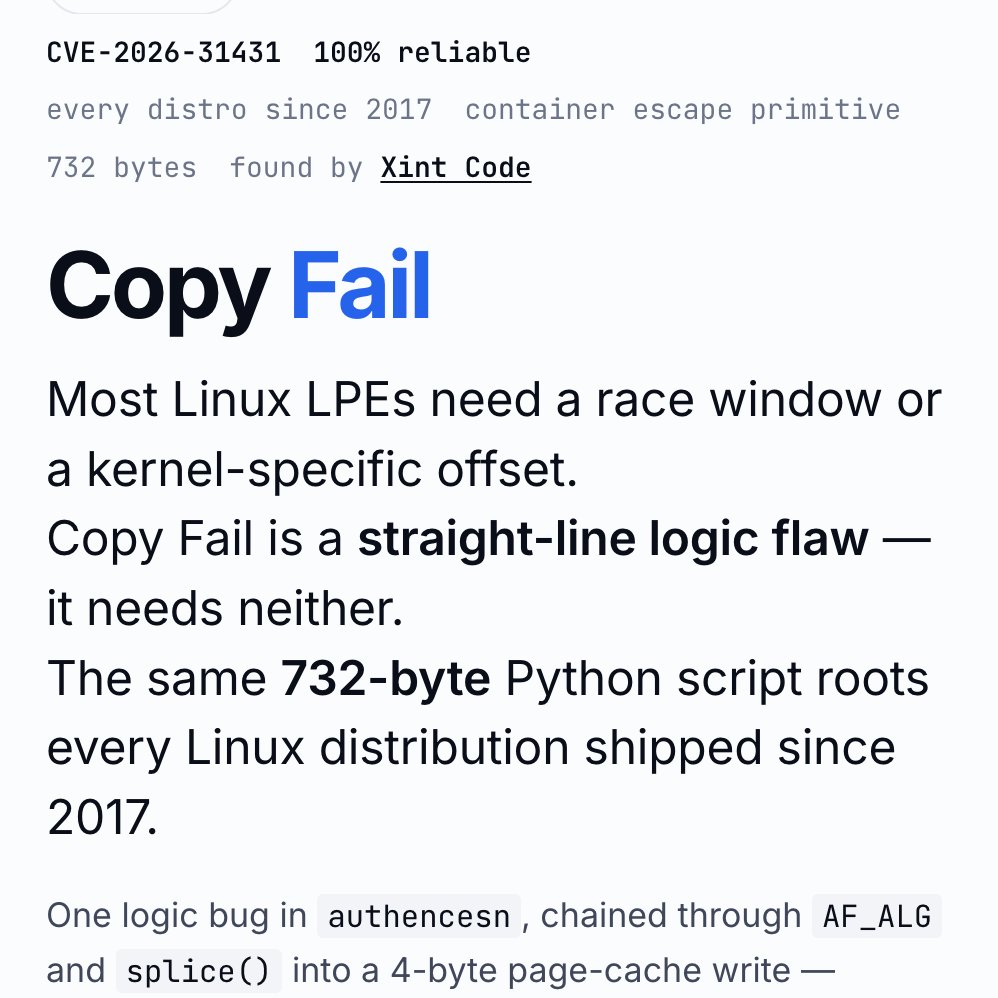
‼️🚨 BREAKING: An AI found a Linux kernel zero-day that roots every distribution since 2017. The exploit fits in 732 bytes of Python. Patch your kernel ASAP.
The vulnerability is CVE-2026-31431, nicknamed "Copy Fail," disclosed today by Theori. It has been sitting quietly in the Linux kernel for nine years.
Most Linux privilege-escalation bugs are picky. They need a precise timing window (a "race"), or specific kernel addresses leaked from somewhere, or careful tuning per distribution. Copy Fail needs none of that. It is a straight-line logic mistake that works on the first try, every time, on every mainstream Linux box.
The attacker just needs a normal user account on the machine. From there, the script asks the kernel to do some encryption work, abuses how that work is wired up, and ends up writing 4 bytes into a memory area called the "page cache" (Linux's high-speed copy of files in RAM). Those 4 bytes can be aimed at any program the system trusts, like /usr/bin/su, the shortcut to becoming root.
Result: the next time anyone runs that program, it lets the attacker in as root.
What should worry most: the corruption never touches the file on disk. It only exists in Linux's in-memory copy of that file. If you imaged the hard drive afterwards, the on-disk file would match the official package hash exactly. Reboot the machine, or just put it under memory pressure (any normal system load that needs the RAM), and the cached copy reloads fresh from disk.
Containers do not help either. The page cache is shared across the whole host, so a process inside a container can use this bug to compromise the underlying server and reach into other tenants.
The original sin was a 2017 "in-place optimization" in a kernel crypto module called algif_aead. It was meant to make encryption slightly faster. The change broke a critical safety assumption, and nobody noticed for nine years. That bug then rode every kernel update from 2017 to today.
This vulnerability affects the following:
🔴 Shared servers (dev boxes, jump hosts, build servers): any user becomes root
🔴 Kubernetes and container clusters: one compromised pod escapes to the host
🔴 CI runners (GitHub Actions, GitLab, Jenkins): a malicious pull request becomes root on the runner
🔴 Cloud platforms running user code (notebooks, agent sandboxes, serverless functions): a tenant becomes host root
Timeline:
🔴 March 23, 2026: reported to the Linux kernel security team
🔴 April 1: patch committed to mainline (commit a664bf3d603d)
🔴 April 22: CVE assigned
🔴 April 29: public disclosure
Mitigation: update your kernel to a build that includes mainline commit a664bf3d603d. If you cannot patch immediately, turn off the vulnerable module:
echo "install algif_aead /bin/false" > /etc/modprobe.d/disable-algif.conf
rmmod algif_aead 2>/dev/null || true
For environments that run untrusted code (containers, sandboxes, CI runners), block access to the kernel's AF_ALG crypto interface entirely, even after patching. Almost nothing legitimate needs it, and blocking it shuts the door on this whole class of bug...
🛑 WARNING: Bitwarden CLI was compromised in a supply chain attack.
@bitwarden/[email protected] included malicious code after attackers hijacked GitHub Actions, stole secrets, and pushed a tampered version to npm.
🔗 Learn how the attack worked → https://t.co/xqqJ7a9REL