ELON MUSK: Earth is Tiny. The Future is Space.
Human civilization uses only a tiny fraction of the Sun’s energy. Even if humanity used a million times more energy, it would still be extremely small compared to the Sun’s power.
The Sun dominates the solar system, holding around 99.8% of its total mass.
Everything outside the Sun is almost insignificant when measured against the Sun’s scale and energy.
Earth-based civilization has a natural limit because our planet’s resources are small compared to what exists in space.
To grow civilization in a truly meaningful way, humanity has to expand beyond Earth.
Space is not optional for long-term growth — it is the next step for civilization.
This is not just a song…it’s an anthem for life.
“I'm at peace with the measure of my worth.
I've freed myself from every doubt, every disguise.
Even if we win the world’s approval, peace will not come this way.
Whatever is yours will find its way to you by any means possible
Let your heart understand this truth and Jhoom, Jhoom, immerse yourself in joy.”
I’ve heard many versions of it, including Abida Parveen’s famous rendition…
This one stands out.
I don’t know who the soulful singer is, but she has brought peace to this saturday…I applaud her and thank her.
(Video courtesy @beingcalm02 )
"a first step towards becoming a Kardashev II-level civilization." - Elon Musk
In the last three weeks:
SpaceX acquired xAI, merging the world's largest rocket company with one of the fastest-moving AI labs on the planet. SpaceX valued at $1 trillion.
The stated goal of the merger: build orbital data centers. A constellation of a million satellites that generate AI compute in space, powered by near-constant solar energy with near-zero operating costs. Elon Musk's words: "Within 2 to 3 years, the lowest cost way to generate AI compute will be in space."
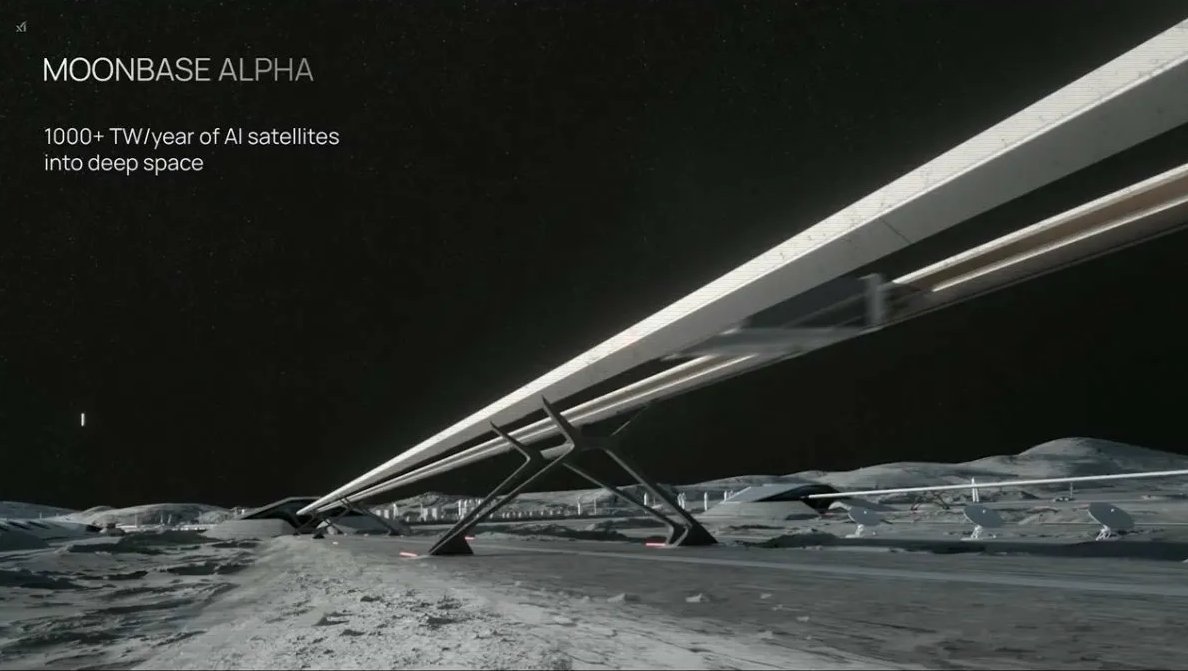
The math he laid out: launching a million tons per year of satellites generating 100 kW of compute per ton adds 100 gigawatts of AI compute capacity annually. The long-term path is 1 terawatt per year from Earth launches alone. And with lunar factories using electromagnetic mass drivers, 500 to 1,000 terawatts per year into deep space.
Elon Musk also announced SpaceX is building a self-growing city on the Moon. Target: under 10 years. First uncrewed landing: March 2027. Lunar manufacturing will feed the orbital compute network. Factories on the Moon building satellites and launching them deeper into the solar system.
And the rocket that makes all of it possible, Starship V3, with 100+ tons to orbit, orbital refueling, and Raptor 3 engines, is targeting its first flight in mid-March. The plan: launches every hour, 200 tons per flight, millions of tons to orbit per year.
The most powerful rocket in history. Aimed at the Moon. Designed to launch the largest AI infrastructure ever built. Weeks from flying.
It's happening.
Meet Velu.
He and his team have just introduced the world’s first suspension featuring DaVinci damping technology in the new Mahindra XUV 7XO
As you can see, he can’t conceal his excitement to demonstrate it personally.
Velu, or "Velu Guru” as we affectionately call him, started his journey in a government school in Namakkal, TN, before graduating from Anna University with a https://t.co/0A8EOxeLos in Automotive Engineering.
He joined us as a Junior Engineer and rose through the ranks to become Head of Technology & Product Development.
Last year, he was appointed President of our Automotive Business.
There are thousands more at Mahindra Research Valley & in our entire R&D team cast from the same mould.
Homegrown engineers who are:
Hungry to learn
Hungry to lead
Hungry to take on the world’s best.
India is a talent factory.
Which is why, in 1991, when global consultants suggested we "throw in the towel" as the economy opened up and global competitors were expected to write our obituary, we chose not to listen.
We’re still here.
We’re still learning.
And we’re still driven to serve you with world-class technology.
There’s much more to come…
Velu and our Automotive Team are not just my #MondayMotivation but my constant inspiration
This clip has been doing the rounds.
I paused to check if it was too good to be true.
It isn’t.
What it captures is a quiet success story in our own backyard.
A village that has become a role model, not just for cleanliness or sustainability or shared amenities, but for an entire way of living.
It reminds us that transformative change doesn’t require massive capital, glittering infrastructure, or shiny new buildings.
What it does require is leadership; and a community united by the will to decide its own future.
Gajanan and the people of Satara village give us powerful #MondayMotivation.
Courage, thy name is Jaspreet.
But his education shouldn’t suffer.
I believe, he’s in Tilak Nagar, Delhi. If anyone has access to his contact number please do share it.
The Mahindra foundation team will explore how we can support his education.
What are off-road vehicles meant to do?
Help people go places they haven’t been able to before..
Help people explore the impossible..
And in particular we want OUR cars to help people Rise & live their dreams..
Now you know why I love this video….
Impressive. Won’t be of any use during the kind of cyclone flooding in cities we’ve been experiencing, but I hope technologies like these become affordable & are adopted widely. They would make a big difference during normal monsoon downpours
This is a remarkable video of an incredible man who climbs a giant chimney, tasked with destroying it, one brick at a time.
Listen to this courageous man who is grateful, optimistic and hard working
Here’s a bit of Wednesday Wisdom that a friend passed on to me. Whenever I’m asked who invented the automobile, I reflexively say: ‘Karl Benz,’ I had no clue that a French Army captain Nicolas-Joseph Cugnot built the first known self-propelled vehicle using steam as the fuel in 1769! It was called the: ‘fardier à vapeur (steam dray)’ And it was a three-wheeler. (@sumanmishra_1 please note!We should all have more respect now for the humble auto-rickshaw. 🙂) Benz built the 1st gasoline powered vehicle, but as we know, the fuel used should not be the criterion. After Cugnot, Robert Anderson, a Scotsman built the 1st Electric carriage around 1832 and Benz followed only in 1885.