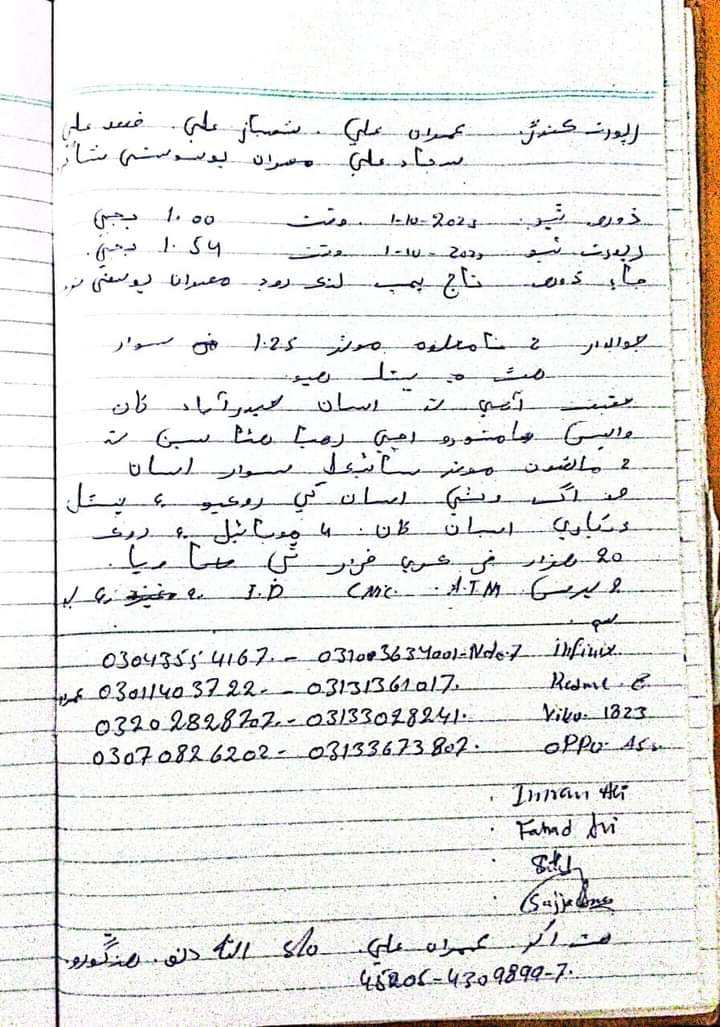
Jamshoro's law and order is in chaos, with criminals causing routine robberies. Four smartphones and 20 thousand cash were stolen from Mehran University students by highway policemen. We urge the administration to act promptly, return the stolen items, or face student protests
Every budget season, Pakistan returns to the same question:
How do we raise more taxes?
It is an important question, but I am not convinced it is the first one we should be asking.
Perhaps we should begin with something more fundamental:
Why do we continue to tolerate a system that allows wealth to be transferred through exemptions, distortions, preferential treatment and protected privilege?
This is the essence of what economists describe as elite capture.
According to some estimates, its annual cost to Pakistan runs into trillions of rupees. The exact number will always be debated, but the broader issue is difficult to ignore.
Elite capture is often misunderstood as an attack on wealth or successful businesses. It is neither.
Every economy needs entrepreneurs, investors and companies that create jobs, innovate and generate prosperity.
The problem begins when economic success depends less on productivity and competition, and more on access, influence and preferential treatment.
A competitive economy rewards innovation, efficiency and risk-taking.
A captured economy rewards proximity to power.
The greatest cost is not simply the revenue lost to the state. It is the investment that never happens, the entrepreneur who never enters the market, the business that cannot compete on equal terms, and the innovation that never reaches consumers.
These losses do not appear in the national accounts, yet they reduce growth year after year.
This is why fiscal reform cannot be confined to tax rates and revenue targets. It must also address the institutions and incentives that allow economic privilege to become entrenched.
Pakistan does not need an economy where everyone ends up with the same outcome.
It needs an economy where everyone begins with the same rules.
Only then can markets reward merit rather than influence, competition rather than connections, and enterprise rather than privilege.
That is not only a question of fairness.
It is a prerequisite for sustainable economic growth.
The greatest cost of elite capture isn’t the revenue the government loses.
It’s the opportunities ordinary Pakistanis never receive.
Every protected privilege means a competitor kept out, an entrepreneur discouraged and an innovation that never reaches the market.
That cost never appears in the budget, but it is paid by the entire economy.
Are cryptocurrencies haram or halal?
It is a question that will haunt us for quite some time, as Mufti Taqi Usmani has declared cryptos haram.
Any reader of Islamic jurisprudence will find that a blanket ruling declaring all cryptocurrencies halal or all haram is difficult to justify using classical fiqh methodology. Each currency has to be analysed individually.
I will write about how the Islamic world now comfortably uses paper money and plastic money in the form of debit and credit cards, and has long used copper coins, leather coins, etc. As a student of economics and finance, I will draw parallels and contrasts for the future.
The classical juristic question was never: Is it gold, paper or digital?
The real questions were: Does it qualify as māl (an asset with recognised value)? Has it acquired thamaniyyah (the status of money)? Does it function as a reliable medium of exchange, store of value and unit of account? And is it free from riba (interest/usury), gharar (excessive uncertainty) and maysir (gambling or speculation which looks like gambling)?
That is where the crypto debate truly begins.
A common misconception is that Islam only recognises gold and silver as money.
The four Sunni schools never froze the concept of currency. Muslim societies have historically used gold, silver, copper (fulūs), and later accepted representative and fiat money as commerce evolved.
The principles remained the same but money changed many forms.
The strongest argument for Bitcoin is that it is scarce, transferable, widely recognised and increasingly treated as māl by millions.
The strongest argument against it is not that it is digital, but that today it is driven largely by speculation, extreme volatility and questions over whether it has truly acquired thamaniyyah.
The debate is therefore about applying classical fiqh principles to a modern problem not inventing new ones.
The IMF programme may talk about stabilisation. But Pakistan’s problem has never only been the deficit. It is the method of reducing the deficit. If stability is built on regressive taxation, the government may showcase improvement in numbers but the condition of the common man will deteriorate.
Pakistan’s deficit has fallen to 0.7% of GDP.
But petroleum levy collection has jumped by 45% to Rs1.205 trillion.
This is not fiscal genius. This is fiscal pain transferred to the common man through petrol, transport, food prices and daily survival.
Broadening the tax base and improving governance, reducing wasteful government expenditure, and plugging the bleeding SOEs. There can be a long list of what must be done, but the core is whether we have the sincerity and resolve to do it.
While the nation feels the pinch of skyrocketing fuel prices, the govt has passed the entire burden onto consumers. Petrol & diesel both hit ~Rs 414/litre today after another hike.
This isn’t just “fuel”, it’s an indirect tax on everyone, hitting the poor hardest.
Transportation costs surge → prices of food, milk, veggies, medicines all go up.
Are we awake to this?
A thread : 1/6
The pleasure of doing nothing is a great concept.
It’s not about doing nothing but about being calm, enjoying the moment, and appreciating simple pleasures of life.
Today, loneliness is no longer merely a private sadness. It has become a public health issue. The World Health Organization has warned that social isolation and loneliness are linked to higher risks of heart disease, stroke, diabetes, cognitive decline, depression, anxiety and premature death. The U.S. Surgeon General has compared the mortality effect of social disconnection to smoking up to 15 cigarettes a day.
A society of lonely people becomes easier to manipulate, easier to anger, easier to divide and easier to sell things to. Loneliness is not only a health crisis. It is a social and political crisis.