Arthur Hughes painted Amy in 1857, the year his daughter of that name was born, and finished The Long Engagement two years later. The smaller oil on panel reads as a trial for the canvas: the same lovers, the same tree with her name carved into it, ivy already growing over the letters.
Her slight smile can be read as a secret or as regret. No ring, and the ivy, leave the story open — a tryst still waiting, or a love already past.
Both works are in the Birmingham Museums and Art Gallery.
Amy, 32 × 18.5 cm. The Long Engagement, 105.4 × 52.1 cm.
#paint #art #artistsoftwitter #painting #oilpainting #oilpaint #3Octubre
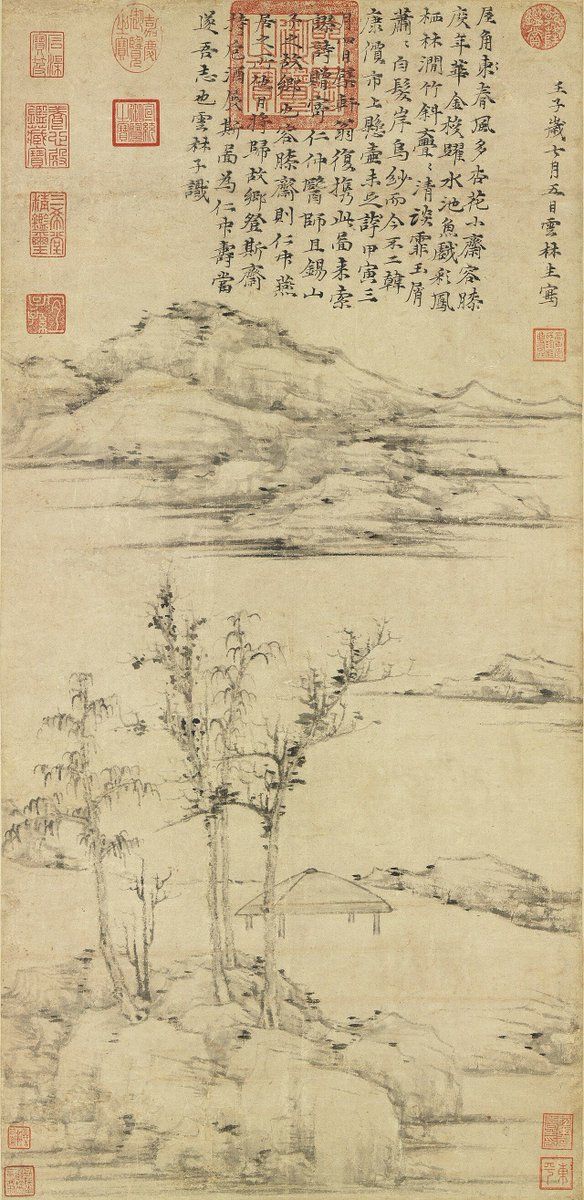
Ni Zan was born rich. When famine and revolt hit, on top of heavy taxes, he gave it all away to friends and moved onto a houseboat. His bare riverbank landscapes never show a person. The Rongxi Studio, 1372.
National Palace Museum, Taipei
#ChineseArt#ArtHistory#Art
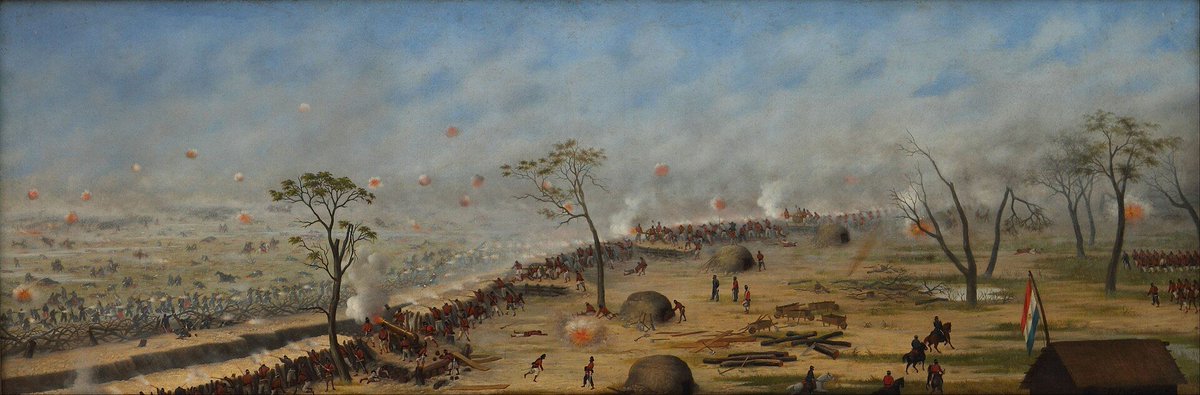
It was 1869 before he felt good enough to carry on. From then on he painted battles and army camps, working from sketches he'd made at the front. This is the trench at Curupayty, painted in 1893. The soldiers are tiny, and the sky is calm.
Cándido López signed up when the Paraguayan War began. At the Battle of Curupayty a grenade shattered his right wrist and his arm had to come off above the elbow. So he taught himself to paint left-handed.
Museo Nacional de Bellas Artes, Buenos Aires
#ArtHistory#Art
By 1910, when he painted Black Cat, Hishida Shunsō had kidney disease and was scared of going blind. He painted in a rush whenever he felt better. He died the next year, just short of 37.
Eisei Bunko collection, Kumamoto Prefectural Museum of Art
#JapaneseArt#ArtHistory#Art
John Singleton Copley, Watson and the Shark (1778).
Copley never went to Havana and likely never saw a shark. This one has lips. The boy, Brook Watson, lost a leg in the 1749 attack and later became Lord Mayor of London.
National Gallery of Art @ngadc#Copley#ArtHistory#Art
Frances Benjamin Johnston's first camera was a gift from George Eastman, the Kodak man. By 1894 she was the only woman photographer in Washington. Here she is in 1896 with a cigarette and a beer stein.
Library of Congress, Washington @librarycongress#WomenInArt#ArtHistory#Art
Sehando means a picture of the bitter cold around the lunar new year. Yi took it to China in 1845 and 16 scholars there wrote tributes onto it, so it grew into a long scroll. By 1943 it was in Japan, and the calligrapher Son Jae-hyeong went over to bring it home.
In 1844 Kim Jeong-hui was in exile on Jeju Island. His student Yi Sang-jeok kept bringing him rare books from China anyway. As thanks, Kim painted him this. Just a bare hut under old pines, and a lot of empty paper.
National Museum of Korea, Seoul
#KoreanArt#ArtHistory#Art
Ethel Carrick painted this Balmoral Beach scene on a 1913 trip out from Paris, and that November she had her own show in Sydney. Busy beaches and parks full of people were her thing.
Mosman Art Gallery, Sydney
#AustralianArt#ArtHistory#Art
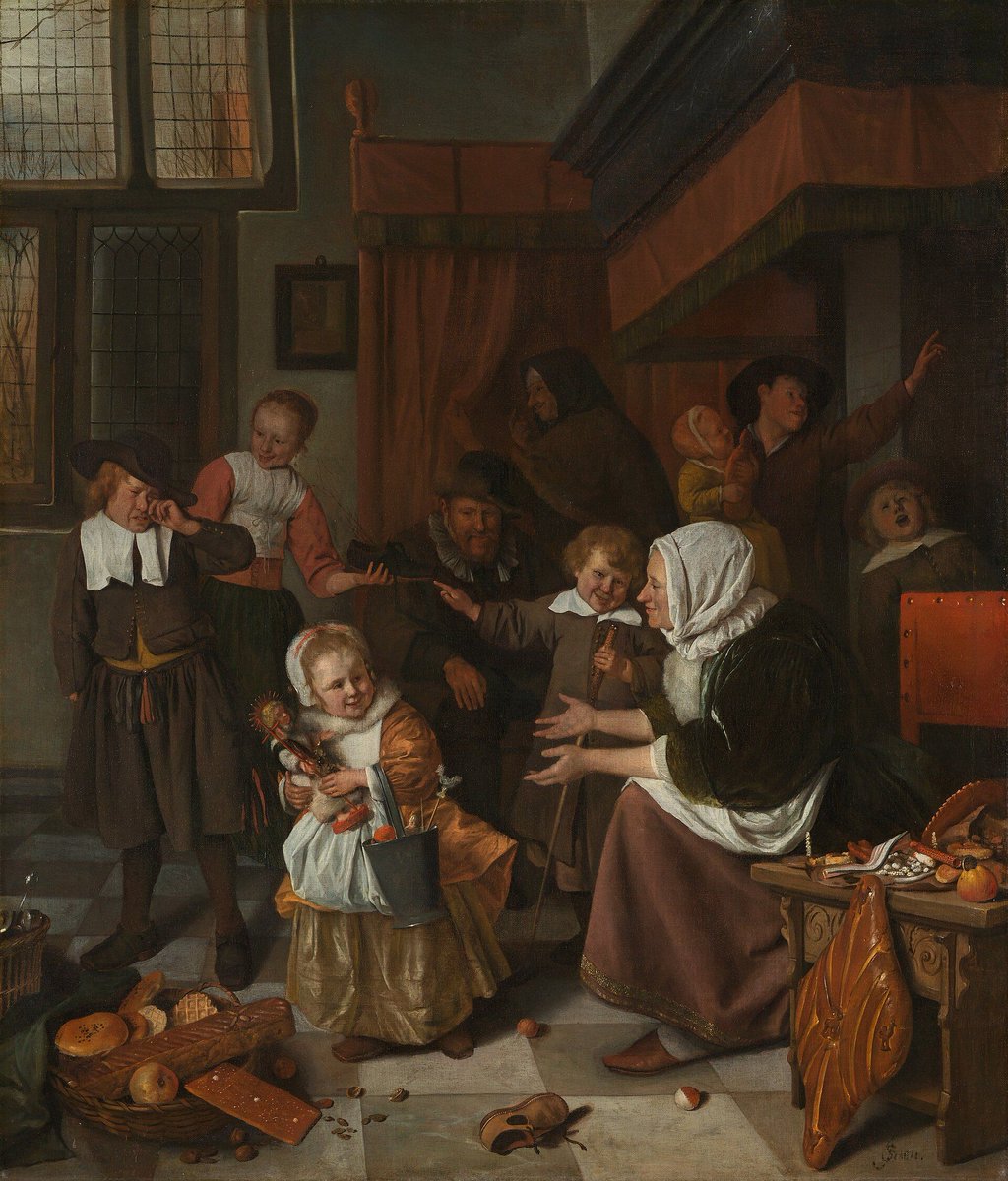
Jan Steen, The Feast of Saint Nicholas (1660s).
His family scenes got so chaotic that a messy home became known in Dutch as a Jan Steen household. He ran a brewery for a while, and later a tavern.
Rijksmuseum, Amsterdam
#JanSteen#DutchGoldenAge#ArtHistory#Art
Soga Shōhaku had lost his whole immediate family by 18. He picked a brush style that was out of date 150 years before he was born, and painted Zen saints and famous poets as grotesque, vulgar types. This one's calmer.
The Met, New York @metmuseum#JapaneseArt#ArtHistory#Art
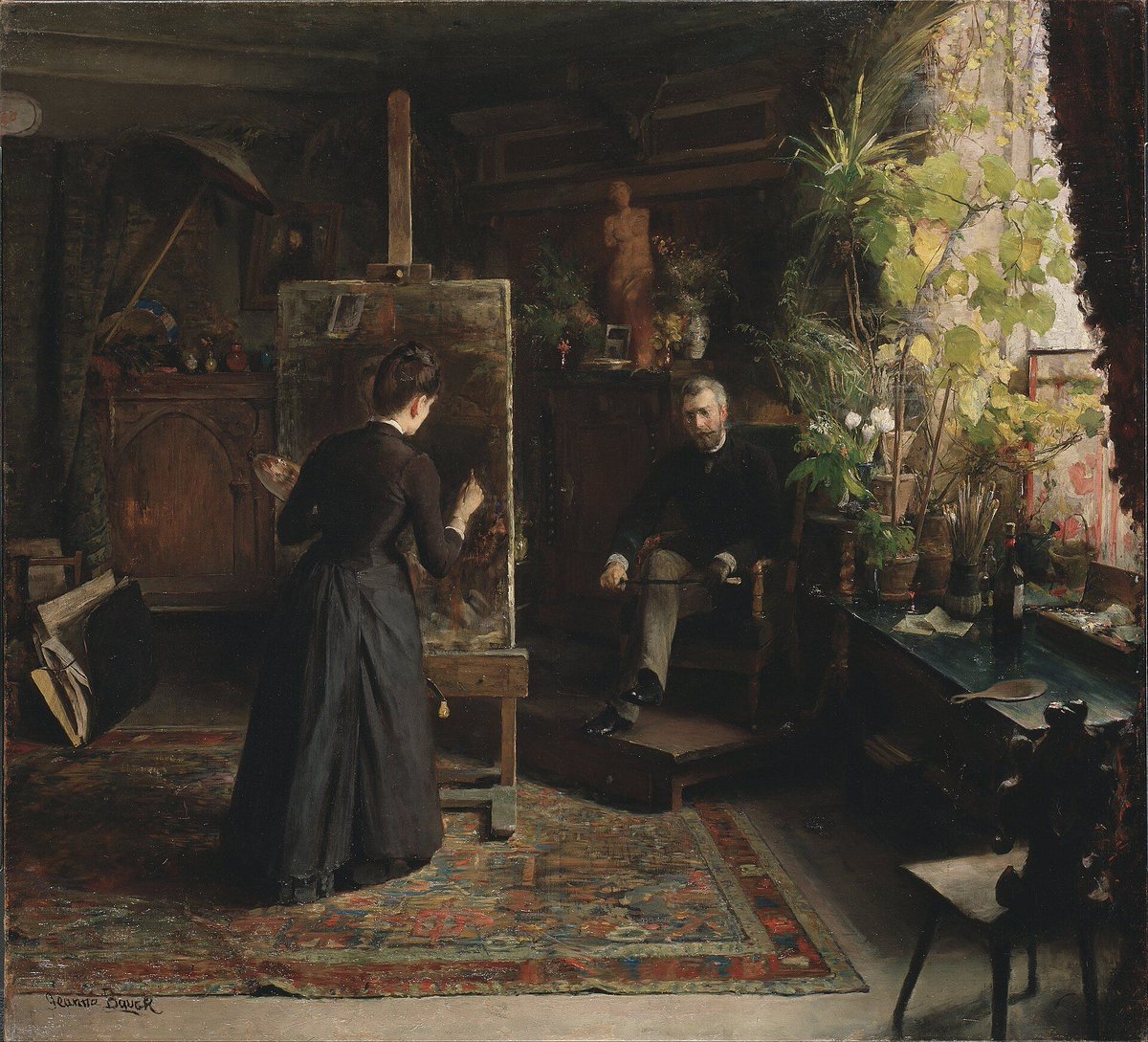
Bertha Wegmann became the first woman to hold a chair at the Royal Danish Academy in 1887. Here she's at work, painted by her close friend, Swedish artist Jeanna Bauck. The two travelled together and each painted the other.
Nationalmuseum, Stockholm
#WomenInArt#ArtHistory#Art
Pedro Américo finished Independence or Death in Florence in 1888, 66 years after Prince Pedro declared Brazil independent. It was meant to glorify the monarchy. The very next year Brazil became a republic.
Museu Paulista, São Paulo
#BrazilianArt#ArtHistory#Art
Mikhail Vrubel, The Demon Seated (1890).
His first big canvas in Moscow. Critics tore into it. He laid the paint on with a knife, so it looks like stained glass. Vrubel said his demon was less evil than suffering.
Tretyakov Gallery, Moscow
#Vrubel#Symbolism#ArtHistory#Art
@metmuseum They went back a long way. She'd met Herschel at the Cape of Good Hope when she was young, and in 1839 he wrote to tell her about a new invention called photography. Critics of her day sneered at her soft focus, but her portraits of him have always been admired.
Julia Margaret Cameron got her first camera at 48, a present from her daughter. She took around 900 photos in about 12 years and is credited with the first close-ups in photography. This is Sir John Herschel, 1867.
The Met, New York @metmuseum#WomenInArt#ArtHistory#Art
In 1447 a Korean prince dreamed of a peach blossom paradise and asked the court painter An Gyeon to paint it. An took three days. It's thought to be the oldest surviving Korean landscape painting.
Tenri University, Japan
#KoreanArt#ArtHistory#Art
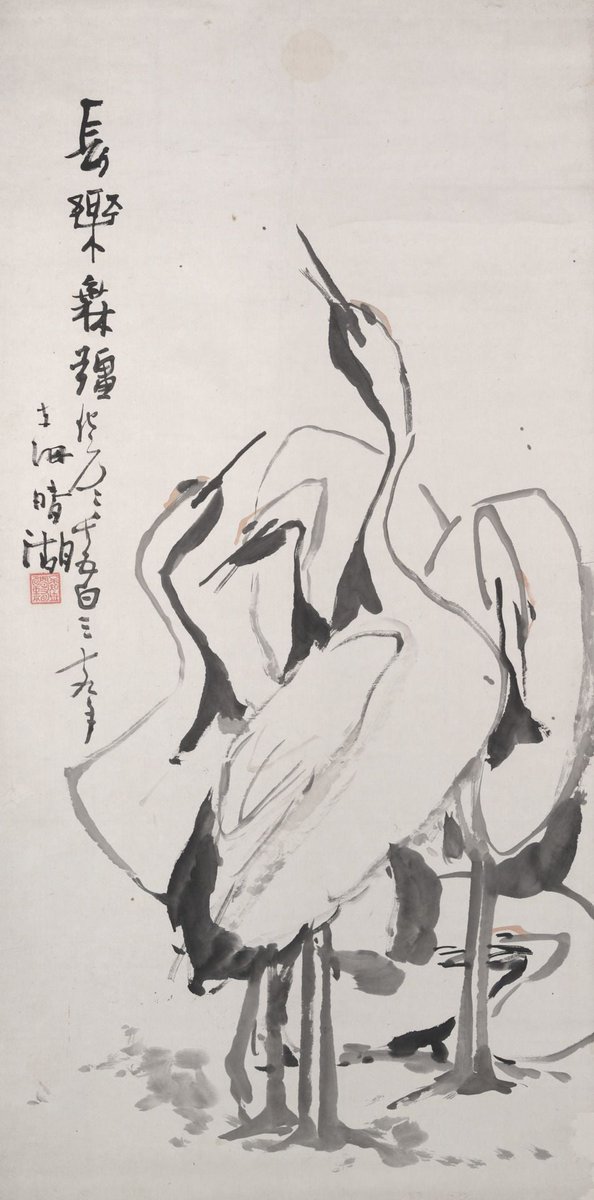
Okuhara Seiko wore her hair short, dressed in men's clothes and swapped her name Setsuko for the gender-neutral Seiko. She became a leading literati painter of Meiji Japan and ran her own school. Her cranes.
Yale University Art Gallery, New Haven
#JapaneseArt#ArtHistory#Art
Franz Marc, Blue Horse I (1911).
At first it was mocked and even spat on. For Marc and the Blue Rider group, blue stood for the spiritual. By 2010 it was one of the most reproduced paintings in art history.
Lenbachhaus, Munich
#FranzMarc#Expressionism#ArtHistory#Art
Lilla Cabot Perry had no formal art training until 36. After seeing Monet's work in Paris she spent nine summers at Giverny, became his friend and helped bring Impressionism to the US. Angela, 1891.
High Museum of Art, Atlanta
#WomenInArt#ArtHistory#Art