🚀 SWE-rebench V2.1 RL is out: 13,337 free RL environments for coding agents (20 languages, Harbor format)!
🔧 Fixed tasks, envs, and graders → fast, reliable rollouts.
Doing RL post-training or research? DM or reply. We can share data and RL envs early for free, so we can make them better for open source!
🙏 Please RT or share with anyone who might need free RL envs!
this is how finding GPUs goes
1. someone says they have GPUs
2. turns out they are a broker for some other guy
3. that guy doesn't have the GPUs either, they are waiting for a buyer so they can place an order
5. they don't even have the space yet, that is owned by some other guy who's upgrading it
one of these guys is always named carl
Hot take: The compute credit crunch is not real and Elon is fearmongering.
I see no slowdown in my non-IG pipeline (deals under $500M mostly)
Real issues:
- Higher interest rates
- Supermicro delaying all their deliveries
A 300-rack AI supercomputer powered by 9,600 Nvidia A100 GPUs is listed on eBay for $59.7M.
That’s 1,200 GPU compute servers with 384TB of combined GPU memory and roughly 1.4 petabytes of system RAM.
Each compute server connects eight A100 GPUs through $NVDA's NVSwitch technology.
More than six years after A100 launched, The seller is offering these systems refurbished for new AI training and inference deployments.
which one earns more per unit of silicon:
renting gpus per hour, or selling inference per token?
compressed insights:
-> for the gpu-hour seller: h100 repriced up ~40%, b200 repriced up ~15%
-> for the token-seller: algorithmic optimization keeps cutting the cost of serving 1M tokens -> margin expands
the dilemma:
-> for the token-seller: token prices fall ~10x/year as better models come out
-> for the gpu-hour seller: efficiency makes more workloads economical on the same card
conclusions:
-> the token-seller needs to outrun the curve of intelligence capabilities with inference optimization to keep margins
-> the gpu-hour seller wins as long as ai penetrates more verticals and demand grows faster than efficiency shrinks it
curious what people pricing either side of this think; which one actually compounds?
the case against owning GPUs was always depreciation: “obsolete in 2 years”
-> H100 (2023): 1-yr contracts repriced UP 40% between oct ‘25 and mar ‘26
-> B200 (2025): under $5/hr in january, $5.5–5.8 by august
inference demand keeps growing, and efficiency gains mean that an old gpu can serve more tokens per hour than it did at launch
anyone buying GPUs owns an asset that can appreciate mid-life
CoreWeave's debt, explained simply, because I like to speak plainly:
Secured debt = the mortgage. Backed by the house. The GPUs and the contracts they serve are the collateral.
Unsecured debt = the credit card.
Backed by a promise.
Everyone is panicking that $CRWV UNSECURED yield to MATURITY hit 15%
But a credit card rate spiking doesn't mean the house (or in this case the GPUs/data centers) lost value.
The secured lenders or the ones who underwrote the actual GPUs and contracts aren't selling here.
Now zoom out, because this is analogous to the entire AI market in wrapped up in a single company.
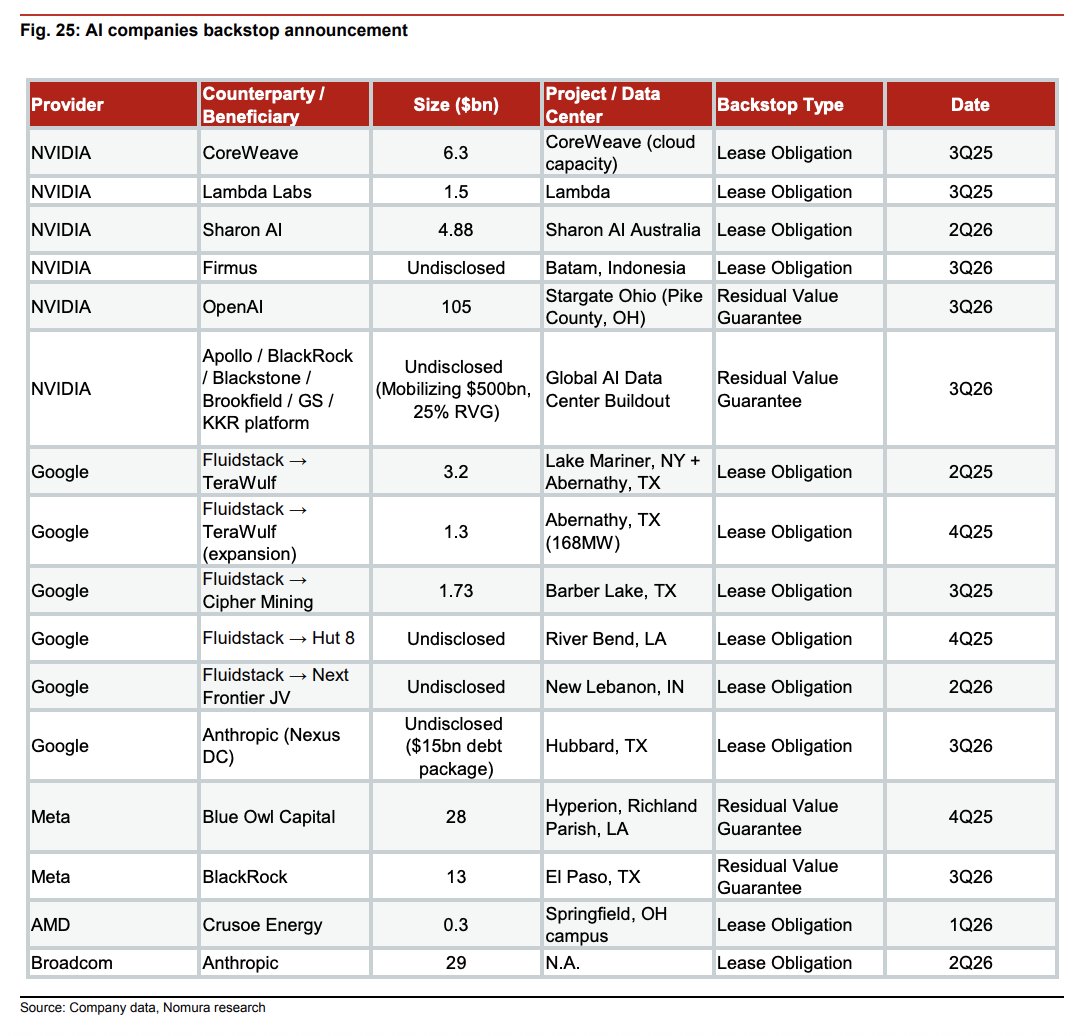
Trillions in secured, asset-backed debt are loaned against GPUs, data centers, power contracts, and signed capacity deals with hyperscalers. This money doesn't care about stock prices or investor sentiment.
It gets paid if the contracts pay. (Sounds pretty similar to $next if you ask me…)
Below that in line is unsecured debt, a bet on the companies themselves.
On top of everything is the equity, a bet on the story.
So when you see scary headlines about "AI debt," ask one question: which layer?
Yields spiking on unsecured debt and equities dropping while secured debt sits calm simply means the market is repricing the story.
The assets are fine.
The buildout keeps getting funded because the secured debt holders still believes in the collateral.
The day that changes… well the day secured lenders start questioning GPU values and contract quality, is the day the AI trade actually breaks and we should run for the hills.
Until then, volatility at the top of the stack (unsecured, equities) is just the shock absorbers doing their job.
i spent 2 weeks digging into task-level agent benchmarks and derived a fixed unit of agentic work per sector:
-> index of agentic work in Operations: $22.60
-> index of agentic work in ML: $13.90
-> index of agentic work in Security: $7.62
-> index of agentic work in Hardware: $8.43
-> index of agentic work in Software: $6.76
i think pricing agents on the value they deliver, rather than the tokens or GPU time they consume, will make markets more efficient.
(index = $ spent per completed task, normalized for tokens, model type, and retries before the task passes)
i spent 2 weeks digging into task-level agent benchmarks and derived a fixed unit of agentic work per sector:
-> index of agentic work in Operations: $22.60
-> index of agentic work in ML: $13.90
-> index of agentic work in Security: $7.62
-> index of agentic work in Hardware: $8.43
-> index of agentic work in Software: $6.76
i think pricing agents on the value they deliver, rather than the tokens or GPU time they consume, will make markets more efficient.
(index = $ spent per completed task, normalized for tokens, model type, and retries before the task passes)
I had 1,270 agent sessions sitting in ~/.claude, ~/.codex and ~/.pi
that’s an eval set: my corrections to the agent are the test cases
turned it into the my-mini-benchmark. now I test any model, harness or plugin on my own tasks
guide + the skill 👇 https://t.co/oaRtwFJTxT
there is huge interest in compute markets and it’s all built on the idea that GPUs/tokens are fungible.
my finding is that $/1M tokens has a weak correlation (spearman = −0.26) to how much it would cost for an agent to complete a task.
GPU $/hr is one step further removed from delivered work.
this means inference contracts and the valuation of any lab, cloud, or company running agents are tied to a variable that token and gpu prices capture only indirectly.
calculating value delivered by agent per $ spent is a great instrument for hedging and absorbing risks for:
-> lenders financing GPU build-outs against future revenues
-> cloud providers reselling inference
-> and anyone doing unit economics on labs and clouds.
i spent 2 weeks digging into task-level agent benchmarks and derived a fixed unit of agentic work:
-> index of agentic work in Operations: $22.60
-> index of agentic work in ML: $13.90
-> index of agentic work in Security: $7.62
-> index of agentic work in Hardware: $8.43
-> index of agentic work in Software: $6.76
($ spent per completed task, normalised on tokens spent, model types, and retries until the task actually passes)
could we make a unit of agentic work a commodity?
compute scarcity doesn’t just raise prices - it degrades standardization.
when supply gets tight, buyers stop getting the clean, canonical product.
restricted GPUs get stripped for dies + memory and rebuilt onto custom boards. clusters cut on network, storage, redundancy, or cooling. datacenters use whatever power they can get online fastest. and buyers take what they can get.
the market is becoming less fungible as people are trying to trade and finance it like a commodity.
neoclouds that figure out how to be power-first (not just gpu-first) will do much better than the ones that stay nvidia resellers
this will help them get customers and give them freedom (both in not being locked into just nvidia, and finally not depending on a landlord for their data center)
they're following the playbook of the ones who figured this out first, @CrusoeAI and @IREN_Ltd
now we see other neoclouds trying to do the same:
- @CoreWeave tried to buy @Core_Scientific for $9B, partly to get more power and sites (core scientific’s shareholders voted no)
- @nebiusai is building its own data centers in missouri, pennsylvania, and finland instead of renting space
it's the same reason inference companies want to own their gpus instead of renting them. for neoclouds, owning power matters just as much
- it will get them customers faster. AI companies need more and more compute and will do deals with whoever has compute. a neocloud that owns power won't need to wait
- it gives them the option to swap in new gpus, especially if they start using more than one kind of chip (which is already happening and will happen even more)
- no landlord! if you own the site, you’re not paying part of what you make to a landlord
i was able to cut inference costs by 17x using prompt optimization
what took me the longest was setting up evals + preparing the dataset
the recipe:
→ collect your agentic trajectories
→ build a golden reference train/test set
→ run GEPA (developed at uc berkley/stanford) to make the cheaper model match the capability of a larger one
i’m planning to open source the framework that does this automatically.
do you think prompt optimization will beat fine-tuning?
We were able to fine tune an open weight model (Qwen3.5-9B) on proprietary internal data at @coinbase, and it out performed frontier models, at much lower cost and speed, for a specialized task (fraud prevention in this case).
I think we'll see more of this pattern inside companies. The frontier models are amazing generalists. But increasingly you'll see specialist models out perform on more narrow tasks, either working on teams, or by themselves.
We're making it easy to fine tune models internally for our employees. We even have a skill for it in our internal harness that makes it easy to spin these up and start training them:
"/fine-tune-and-serve-llm I want to fine-tune Qwen for payments risk review. help me get started"
I imagine we'll have some backend services that could be replaced entirely by this new architecture.
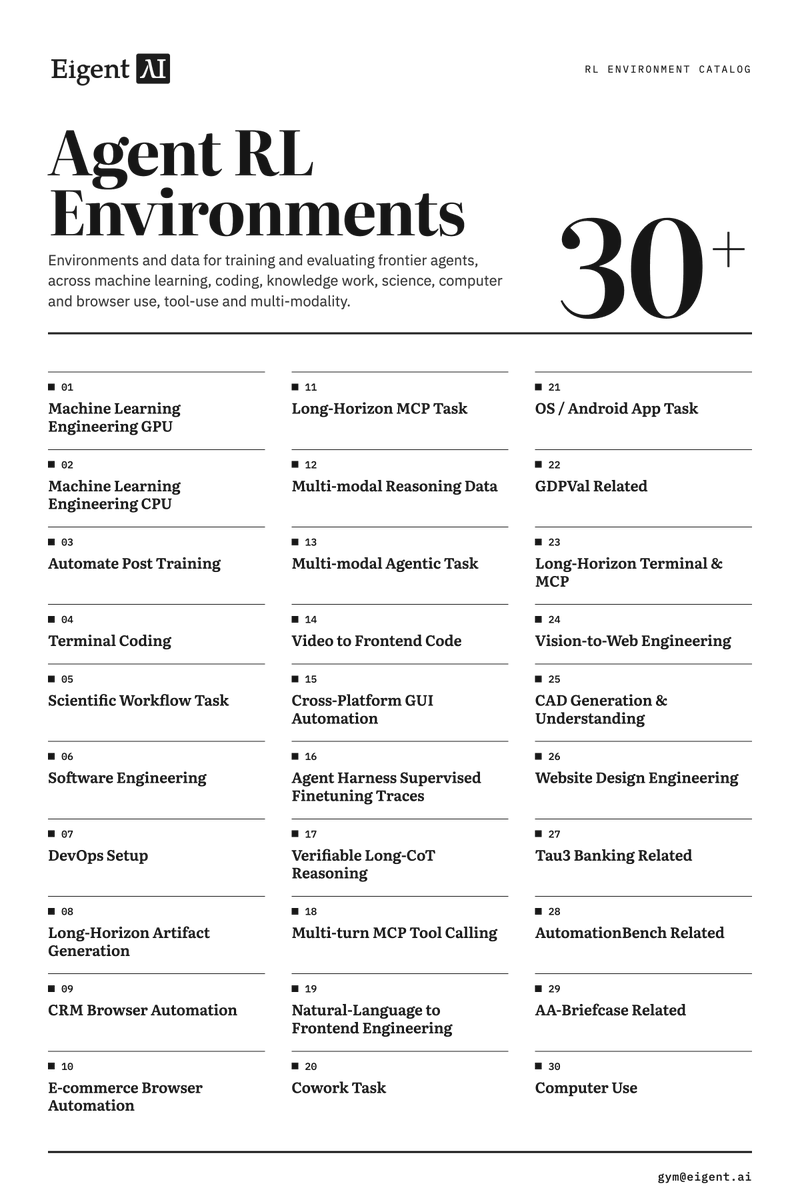
Many discussions about RL environments lately. Happy to share that we’ve just crossed $12M in annualized revenue from building RL environments for frontier labs!
From open-sourcing RL environments in 2024 to securing our first contract with a frontier lab in January 2026, we’ve come a long way. Since then, we’ve been building 30+ types of RL environments across machine learning, coding, knowledge work, science, computer and browser use, tool use, and multimodality. And we’re just getting started.
Would love to chat with folks working on model training and RL environments!
nobody sees the true bottleneck to AI drug discovery's growth (capital allocation view)
here is the chain of thought:
-> ~90% of drugs fail in trials, mostly because we fail to understand how disease works (efficacy).
-> drugs with human genetic support are ~2x more likely to get approved.
-> LLMs excel at reasoning across a massive corpus of data, so they can improve our understanding of disease.
-> LLMs enable hypothesis generation at scale and move the bottleneck to wet labs and data.
for capital allocation, this means tracking what shapes wet-lab demand:
-> target and disease biology
-> target types (which point to modality, and so to manufacturing needs)
-> trial design
-> why trials were discontinued
-> etc.
to track that, we need large-scale standardization of existing biological and financial data.
interestingly, this is not a trivial task to accomplish at scale ($/tokens spent to achieve X% data extraction accuracy).
the edge goes to whoever has properly structured data that an LLM can reason from.
to accomplish this, i built self-improving agents that extract intelligence at scale on:
-> target and disease biology
-> clinical trials and human readouts
-> chemistry data
if you invest in biotech institutionally or run a biotech, i would love to chat!!