Researcher studying nonequilibrium thermodynamics, info theory, origin of life, complexity. Currently at U Pompeu Fabra in Barcelona. @artemyte.bsky.social
Our new work on arXiv🔥
We introduce the geometric complexity for reset maps and uncover a dynamics-independent trade-off relation between complexity and error, which can be regarded as a generalized geometric third law of thermodynamics.
https://t.co/KJq6l14Rcs
This was a very fun collaboration with Giacomo and Jonathan, and my first chance to dive deep into the thermodynamics and dynamics of phase separation.
How does phase separation, a key mechanism of equilibrium self-organization, interact with nonlinear nonequilibrium dynamics? In our paper with Jonathan Bauermann and Giacomo Bartolucci, we look at phase separation in chemical oscillators
https://t.co/rz5E04nFbS
We find that phase separation can slow down, speed up, damped or amplify oscillations, depending on alignment b/w interaction energies & nonlinear kinetics. In spatial systems with phase separation + reaction + diffusion, rich traveling patterns of concentration & phase emerge
Open postdoc with the amazing Sarah Marzen (Scripps College, Claremont, California). Intersection of information theory, biophysics, neuroscience, and machine learning. Please RT https://t.co/NbOirl6ZlZ
We discuss research on non-Markovian systems, active matter, and optimal transport, as well as challenges in scaling up stochastic thermo to complex systems beyond the microscopic scale.
We wrote a perspective piece on future directions & challenges for stochastic thermodynamics. Great collaboration with Jan Korbel, Sarah Loos, Gonzalo Manzano, Rosalba Garcia-Millan, Olga Movilla Miangolarra, Edgar Roldan @edgarroldankb https://t.co/rXDNLX8Zw9
Our paper with Andreas Dechant, Kohei Yoshimura and @ito_sosuke is out in Phys Review Research (https://t.co/HC9DAVToz1). We propose a "generalized free energy" for nonequilibrium systems, plus an information-geometric decomposition of dissipation into excess & housekeeping terms
The paper builds on our earlier work (https://t.co/gtMa9w5vSR) on decompositions of entropy production based on Euclidean geometry, which works best for near-equilibrium and diffusive systems. As we show here, info-geometry emerges naturally in the far-from-equilibrium regime
How do time series foundation models forecast unseen dynamical systems? In new experiments, we find that small transformers learn to approximate transfer operators in-context. (1/N)
https://t.co/6YuLr8QuJD
@RomeoLupascu@pfau@m_aguilera_@ito_sosuke To be precise, the term "neural data" refers to actual brain recordings (spike train dataset). In our paper, we did not apply our method to neural networks
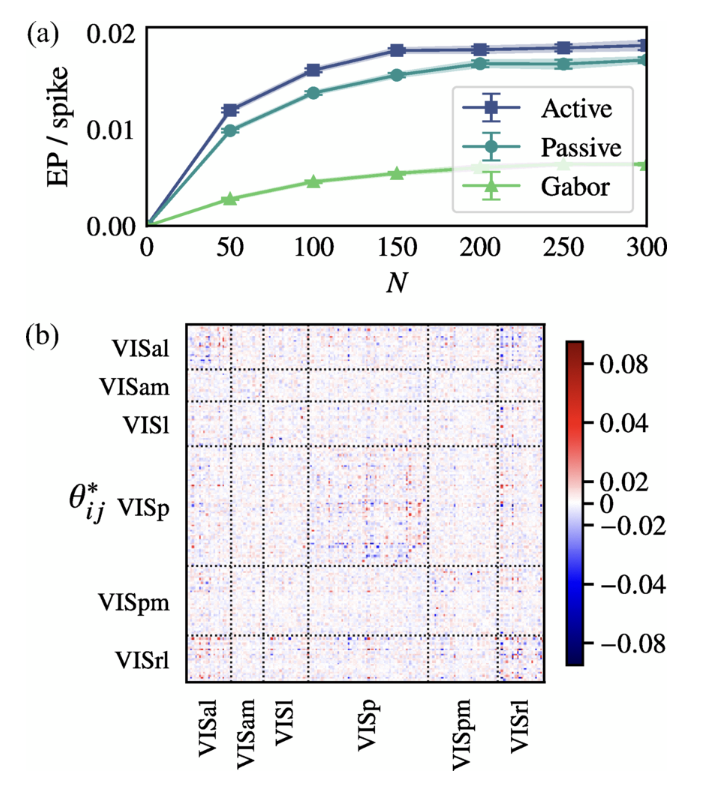
Our paper w/@m_aguilera_& @ito_sosuke is out in PRL. We combine ideas from stochastic thermodynamics & nonequilibrium Maximum Entropy to quantify forces + dissipation in high-dimensional nonequilibrium systems, including spin glasses and neural data
https://t.co/dnDycyJeew
Generative thermodynamic computing
Diffusion models are powerful generative tools, but they come with a hidden cost: every denoising step requires a digital neural network, artificially injected noise, and substantial energy consumption. Yet physics offers an alternative—what if the noise needed for generation arose naturally from thermal fluctuations, and the denoising process was physically enacted rather than simulated?
Stephen Whitelam introduces exactly this: a generative modeling framework for thermodynamic computing. Instead of using neural networks to transform noise into structure, the approach encodes denoising information directly in the energy landscape of a physical system evolving under Langevin dynamics.
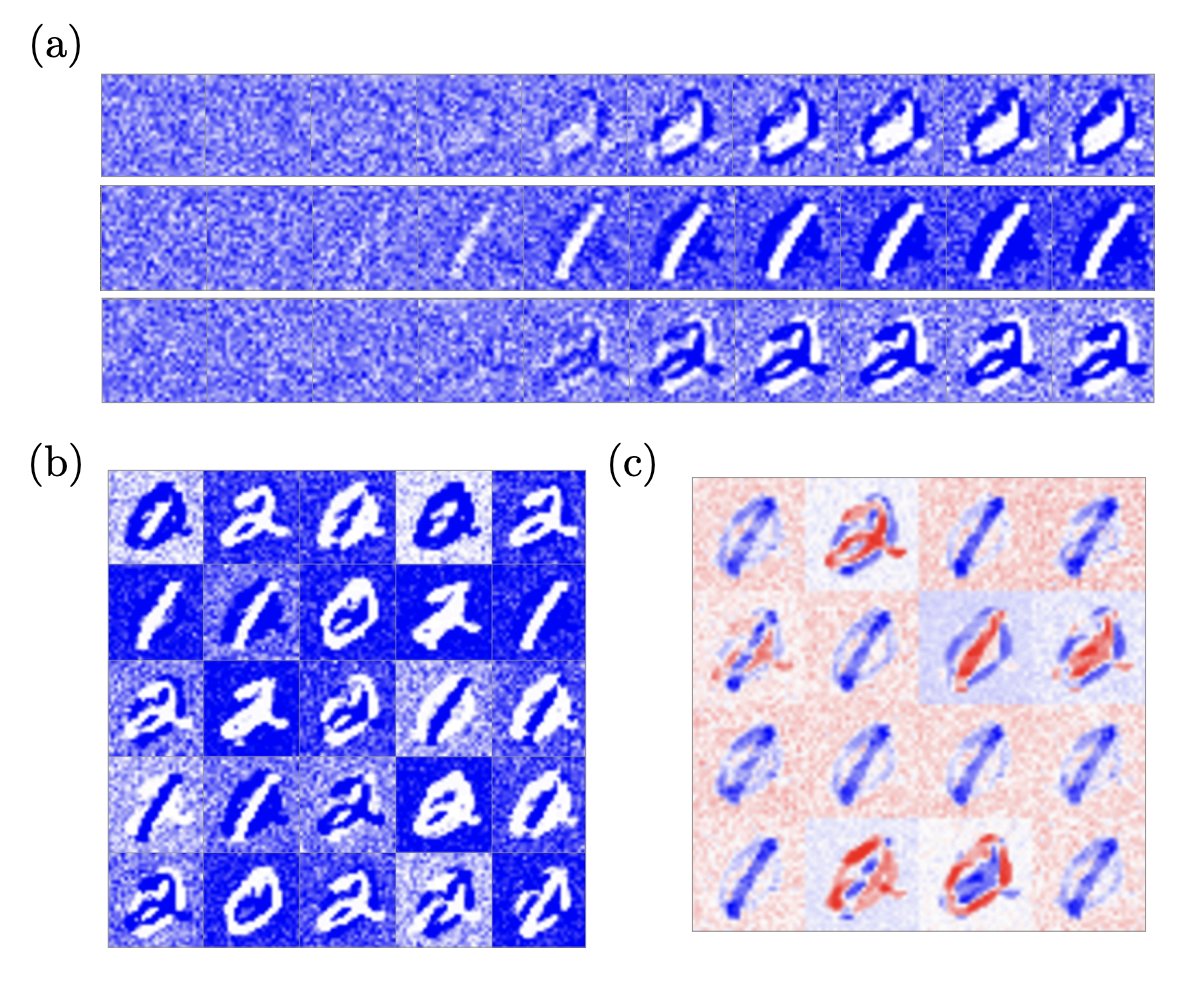
The training principle is elegant: observe noising trajectories (structured data degrading into noise), then adjust the system's couplings via gradient descent to maximize the probability that a thermodynamic computer would generate the reverse—structure from noise. This process has a beautiful physical interpretation: it minimizes the heat emission and entropy production of the generative process.
In a proof-of-concept simulation with 784 visible units and 512 hidden units trained on just three MNIST digits, the thermodynamic computer learns to transform noise into recognizable digit-like structures through physical dynamics alone—no external control or pseudorandom numbers required.
The energy implications are striking: the simulated thermodynamic computer emits ~2,900 kᵦT of heat per generation, compared to ~5 × 10¹⁴ kᵦT for a digital neural network doing equivalent denoising—a difference of more than 10 orders of magnitude.
The message is compelling: by grounding generative modeling in thermodynamic principles, we can design systems where computation emerges from physics itself, opening paths toward autonomous, energy-efficient generation that could fundamentally change how we think about the hardware of machine learning.
Paper: https://t.co/c8vLmgnLZ8
The chemosensing accuracy of 𝘌. 𝘤𝘰𝘭𝘪 cells is shown to be limited by internal noise in signal processing, rather than the stochasticity of molecule arrivals at their receptors, contrary to long-held understanding in the field.
https://t.co/gsuTNzcf5p
Our paper was published on the relationship between thermodynamic driving and eigenvalues in Markovian master equations. It proves a weaker version of a beautiful conjecture proposed by Uhl and Seifert. Led by Guo-Hua Xu , with Jean-Charles Delvenne and @ito_sosuke
A thermodynamic constraint is placed on the spectrum of Markov rate matrices, allowing for a better understanding of the dynamics of biochemical clocks #OpenAccess
https://t.co/ndur0mtV4g
We are hiring 1-2 postdocs for next year! Please reach out if interested in:
1. Inter-brain information translation & control
2. Characterizing brain states via thermodynamics & control theory
3. Comparing qualia structures across individuals & identifying neural substrates
See the new lab website for the details!
https://t.co/D7165dgt6s
In Fall 01968, @stewartbrand put the Whole Earth Catalog out into the world.
55 years later, our friends at @grayareaorg and the @internetarchive are launching the Whole Earth Index: a nearly complete free online archive of Whole Earth publications. https://t.co/2T2RZNHPQF