Geopolitics, deep-tech, and global business analysis for Indian firms & the Indian govt.
Launching soon! Previously on X as Shores Beyond UPSC. Stay tuned!
IIT Bombay is proud to have taken sixteen of its deep-tech startups to Bharat Innovates 2026, the Ministry of Education's International Innovation Showcase in Nice, France, held as part of the India-France Year of Innovation.
For three days, these sixteen teams stood shoulder to shoulder with the best of global innovation, exhibiting at their own stalls, meeting investors, industry partners and policymakers, and showcasing the excellence and impact that Indian deep-tech, built on our campus, are capable of.
What makes this stand out is the sheer breadth: sixteen companies across seven frontier sectors, each taking on a hard, real-world problem.
Aerospace & Defence: Bellatrix Aerospace, ideaForge and Manastu Space, building the propulsion systems, drones and space technologies of the future.
Biotechnology: AmyScan Healthcare and Immuno Adoptive Cell Therapy, advancing diagnostics and next-generation cell therapy.
Healthcare & MedTech: Ayati Devices, Haystack Analytics and Lifespark Technologies, taking earlier, smarter care to more people.
Sustainability & Climate: Inphlox Water Systems, Torus Robotics, Trinano Technologies, UrjanovaC and VDT Pipeline Integrity Solutions, working across water, robotics, advanced materials, clean energy and critical infrastructure.
Advanced Computing: QuNU Labs, securing the quantum era.
Semiconductors: iMumbai Semiconductor, building India's own chip capability.
Manufacturing 4.0: Atomberg Technologies, reimagining everyday products through energy-efficient design.
Every one of these companies began with a question asked in a lab, a classroom or a hostel room at IIT Bombay. To watch them carry that question onto a global stage, and to be met there by the world, is exactly why an institution like ours exists.
This is only the beginning of their journey, and of what India's deep-tech ecosystem will take to the world.
#BharatInnovates2026 #IITBombay #MinistryOfEducation #MoEIndia #IndiaFrance #DeepTech #Innovation #Startups #MadeInIndia
Let’s enable leadership in AI quantum & other emerging technologies through less regulation & greater investment from VCs & Capital markets.
I led a @ficci_india CEO delegation to China and visited companies like BYD, Geely, Midea, Mindray.
My 3 top takeaways:
1. China is like a no frills fighting ring. Extremely competitive. Businesses operate at margins (2-3%) global boards would never approve. Only market share matters and there is no concept of ROI. The few who survive are the toughest and the best.
2. R&D and automation are at the highest levels. The scale of automation and R&D investment at these companies is built for a 10-year time horizon, not a quarterly one. They celebrate innovators, have walls of patents and dark factories with unmatched efficiency.
3. The state is a silent shareholder everywhere. Cheap capital, land, power, and policy support at a scale that fundamentally changes unit economics. As long as you service interest (@ only 2-3%), debt doesn’t have to be paid back. This isn’t a level playing field.
It is a moment of immense pride and celebration for the IIT Madras community. Our Director, Prof. V. Kamakoti, has been conferred the prestigious Padma Shri by the Hon'ble President of India, Smt. Droupadi Murmu, for creating India’s first indigenous microprocessor, SHAKTI, and for strengthening national security capabilities through his contributions to telecom security and cybersecurity.
As a visionary leader, educator, and innovator, he has championed cutting-edge research, nurtured generations of engineers and entrepreneurs, and advanced IIT Madras' mission of creating impactful solutions for society.
This honour celebrates his remarkable contributions to research, innovation, education, and nation-building.
@iitmadras@EduMinOfIndia@rashtrapatibhvn
#PadmaShri2026 #IITMadras
Elite tech meets national security.
IITs are powering India’s 7 new defence manufacturing clusters to create military industrial complex.
From drones to precision engineering, this is a massive GDP multiplier.
PM Modi gave a vision yesterday: India will be a global defence producer, not just a buyer. This initiative ties into it.
The Centre is building a first-of-its-kind federal architecture for defence indigenisation, beyond current UP & Tamil Nadu defence corridors.
The states, UTs & IITs team up for thematic excellence.
The 7 Clusters:
1. Karnataka-led: Policy, Institutions & Innovation.
2. Maharashtra-led: Indigenisation & Private Participation.
3. Uttar Pradesh (+Jharkhand): Testing & Certification.
4. Assam-led (NE & border States): Quality Assurance & Standards.
5. Telangana-led: Market Access & Defence Exports.
6. Gujarat (+others): Skills & Industry-Academia Linkages.
7. Tamil Nadu-led: Industrial Infrastructure & Common Facilities.
Strategies & Initiatives:
•States submit detailed inputs next month
•IITs deliver R&D, testing & skilling
•Heavy focus on MSMEs, startups & exports
• Specialised hubs built on existing corridors.
Roadmaps follow soon.
Implications:
• Jobs boom + tech innovation
• Positions India as global defence manufacturing hub.
• Stronger strategic autonomy.
Atmanirbhar Bharat just levelled up in Defence. 🇮🇳
#AtmanirbharBharat #Defence #Manufacturing #MakeInIndia
@narendramodi@rajnathsingh@DefProdnIndia
By @Dalipjourno
16th BRICS National Security Advisers' Meeting | Delhi
National Security Advisor (NSA) Ajit Doval says, "We need to be cognizant of the new security threats and challenges. 𝐍𝐨𝐧-𝐭𝐫𝐚𝐝𝐢𝐭𝐢𝐨𝐧𝐚𝐥 𝐭𝐡𝐫��𝐚𝐭𝐬 𝐡𝐚𝐯𝐞 𝐭𝐫𝐚𝐧𝐬𝐜𝐞𝐧𝐝𝐞𝐝 𝐧𝐚𝐭𝐢𝐨𝐧𝐚𝐥 𝐛𝐨𝐫𝐝𝐞𝐫𝐬 𝐚𝐧𝐝 𝐡𝐚𝐯𝐞 𝐝𝐞𝐯𝐞𝐥𝐨𝐩𝐞𝐝 𝐝𝐞𝐟𝐞𝐚𝐭 𝐬𝐲𝐬𝐭𝐞𝐦𝐬 𝐚𝐠𝐚𝐢𝐧𝐬𝐭 𝐜𝐨𝐧𝐯𝐞𝐧𝐭𝐢𝐨𝐧𝐚𝐥 𝐫𝐞𝐬𝐩𝐨𝐧𝐬𝐞𝐬. Innovative disruptive technologies, more camouflaged variants of terrorism, cyber threats, in a world are getting increasingly digitised. They all constitute an important threat for us. Today, we will be navigating some of these non-traditional security challenges in our collective deliberations here."
#BRICS #NationalSecurityAdvisersMeeting
Do school marks really tell us how much someone can achieve?
For Pawan Kumar Chandana, a score of 51 in Mathematics certainly didn't.
Years later, the former ISRO scientist would go on to co-found Skyroot Aerospace, India's first space-tech unicorn, and help lead the launch of Vikram-S, the country's first privately developed rocket.
Born into a middle-class family in Hyderabad, Chandana wasn't always seen as a future space entrepreneur.
While Mathematics was a challenge in school, his preparation for engineering entrance exams sparked a deeper interest in science and technology.
That curiosity eventually took him to IIT Kharagpur, where he earned a dual degree in Mechanical Engineering.
In 2012, he joined ISRO and spent nearly six years working on major programmes including GSLV Mk-III, the S-200 solid rocket booster, and the Small Satellite Launch Vehicle.
But in 2018, he chose to leave the security of a government career and build a private space company alongside fellow engineer Naga Bharath Daka.
Today, Skyroot is valued at over $1 billion and is preparing for the orbital launch of Vikram-1.
@PawanKChandana | @SkyrootA
#SpaceTech #Innovation #Entrepreneurship #ISRO #Skyroot
[Pawan Kumar Chandana, Skyroot Aerospace, India's first space-tech unicorn, Vikram-S]
Breaking news: Keir Starmer has announced that he will step down as prime minister amid a collapse in his popularity less than two years after he swept the Labour Party back to power with a promise to rebuild Britain. https://t.co/6vbtc8mbdQ
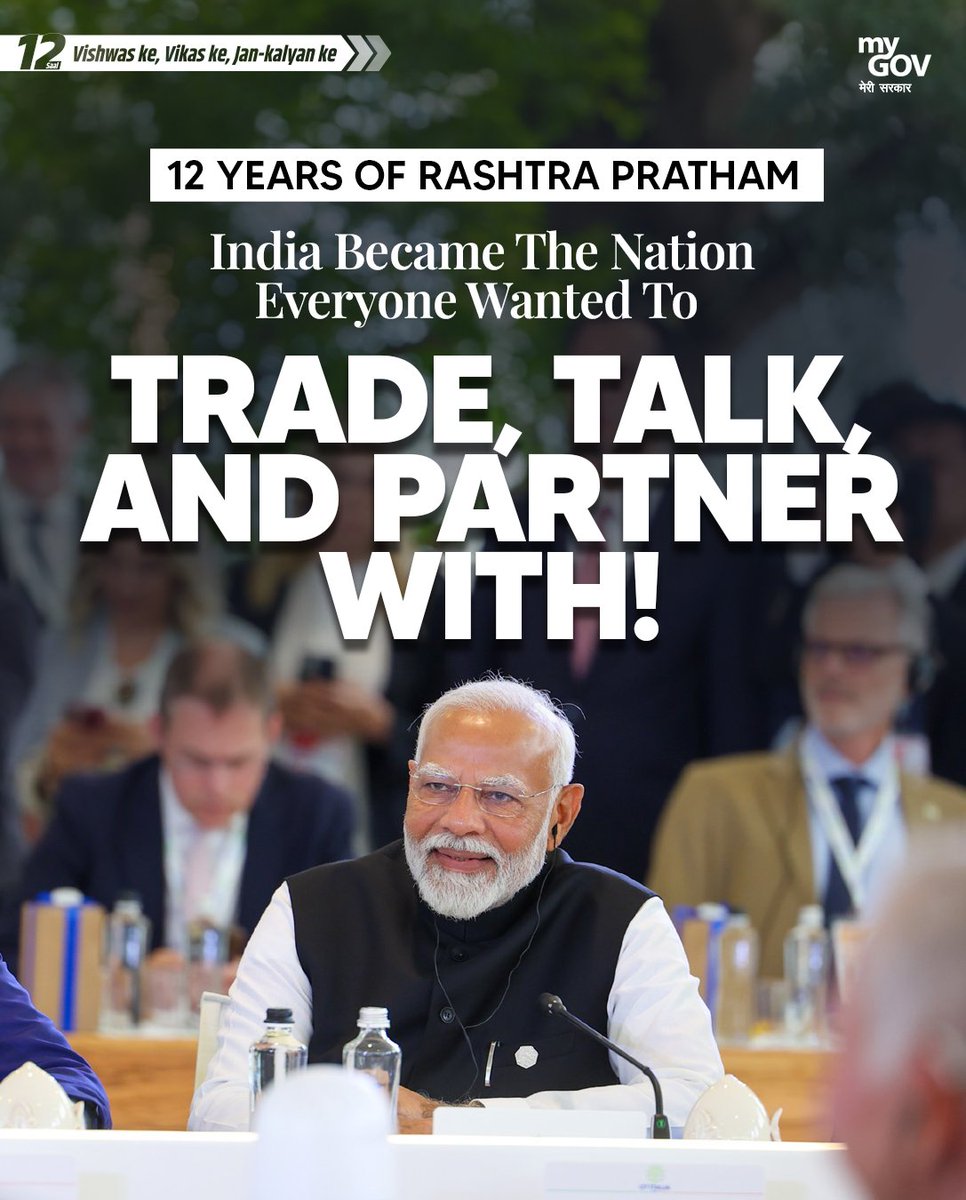
India’s Global Momentum: A Shift the World Can’t Ignore
Since 2014, India’s engagement with the world has entered a more impactful phase. The country is increasingly helping shape global conversations, strengthening partnerships, and contributing to international priorities with greater visibility, credibility, and trust.
Read the full thread to explore how this transformation unfolded across global platforms and partnerships, reflecting India’s growing role and influence on the world stage.
#12YearsOfIndiaFirst
Sarvam joined the AI discussions at the 52nd G7 Summit in Évian-les-Bains, France.
@vivekrag participated alongside G7 leaders and chief executives from some of the world’s leading AI companies. The discussion centered on frontier AI risks, infrastructure, and sovereignty in the age of AI.
A significant moment for Sarvam and for India’s AI ecosystem.
The India–UK Comprehensive Economic and Trade Agreement (CETA), set to enter into force on 15 July 2026, marks an important step in strengthening cooperation in services and professional mobility. By expanding opportunities across a wide range of service sectors and facilitating greater movement of professionals, the agreement supports deeper economic engagement between India and the United Kingdom.
Read more: https://t.co/0ZwvbbD1Cj
#IndiaUK #CETA #TradePartnership #DoC_GoI @PIB_India@RajeshAgrawal94
Dear @narendramodi, it is a pleasure to meet again so soon.
Since we have concluded the mother of all trade deals, we have been moving fast to deliver on our commitments.
We will sign the Free Trade Agreement by the end of the year.
And accelerate work on an investment agreement.
We will also step up security & defence cooperation.
And join forces for better connectivity by advancing IMEC, the India–Middle East–Europe Corridor.
Had a fruitful discussion with Mr. Rodolphe Saadé of CMA CGM on maritime connectivity, global shipping trends and emerging opportunities in India’s rapidly growing maritime sector.
Discussed avenues for greater collaboration in shipbuilding, container manufacturing, digital maritime innovation, logistics and skill development.
India’s expanding port infrastructure offers promising opportunities for global maritime leaders.
@cmacgm


![thebetterindia's tweet photo. Do school marks really tell us how much someone can achieve?
For Pawan Kumar Chandana, a score of 51 in Mathematics certainly didn't.
Years later, the former ISRO scientist would go on to co-found Skyroot Aerospace, India's first space-tech unicorn, and help lead the launch of Vikram-S, the country's first privately developed rocket.
Born into a middle-class family in Hyderabad, Chandana wasn't always seen as a future space entrepreneur.
While Mathematics was a challenge in school, his preparation for engineering entrance exams sparked a deeper interest in science and technology.
That curiosity eventually took him to IIT Kharagpur, where he earned a dual degree in Mechanical Engineering.
In 2012, he joined ISRO and spent nearly six years working on major programmes including GSLV Mk-III, the S-200 solid rocket booster, and the Small Satellite Launch Vehicle.
But in 2018, he chose to leave the security of a government career and build a private space company alongside fellow engineer Naga Bharath Daka.
Today, Skyroot is valued at over $1 billion and is preparing for the orbital launch of Vikram-1.
@PawanKChandana | @SkyrootA
#SpaceTech #Innovation #Entrepreneurship #ISRO #Skyroot
[Pawan Kumar Chandana, Skyroot Aerospace, India's first space-tech unicorn, Vikram-S]](https://pbs.twimg.com/media/HLauIDnbEAAYFbD.jpg)