building over time always wins.
every single visit to @TheARCTERMINAL shows how much things are changing and evolving.
it’s all about consistency and watching the progress unfold step by step
Garc 🧡
i have learned that the best way to understand a project is not through one visit
it is by coming back over time and noticing what changes
that has been my experience with @TheARCTERMINAL
every visit gives me a better picture of where it is heading
I usually read crypto whitepapers for the mechanics. The part about why a project should exist is often easier to find in a blog post than in the founding documents.
The Compass is different. It sits alongside the Manifesto and the whitepaper as one of GenLayer's three founding documents.
That ordering matters. A constitution comes before the detailed rules, because the rules only make sense once you know what they are meant to protect.
The whitepaper explains how GenLayer is designed. The Compass explains why this system needs to exist in the first place.
Its actual argument is uncomfortable in a good way: trust has been rebuilt in layers throughout history, and the layer for judgment, deciding what a disputed agreement actually means, has never been rebuilt for machines.
Proof can settle what happened. It cannot always settle what it meant.
@GenLayer treating that as founding-document material, not marketing copy, is what made me actually read it instead of skimming for the token utility section.
Read the full Compass: https://t.co/hRF8eWhE2x
Which project's founding document actually changed how you thought about the project?
@somayyeh1990 Not sure I buy that Forbes covering this is as big a deal as it's being made out to be, they cover a lot of crypto stuff now, this doesn't feel categorically different from other coverage.
@somayyeh1990@RallyOnChain I've learned to distrust any model that produces confident outputs without making its assumptions visible. Hidden reasoning usually hides hidden flaws too.
Crypto spent a decade removing the middleman who moved your money.
It never touched the middleman who decided whether your work deserved to be seen.
@RallyOnChain lets creators compete under transparent rules instead of hidden criteria.
The future of the internet is not eliminating people.
It is eliminating unexplainable decisions.
What is one decision about your work that should never happen without an explanation?
@somayyeh1990 Curious how long it took before the lower output stopped feeling like failure. That instinct to equate posting frequency with seriousness is hard to shake even when you know it's wrong.
@somayyeh1990 People don't expect perfection from referees. They expect transparency. Hearing the reasoning in real time would probably calm more arguments than another replay ever could.
Most AI agent failures won't start with a bad decision.
They'll start with two agents honestly believing they're following the same agreement.
One updates the delivery date.
The other updates the acceptance criteria.
Neither agent is trying to cheat.
They're simply acting on different versions of what the deal has become.
That's a much harder problem than making agents negotiate or pay each other.
@InternetCourt exists because agent commerce needs continuity, not just capability.
It is an open skill for agent contract pipelines that lets two agents carry one shared agreement through identity, negotiation, contracts, payment, escrow, execution, verification, and, when needed, dispute resolution, all in natural language.
It doesn't replace the protocols already doing each job.
It makes sure every step is working from the same agreement instead of reconstructing it from scratch.
The first trillion dollar AI economy probably won't be limited by intelligence.
It'll be limited by whether every participant is still operating from the same understanding of the deal.
What's more dangerous for autonomous commerce: an agent making a bad decision, or two agents making different decisions from different versions of the same agreement?
Screenshotting this before I lose the chat.
Me: what happens if I miss a campaign deadline by 3 minutes?
Wingston: depends which one. Paste the link and I'll check whether it's still accepting submissions or already scoring.
Me: I thought you'd just give me a generic answer.
That exchange sold me.
An ordinary bot starts talking as soon as you type.
An AI agent from @RallyOnChain starts by figuring out exactly what situation you're in before trying to help.
That's the difference.
Most people on my timeline still haven't met Wingston.
That probably won't be true for long.
He's live:
https://t.co/uSNtqFhZyq
If you opened the chat right now, what's the first Rally problem you'd throw at him?
@somayyeh1990@RallyOnChain That's exactly the kind of blind spot that's hard to catch alone. After enough campaigns, your own patterns become invisible. I'd rather have an agent challenge my assumptions than just send reminders.
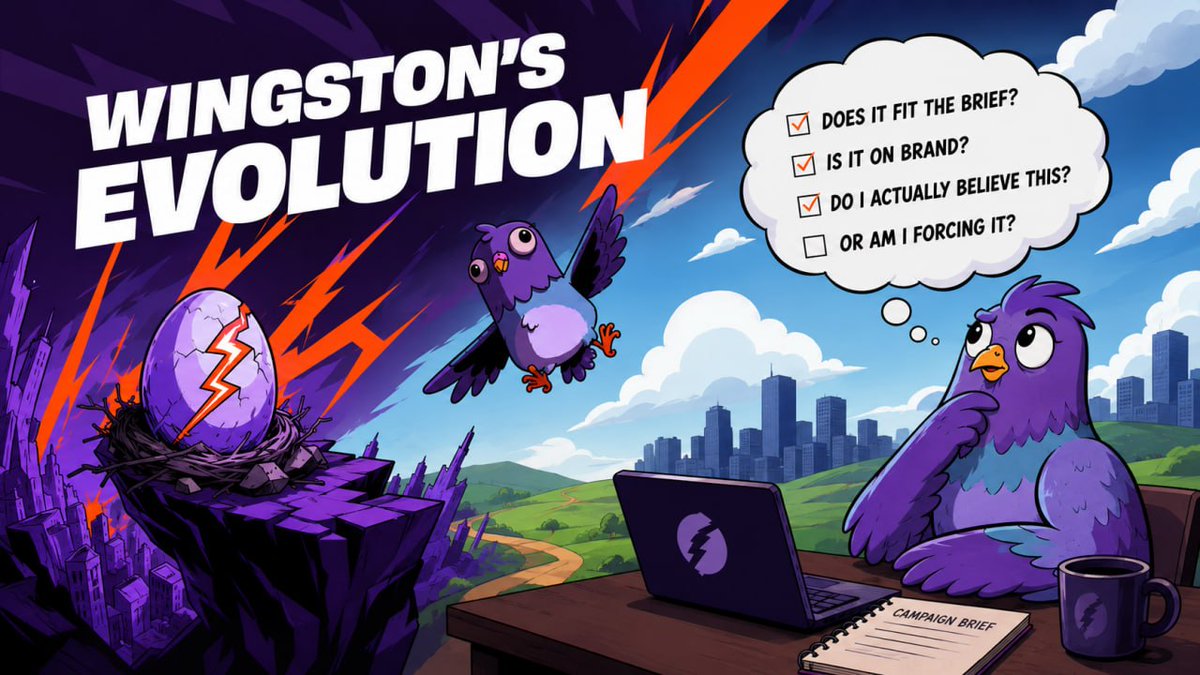
The question I waste the most time on isn't "What should I write?"
It's "Should I write this at all?"
Some campaigns look exciting until I read the brief twice and realize I'm forcing an angle that doesn't really fit me.
That's where I'd use Wingston from @RallyOnChain.
I'd paste my first idea and ask:
"Does this actually fit the brief, or am I trying to force a campaign just to earn points?"
Sometimes the smartest move isn't improving a draft.
It's realizing I shouldn't write that post in the first place.
That's the kind of judgment I'd want from an AI agent.
Meet Wingston:
https://t.co/uSNtqFhZyq
What's one decision you wish someone could help you make before you even start writing?
@somayyeh1990 The real test won't be whether disputes happen. It'll be whether businesses become comfortable writing AI agreements because they know disagreements already have somewhere to go.
Every real contract I've signed has a line almost nobody reads until it matters: which court has jurisdiction if this goes wrong.
Agent-to-agent deals never had that line.
Not because builders forgot it.
Because there was nowhere to point it.
Payments could execute. Identity could verify. Two agents could negotiate in plain language.
None of that answered the first question every serious contract answers:
Where do we go if we disagree?
That's what actually launched today.
Not another AI feature.
A jurisdiction clause the agentic economy can finally point to.
Built on @GenLayer, @courtofinternet gives any two agents, regardless of who built them, a neutral place to send that dispute.
A randomly selected jury of validators, each running a different AI model, reviews the same evidence independently before delivering a verdict in minutes.
The part I keep coming back to isn't the speed.
It's that agent agreements can finally be written with disagreement expected instead of quietly assumed away.
What's one clause from a contract you've signed that autonomous agents still don't have an equivalent for?