Hello friends, I’ve utilized this Stay at Home period to add value to myself by successfully training on a complete Python for DataScience and Machine Learning course on Udemy. #DataScientists#MachineLearning and Certified. Enjoy.
KANU DID NOT ADMIT ME INTO DOS — CHINASA NWORU REVEALS HOW HE PASSED THE “THREE-HOUR” TEST
“No Direct Communication With Kanu During My Admission” — Nworu Opens Up on DOS Recruitment, Edoziem’s Role and the Merit-Based Structure
Anyi Kings | The Biafra Post | August 2026
Kuwait — A fresh revelation from Mazi Chinasa Nworu has reopened the debate over who actually admits people into the highest leadership structure of IPOB—and whether positions within the organisation are earned through due process or simply handed down through personal influence.
Speaking during a live Radio Biafra/Biafra TV broadcast in August 2026, Nworu made a striking clarification about his own journey into the Directorate of State (DOS), declaring that Mazi Nnamdi Kanu had no direct involvement or communication with him throughout the process that led to his admission.
According to Nworu, although Kanu, as the general leader of IPOB, could possibly have been aware of recommendations or decisions surrounding the restructuring of the DOS, he did not personally communicate with Kanu during his admission process.
Instead, Nworu said his journey into the DOS followed an internal process that began from his previous responsibilities within IPOB.
FROM KUWAIT COORDINATOR TO DOS MEMBER
Nworu revealed that long before becoming a member of the DOS, he had already established IPOB in Kuwait and was functioning as its national coordinator.
He explained that his commitment to the organisation also saw him regularly travel from Kuwait to the United Arab Emirates to participate in IPOB family monthly meetings coordinated by the then UAE national coordinator, Prince Iyke Ikechukwu.
It was against this background, he said, that he eventually became a candidate for a position within the DOS.
But according to Nworu, there was no shortcut.
THE THREE-HOUR INTERVIEW
Following the dismissal of 11 former DOS members whom Nworu described as erring members, he said the structure underwent a major reorganisation.
According to his account, Mazi Chikadibia Edoziem—then the oldest serving DOS member and the serving DOS Secretary—was elevated to the position of Head of Directorate of State (HODS).
Nworu said that after the restructuring, both he and Prince Iyke Ikechukwu were separately approached by Edoziem for interviews.
His own interview, he disclosed, lasted approximately three hours.
During the lengthy encounter, Nworu said he was questioned about his vision, capacity, commitment, passion and understanding of the Biafra restoration struggle, as well as his suitability for membership of the highest decision-making body.
He said he answered the questions as directly and honestly as possible.
Then came the verdict.
According to Nworu, he was subsequently contacted by Chikadibia Edoziem and congratulated on his selection as IPOB Middle East Representative and a member of the Directorate of State.
WHY WAS NWORU CHOSEN AHEAD OF HIS UAE COUNTERPART?
Nworu's account also provided an interesting detail about the criteria he believes governed DOS admission.
He explained that holding a regional or continental leadership position within IPOB was one of the qualifications for becoming a member of the DOS.
Interestingly, he acknowledged that Prince Iyke Ikechukwu had become a national coordinator in the UAE before him.
Yet, according to Nworu, he was eventually selected ahead of his UAE counterpart.
Rather than becoming a source of division, Nworu said the decision did not create bitterness between them.
He maintained that both men continued to collaborate, united by what he described as their common commitment and passion for the Biafra restoration struggle.
“DON'T BRING A TOTAL STRANGER TO HEAD IPOB”
The most consequential part of Nworu's revelation, however, was not about his personal journey.
It was his broader warning about leadership recruitment within IPOB.
Playing the High Level Politics: Silent Strategy and Institutional Discipline in the Biafran Struggle
Politics has always been a game of interest. Nations, movements, and peoples advance their causes not merely through passion or moral claims, but by aligning those claims with the concrete interests of powerful actors who can influence outcomes.
For the Biafran restoration project, this reality demands a deliberate shift toward high level politics engagements capable of capturing the attention of decision makers, institutions, and contacts who possess the capacity to shape international discourse and, ultimately, help pilot the affairs of a future Biafra.
High level politics cannot succeed on rhetoric or street level mobilisation alone. It requires high level composure: a disciplined, patient, and professional posture that signals seriousness to the international community.
It also demands a robust institutional framework, a clear constitutional order, and delegates who understand the language, norms, and incentives of international politics. Without these elements, even the most legitimate aspirations risk being dismissed as unstructured agitation rather than a coherent political project worthy of serious consideration.
Biafra’s path forward must therefore prioritise a silent and smart strategy. Loud confrontation may mobilise domestic support in the short term, but sustained progress on the global stage depends on quiet, methodical work: building relationships, presenting evidence based cases, respecting diplomatic protocols, and demonstrating organisational maturity. In an environment where external actors carefully weigh risks, stability, and mutual benefit, composure and strategic restraint become force multipliers.
In this regard, the IPOB Directorate of State (DOS) under the leadership of Chika Edoziem has offered a practical demonstration of internationally acceptable composure in the handling of international politics. Operating within a structured administrative framework, the DOS has maintained a consistent focus on engagement rather than spectacle. This approach has allowed the movement to communicate with global institutions, governments, and civil society actors in a manner consistent with recognised diplomatic practice.
By emphasising institutional continuity, constitutional order within the movement, and the selection of representatives conversant with international norms, the Edoziem led administration modelled the kind of seriousness that high level contacts expect.
Such composure is not passive. It involves proactive, sustained outreach cultivating relationships with figures and organisations that can amplify the Biafran case in forums where policy is shaped.
It means presenting the demand for self-determination through the lens of international law, human rights, democratic principles, and shared strategic interests, rather than solely through historical grievances.
It also requires internal discipline: clear lines of authority, accountability mechanisms, and a constitutional culture that prevents factionalism from undermining external credibility.
The continuation of this trajectory remains essential. Chika Edoziem and the DOS administration he has led should continue to maintain and expand engagements with global figures.
High level contacts diplomats, parliamentarians, policy institutes, human rights bodies, and influential diaspora networks who are more likely to respond to partners who demonstrate institutional reliability and strategic sophistication.
Every successful interaction strengthens the case that Biafra is not merely a protest movement but a political project preparing itself for responsible statehood.
This is not a call for secrecy or isolation. It is a call for maturity. A silent and smart strategy does not abandon the people or silence legitimate advocacy; it channels energy into channels that can produce tangible leverage.
Institutional frameworks and constitutional clarity provide the internal scaffolding that makes external engagement credible. Delegates skilled in international politics ensure that opportunities are recognised and pursued with precision.
Ultimately, the success of the Biafran project will depend less on the volume of noise generated than on the quality of relationships cultivated and the seriousness of the structures presented to the world. Politics remains a game of interest.
By playing at the highest level with composure, institutional depth, and strategic patience Biafra positions itself to attract the contacts and support necessary to pilot its own affairs. The measured international posture demonstrated under the DOS leadership of Chika Edoziem offers a viable template. That work should continue, expanded and refined, until the objective is secured.
Family Writers Press International
Institution Over Individual: Mazi Chika Edoziem’s New IPOB Oath Strengthens the Global Case for Biafran Self-Determination”
Mazi Chika Edoziem’s August 2, 2026 national broadcast (on Radio Biafra / Biafra TV platforms) marked a deliberate shift toward institutionalizing the Indigenous People of Biafra (IPOB) as a structured self-determination movement under the Directorate of State (DOS). He announced that on 30 May 2026 the DOS had abrogated the prior IPOB oath of office (effective 2018) and Code of Conduct (effective June 2020), replacing them with a new institutional oath of allegiance, a Biafran pledge, and a new constitution. Edoziem led by taking the new oath himself (barefoot, invoking spiritual witness), then administered it to DOS members listening and directed cascading administration downward through continental, regional, national, and unit levels via recordings and video conferences.
The new oath centers exclusively on the Indigenous People of Biafra led by the Directorate of State. Key elements include: solemn voluntary allegiance to IPOB under DOS leadership; upholding the objectives and constitutional order; rejection of insubordination to the leadership or constitution or any action jeopardizing Biafran restoration; faithful discharge of membership duties and compliance with lawful DOS directives; commitment to freedom, dignity, unity, and self-determination; preservation of the movement’s integrity and independence; protection of fellow members’ lives; adherence to a moral code forbidding use of membership, office, or authority for personal gain, nepotism, or corruption; and acceptance of constitutional rights, duties, and responsibilities. It concludes with an invocation to Chiukwu Okike Abiama (with traditional affirmations). A companion pledge affirms allegiance to IPOB and its institutions led by the DOS, defense of sovereignty and dignity, remembrance of fallen heroes, and upholding rule of law, heritage, liberty, equality, and justice. No individual personal names appear.
These steps frame IPOB as moving from personality-driven dynamics to formal institutions: DOS structure (Head, Deputy Head, Secretariat) with defined organs and departments (foreign affairs, legal, finance, media, security, etc.), command-and-control principles, transparency mechanisms (budgets, audits), rule of law, and continuity beyond any single person. Edoziem presented this as aligning with principles from the first Biafran Republic, customary norms, and global governance standards for a durable freedom movement.
The August 2, 2026 reforms centering loyalty on the IPOB institution and its administrative body (the DOS) rather than any named individual, carry significance for international observers of self-determination struggles, governance standards, and conflict resolution.
History shows personality centric organizations often fracture under leadership vacuums, detention, or succession disputes; clear constitutional frameworks, impersonal oaths, defined roles, and accountability tools (audits, due process, moral codes) reduce that risk.
By nullifying prior instruments and installing ones focused on the collective, the constitution, and lawful directives from the DOS, the changes signal an attempt to prioritize the cause and the people over any one figure. This mirrors practices in durable institutions worldwide and can make the movement more predictable and less prone to internal capture or arbitrary rules.
For the global community, diplomats, human-rights bodies, diaspora networks, and analysts of African self-determination, the shift offers clearer interlocutors. An organization that publicly adopts transparent financial practices, rejects personal enrichment and nepotism in its core oath, protects members, and grounds itself in rule-of-law language becomes easier to engage on peaceful, rights-based terms. International norms favor structured non-state actors that demonstrate internal accountability over opaque or personality driven ones. These reforms, if consistently implemented, could strengthen claims to legitimacy when seeking external attention on issues of self-determination, historical grievances, and security in the region.
The emphasis on institutional continuity also addresses a practical global concern: sustainability of long-running campaigns. Self-determination efforts that survive leadership changes without collapsing or turning inward are more likely to maintain coherent advocacy, diaspora coordination, and non violent mobilization. By cascading the new oath and preparing a printable constitution with the oath and pledge as appendices, the DOS is attempting to embed shared standards across continental and unit levels. This creates a common reference point that reduces ambiguity about authority and obligations.
Finally, the changes contribute to a broader conversation about governance models in contested spaces. Explicit rejection of personal gain, commitment to fellow members’ safety, and invocation of constitutional order and ancestral/spiritual accountability project an internal ethic that external audiences can evaluate on its own terms. Whether one supports the ultimate political goal or not, the move from name centered loyalty to institution centered loyalty is a measurable step toward the kind of organizational maturity that international practice associates with more stable and accountable movements.
In short, Edoziem’s broadcast and the new DOS-centered oath represent an explicit effort to professionalize and depersonalize the administrative core of the struggle. For the global community, the practical value lies in greater predictability, stronger internal checks, and clearer alignment with principles of institutional continuity and ethical conduct qualities that facilitate informed observation, dialogue, and assessment of any self-determination process over time.
Family Writers Press International.
They'll give birth and teach their children wahabism. The kids would then grow up to hate other people and that includes the children of the Christians and etc
The game continues...
The DOS must focus, and leave the internet battle for IPOB Media for us. We will definitely put Sokoto children to where they belong. Wemove Umuchineke
‘The Moment These JTF Officers In Imo Noticed He Was Recording Them With His Glasses, They Ordered His Bus To Leave Him Behind, Took Him To The Bush, Threatened Him To Remove His Clothes, And Asked Him To Start Running So They Could Shoot Him And Tag Him As Unknown Gunmen. These JTF Officers Have Continued To Go Unchecked Even With All The Videos That Have Been Coming Out Of Imo State. Some Of These Officers Who Have Been Caught Extorting People Are Still Operating Till Now. When Is It a Crime To Record Police Officers That They Will Threaten To Unalive You Just Because They’re Being Recorded? Videos Keep Emerging, Yet The Same Pattern Of Extortion And Threats Persists. Until There Is Real Consequence For This Kind Of Conduct, These Incidents Will Keep Repeating. @PoliceNG_CRU@TunjiDisu1
IPOB Advances Institutional Revolution with New Oath of Allegiance to Secure Biafran Struggle
In a significant step aimed at fortifying the Biafran self-determination movement against internal threats and external ridicule, the Indigenous People of Biafra (IPOB) has launched a global institutional overhaul. The initiative centers on the administration of a new oath of allegiance to Biafra and its constitution, designed to protect the struggle from collapse and association with criminalities.
The Directorate of State (DOS) has driven this process of institutionalisation, approving a renewed membership oath, pledge, code of conduct, and constitutional framework. These measures emphasize allegiance to the institution of IPOB, the Biafran people, constitutional order, foundational principles of the freedom movement, and a moral code of truth and integrity for all members, regardless of position. IPOB have described the reforms as aligning the organisation with principles of rule of law, the tenets of the first Biafran Republic, customary laws, and global governance standards. Older oaths and codes from prior years have been set aside to make way for this institutional focus.
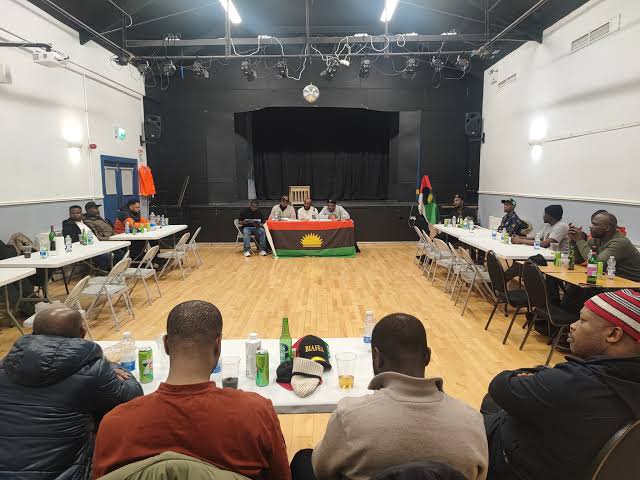
IPOB Ireland and its zones have joined other countries in implementing the new oath. The IPOB Dublin Zonal Meeting held on 9 August 2026 specifically advanced the institutionalisation agenda, with members participating in the administration of the allegiance pledge. This local action forms part of a coordinated rollout across Irish zones.
In the United Kingdom and other diaspora chapters, administration of the new oath continues steadily among members. The global family of IPOB is collectively embracing the process, reinforcing unity under the DOS structure.
Members frame the reforms as a necessary evolution, transforming a long-running agitation into a more disciplined, accountable, and institutionally resilient organisation capable of sustaining the Biafran cause without vulnerability to fragmentation or criminal associations.
The move builds on earlier declarations of loyalty from various national chapters and strategic meetings emphasising command structures, transparency, financial accountability mechanisms (including audit provisions), and protection of human rights and cultural values. By binding members to a single institutional oath worldwide, leadership seeks to eliminate dual allegiances or external factional influences.
Observers view this institutional revolution as essential for long-term viability. It aims to shield the Biafran struggle from ridicule, maintain operational integrity across continents, and position IPOB structures for greater coherence in pursuit of self-determination goals. As zones in Ireland, the UK, and beyond proceed with the oath administration, the global family signals a renewed commitment to disciplined, constitutionally grounded organisation.
The Dublin zonal gathering of 9 August stands as a concrete example of this ongoing implementation, underscoring the movement’s determination to institutionalise its structures for the protection and advancement of the Biafran project.
Family Writers Press International.
Watering Soft Ground: How Elochukwu Ohagi Prepares the Way for Accepting Simon Ekpa
https://t.co/35AvEk1rZv
Elochukwu Ohagi, who spent years publicly condemning Simon Ekpa’s alleged violence and criminality, now pivots with a Facebook post that dismisses those same red lines as mere “gossip.”
By claiming “we don’t care” if Nnamdi Kanu associates with Ekpa or even with Buhari and Tinubu, he exposes the hypocrisy of a man who once demanded clear moral distinctions yet now dissolves them under the cover of loyalty, softening the ground for the very association he long rejected.
Before I start to set this record straight, if you are an IPOB member, if you are a Biafran, setting the record straight will lead to calling some people out. You know how the agricultural initiative became popular and the initiative was productive.
By this announcement, I use the power vested in me that Chuks Egwuatu is declared wanted. The rice farm from the agric department was handed over to Chuks Egwuatu and he has stolen the money generated from the 20 tons generated from the rice. After the harvesting, we don't know that Chuks Egwuatu has been a criminal element. And he was the secretary to former Biafra land coordinator and even lobbied for the coordinator post when Ugwuoha was murdered.
After stealing the hard earned resources of our people got through hard work and borrowing, some riffraff will embezzle and steal from our people. Chuks Egwuatu must return what he stole from IPOB or he will never walk on Biafraland. Not even Sokoto, Uyo or Benjamin Madubugwu will save him. It is a promise!
Maazi Chinasa Nworu, Live Radio Biafra Update By FWPI
08-08-2026
"Tagging all these crimes on IPOB ESN will not stop the Biafran cause. The Nigerian government, military and media should understand that our people now know the truth that these tags are lies and blackmails to paint us black"
- Chinasa Nworu-
8/8/26
ME: FREE BIAFRA @UN@EU
ENUGU STATE.KIDNEY DESEASE PATIENTS.
This is a pathetic case.Clear case of failed Health sector.And this is traceable to faulty foundations of a nation that is controlled by sponsors of terrorism. FREE BIAFRA @AFRICANUNION@EU@UN
ATTENTION:
NDIGBO & BIAFRANS with South-East Lawyers, Civil Societies Accuse Nigerian Security Agencies Of Rights Abuses, extortion, killings, & hundreds of check points Demand End To Torture, Arbitrary Arrests .
ME: CONDUCT a REFERENDUM.
FREE BIAFRA @AFRICANUNION@EU@UN