Since November 2000, the United Kingdom has had 8 prime ministers: Tony Blair, Gordon Brown, David Cameron, Theresa May, Boris Johnson, Liz Truss, Rishi Sunak, Keir Starmer, and the current “shoe-in”, Andy Burnham – and there have been 14 Arts Ministers. In this period, have any significant changes of policy taken place within the non-elected DCMS?
In November 2000 we wrote (Telegraph Letters):
“There is no chance of halting the ‘Leftwards drift of the upper middle classes’ (Comment, Nov. 4th) until we acknowledge the extent to which arts and heritage bodies have been politicised by their administrators.
“An arts administrative caste has for decades substituted social engineering and the imposition of quotas for a due recognition that, in the arts, quality and merit alone are of the essence.
“Any attempted reforms that do not start with the Department for Digital, Culture, Media and Sport will fail.”
Nothing of significance has changed since that date.
Tonight, "Discover how migration, movement, belonging and resettlement shaped more than a century of word-image experimentation, from the historical avant-gardes and concrete poetry to contemporary conceptual practice. Exploring disruption both as an artistic strategy and as a lived experience, the exhibition examines..."
To register: Eventbrite or Trybooking
For more information and image contact: [email protected]
For further information on the width and depth of Ben Uri’s impact please see https://t.co/2arHksBufh, https://t.co/DYqBazX5xs, https://t.co/pcUTWatFL2 and https://t.co/tNXHMXYQQp
For once, some restorers who don't diss their predecessors' work:
"...During the restoration ahead of the 1989 statehood centennial, minimum-security inmates had a hand in some aspects of the project, Haugan said. It helped the state save on labor costs. 'They’re very talented artists that were there, and they came and they did beautiful work, and we don’t want to diminish the work that they did by re-restoring it,' she said. We just would like it to be historically correct'.”
https://t.co/CaHpqO5Cmb
It is striking how Stella in his switch from straight to curvy abstractions moves closer to figuration - as seen in Picasso's famous 1945 Bull metamorphoses series?
Artistic transcendence alights promiscuously in all fields - including in supposedly utilitarian ones like furniture. The Antiques Trade Gazette reports on a Belle Époque table of astonishing vivacity that has been sold by a Brighton dealer to Musée des Arts Décoratifs in Paris:
https://t.co/joCHkzCduc
Struck first by this demonstration of the intrinsically life-enhancing character of curved lines, as found in a table, we were reminded of the remarkable stylistic metamorphosis that took place in Frank Stella’s paintings when he rejected his trademark straight-edged pictures – as seen below (clockwise) in three works of 1959, 1962 and 1978:
A BOOK PLUG:
Marion Maneker writes: "I’m taking a moment to reflect on the history of art dealing, prompted by Valentina Castellani’s recent book, Trading Beauty. There’s been a lot of handwringing in recent years that young people prize experiences over objects, and art collecting might be a thing of the past. Castellani’s book, however, suggests that the art market has always relied upon a few dominant figures who identified the artists they believed captured the present, and would be remembered in the future..."
https://t.co/G7Bko5s2Gb
"'We've never seen a proposal that would do this much damage to this much of the country's history in one stroke,' said Greg Werkheiser, founding partner of Cultural Heritage Partners, which is currently litigating against Trump's Kennedy Center alterations and his planned whitewashing of the Old (now Eisenhower) Executive Office building. Cultural Heritage Partners has set up an online war room to fight against the proposed Section 106 changes..."
https://t.co/wyULeCbITc
For example, how many people would really believe that Durer depicted St. Jerome, as below on the left, and, also, as on the right? If he had painted the NG picture, what had persuaded him to depict the Saint-in-the-Wilderness sporting a neatly trimmed moustache and wearing a single piece slip of a dress with with a massive "v" necked plunge down its front?
It is important that the National Gallery’s present conspiracy of silence over its recently disclosed removal of material that had shown its supposed Rubens “Samson and Delilah” to be inauthentic – and the subsequent false and dissembling reporting of its own actions - be seen for what they are: the insufferable sense that heads of major international art museums acquire on appointment of being above any normal professional or fiduciary constraints and obligations. In this, they are not acting in delusional or irrational fashion - for the duration of their tenure (and thereafter) a wider political conspiracy of unquestioning support from trustees and political parties can be expected.
The truth is museums are now considered too big, too hallowed, to be permitted to fail on anybody’s watch. In this climate of state-sanctioned cultural deference and acquiescence, not only are administrators never expected to acknowledge or apologise for their professional blunders, neither are they required to learn from them. If they can appear to grow their holding of cultural treasures, that is sufficient justification for any acquisition however dubiously attributed and at whatever cost - simply being seen to have bested overseas rivals is considered a supreme achievement. Above all else, museum administrators must never embarrass their (fig-leaf) trustees or their political masters by acknowledging a professional misjudgement. As we are now seeing with the National Gallery's non-Durer "Durer" St. Gerome - the more egregious the error, the greater the need for denial and concealment.
Those mystified by the Trappist silence of the National Gallery’s present director in the face of published disclosures of the staff members who had secretly removed the back of the supposed Rubens Samson and Delilah and then falsely claimed (- against all technical and documentary records and in the gallery’s own Technical Bulletin) that the removal had occurred long before the gallery had bought the picture in 1980, should appreciate the magnitude of the incumbent’s dilemma: admit to a single mis-purchased, misattributed work and you open the door to examinations of all of the other such works.
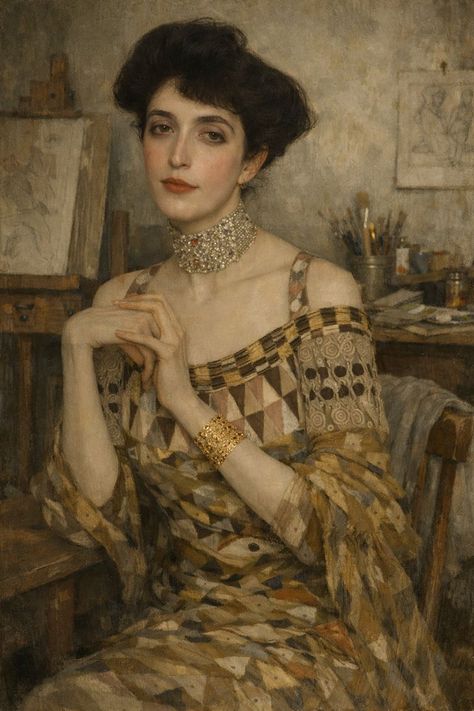
There's no difficulty telling one from t' other above. The hand/brain/eye-crafted image on the left comprises an entirely distinctive fusion of precise and well-observed drawing with subtly and beautifully fused tone/colours. The giraffe-necked, meretricious, vulgar and AI assembled confection on the right delivers a mannequin weighted with gold bling indebted to both Klimt and ancient Egypt.
"...Pace sneering art historians, to artists’ art practice trained eyes, spotting such injuries is as easy as it is for accountants to spot errors of arithmetic. That many art historians fail to recognise injuries to the works of the artists they study, might indeed suggest (as others have recently claimed) that something very wrong has been going on in art history education. And yet, at the end of the 1980s, when artists and rare visually discerning scholars challenged officially-sanctioned and endorsed restorations, it was they, not the visually-limited, who met with abuse. When I introduced myself to James Beck, prior to writing the 1990 Independent on Sunday article discussed below, he had been reviled in scholarly print by his peers – not least by a sister professor who served the Vatican as its art historical adviser/spokesman on the Sistine Chapel restoration. When I asked him if it might be helpful for an artist to make visual demonstrations of the injuries to Michelangelo’s work, he replied that it would be the most important thing to do, because “only artists understand these matters”. (Beck’s sister was a painter and he had studied fine art before switching to art history.)
https://t.co/0oXqwrAz0s
🚨ARGENTINA PLAYERS DISGRACED THE WORLD CUP CELEBRATIONS
DURING SPAIN'S TROPHY CEREMONY ALL THR PLAYERS OF ARGENTINA TURNED THEIR BACK TO THE THE SPANISH FLAG AND THEIR CELEBRATION
ARGENTINA REALLY ARE SOREST LOSERS OF ALL TIME 😤
Aside from Argentine flag-trampling, which country invented football? Google AI reports:
"Britain codified and invented the modern rules for many of the world's most popular sports, particularly during the 18th and 19th centuries. Major sports and games that originated in the UK include: Football (Soccer): Codified by the Football Association in England in 1863. Cricket: Developed in southeast England and standardized by the Marylebone Cricket Club. Rugby: Split into Rugby Union and Rugby League, originating at Rugby School in England. Golf: Emerged in Scotland in the 15th century. Tennis: The modern game of lawn tennis was developed in Birmingham, England, in the 1860s. Badminton: Invented in England at the Badminton House estate in the 19th century. Table Tennis (Ping Pong): Created as an indoor parlor game in Victorian Britain in the 1880s. Boxing: Modern codified rules, including the Marquess of Queensberry rules, were established in England. Squash: Developed in 19th-century English schools like Harrow from the older game of rackets. Snooker: Invented by British Army officers stationed in India. Field Hockey: The modern game was established in 19th-century English public schools. For more details on the origins and histories of these disciplines, you can read more on the Wikipedia Sport in the UK page or check out the BBC 7 Amazing Sports Invented in the UK article."
Let us not deny it: bent politics and crass, commercialised vulgarities notwithstanding, sport, like art, is a venue of transcendence - in both unimaginable achievements are realisable and sometimes realised. It is possible that neurology assists in these fields – lefthanders excel to a disproportionate degree (think Michelangelo, Leonardo, Holbein, Lautrec…and, in cricket’s batsmen, Lara, Gilchrist and, above all, Sanath Jayasuria). Researchers say this is not a question of intelligence, per se, but of right-brain dominance which is associated with spatial awareness and creative thinking. Certainly, in art sociability is a dispensable trait – Michelangelo, who noted that he was never less alone than when alone with his thoughts, was plagiarised by the highly sociable Raphael, not vice versa. But in team sports, teamwork is the name of the game, as was seen in the last two - and the most delightful - games of the world cup where England, freed from brutal Argentinian sabotage outplayed France in a sparkling and thrilling game. In the final, and notwithstanding their dirty, habitual brutality and their possession in Messi of the game’s greatest player and thinker, Argentine was outclassed and overcome by Spain’s fabulous display of consistent, individual and collective ball control and positional awareness.