#Ep#INTRADAY stocks for Monday
Krishana poschemical
Mbapl
Prime focus
Belrise
Inox green
Syncom
Maeson
Orchid pharma
Nibe
First cry
Sky ways
This one is better than previous list .
Shared list of best #stock
Like ❤️, Bookmark 📑 for boosting
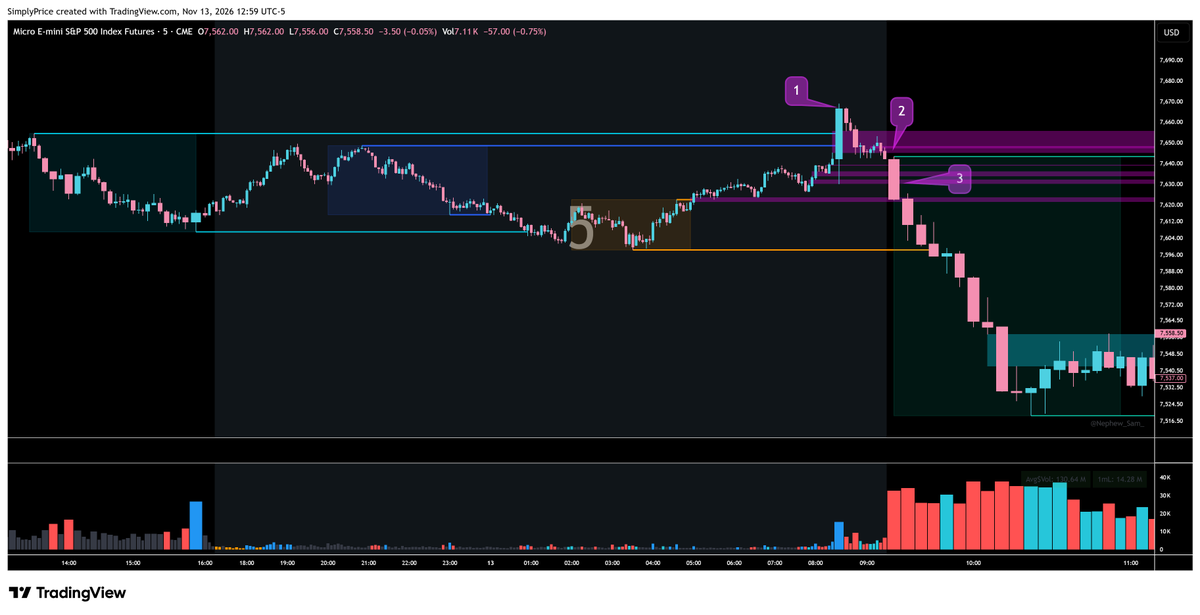
You only need 3 things to find a high-quality trade:
1. A sweep of a key liquidity level that creates an imbalance.
2. A sharp reversal that fills the imbalance.
3. A Market Structure Shift (MSS) confirming the reversal.
That's it.
Stop cluttering your charts with endless indicators and concepts.
Master these 3. Wait for the right sequence. Execute with precision.
I have taken over 3,000 trades in the last 8 years while trading full-time as my bread and butter.
I’ve learnt only the 7 most important lessons that I believe every aspiring trader should know.
Here is each one of them:
1. Be comfortable with missing profits, but do not be comfortable with losing your capital.
During my loss-making days, I used to trade without a pre-defined stop loss.
Now I make sure to risk only 1-2% of my capital in a trade, no matter how good the opportunity is.
2. Trading on your setup is way better than taking trades on the basis of news, events, or tips.
Earlier, I used to take buy trades whenever the RBI reduced interest rates. I used to trade a lot on news.
Now I only trade on the basis of my setup, completely ignoring news or events.
Even if there’s major bad news, if my setup tells me to sell, I happily sell.
3. Having a real and good strategy is far better than copying random strategies from the internet.
In my beginning days, I used to try a new strategy every week, which I used to find on social media. None of them worked.
Now I’ve been trading only on 1 setup named Magic Levels, which I created by myself.
Practicing one setup for thousands of trades is better than changing setups every other week.
4. Maintaining a trading journal and then analysing it once every 3 months will improve you more than anything else.
Earlier, I used to execute trades and then just say to myself what my mistakes were and what to fix.
Now I write every single trade down on a sheet of paper, then analyse its performance to make improvements in my trading style.
5. Overtrading or revenge trading has the capability to wipe out your capital before you blink an eye.
Earlier, I used to try to recover my losses on the same day, which led to overtrading and revenge trading.
Now I only take one trade a day, no matter whether it’s a profit or loss.
The market will stay there forever, so I don’t think I need to recover on the same day.
6. Keep improving every single day because what might have worked in 2010 will not work in 2026.
Earlier, I used to trade on age-old setups like indicators and chart patterns, due to which I made losses.
Now I trade on modern quant-based setups like Magic Levels, which get adjusted according to new market conditions automatically.
If you haven’t watched “Trading in the Zone” by Mark Douglas, you’re missing the real foundation of trading.
Just 22 minutes.👇📊
But it can change how you think about the market forever.
Because your real advantage isn’t on the screen, it’s in your psychology.
One of the most profitable skills in 2027:
Swing trading.
But most people don't know how to swing trade. They only know how to buy.
This is the only framework you need: 🧵
After 20 years of trading, I'm still working on the same thing:
PATIENCE.
The longer I trade, the more I realize that the big money isn't made by trading more.
It's made by waiting for the right opportunities.
And that's much harder than it sounds.
The market constantly offers you something to trade. A decent breakout here. An interesting setup there. A stock that might make a quick 10–20% move.
Especially during choppy markets, it's incredibly tempting to take these trades just to stay active.
But here's what I've learned:
You don't build exceptional trading results by collecting mediocre opportunities.
You need to wait until several edges come together:
1. THE RIGHT MARKET
A strong market makes everything easier. Your breakouts have a better chance of working, leading stocks can develop sustained trends, and you don't have to fight the overall environment.
2. THE RIGHT STOCK
I'm looking for exceptional momentum, a clear catalyst, and a stock that has the characteristics of the biggest winners I've studied in my model books.
A chart pattern alone isn't enough.
3. THE RIGHT SETUP
A tight, constructive base. Picture-perfect price action. A clean entry that allows me to take meaningful exposure while keeping my initial risk small.
When all three align, that's when trading gets really interesting.
My own statistics confirm this: My highest-quality setups have twice the expectancy of my other trades.
Yet I still take plenty of good-but-not-great trades.
Why?
Because waiting is difficult.
The four-star opportunities are everywhere. The truly exceptional ones are rare.
And while those good trades can make money, they also consume time, attention, and risk.
That's why I'm constantly asking myself:
Could I achieve similar or even better results with significantly fewer trades?
I believe I can.
But it requires the discipline to sit through weeks of mediocre opportunities without feeling the need to do something.
Even after 20 years, that's something I'm still working on.
My goal isn't to become a more active trader.
It's to become a more selective one.
Trade less.
Trade higher quality.
Wait for the exceptional opportunities.
That's where I believe the big money is made.
India’s stock market tax stack:
• STT (2004): Payable even on losing trades, with hikes in 2023, 2024 and 2026. Estimated cumulative collection: ~₹3.7 lakh crore up to mid-October 2026.
• LTCG (2018): Reintroduced at 10%, increased to 12.5% in 2024. ₹2.01 lakh crore reported for FY24 and FY25 combined.
• STCG: Increased from 10% → 15% → 20% on eligible short-term equity gains.
• GST (2017): 18% on brokerage and taxable service charges.
• Stamp duty: Charged on purchases, with uniform securities rates introduced in 2020.
• Dividend tax: DDT abolished in 2020; dividends now taxed in investors’ hands.
• Buyback tax: Moved from company-level taxation to shareholder dividend tax, then capital gains in 2026, with additional promoter taxation.
• Trading-profit tax: Intraday and F&O profits attract applicable business-income tax.
• Cess & surcharge: Additional levies on income tax, including 4% cess.
Brokerage, SEBI fees and exchange charges come on top of all this.
Despite this tax burden, our markets continue to attract liquidity. The Finance Minister should welcome that resilience. Unfortunately, liquidity itself now seems to have become a concern.
@LGIndia@LGE_Global
Purchased LG washing machine on 9th February 2026 from Khosla electronics located in Rajarhat Kolkata. They have delivered demo product to me which is 5 years old which I didn't want. When reaching to the for replacement, they are ignoring.
Please help me
In the world of options trading, the difference between a "good trade" and a "blown-up account" isn't just about picking the right direction—it’s about knowing the price of being wrong.
Here is a breakdown of the risk landscape for popular strategies and some essential "Risk Management Gyaan" to keep you in the game. 🧵👇
1/ The Risk Hierarchy: What happens when you're wrong? 📉
Not all strategies are created equal. Depending on your setup, "going wrong" can mean anything from a small dent to a catastrophic loss.
🔴 Naked Option Selling: The "Extreme Risk" zone. Selling options without a hedge (naked) gives you a high win rate, but one "black swan" event can lead to unlimited losses.
🟠 Naked Option Buy: Your risk is "100% Capital Loss." While your loss is capped at the premium paid, the probability of losing that entire premium is high due to time decay (Theta). So here position sizing becomes important.
🟡 Credit Spreads: Risk is "Defined but High." By buying a further OTM option to hedge your sell, you cap your max loss. However, the risk-to-reward ratio is often skewed (e.g., risking 2 Rs to make Rs. 1).
🟢 Debit Spreads: "Low & Fixed." You pay a premium to enter, and that’s the most you can lose. It’s a more conservative way to play a directional move.
✅ Butterfly Strategy: The "Minimal Cost" champion. By combining multiple spreads, you create a "peak" profit zone. If the market moves against you, the loss is often very small compared to the potential reward. More powerful near expiry
2/ Risk Management Gyaan: The Trader's Survival Guide 🛡️
Knowing the strategy is 20% of the battle. The other 80% is managing the risk. Here are 3 rules to live by:
A. The 2% Rule 📏Never risk more than 1–2% of your total trading capital on a single trade. If you have a ₹1,00,000 account, a single "wrong" trade shouldn't cost you more than ₹2,000. This ensures that even a losing streak won't wipe you out.
B. Trade "Defined Risk" as a Beginner 🚧If you are just starting, stay away from "Naked" selling. Use Spreads or Butterflies. They have a built-in "safety net" that prevents a market gap from destroying your account overnight.
C. Respect the Greeks (Especially Theta & Vega) 🕒
Theta: If you’re a buyer, time is your enemy. Don't hold losing "naked buys" hoping for a miracle.
Vega: Volatility can kill a trade even if you get the direction right. Be careful selling options when IV (Implied Volatility) is low
3/ The Bottom Line 🏁
Trading is a marathon, not a sprint. The goal isn't to be right 100% of the time; it’s to ensure that when you are wrong, it doesn't hurt.
Choose strategies like Spreads or Butterflies to keep your "cost of going wrong" manageable.
#OptionsTrading #RiskManagement #StockMarketIndia #TradingTips #Nifty50