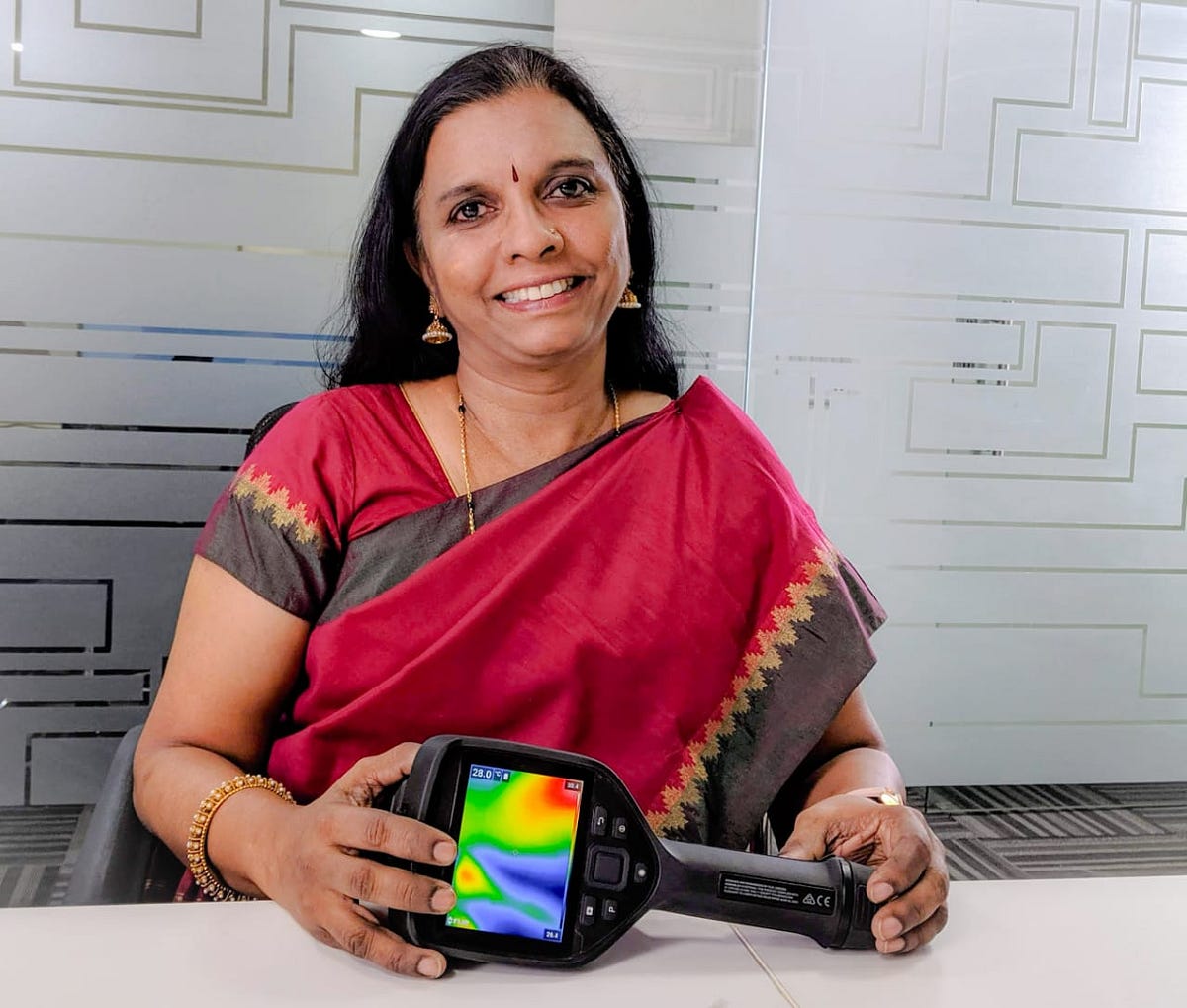
In 2016, Dr. Geetha Manjunath was heading AI research at Xerox's Bengaluru lab, a role that followed a PhD from IISc, a stint as Principal Scientist at HP Labs, and over two decades building enterprise AI systems. Then her cousin, in her early forties, was diagnosed with breast cancer at a stage too advanced to treat.
"The mammogram had missed her cancer earlier," Geetha would later say. She quit her job soon after.
Mammography, the global standard for breast cancer screening, has real limits. It uses ionising radiation, is often painful enough that women actively avoid it, and is known to be less reliable in younger women and in the dense breast tissue common across Indian women. In India, where breast cancer accounts for over a quarter of all cancer diagnoses and the five-year survival rate trails far behind the United States and Australia, late detection is not a statistic. It is the difference between a cure and a funeral.
Geetha had spent years working with thermal imaging on unrelated projects. She wondered if temperature variation in breast tissue could reveal what mammograms missed, and built the science to test it. The result, Thermalytix, requires no radiation, no incisions, and no physical contact: a woman sits before a thermal sensor for a few minutes, and an AI model trained on clinical data analyses the image.
Niramai Health Analytix, the company Geetha founded and now leads as CEO and CTO, has since screened over 300,000 women across more than 20 countries, built on 39 patents and validated in 55+ peer-reviewed clinical studies. Geetha herself has been named to Forbes India's Top 20 Self-Made Women and inducted as a Fellow of the Indian National Academy of Engineering.
For India, where cost and discomfort keep millions of women away from regular screening, a radiation-free test that can be deployed in a primary clinic is not a convenience. It is a chance to catch what would otherwise be caught too late.
Ein junger SpaceX-Mitarbeiter fragte Elon, was passiert, wenn sie den Mars zu seinen Lebzeiten nicht erreichen. Der Raum war voller Ingenieure und die Frage landete schwerer, als irgendjemand erwartet hatte.
Es war eine einfache Frage, doch sie traf den Kern, wofür SpaceX existiert. Das gesamte Unternehmen, jede späte Nacht, jeder explodierte Prototyp, jeder Ingenieur, der den Geburtstag seines Kindes für ein Startfenster verpasst hat – alles zielt auf den Mars. Was, wenn es nicht rechtzeitig passiert?
Elon hielt inne.
Er sagte, das Ziel sei nie gewesen, persönlich auf dem Mars zu landen. Es gehe darum, die Infrastruktur aufzubauen, die unvermeidlich ist. Selbst wenn er stirbt, bevor die erste Besatzung landet, würde das System die Mission ohne ihn vorantreiben.
Die Raketen, die Fabriken, das Team, die Kultur – alles sei darauf ausgelegt, jede einzelne Person zu überdauern. Einschließlich ihm. Besonders ihn.
Dann sagte er etwas, das die Leute im Raum bewegte: Wenn er glaubte, der Erfolg hänge davon ab, dass er am Leben sei, hätte er bereits versagt. Der Punkt sei, etwas zu bauen, das seinen Gründer nicht braucht.
Er verglich es mit einer Kathedrale. Die Architekten mittelalterlicher Kathedralen wussten, dass sie sterben würden, bevor das Gebäude fertig wäre. Dennoch entwarfen sie es und gaben ihr Leben für etwas, das sie nie vollenden würden. Die Verpflichtung war der Punkt.
SpaceX ist seine Kathedrale. Er wird vielleicht nie einen Fuß auf den Mars setzen. Aber die Straße dorthin wird existieren, weil er sich weigerte zu akzeptieren, dass niemand sie baut.
Der ehrgeizigste Mann der Welt hat sich mit der Möglichkeit abgefunden, dass seine größte Leistung nach seinem Tod erfolgen könnte.
Das ist kein Misserfolg. Das ist der Glaube an etwas Größeres als sich selbst.
Happy Birthday Elon 🚀💪🔥
The economic and demographic effects of corruption.
Cost of land in our urban areas is far higher than what our GDP per capita would dictate. The ratio of land value to per capita GDP is probably higher in India than anywhere else. As an example, land prices in Chennai or Bengaluru rival that of cities like New York which has a vastly higher per capita GDP.
The key reason?
First, vast sums of political corruption money is parked in real estate. This raises real estate prices and high real estate prices affect everything downstream.
Second, corruption in building approvals and the like - the famous DTCP - raises construction costs, on top of already higher real estate costs.
Third, corruption in private school regulatory compliance enforcement raises school fees.
Fourth, corruption in private hospital regulatory compliance enforcement raises health care costs.
Fifth, household goods need sales outlets and those pay higher rents due to high real estate prices and construction costs.
So housing, education, healthcare and household goods - all of these now cost higher.
As a direct consequence, the economic burden on the average person gets worse. Young people, facing all these costs, postpone marriage, and postpone children or have fewer children.
That directly affects our demographics.
While this issue exists in many parts of India, Tamil Nadu, being the most urbanized of the bigger states, is particularly hit hard.
So corruption is becoming an existential threat to our society.
If you worry about the super-low birth rate in Tamil Nadu, way below replacement, understand that corruption raising our cost of living is one of the major causes, not the only cause, but a big one in our context.
Winning against the Chinese. In China.
At the Asian Relay Championships.
Srabani, Sudeshna, Sneha & Tamanna in the 4x100 relay.
Power. Speed. Grace. Commitment.
But above all, teamwork.
This clip has it all.
I’m watching it on loop.
More of this please. 🇮🇳
India's Quantum Hardware Dream Advances As Amaravati Facility Achieves Extreme Cryogenic Temperatures
🥶 Indigenous dilution refrigerator hits minus 269°C, among India's coldest ever
⚛️ System to cool further to millikelvin for superconducting quantum computing
https://t.co/KhS3bKX3V7
Nearly every Mercedes Benz car sold in India comes with an engine produced by Force Motors at its Chakan factory near Pune.
Force Motors just handed over the 200,000th engine to Mercedes Benz. It was a M256 straight six turbo petrol engine that's used in cars like the Mercedes Benz S-Class. The 200,000th motor went to a GLS 450.
Force Motors also produces engines for BMW at a different factory in Chennai. Force has built over 1 lakh engines for BMW, too. It even makes large, 10 cylinder and 12 cylinder industrial engines for Rolls Royce.
Did you know that the OM616 diesel engine that the Tempo (Force) Traveller used is a Mercedes Benz engine?
Force Motors later came up with re-engineered versions of this engine for the Gurkha, Travellers and Traxes, called FM2.6 and OM611.
@CarToq
At IIT Bombay, three undergraduates have spent ten months building a semiconductor fab from scratch, fabricating their first working devices this week.
A complete NMOS transistor — on tools they made themselves — is expected by the end of the summer. 🧵
India's Biggest Economic Challenge Is not Inflation, Oil, or War - It is an Unskilled Population Addicted to Distraction.
Every time oil prices rise, economists panic. Every time a war breaks out in the Middle East or Europe, television studios declare that India's economy is under threat. And yes, both matter. But neither represents India's greatest economic challenge. The real crisis is unfolding much closer to home.
It is a generation that spends more time consuming content than creating value. A workforce that debates geopolitics without mastering spreadsheets, artificial intelligence, coding, welding, precision manufacturing, sales, finance, communication, or even basic problem-solving. An economy where attention has become the most wasted national resource.
India is one of the youngest countries in the world. That should have been our greatest competitive advantage. Instead, we risk turning our demographic dividend into a demographic liability.
The Age of Endless Consumption
Never before has information been so accessible. Yet never before have so many people spent so much time learning so little. Hours disappear into political debates, celebrity gossip, cricket controversies, influencer reels, conspiracy theories, and outrage cycles that have absolutely no impact on an individual's earning potential. Ask someone how many hours they spent on social media last week. Then ask them how many hours they invested in acquiring a new professional skill. For many, the answer is uncomfortable. We have become experts at commenting on the economy while contributing very little to it.
Degrees Are Not Skills
India has no shortage of graduates. It has a shortage of employable graduates. Companies repeatedly report the same problem: vacancies exist, but suitable candidates are difficult to find. Not because people lack certificates. Because many lack practical skills. The world is rewarding competence, not credentials.
- Can you solve problems?
= Can you communicate effectively?
- Can you sell?
= Can you lead a team?
- Can you analyze data?
- Can you use AI to improve productivity instead of merely asking it amusing questions?
- Can you create something that another person is willing to pay for?
Those are the questions that determine economic success. Not the number of degrees hanging on a wall.
Attention Is the New Currency
The biggest theft today is not of money. It is of attention. Every notification fragments concentration. Every endless scroll delays mastery. Every hour spent consuming outrage is an hour not spent building expertise.
Modern economies reward deep work, specialized knowledge, creativity, and disciplined execution. Algorithms reward emotional reactions. Unfortunately, millions choose the algorithm.
The Coming Divide
Artificial intelligence is not replacing everyone. It is replacing people who refuse to learn. The future will belong to workers who continuously upgrade themselves. Those who combine human judgment with technological tools will become dramatically more productive. Those who stop learning will find themselves competing for fewer opportunities at lower wages. The divide will not be between rich and poor. It will increasingly be between skilled and unskilled.
National Growth Begins With Individual Discipline
Governments can build highways. Businesses can build factories. Universities can build campuses. But none of them can force an individual to develop skills. Economic transformation begins with personal responsibility. Spend one less hour arguing online. Spend one more hour learning. Read instead of scrolling. Build instead of complaining. Acquire one valuable skill every year. Become indispensable.
If millions of Indians made that simple choice, the country's economic trajectory would change more profoundly than any fiscal stimulus, any election promise, or any temporary fall in oil prices.
Wars will end. Oil prices will rise and fall. Markets will recover. But a nation that neglects skill development while surrendering its attention to endless distraction will struggle long after those headlines have disappeared.
The strongest economy is not built by the loudest voices. It is built by the most capable people.
#JaiHind
TCS, which employs 584,519 people and is a renowned IT company, lost the CBSE OSM bid to COEMPT, which has only 51-200 employees, because COEMPT’s bid value was ₹566 crore lower than that of TCS.
The only priority of CBSE was to save money, not to safeguard the future of young students. Their greed to save costs has ruined the lives of lakhs of students.
Indian scientists just made history.
Researchers from IIT Madras and IISc Bengaluru just pulled off something impossible.
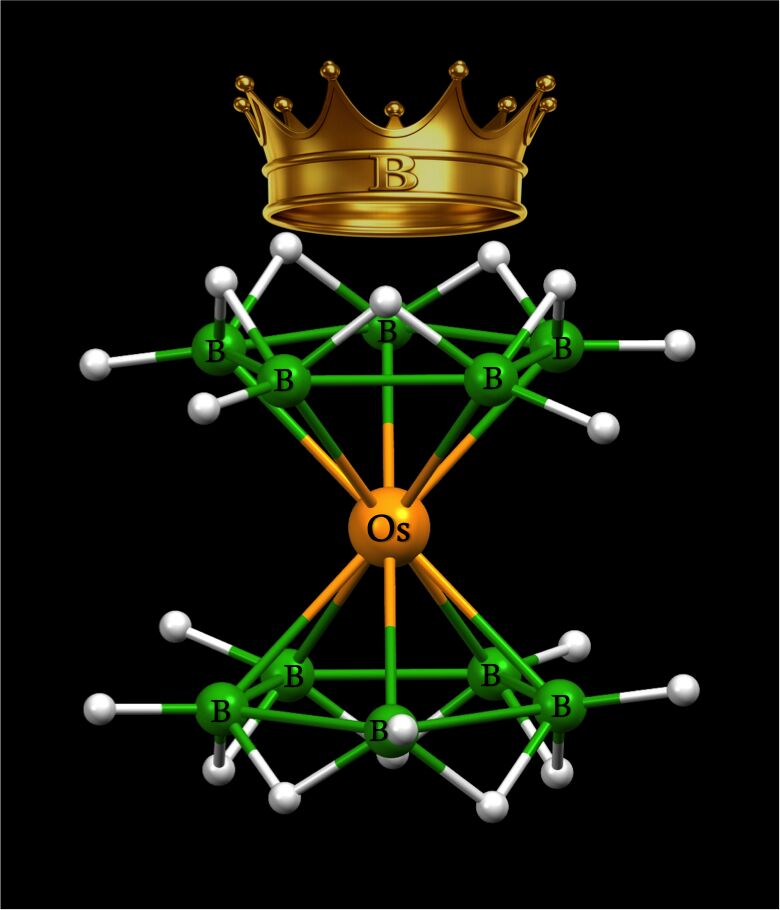
They've created the world's "first carbon-free ferrocene".
This means we can finally build the next generation of incredibly durable tech.
Let me explain.
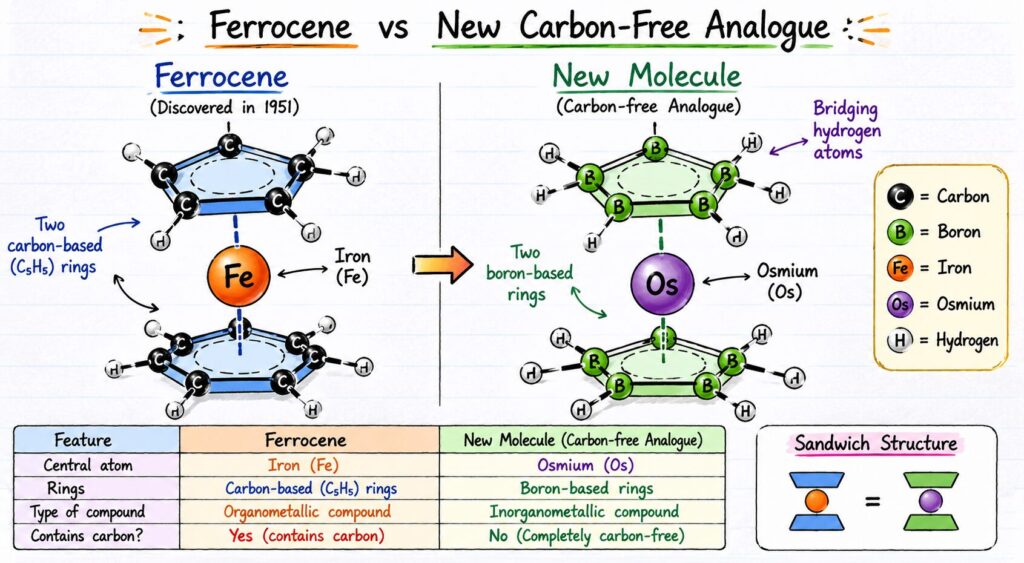
See, ferrocene is this wild organometallic molecule - where an iron atom is perfectly sandwiched between two carbon rings.
But it’s insanely stable.
Which is why it is already used in rocket fuels, car gasoline additives, long-life batteries, and even cancer medicines.
And for the last 75 years, everyone thought it was impossible to build the same stable structure without using carbon.
But this team of Indian scientists proved everyone wrong.
They created the same perfect sandwich structure - by swapping iron for osmium and carbon rings for boron rings.
And what they got was the world's first carbon-free ferrocene - which is so much stronger than the carbon bonds.
By doing so - they've opened up a whole new era of chemistry. And we have no idea how many amazing things we might discover.
But to think all of this started in India is truly amazing.
Kudos to everyone on this team: Sundargopal Ghosh, Stutee Mohapatra, Suvam Saha, Urvashi Gupta, Deepak Patel - from IIT Madras, Gaurav Joshi and Eluvathingal D. Jemmis - from IISc Bengaluru.
@SwarajyaMag 2/2 You shall provide Indian industry space to develop organically. This will provide place for indigenous machinery, raw material and process development. Cell is strategically important and it is crucial that we have all components of it domesticated.
@SwarajyaMag 1/2 The industrial model India is following up for Cell Manufacturing is not the best. It will keep cell manufacturing concentrated and it will develop slowly. A more adoptable model is to promote 2-3 GWH capacity in each state with smaller plants.
IIT Delhi to IIM Bangalore to IAS. I got the best education my country had to offer. It taught me how to crack tough exams and manage big responsibilities. But it never taught me how to quiet my own mind or handle loneliness. We spend many years learning how to achieve, but not a single day learning how to be happy.
My thoughts on what is missing in school education.
Emotional Regulation:
We memorized the periodic table, but no one explained the chemistry of a broken heart. School demanded we stay quiet, confusing silence with peace. Now, we don't know how to host our own storms without drowning in them. We feel lost because we were taught to suppress, not to process.
Deep Communication:
We were taught to write perfect essays, but not how to say "I’m hurting" or "No." While there is a strong emphasis on communication, we are not taught the vocabulary of the adult life. There is no course on how to stand our ground in face of bullying by a boss or how to protect our work boundaries by saying 'No'
Critical Thinking:
In school, the person with the most answers won. In life, the person with the most questions survives. This is the reason many adults can repeat opinions confidently without ever questioning where those opinions came from. We are told everything as the gospel truth. So we end up just following blindly
Financial Literacy:
We spent years learning maths and solving for x, but never learned how to keep ourselves from falling in a debt trap. Money isn't just about math; it’s about the dignity of choice. We do not learn how to use debt effectively without it controlling our freedom. How impulsive spending compounds over time, or how money affects stress, relationships, and mental peace. Financial literacy is missing because education often focuses on earning money someday, not managing it wisely once it arrives.
Self-Discipline
School is a world of bells and schedules. Someone else always tells you what to do and when. But adulthood is a world of total silence. We feel stuck because we were never taught how to push ourselves without a teacher watching. Discipline is simply the habit of keeping promises to yourself. This is a habit many of us are lacking
Handling Loneliness
In school, you are always shrouded by people. You never realize how loud the silence of adulthood can be until you’re in it. We feel lonely because we weren't taught how to be our own best friends. Peace is learning that being alone doesn't mean being lonely. It is a sacred space, not a sign of being unwanted.
Reading People
School is a time of innocence where friendships are often given to you. But as we go along, not everyone retains that purity. We feel cheated because we weren't taught to see the hidden intentions or the masks people wear. Reading people is the quiet wisdom of seeing the truth behind the words.
Mental Health Maintenance
We have gym class for our bodies, but nothing for our souls. We are taught to push through exhaustion to finish a project, which is exactly how we end up in burnout. Honoring your nervous system is the only way to make sure the light inside you doesn't go out. We should know when we are dealing with a stressor and unable to handle it anymore. We should know when to reach out for help if we feel that we are drowning in that distress
Knowing Yourself
We spend years trying to be the "best" student, only to realize we don't know who we are without a gold medal. We are left inadequate because we studied every subject except our own souls. The ultimate education is discovering what truly matters to you before the world tells you what to want.
Tata Electronics just signed ASML for India's first 300mm front-end semiconductor fab. Gujarat.
ASML makes the machines nobody else can make. Their EUV lithography systems cost ₹1,500+ crore each. Only 3 countries had access to these machines till recently — Taiwan, South Korea, Netherlands.
India is now the 4th.
I think people underestimate what 'front-end fab' means here. This isn't packaging or testing — this is where the actual transistors get etched onto silicon. The hardest part of the chip value chain.
Two years ago we had zero fabs. By December we'll have four operational facilities. The pace is genuinely unprecedented for a country that wasn't even in the conversation five years ago.
Most people don’t know this yet...
SpaceX’s Falcon 9 is one of the most autonomous orbital rockets flying today
Once it lifts off, controllers basically just watch - the rocket runs fully autonomously
But here’s the part that surprises people: It doesn’t use AI
The autonomy comes from incredibly well-engineered traditional software + advanced math (convex optimization), refined over hundreds of Falcon 9 flights. After the final human “go”, the rocket’s deterministic systems handle everything:
→ Liftoff & Ascent: Guided by closed-loop control systems
→ Stage Separation: Executed via strict, sensor-based triggers
→ Booster Landing: The G-FOLD algorithm calculates the optimal path to a moving droneship in milliseconds
→ Payload Deployment: Complex orbital maneuvers with zero human input
→ Autonomous Flight Termination (AFTS): It can even detect if it’s going off-course and destroy itself without ground control
All of this is powered by brilliant human engineering, flawless code, and hyper-accurate sensors. Zero neural networks
We are watching the greatest aerospace engineering team on Earth flexing their skills
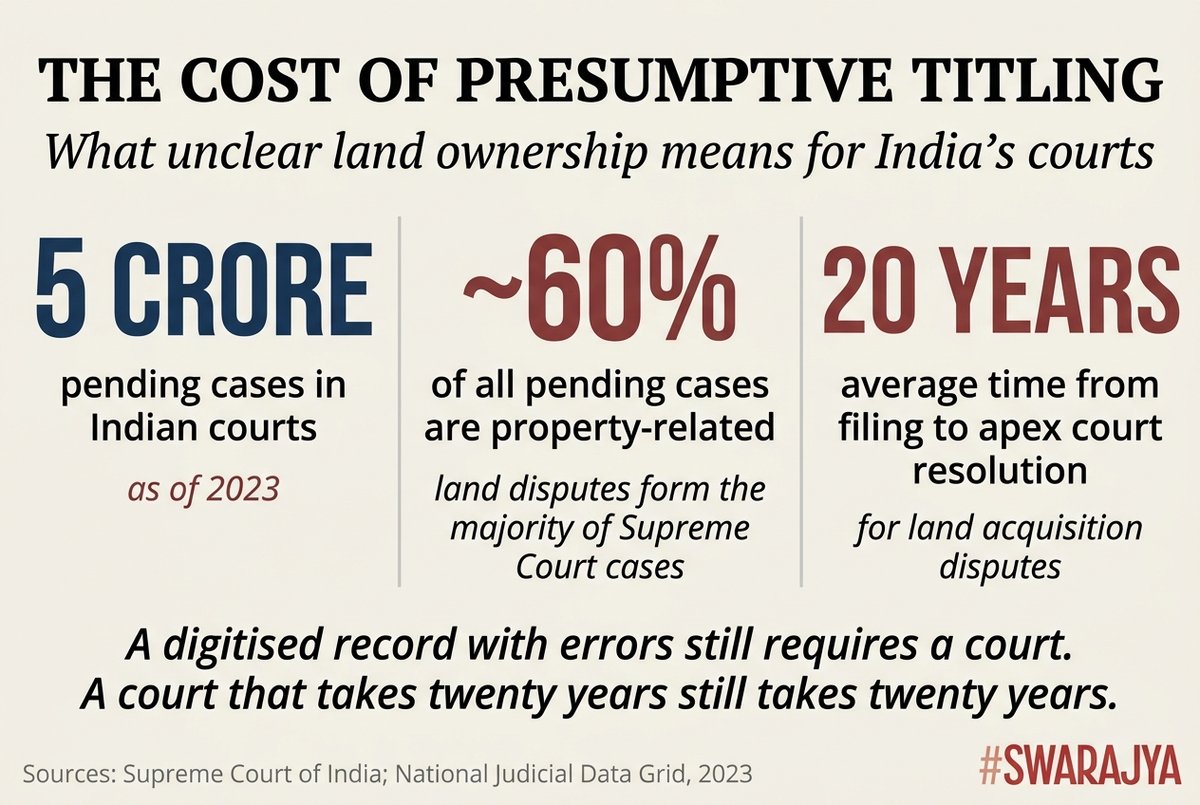
Australia, the UK, Singapore and New Zealand use guaranteed land titling.
When you register a property in those countries, ownership is created by the act of registration itself, rather than merely recorded. If an error appears later, the state indemnifies the citizen.
On a ₹5 crore property deal in India, the state collects roughly 5.68% in stamp duty and registration charges.
All it gives back is a record that the transaction happened. It does not confirm that the seller had the right to sell or that the buyer is safe from later claims.
This is not just a song…it’s an anthem for life.
“I'm at peace with the measure of my worth.
I've freed myself from every doubt, every disguise.
Even if we win the world’s approval, peace will not come this way.
Whatever is yours will find its way to you by any means possible
Let your heart understand this truth and Jhoom, Jhoom, immerse yourself in joy.”
I’ve heard many versions of it, including Abida Parveen’s famous rendition…
This one stands out.
I don’t know who the soulful singer is, but she has brought peace to this saturday…I applaud her and thank her.
(Video courtesy @beingcalm02 )