New paper: "Measuring the Stability Assumption Behind Action Chunking"
arXiv: https://t.co/X5X4WTCHrA
Project page: https://t.co/Wt8Ucv86PZ
Empirically, action chunking works better than step-by-step execution in imitation learning, and several explanations have been proposed for why, including temporal consistency, horizon reduction, and delayed conditioning.
All of these explanations address how often error enters the loop or how much of it there is, but some error is inevitable, since a learned policy is slightly wrong at every step, and the more consequential question is what happens to that error afterwards: whether it expands or contracts over the steps that follow.
Existing theory handles this question by assumption: the guarantees for chunked execution assume that the dynamics contract errors at a single fixed rate, the same at every state of every episode, and the error bounds are derived from that one constant. There is little reason to expect it to hold, since a robot moving through free space and the same robot mid-grasp are unlikely to treat an error in the same way.
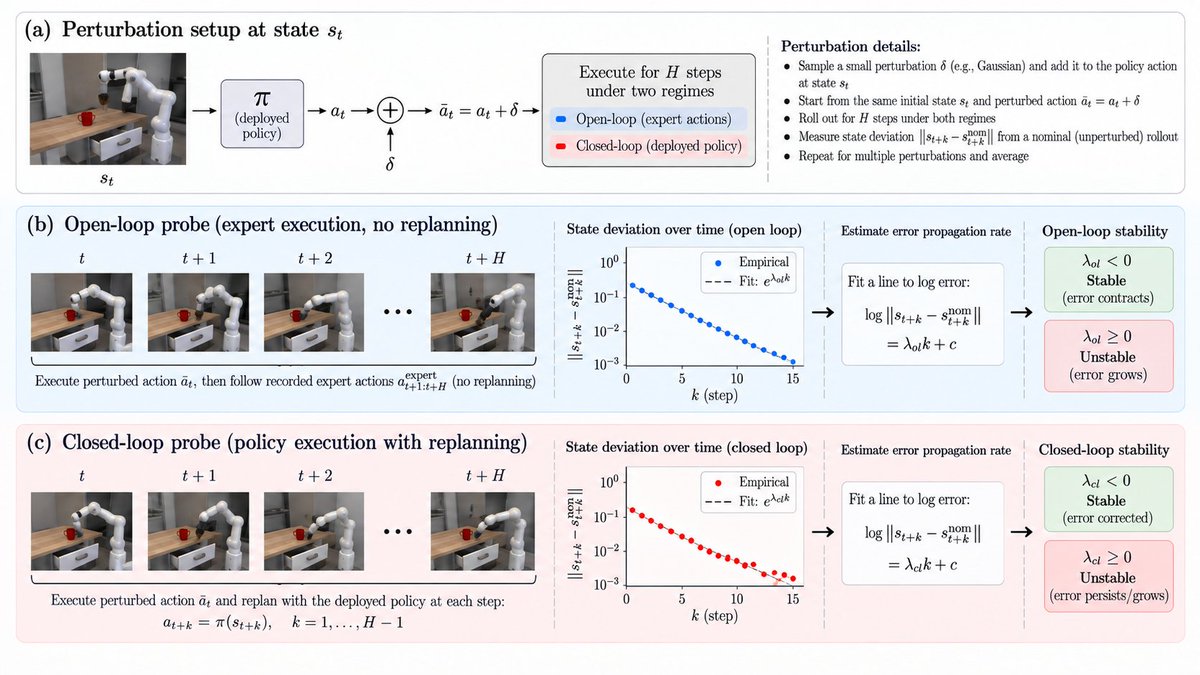
We challenge that assumption with a new per-state probe that tests whether an injected action error expands or contracts, perturbing a single action at each state and tracking the resulting deviation twice, once with the rest of the chunk replayed without replanning and once with the policy replanning after the error. Using it, we label open-loop and closed-loop stability across three benchmark families, robomimic, MimicGen and RoboCasa, covering twelve tasks and two policy classes.
Across all three, errors expand far more often than they contract, and replanning does not turn them around either: the one case that would justify shorter chunks, where an error expands without replanning but contracts once the policy replans, covers only about 0.1 to 0.3 percent of states. We also find that a state's open-loop regime can be predicted from camera frames and proprioception alone, while its closed-loop regime is only partially predictable, because it also depends on how the policy acts after the error.
These results also suggest that closed-loop stability should not be expected to emerge reliably from standard imitation learning; it should be trained explicitly by exposing the policy to perturbations and recovery trajectories.
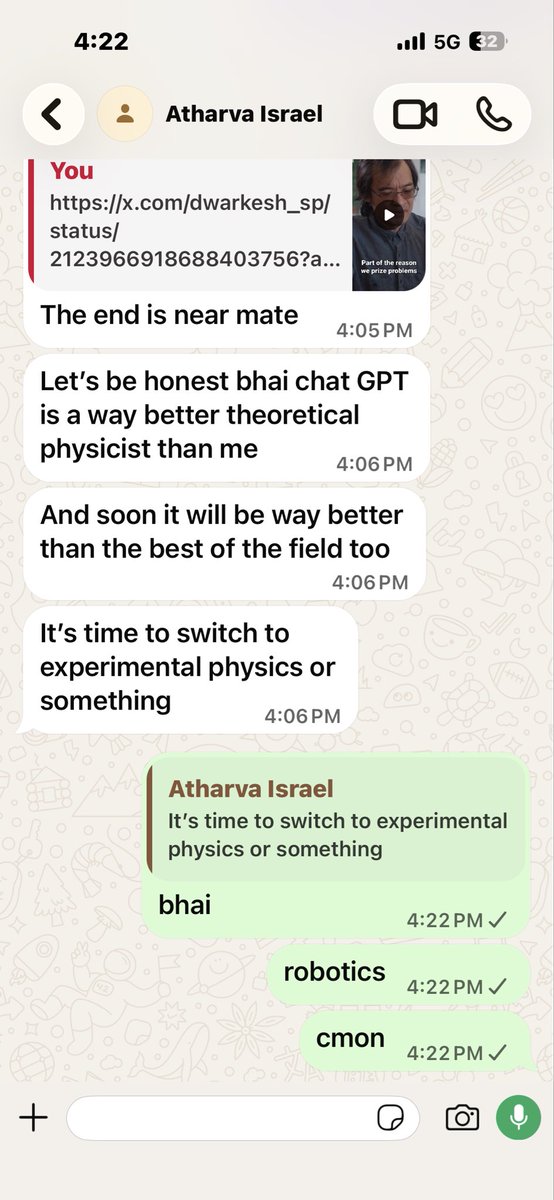
my friend is a theoretical physics phd at weizmann having an existential crisis over AI solving riemann hypothesis. i'm taking this as a recruitment opportunity for robotics 😛
Excited to announce that I've joined the policy research team at @NeocambrianAI to work on the hardest problems in imitation learning.
Sharing our real2sim work for training dexterous manipulation policies: We reconstructed a real scene in simulation, giving policies virtually unlimited RL practice.
Replaying recorded robot commands open-loop in the reconstruction consistently tracks the real gripper within 9-10 mm RMS error across episodes.
The result is not a one-off. Here are two more episodes from different grasps.
Next, I am training policies with RL inside these reconstructed scenes and testing how well they transfer back to the real robot.
This particular paper gathers evidence that flow models don't show multi-modality.
"Much Ado About Noising" (https://t.co/sF61uauX0P) tests whether trained generative robot policies actually hold multiple action modes — and finds they don't. But they check it for flow models. I check the same for diffusion
Is diffusion better at capturing modes than flow? Slightly, in one dataset: on square, diffusion's sampled actions form TWO distinct successful behaviors; flow's form one (left vs right below). That's the whole advantage.
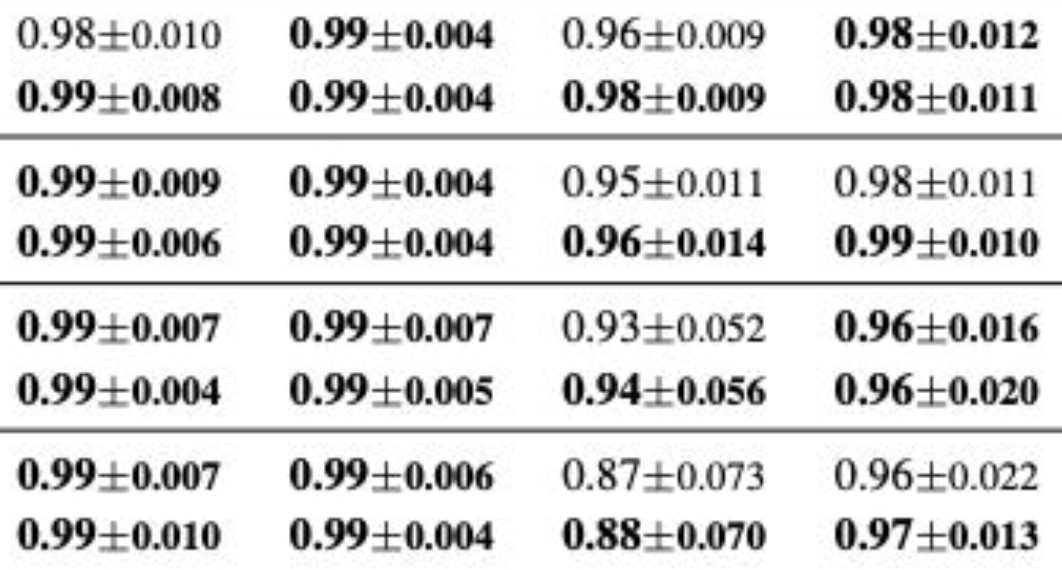
Does it help? Not really. Task success is the same for both: 0.90 . And on the hardest task (transport), flow wins by a considerable margin: 0.55 vs 0.30