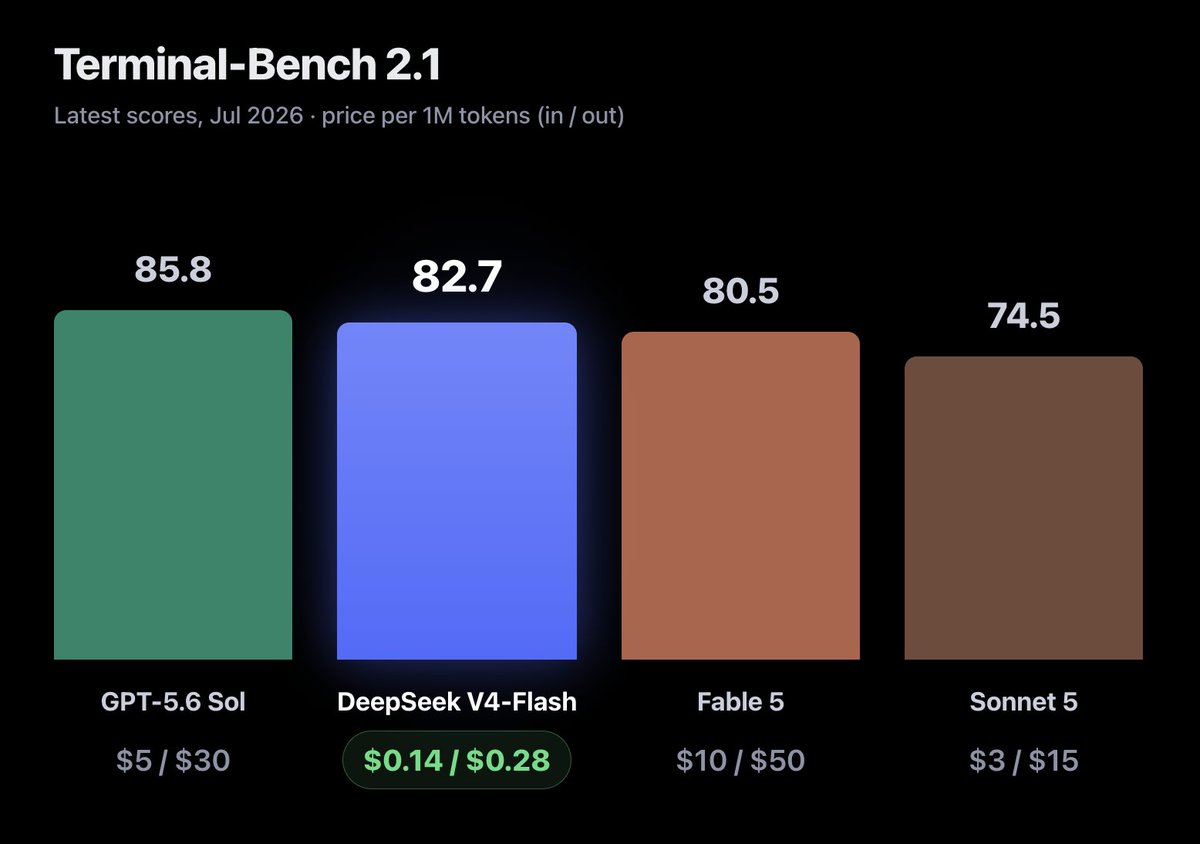
Deepseek V4 Flash is almost 80 times cheaper than Opus 5 when it takes to complete the same task
And there is not much difference between it and Opus 5 as per the newer benchmarks 🤯
While DeepSeek V4-Flash is significantly cheaper on price per token, this can be misleading if the overall cost per task ends up being higher due to more turns being made.
However, @ArtificialAnlys reports DeepSeek completing the same benchmark tasks as Fable at 105x lower cost.
We are making the updated DeepSeek V4-Flash 0731 free in Cline.
This is the first flash model we've found performs at SOTA levels, and are excited for you to feel the new frontier.
1. npm i -g cline
2. Open /settings > Cline provider
3. Select deepseek-v4-flash
Elon Musk 's interview with The Economist full length video in which he talks about AI Advancements and 10-20 percent chances of Humans Being wiped out by AI
What are your prediction on this?
Will Humans be in charge even after next 100 years?
https://t.co/wFcDU6q9v0
It is insane it's so cheap
Really good thing happening for users right now
If there wouldn't have been competitors, Anthropic would have been charging probably 100-200 dollars per 1 M tokens output for Fable
DeepSeek silently updated their changelog with a new V4-Flash upgrade 1 hour ago.
Their new Terminal-Bench score is 82.7, a massive +25.8 point leap from its initial April preview score of 56.9.
Currently only available via their API, open weights release will follow shortly.
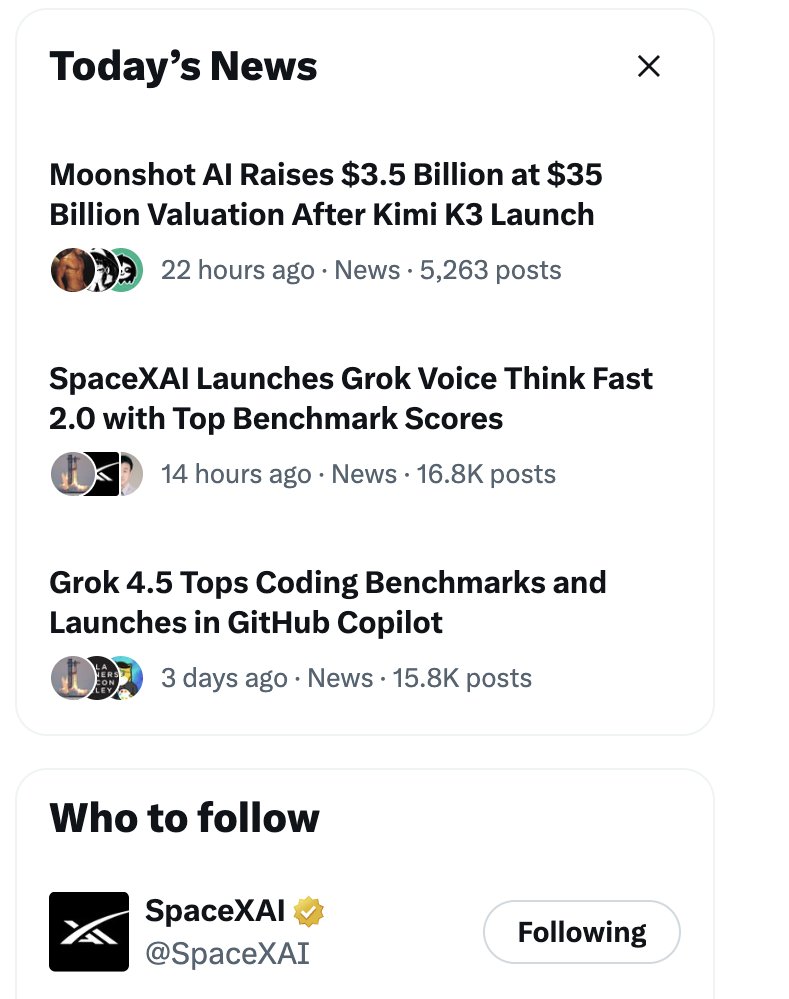
Right now SpaceXAI is doing much better in AI as compared to Google
While SpaceXAI is breaking the internet with Grok 4.5 and Grok Voice Think fast 2.0 the Google is failing to bring any AI model which ranks even in top 10
#google#grok#spacexai#gemini#ai
Announcing Grok Voice Think Fast 2.0, our next-generation voice model with improved intelligence, transcription accuracy, and conversational capabilities.
https://t.co/XUiX1CouKz
I have seen many developers still doing the coding traditional way without help of AI
Upon asking why they say tokens cost a lot and are unaffordable for them
However to your surprise, "you don't even need to pay a single dollar to do AI coding!"
Just download open code from
https://t.co/nmau5PGkZW
And it comes preloaded with free models like Deepseek V4 Flask Free, Nvidia's Nemotron 3 Ultra Free, etc
If you are using Openrouter you can even get access to more free models
These models are not as good as top models like Fable 5, Opus 5, Kimi K3 or GPT 5.6 Sol but they are still decent to get shit done
It is always better to use these than not using AI at all
#opencode #deepseek #nvidia #nemotron #ai #cursor #claude
🚀 Startup Concepts Every Founder Should Know [Part 3]
In Part 2, we explored Competitive Advantage, Network Effects, and Switching Coste, the concepts that help startups defend their position once they've built something valuable.
But before any of those matter, a startup first needs to answer one question:
Do people actually want this product?
Let's look at three concepts that explain how successful startups find product-market fit and scale from there
1. Product-Market Fit (PMF)
Product-Market Fit is the stage where your product solves a real problem for a specific group of customers so well that they keep coming back and actively recommend it to others.
Before PMF, growth often feels forced.
After PMF, customers start pulling the product instead of the company constantly pushing it.
Signs of Product-Market Fit include:
- Strong customer retention
- Word-of-mouth referrals
- Increasing organic growth
- Customers saying they would be disappointed if the product disappeared
Example
Imagine you build an AI coding assistant.
Initially, developers try it but continue using other tools because it doesn't offer enough value.
Over time, you add a planning mode, task checklists, significantly improve code quality, reduce hallucinations, and make it consistently follow software engineering best practices.
Developers now rely on it for their daily work, use it across entire projects, and recommend it to their teammates because it has become an essential part of their workflow.
That's a strong indicator of Product-Market Fit.
2. Growth Loops
A growth loop is a system where each new user helps generate future users.
Instead of relying only on paid marketing, the product itself drives growth.
Example
Imagine you build an AI resume platform.
A job seeker creates a polished resume using your AI tool and shares a review link with mentors or friends for feedback.
They also share the resume with recruiters and hiring managers during job applications.
The mentors, recruiters, and hiring managers discover the platform, recommend it to other candidates, or use it to create and review resumes themselves.
Those new users then share resumes with even more people, bringing additional users onto the platform.
Every new user helps attract more users, creating a continuous growth loop.
3. Flywheel
A flywheel is a self-reinforcing cycle where improvements in one part of the business make every other part stronger.
As the cycle repeats, growth becomes easier and faster.
Example
An AI coding platform attracts more developers.
More developers generate more feedback and bug reports.
That feedback improves the model.
A better product attracts even more developers.
The cycle keeps reinforcing itself, making the business stronger over time.
Many of the world's most successful companies are built around powerful flywheels rather than one-time growth hacks.
Thanks a lot for staying till the end!!
Wait for Part 4!
#startups #tech #business
🚀 Startup Concepts Every Engineer and Founder Should Know [Part 2]
In my previous post, I covered TAM, SAM, SOM, and Beachhead Strategy—concepts that help founders identify the right market and develop a go-to-market strategy.
Today, let's explore three more concepts that determine whether a business can build a lasting competitive edge.
1️⃣ Competitive Advantage
A competitive advantage is something that allows your business to consistently outperform competitors and makes it difficult for others to copy what you do.
In simple terms, it's the reason customers choose your product over someone else's.
A competitive advantage can come from:
✅ Lower costs
✅ A superior product or user experience
✅ A strong brand
✅ Proprietary technology or patents
✅ Exclusive data
✅ Network effects [Covered as next concept]
✅ High switching costs [Covered as third concept in the same post]
Example
Imagine two startups building AI coding assistants.
Both offer similar features today.
One of them has spent years collecting high-quality code review data that no competitor has access to. As a result, its AI provides significantly better suggestions.
That exclusive dataset becomes a competitive advantage because competitors can't easily replicate it.
Whenever investors evaluate a startup, one of the first questions they ask is:
"Why can't a larger company simply copy your product?"
If the answer is compelling, the startup has a much better chance of building a durable business.
2️⃣ Network Effects
A business has network effects when its product becomes more valuable as more people use it.
Every new user increases the value of the product for existing users.
Example: Messaging Apps
Imagine a messaging app.
If only one person uses it, it's almost useless.
If all your friends, family, and colleagues use it, it becomes incredibly valuable because you can communicate with everyone.
That's called network effect.
Network effects are one of the strongest competitive advantages because they're extremely difficult for competitors to replicate once a platform reaches scale.
Bonus Concept that deserves a separate post: Direct Network effects vs Two-sided Network Effects
3️⃣ Switching Costs
Switching costs are the costs or difficulties customers face when moving from one product or service to another.
These costs aren't always financial.
They can also involve:
• Time
• Learning a new system
• Data migration
• Rebuilding integrations
• Risk of losing information
Example
Imagine a company has been using the same CRM software for five years.
All customer data, workflows, reports, and employee training are built around that platform.
Even if another CRM is slightly better, switching would require migrating data, retraining employees, and rebuilding processes.
Those are switching costs.
High switching costs reduce customer churn because customers are less likely to leave.
Thanks a lot for staying till the end!!
Wait for part 3 of it!
#startups #tech #business
🚀 Startup Concepts Every Engineer and Founder Should Know [Part 1]
When people think about startups, they often focus on the product. But building a successful company also requires understanding your market.
Here are four fundamental concepts that every aspiring founder should know. Other important Concepts in Next Post
1️⃣ TAM (Total Addressable Market)
TAM is the largest possible market for your product or service if you captured 100% of all potential customers.
Think of it as answering the question:
"How big could this opportunity be in theory?"
Example:
Suppose you're building a project management tool.
Your TAM could be every business in the world that uses project management software.
Of course, no company captures the entire market, but TAM helps investors and founders understand the long-term opportunity.
2️⃣ SAM (Serviceable Available Market)
SAM is the portion of the TAM that your business can actually serve based on your product, geography, pricing, or target customers.
It answers:
"Which part of the total market can we realistically target?"
Continuing the previous example
Suppose your software is designed only for small businesses in North America.
Now you're no longer targeting every business in the world.
Your SAM becomes:
➡️ Small businesses in North America that need project management software.
3️⃣ SOM (Serviceable Obtainable Market)
Even within your SAM, you won't acquire every customer.
SOM is the market share you can realistically capture considering competition, marketing budget, sales team, and execution.
It answers:
"How much of this market can we realistically win?"
Example:
Suppose your SAM is worth $500 million.
If you believe your startup can capture 2% of that market in the next few years, then:
SOM = $10 million
This is usually the number investors care about the most because it reflects realistic execution rather than optimistic assumptions.
4️⃣ Beachhead Strategy
One of the biggest mistakes startups make is trying to build a product for everyone.
Instead, start by dominating one small, specific market.
This approach is called the Beachhead Strategy.
The term comes from military history, where an army first secures a small position on a beach before expanding inland.
The same principle applies to startups.
Example
Imagine you're building an AI coding assistant.
❌ Bad approach:
"We're building for all software developers."
✅ Beachhead strategy:
"We help Python backend developers at fintech startups automate code reviews."
After becoming successful there, you can expand to:
• All backend developers
• Frontend developers
• Enterprise engineering teams
• Other AI developer tools
Winning one niche first is usually much easier than trying to win an entire market from day one.
For other important concepts wait for my next post!
Everyone talks about prompt injection or hallucination
But there is even a bigger challenge
"Context Poisoning"
Modern AI systems don't rely only on the prompt
They also consume
• Retrieved documents (RAG)
• Long-term memory
• Previous conversations
• Tool outputs
• Web search results
• Shared files
The model assumes this context is trustworthy.
That's where the problem begins.
Here are a few examples:
- A coding assistant retrieves an outdated Stack Overflow answer that recommends an insecure authentication method.
- A customer support agent searches an internal knowledge base and finds an old refund policy that has since changed, giving customers incorrect information.
- A recruiter AI ranks candidates using a spreadsheet that accidentally contains outdated or incorrect evaluation data.
- An AI research assistant reads a blog post filled with factual errors and confidently includes those claims in its summary.
- An AI with long-term memory stores a user's temporary preference ("I no longer want notifications") as a permanent fact, leading to incorrect behaviour in future conversations.
In every case, the model isn't necessarily "hallucinating" or "having poor performance"
It's reasoning over bad context.
As AI systems become more agentic, the quality of the context will matter just as much as the quality of the model.
That's why leading AI companies are investing in:
- Context validation
- Source trust and ranking
- Retrieval quality
- Memory management
- Sandboxed tool execution
The next major security challenge in AI won't just be protecting the model.
It will be protecting everything the model reads before it thinks.
🚀 Startup Concepts Every Founder Should Know [Part 4]
In Part 3, we explored the Product Market Fit, Growth Loops, and Flywheels concepts that help startups build products people love and scale efficiently.
But even rapid growth isn't enough.
A startup also needs a business model that makes economic sense.
Let's look at three concepts every founder and engineer should understand.
1. Customer Acquisition Cost (CAC)
Customer Acquisition Cost (CAC) is the average amount a company spends to acquire one new customer.
This includes expenses such as:
- Advertising
- Sales teams
- Marketing campaigns
- Referral incentives
Formula
CAC = Total Sales & Marketing Cost ÷ Number of New Customers Acquired
Example
Imagine your startup spends $30,000 on sales and marketing in a month and acquires 600 new customers.
Your CAC is $50 per customer.
Reducing CAC allows a startup to grow more efficiently.
2. Lifetime Value (LTV)
Lifetime Value (LTV) is the total revenue or profit a customer is expected to generate throughout their relationship with your business.
Generally, the higher the LTV, the more valuable each customer becomes.
A business can increase LTV by:
- Improving customer retention
- Selling additional products or premium plans
- Increasing customer satisfaction
Example
Imagine a customer subscribes to your AI coding assistant for $40 per month and remains a customer for 30 months.
Their Lifetime Value is approximately $1,200 in revenue.
3. Payback Period
Payback Period is the amount of time it takes to recover the money spent acquiring a customer.
The shorter the payback period, the faster a business can reinvest in acquiring more customers.
Example
Suppose your CAC is $150, and each customer generates $30 in monthly gross profit.
It takes 5 months to recover your customer acquisition cost.
After that, the customer becomes profitable for the business.
One metric alone never tells the full story.
A startup with a low CAC but poor retention may still struggle.
Likewise, a company with a high CAC can build an outstanding business if customers stay for years and generate a high LTV.
That's why investors often evaluate these metrics together rather than in isolation.
Thanks a lot for staying till the end!!
Wait for Part 5!
#startups #tech #business
🚀 Startup Concepts Every Founder Should Know [Part 3]
In Part 2, we explored Competitive Advantage, Network Effects, and Switching Coste, the concepts that help startups defend their position once they've built something valuable.
But before any of those matter, a startup first needs to answer one question:
Do people actually want this product?
Let's look at three concepts that explain how successful startups find product-market fit and scale from there
1. Product-Market Fit (PMF)
Product-Market Fit is the stage where your product solves a real problem for a specific group of customers so well that they keep coming back and actively recommend it to others.
Before PMF, growth often feels forced.
After PMF, customers start pulling the product instead of the company constantly pushing it.
Signs of Product-Market Fit include:
- Strong customer retention
- Word-of-mouth referrals
- Increasing organic growth
- Customers saying they would be disappointed if the product disappeared
Example
Imagine you build an AI coding assistant.
Initially, developers try it but continue using other tools because it doesn't offer enough value.
Over time, you add a planning mode, task checklists, significantly improve code quality, reduce hallucinations, and make it consistently follow software engineering best practices.
Developers now rely on it for their daily work, use it across entire projects, and recommend it to their teammates because it has become an essential part of their workflow.
That's a strong indicator of Product-Market Fit.
2. Growth Loops
A growth loop is a system where each new user helps generate future users.
Instead of relying only on paid marketing, the product itself drives growth.
Example
Imagine you build an AI resume platform.
A job seeker creates a polished resume using your AI tool and shares a review link with mentors or friends for feedback.
They also share the resume with recruiters and hiring managers during job applications.
The mentors, recruiters, and hiring managers discover the platform, recommend it to other candidates, or use it to create and review resumes themselves.
Those new users then share resumes with even more people, bringing additional users onto the platform.
Every new user helps attract more users, creating a continuous growth loop.
3. Flywheel
A flywheel is a self-reinforcing cycle where improvements in one part of the business make every other part stronger.
As the cycle repeats, growth becomes easier and faster.
Example
An AI coding platform attracts more developers.
More developers generate more feedback and bug reports.
That feedback improves the model.
A better product attracts even more developers.
The cycle keeps reinforcing itself, making the business stronger over time.
Many of the world's most successful companies are built around powerful flywheels rather than one-time growth hacks.
Thanks a lot for staying till the end!!
Wait for Part 4!
#startups #tech #business
🚀 Startup Concepts Every Founder Should Know [Part 3]
In Part 2, we explored Competitive Advantage, Network Effects, and Switching Coste, the concepts that help startups defend their position once they've built something valuable.
But before any of those matter, a startup first needs to answer one question:
Do people actually want this product?
Let's look at three concepts that explain how successful startups find product-market fit and scale from there
1. Product-Market Fit (PMF)
Product-Market Fit is the stage where your product solves a real problem for a specific group of customers so well that they keep coming back and actively recommend it to others.
Before PMF, growth often feels forced.
After PMF, customers start pulling the product instead of the company constantly pushing it.
Signs of Product-Market Fit include:
- Strong customer retention
- Word-of-mouth referrals
- Increasing organic growth
- Customers saying they would be disappointed if the product disappeared
Example
Imagine you build an AI coding assistant.
Initially, developers try it but continue using other tools because it doesn't offer enough value.
Over time, you add a planning mode, task checklists, significantly improve code quality, reduce hallucinations, and make it consistently follow software engineering best practices.
Developers now rely on it for their daily work, use it across entire projects, and recommend it to their teammates because it has become an essential part of their workflow.
That's a strong indicator of Product-Market Fit.
2. Growth Loops
A growth loop is a system where each new user helps generate future users.
Instead of relying only on paid marketing, the product itself drives growth.
Example
Imagine you build an AI resume platform.
A job seeker creates a polished resume using your AI tool and shares a review link with mentors or friends for feedback.
They also share the resume with recruiters and hiring managers during job applications.
The mentors, recruiters, and hiring managers discover the platform, recommend it to other candidates, or use it to create and review resumes themselves.
Those new users then share resumes with even more people, bringing additional users onto the platform.
Every new user helps attract more users, creating a continuous growth loop.
3. Flywheel
A flywheel is a self-reinforcing cycle where improvements in one part of the business make every other part stronger.
As the cycle repeats, growth becomes easier and faster.
Example
An AI coding platform attracts more developers.
More developers generate more feedback and bug reports.
That feedback improves the model.
A better product attracts even more developers.
The cycle keeps reinforcing itself, making the business stronger over time.
Many of the world's most successful companies are built around powerful flywheels rather than one-time growth hacks.
Thanks a lot for staying till the end!!
Wait for Part 4!
#startups #tech #business
🚀 Startup Concepts Every Founder Should Know [Part 4]
In Part 3, we explored the Product Market Fit, Growth Loops, and Flywheels concepts that help startups build products people love and scale efficiently.
But even rapid growth isn't enough.
A startup also needs a business model that makes economic sense.
Let's look at three concepts every founder and engineer should understand.
1. Customer Acquisition Cost (CAC)
Customer Acquisition Cost (CAC) is the average amount a company spends to acquire one new customer.
This includes expenses such as:
- Advertising
- Sales teams
- Marketing campaigns
- Referral incentives
Formula
CAC = Total Sales & Marketing Cost ÷ Number of New Customers Acquired
Example
Imagine your startup spends $30,000 on sales and marketing in a month and acquires 600 new customers.
Your CAC is $50 per customer.
Reducing CAC allows a startup to grow more efficiently.
2. Lifetime Value (LTV)
Lifetime Value (LTV) is the total revenue or profit a customer is expected to generate throughout their relationship with your business.
Generally, the higher the LTV, the more valuable each customer becomes.
A business can increase LTV by:
- Improving customer retention
- Selling additional products or premium plans
- Increasing customer satisfaction
Example
Imagine a customer subscribes to your AI coding assistant for $40 per month and remains a customer for 30 months.
Their Lifetime Value is approximately $1,200 in revenue.
3. Payback Period
Payback Period is the amount of time it takes to recover the money spent acquiring a customer.
The shorter the payback period, the faster a business can reinvest in acquiring more customers.
Example
Suppose your CAC is $150, and each customer generates $30 in monthly gross profit.
It takes 5 months to recover your customer acquisition cost.
After that, the customer becomes profitable for the business.
One metric alone never tells the full story.
A startup with a low CAC but poor retention may still struggle.
Likewise, a company with a high CAC can build an outstanding business if customers stay for years and generate a high LTV.
That's why investors often evaluate these metrics together rather than in isolation.
Thanks a lot for staying till the end!!
Wait for Part 5!
#startups #tech #business
Kimi K3 is now in Cursor! It scores close to the frontier on CursorBench.
It's available on US-based inference thanks to our partners Fireworks, Together, and Baseten. Zero Data Retention is also supported.
🚀 Startup Concepts Every Engineer and Founder Should Know [Part 2]
In my previous post, I covered TAM, SAM, SOM, and Beachhead Strategy—concepts that help founders identify the right market and develop a go-to-market strategy.
Today, let's explore three more concepts that determine whether a business can build a lasting competitive edge.
1️⃣ Competitive Advantage
A competitive advantage is something that allows your business to consistently outperform competitors and makes it difficult for others to copy what you do.
In simple terms, it's the reason customers choose your product over someone else's.
A competitive advantage can come from:
✅ Lower costs
✅ A superior product or user experience
✅ A strong brand
✅ Proprietary technology or patents
✅ Exclusive data
✅ Network effects [Covered as next concept]
✅ High switching costs [Covered as third concept in the same post]
Example
Imagine two startups building AI coding assistants.
Both offer similar features today.
One of them has spent years collecting high-quality code review data that no competitor has access to. As a result, its AI provides significantly better suggestions.
That exclusive dataset becomes a competitive advantage because competitors can't easily replicate it.
Whenever investors evaluate a startup, one of the first questions they ask is:
"Why can't a larger company simply copy your product?"
If the answer is compelling, the startup has a much better chance of building a durable business.
2️⃣ Network Effects
A business has network effects when its product becomes more valuable as more people use it.
Every new user increases the value of the product for existing users.
Example: Messaging Apps
Imagine a messaging app.
If only one person uses it, it's almost useless.
If all your friends, family, and colleagues use it, it becomes incredibly valuable because you can communicate with everyone.
That's called network effect.
Network effects are one of the strongest competitive advantages because they're extremely difficult for competitors to replicate once a platform reaches scale.
Bonus Concept that deserves a separate post: Direct Network effects vs Two-sided Network Effects
3️⃣ Switching Costs
Switching costs are the costs or difficulties customers face when moving from one product or service to another.
These costs aren't always financial.
They can also involve:
• Time
• Learning a new system
• Data migration
• Rebuilding integrations
• Risk of losing information
Example
Imagine a company has been using the same CRM software for five years.
All customer data, workflows, reports, and employee training are built around that platform.
Even if another CRM is slightly better, switching would require migrating data, retraining employees, and rebuilding processes.
Those are switching costs.
High switching costs reduce customer churn because customers are less likely to leave.
Thanks a lot for staying till the end!!
Wait for part 3 of it!
#startups #tech #business
UPDATE: The same is happening with Claude’s artifacts too.
It isn’t just the chats. Every app, doc, dashboard and internal tool people published out of Claude is sitting on a public URL, and a chunk of it is indexed and searchable right now.
People have already surfaced company dashboards, project plans with client names in them, and resumes carrying home addresses and phone numbers.
Think about what actually gets built in artifacts. Financial models and cap tables. Payroll breakdowns with employee names attached. Customer lists and CRM exports. Internal wikis, roadmaps, unreleased product plans. Contracts and legal docs mid-draft. Health and medication trackers. Tax documents.
And every dashboard where someone pasted an API key or an env variable straight into the code to get the thing working.
When you publish an artifact, your options are “only me” or “anyone with the link.” Nobody reads the second one as “and Google will list it publicly.” It reads like an unlisted YouTube video, right up until the moment it doesn’t.
Anthropic does tell crawlers to skip these pages in robots.txt, which is exactly why it fails: a disallowed page can still get indexed off an external link, and the block means Google never reads a noindex tag it would otherwise obey.
One link posted in a Slack export, a forum, a portfolio, a client email that ended up on the web, and the page is in the index.
It’s also past the point where Google is the whole problem. Someone had already scraped 25 pages of results into a public GitHub repo before being talked into scrubbing it, and a third-party site was aggregating published artifacts by title. Pulling something from search doesn’t pull it from whoever copied it first.
If you have ever published an artifact, go open your published artifacts and unpublish anything you don’t want strangers reading.
Same for shared chats, under Settings, Privacy, Shared Chats.
Now that we know from the last post that these shared links are appearing in search results, let's understand how @AnthropicAI could have avoided it and how it can fix it.
To answer that, we first need to understand how search engines work.
1. Discovery
The first thing a search engine needs to know is that a page exists.
Search engines first discover URLs through:
- Internal links
- External links
- XML sitemaps submitted by the website owner
- Previously crawled pages
Once discovered, the URL is added to a crawl queue. At this stage, the search engine only knows that the URL exists.
2. Crawling
A crawler (such as Googlebot) visits the URL and downloads its HTML, CSS, JavaScript and metadata.
Before crawling, it checks the site's "robots.txt".
Example:
User-agent: *
Disallow: /private/
This simply tells crawlers:
"Don't crawl these pages."
It does not mean:
"Don't show these pages in search results."
Imagine another website links to:
https:// https://t.co/ay5slNq4Gg share/ abc123
Google discovers the URL from that external link.
If "robots.txt" blocks crawling, Google already knows the URL exists but isn't allowed to visit it. Since it can't crawl the page, it also can't read any instructions inside it.
The URL itself may still appear in search results (sometimes without a title or snippet).
That's why "robots.txt" is not a privacy mechanism.
3. Indexing
After crawling, the search engine decides whether to add the page to its search index.
This is where "noindex" comes in.
<meta name="robots" content="noindex">
or
X-Robots-Tag: noindex
These tell search engines:
"You may crawl this page, but don't include it in your search index."
Even if another website links to the page, Google can crawl it, see the "noindex" directive, and avoid indexing it (or remove it if it was previously indexed).
Discovery ≠ Indexing.
4. Ranking
When someone searches, Google doesn't search the internet in real time.
It searches its index and ranks indexed pages based on relevance, quality, freshness, backlinks, page speed and many other signals.
How Anthropic could fix already indexed pages
If some shared pages have already been indexed, adding "noindex" alone isn't enough, they must remain crawlable so search engines can revisit them and see the new directive.
To speed up the process, @AnthropicAI can also submit removal requests through search engine webmaster tools (such as Google Search Console's Removals tool), allowing the pages to disappear from search results much sooner.
Key takeaway
Discovery → Crawling → Indexing → Ranking
- "robots.txt" controls crawling.
- "noindex" controls indexing.
If the goal is:
"Anyone with the link can access the page, but it shouldn't appear in search results."
Then "noindex" is the correct solution not "robots.txt".
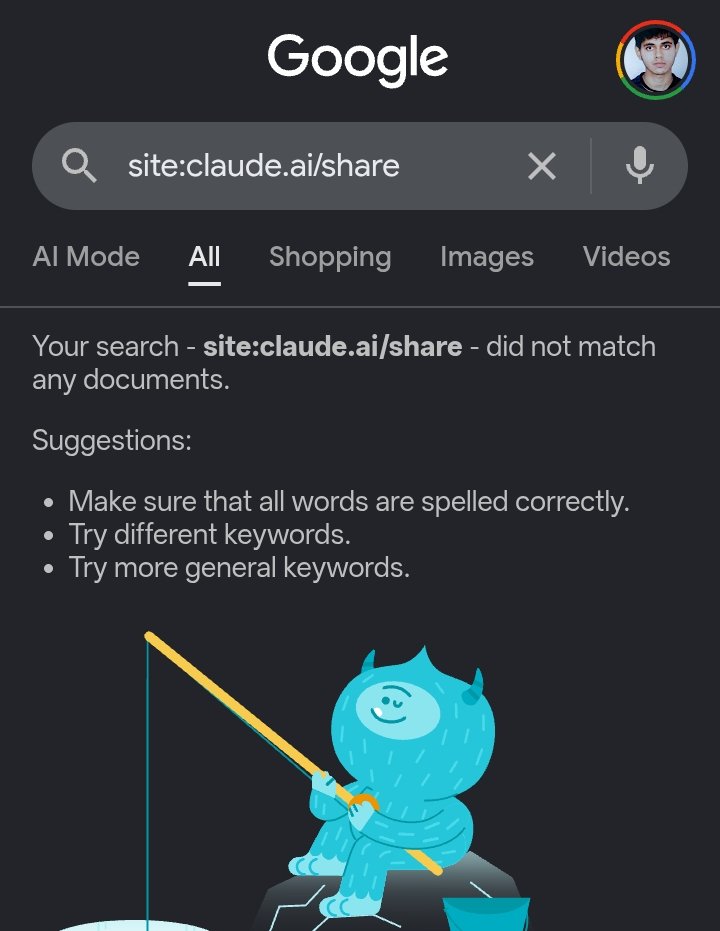
Fun Fact: These Links only appear when using Brave Search and they show no results in Google Search so it appears that @AnthropicAI got them removed by Google but not by Brave
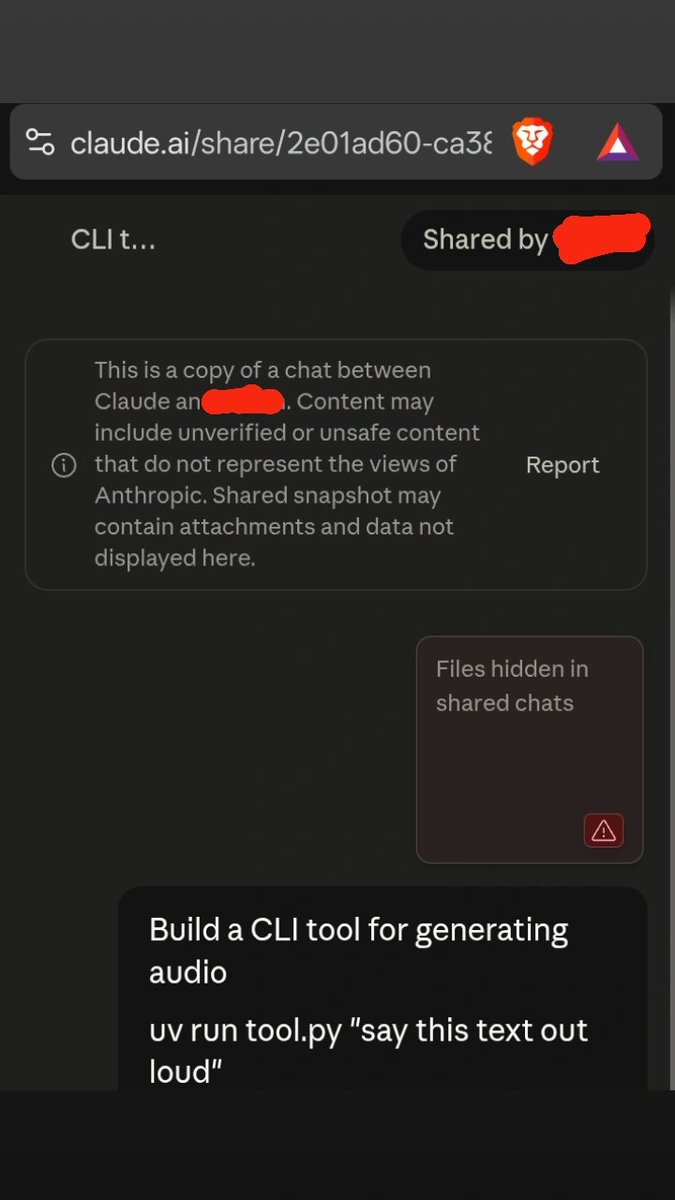
A serious mistake by @AnthropicAI.
Shared Claude chats are currently indexed by search engines and can be discovered using:
"site:https://t.co/2yQYOhoxr4"
Opening these links reveals the user's name (when included) along with the entire shared conversation.
As of writing this post, the issue has not been fixed.
Sharing a chat via a link is one thing, but having those links indexed and easily discoverable through search engines is a significant privacy concern.
Shared conversations should not be discoverable simply by searching the web.