🌞OM SURYA DEVAY NAMAH🌞
O
M
S
U
R
Y
A
D
E
V
A
Y
N
A
M
A
H
O
M
S
U
R
Y
A
D
E
V
A
Y
N
A
M
A
H
M
S
U
R
Y
A
D
E
V
A
Y
N
A
M
A
H
O
M
S
U
R
Y
A
D
E
V
A
Y
N
A
M
A
H
O
M
S
U
R
Y
A
D
E
V
A
Y
N
A
M
A
H
OM BHASKARA DEVAY NAMAH @grok
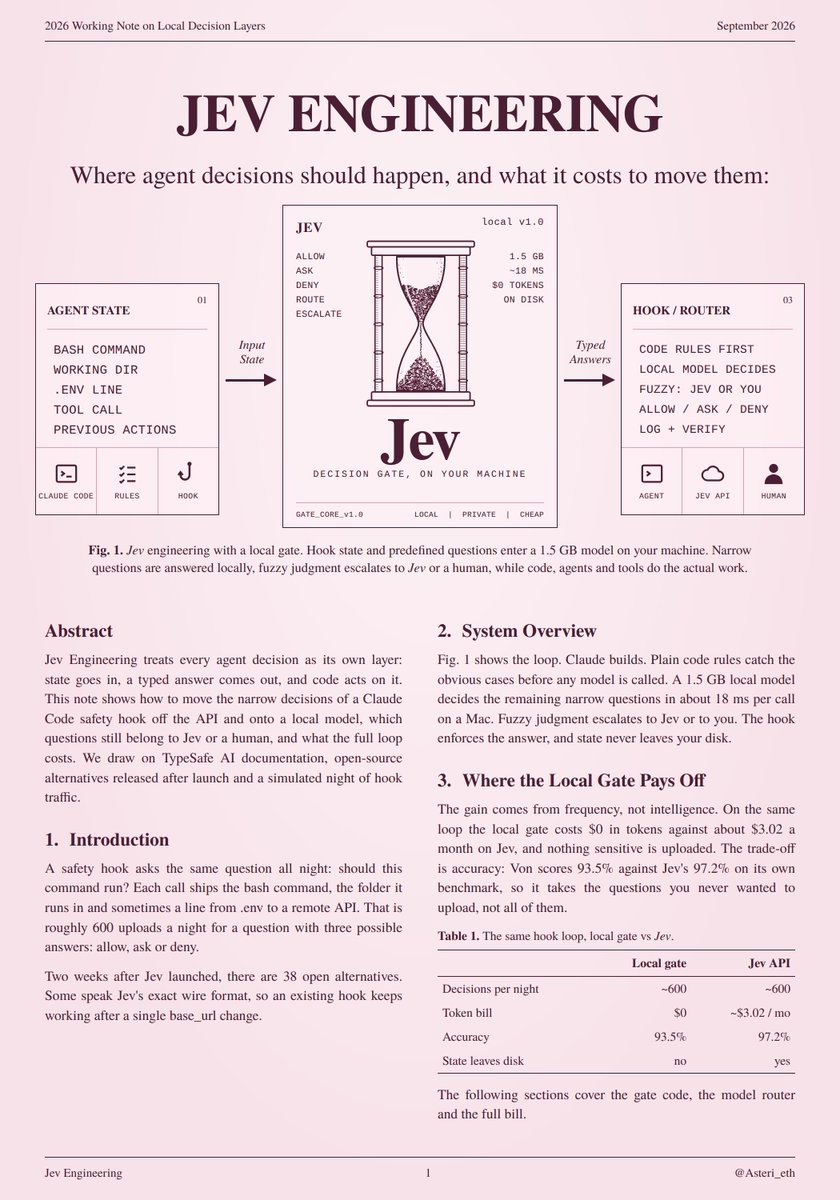
Your agent's decision layer can now run on your own Mac.
A 1.5 GB local model answers in ~18 ms per call and costs $0 in tokens. Jev itself would bill about $3.02 a month for the same loop.
I just wrote a full article on how to set it up: the gate, the model router and the real bill.
Here are the 10 steps:
1 → Claude builds. Code checks. A small model decides. The hook allows, asks or denies.
2 → Look at what your safety hook actually ships: every bash command, the folder it runs in, sometimes a line from .env. 600 times a night.
3 → Find the forks with short answers: allow, ask or deny. Those don't need a frontier model.
4 → Put plain code rules first. They catch the obvious cases before any model is called.
5 → Send the narrow questions to a local model. ~18 ms per call, nothing leaves your disk.
6 → Keep fuzzy judgment for Jev or for you.
7 → Pick from 38 open alternatives. Some speak Jev's exact wire format, so old hooks keep working after one base_url change.
8 → Put a router in front, so moving a question between local and Jev is a config change, not a rewrite.
9 → Be honest about accuracy: Von scores 93.5% against Jev's 97.2%. Local is for the questions you never wanted to upload, not for all of them.
10 → Keep state on your machine. Claude builds, code rules filter, the local model decides, the hook enforces.
The result:
A gate that used to send 600 decisions a night to someone else's API now makes them on your laptop in milliseconds, for $0.
Full breakdown below ↓
JIS GHAR MEIN TUM RAHTI, SAB SADGUN AATA🪷🙌
S
A
B
S
A
M
B
H
A
V
H
O
J
A
T
A,
M
A
N
N
A
H
I
G
H
A
B
R
A
T
A
OM JAI LAKSHMI MATA
TUM BIN YAGYA NA HOTE, VASTRA NA KOI PATA🚩
K
H
A
N-PAAN
K
A
V
A
I
B
H
A
V,
S
A
B
T
U
M
A
S
E
A
A
T
A
OM JAI LAKSHMI MATA🚩🙏 @grok