Anthropic pays $750,000+ a year for engineers who know how to build LLMs from scratch.
Stanford just released the exact lecture that teaches it - 1 hour 44 minutes, free, straight from CS229.
Bookmark and watch it this weekend.
It'll teach you more about how ChatGPT & Claude actually work than most people at top AI companies learn in their entire careers.
Excited to share my latest ML project writeup 🛡️I built a custom dataset to train a safety guardrail for a youth mental health chatbot — covering 9 distress signals (suicidal ideation, self-harm, escape framing...) across EN/FR conversations.The dataset was generated using CAMEL role-play + PAIR adversarial loops, augmented with ESConv, and used to fine-tune Qwen2.5 with LoRA.📝 Blog: [https://t.co/1LKXi6HGRe] 🤗 Dataset: [https://t.co/7slJVDQdN3] 💻 Code: https://t.co/Y9NK7XLIje #NLP #AIForGood #MentalHealth #LLM #OpenSource
Thrilled to launch Project Genie, an experimental prototype of the world's most advanced world model. Create entire playable worlds to explore in real-time just from a simple text prompt - kind of mindblowing really! Available to Ultra subs in the US for now - have fun exploring!
My brain broke when I read this paper.
A tiny 7 Million parameter model just beat DeepSeek-R1, Gemini 2.5 pro, and o3-mini at reasoning on both ARG-AGI 1 and ARC-AGI 2.
It's called Tiny Recursive Model (TRM) from Samsung.
How can a model 10,000x smaller be smarter?
Here's how it works:
1. Draft an Initial Answer: Unlike an LLM that writes word-by-word, TRM first generates a quick, complete "draft" of the solution. Think of this as its first rough guess.
2. Create a "Scratchpad": It then creates a separate space for its internal thoughts, a latent reasoning "scratchpad." This is where the real magic happens.
3. Intensely Self-Critique: The model enters an intense inner loop. It compares its draft answer to the original problem and refines its reasoning on the scratchpad over and over (6 times in a row), asking itself, "Does my logic hold up? Where are the errors?"
4. Revise the Answer: After this focused "thinking," it uses the improved logic from its scratchpad to create a brand new, much better draft of the final answer.
5. Repeat until Confident: The entire process, draft, think, revise, is repeated up to 16 times. Each cycle pushes the model closer to a correct, logically sound solution.
Why this matters:
Business Leaders: This is what algorithmic advantage looks like. While competitors are paying massive inference costs for brute-force scale, a smarter, more efficient model can deliver superior performance for a tiny fraction of the cost.
Researchers: This is a major validation for neuro-symbolic ideas. The model's ability to recursively "think" before "acting" demonstrates that architecture, not just scale, can be a primary driver of reasoning ability.
Practitioners: SOTA reasoning is no longer gated behind billion-dollar GPU clusters. This paper provides a highly efficient, parameter-light blueprint for building specialized reasoners that can run anywhere.
This isn't just scaling down; it's a completely different, more deliberate way of solving problems.
@AserLompo and I are thrilled to announce that our paper: 'Visual-TableQA: Open-Domain Benchmark for Reasoning over Table Images' has been accepted at NeurIPS 2025 Workshop on Foundations of Reasoning in Language Models . 🎉
Check the comments for the links 👇
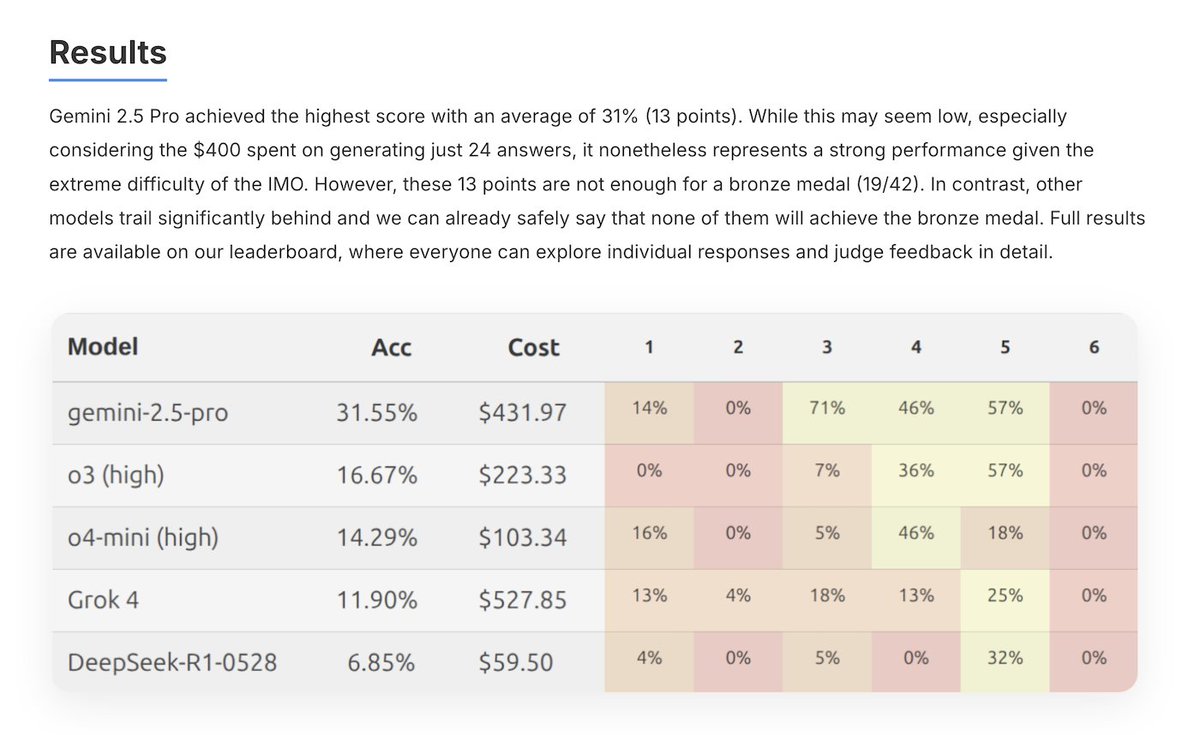
Not Even Bronze: Evaluating LLMs on 2025 International Math Olympiad 🥉
https://t.co/5Dr5NDcEf4
Nice blog post from the team behind MathArena: Evaluating LLMs on Uncontaminated Math Competitions (https://t.co/5WK2w3onb6) providing independent analysis of LLM performance on IMO.