Discipline is the most important trait a trader needs to succeed.
It's a muscle that needs to be strengthened over time, not something you can brute force yourself into. It's how you live, it's everything you do, not something you can turn on and off.
To improve discipline, start small by stacking little victories, doesn't matter how small. If you say you are going to do something, do it. Get comfortable making yourself uncomfortable. Do the things you don't want to do. These little wins stack up, strengthening the muscle over time.
Those wins will eventually bleed outward into other areas of your life, including your trading, making you a more effective person overall.
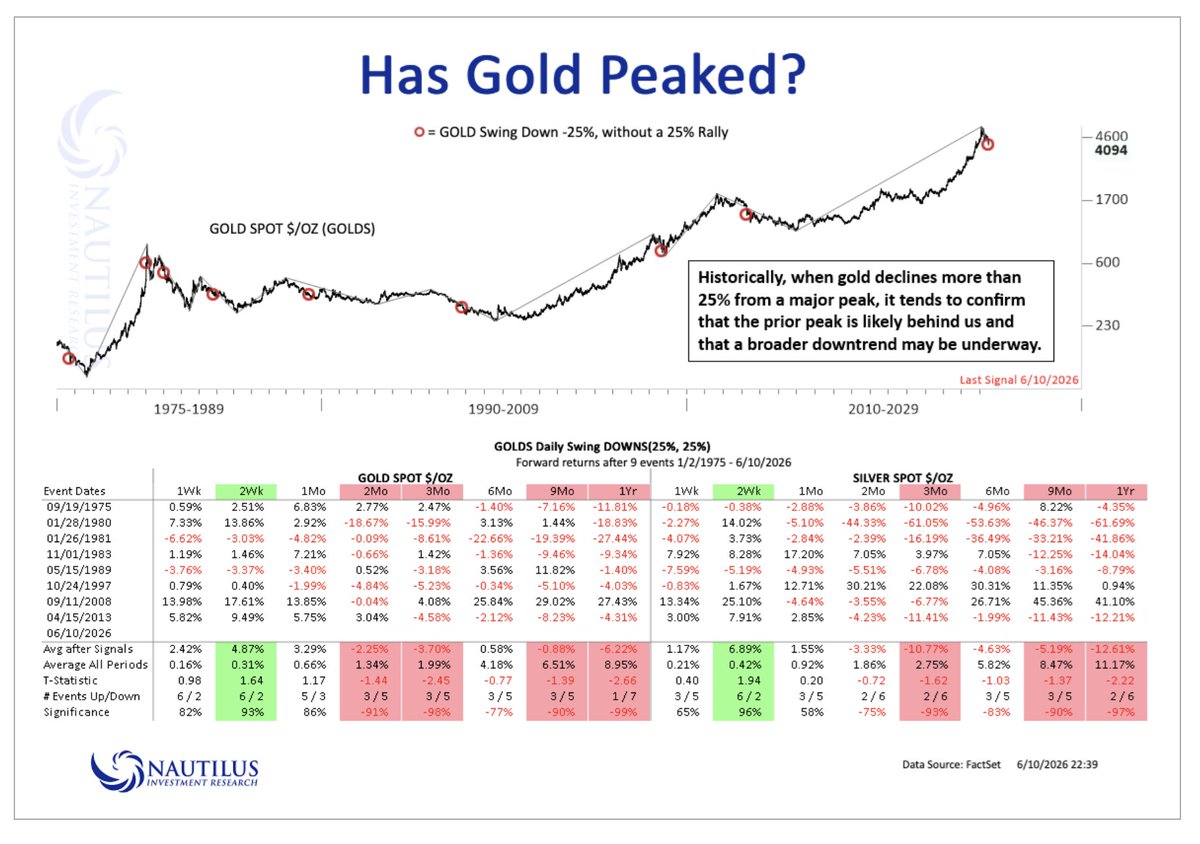
@NautilusCap work showing gold possibly peaking. I haven't talked about this market in awhile but I'm not one to toot my own horn so anyone can look at what I posted last year on gold & silver as they went parabolic.
I ran an anecdotal study last week when gold came down to the 200-day for the first time of bull markets where gold has been well above the 200-day for more than a year (strong trends) and how it fared after it's first test. Small sample but the results were poor so consistent with this study.
History says gold is probably an avoid at best for now. I know the precious metal bulls will hate this but for the life of me I don't understand why people get insulted by analytical work. I had people giving me all kinds of grief for pointing out $SLV & $GLD were topping last year so don't shoot the messenger.
One of my traders sent me this today from Peter Brandt's book. (Shoutout Raymond hit me if you're on twitter)
I just scrolled my timeline and see nothing but traders talking about dealing with extreme emotional pain after today's session.
Timely.
A simple reminder nobody is forcing you to click the buttons when the action is most difficult after a prolonged period of "easy" momentum action.
Regarding the recent action:
You can't make big returns without giving some back.
If you have a system that is based on big/home run trades and selling most of your shares on weakness in stocks, you must accept 5 facts:
1. You can't have outliers by intervening too much into strength.
2. We can never predict the power of a stock beforehand, so there is no reason to judge.
3.Not all drawdowns are created equally. There are drawdowns from peak capital and drawdowns on the money we actually own. There is a difference between the two. We can't avoid the first, but we can do a lot to have protective measures for the second.
4. We are the ones who create our portfolios. If we have a lot of volatile names in our portfolio, we must anticipate and accept the volatility that comes with them, both on the positive and negative side. We need to understand what's normal to give back.
5. No matter how many Market Awareness flags are evident, you can't shift your stance 180 degrees from one day to the next. We take progressive actions into defense as more and more signs appear.
Giving back some profits is not a bug.... It's a natural thing that should happen in a system like this.... It's a healthy sign that you were positioned correctly in a good run, in good stocks, and followed your principles..... You should be proud instead of being salty....
The damage is not caused by giving some profits back
The damage occurs when you are surprised by this fact every time, when it is actually a normality and violate rules after the fact.
The damage occurs when you don't understand how much is normal to give back based on the volatility of your own portfolio in each regime.... 8%, 10%, 15%+???
The damage occurs when you aim only for offense without having defense mechanisms pre planned. Mental and technical.
To be honest, instead of being salty, I treat these corrections as healthy.... More time for research, for refining skills, for time with family....and for new leadership to emerge... Especially when you have made a good buck over the past 2 months....Recharge your batteries , your clarity and be ready again when things turn!
“you survive by aggressively protecting cash…we don't hold losers praying for a bounce, if the math breaks, we liquidate immediately"
THIS IS WHY THE MARKETS MOVE SO QUICKLY
👇👇👇👇👇👇👇👇👇👇👇👇👇👇👇👇👇👇
If yesterday went poorly don't beat yourself up, take the opportunity to learn because we will see this again and again.
Earlier in my career, these days destroyed me - I nearly liquidated my net worth scaling into NQ futures on 9/3/20.
Now yesterday I was making money while many were getting cooked.
The change didn't happen over night, it was a slow progression of getting a little better each time around, and next time I plan to do better than this.
Take note of everything: the technical context, the psychological context, the technical details, the red flags, the green flags, your execution, your emotions, everything.
Identify where you did well and where you can improve. Write it down and then move forward.
For people who are worried about the market today, I get it. This stuff is very stressful.
So I put together a chart of all of the times the VIX (the "fear index" of the market) was up over 30% in a day (like today) in the past ten years.
23 out of 25 instances the market was higher one month later. The only two times it wasn't was Feb 2020 when Covid hit the economy in March 2020.
What is the underlying message? When people are afraid, they make bad decisions. Do the opposite.
Attached is a chart summarizing my results.
After a long period of bull control in any market, there will be a stark tone shift at some point.
When that time comes, bull positioning will be less forgiving. Entries that used to be high probability become high risk once the character changes.
The tricky part is identifying it in real time...
- Pay attention when trades that used to work begin to fail.
- Pay attention to rotation that used to happen that has stopped.
- Pay attention to the first movers beginning to lose supports.
- Pay attention to failed oversold bounces.
- Pay attention to previous support acting as resistance.
It's never out of nowhere, there will be signs.
Don't get caught off guard, don't get stubborn, and be ready to adjust.
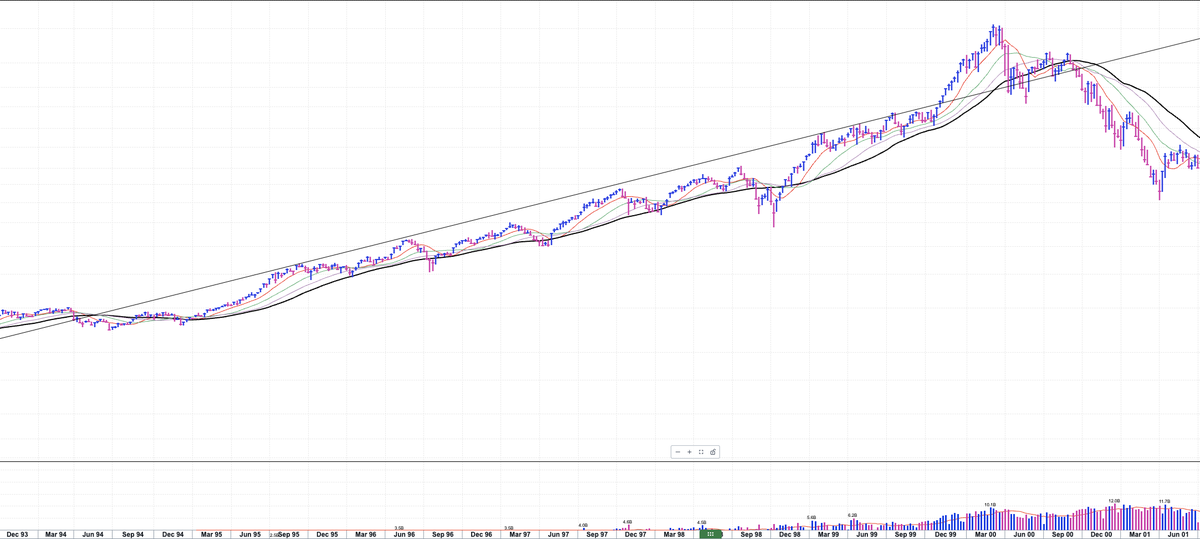
Today (2020 - Present) vs. the 1990s on a weekly multi-year timeframe.
You can see in both scenarios we broke above long-term upper-trendlines and haven't mean-reverted yet...which means a parabolic move is a possibility - that means there could be a scenario where you can make the most amount of money in the shortest period of time.,
AI earnings are growing, sentiment is rising, peace proposal tailwind, and Warsh is looking at alternative measures of inflation (which display lower inflation) maybe to justify rate cuts?
Then we also have the largest IPO ever in SpaceX coming out in two weeks, followed by Anthropic and likely OpenAI.
Who knows when the music and party ends (I suspect once these IPOs are out of the way as Wall Street needs a hot market to dump these IPOs to willing buyers) and it could very well last another 1-2 years easily, but this is a time to not become too contrarian, follow the trend, but stay ALERT - trim crazily extended names 10-15ATR+ above the 50-DSMA into strength, sell out of parabolic movers and know that the biggest losses often come after the biggest gains.
As Paul Tudor Jones says, "My biggest losses have always come after I have had a great period and started thinking I knew something."
Paul Tudor made $100M in one day, Stan Druckenmiller made 1 trade that broke the Bank of England
on one RobinHood stage two $10B+ hedge fund CEOs gave a 30-minute trading masterclass
completely free - two of the greatest traders in history will show you the most important rules of trading
bookmark & watch - this is better than any paid course from fake traders
I will very rarely cut a trade without my stop being hit.
When I enter I'm either going to stop out or hit my target.
Working on that concept has helped my trading big time. I used to self sabotage while in a trade - manufacturing hollow reasons to change the original plan.
Once in a while new information warrants a change of plans but more often than not, the game plan developed with a clear mind is the right one, not the one being built in real time with heightened emotions running the show.
Few more thoughts. I strongly advise everyone to read this post in full, especially right now when everyone is posting their performance charts again, AI names are making 10x in months and retail euphoria is visible everywhere you look. And it looks like a lot of big private companies are willing to use this window of opportunity to offer their shares.
Making a lot of money very fast is genuinely bad for your mental health, because the version of you that made the money is hormonally and psychologically different from the version that needs to hold it, which is what John Coates (quoted in the post) spent years documenting at Cambridge after his own career on a trading desk, finding that extended winning streaks raise testosterone and lower cortisol in ways that systematically push traders into bigger and dumber positions right at the moment they feel most invincible (you probably been there yourself or for sure know someone from Fintwit who has). The euphoria is not a character flaw, it is a measurable chemical state, and almost nobody recognizes it from the inside.
The second thought is that evolution beats revolution in this game, which sounds boring until you actually understand the math, and the best framing of why comes from Kahneman and Tversky rather than from any investor, because their work on loss aversion (the empirical finding that losses hurt roughly twice as much as equivalent gains feel good) explains why a 50% drawdown is not just mathematically harder to recover from than the upside that preceded it, it is also psychologically catastrophic in a way that almost always leads to abandoning the process at exactly the wrong moment when System 1 thinking takes over and the patient, boring approach feels like leaving money on the table. Which is why rule number one is simply DO NOT LOSE, meaning cut your losses fast and without ego the moment your thesis is violated, because preserving capital is the only way you stay in the game long enough for compounding to do its work.
The operational version of the same idea is Moneyball, which is my favorite movie and probably the most underrated investing book ever written even though it is technically about baseball, because Billy Beane and Paul DePodesta did not win by finding one great hitter, they won by systematically exploiting small repeatable edges across hundreds of decisions and refusing to swing for the fences on any individual call, which is exactly the discipline that almost everyone abandons during a euphoric run when in reality it is the entire game.
I see a lot of young bucks flashing P&L on here whenever we have a hot week.
I used to be in this camp until some deep thought had me realize how much I was stunting my own trading growth in the process.
The dopamine hit you get from announcing your wins subconsciously replaces the drive needed to continuously achieve them. In this game you need to maintain that sense of raw hunger above all else.
They say there's only two days in Jail - the day you're in, and the day you're out. Trading is similar in this fashion, the only two numbers that matter are what you came with, and what you leave with. Until then, we're all just in the battle.
Was listening to Derek Sivers TED talk on keeping your goals to yourself which sparked this tweet. "Publicly announcing ambitions can give you a premature sense of identity or accomplishment, which reduces motivation to actually do the work."
Instead, I keep the focus on the Art of Trading. The physical execution. The X's and O's. The numbers are the numbers as a result of this and only this.
@OliverKell_ talks about "sustained ruthlessness," in his book. I love that so much. It speaks to the need to keep the raw hunger day in and day out.
Keep the hunger. Stop flashing the $$$. It will only lead to much more of it. Just my two cents. 🫡
I have mixed feelings about PDT removal. It was definitely annoying as I fluttered back and forth over the $25k mark but when I was put in timeout it forced me to be patient and also forced me to have a couple years of experience + capital cushion before trying different trading styles after starting with $3k.
I'm not sure I would be here without it.
I have a vivid memory of listening to a voicemail from fidelity about my good faith violations 14 years ago 😆
The biggest reward in life is being able to return your parents sacrifices back tenfold. Seeing my old man happy is worth every late night I’ve ever put in 🙏