We’re actively engaging partners and forward-thinking institutions.
If you’re aligned with @RekordAG (https://t.co/4Th62tBjwc) or can make a strong intro, I’d love to connect.
DMs are open.
🚨 "No DeFi is safe anymore" — a top crypto security exec just told everyone to exit their positions.
The risk? Smart contracts. One exploit and funds are gone. (link below to read more)
@RekordAG removes that vector entirely.
✅ No smart contract risk
✅ No token gimmicks
✅ Verifiable RWA-backed rewards
✅ Your tokens never move
Earn on-chain yield without handing your assets to code that can be drained.
Allocators 👉 https://t.co/nuBlWEgHAx
Death of DeFi: https://t.co/cfPHgHMceA
#DeFi #RWA #Tokenization #vRWA
Tokenized Treasuries emerged first because they combine yield demand with strong institutional compatibility:
→ Standardized instruments
→ Observable pricing
→ Deep liquidity
→ Established custody
→ Familiar fund administration
→ Lower reliance on bespoke off-chain data
The same conditions do not extend cleanly to the rest of the RWA market.
Private credit, real estate, infrastructure, and other cash-flow-based assets depend on states that are harder to verify: borrower performance, collateral quality, title, liens, cash flows, operating data, and contractual enforceability.
Broader adoption will depend on vRWA infrastructure that keeps asset state observable, current, and independently verifiable.
Tokenized private credit improved the distribution and administration layer. Subscription workflows, ticket sizes, payment mechanics, operational efficiency: genuinely better.
Continuous verification of the underlying financial state is a different problem.
Our State of RWA 2026 puts distributed private credit at approximately $5.14B as of May 2026. Approximately $27B when distributed and represented assets are combined together.
Still largely unverifiable:
→ Borrower condition between reporting dates
→ Covenant compliance
→ Collateral value in real time
→ Repayment behavior and delinquency trends
→ Cash-flow coverage
A covenant breach can be well underway before the next formal disclosure reaches an investor. Provable finance requires the underlying credit state to be continuously anchored and independently inspectable.
4/ Across jurisdictions, the pattern is not uniform maturity, but gradual movement into regulated financial infrastructure.
Clearer frameworks may bring tokenized assets further into institutional markets, while the less developed area remains the trust layer beneath asset-state reliability: whether collateral, reserves, cash flows, borrower performance, encumbrances, and operating data can be verified over time.
More in Rekord’s State of RWA 2026: Tokenization’s Verification Gap report: https://t.co/8B8Q795d6q
3/ The vRWA standard defines a verifiable asset as one supported by continuously provable, tamper-resistant, and auditable financial state at the asset or position level.
Measured against that standard, the current market remains effectively unverified.
State of RWA 2026: Tokenization’s Verification Gap defines vRWAs and maps the verification problem across major asset classes.
Available here: https://t.co/8B8Q795d6q
RWA tokenization is no longer theoretical.
In State of RWA 2026: Tokenization’s Verification Gap, we found:
→ Distributed RWAs reached ~$33.7B by May 2026
→ Represented assets added another ~$372.6B
→ Combined market: ~$406B, excluding stablecoins
→ Treasuries dominate distributed RWAs at ~45.4%
→ Stablecoins exceeded $300B in market cap and reached ~$33T in 2025 on-chain transfer volume
→ Represented assets outweigh distributed assets by ~11.1:1
→ Effectively none of the market meets vRWA-grade standards for continuously provable financial state
Tokenized markets are becoming increasingly effective at transferring financial claims, but until the current state of the underlying assets can be continuously verified, secondary liquidity, autonomous workflows, institutional risk management, and scaled deployment will remain structurally limited.
Full report: https://t.co/8B8Q795d6q
There is an emerging distinction between RWAs and verifiable RWAs.
Most tokenized RWAs today function as digital representations of largely opaque offchain financial state.
A verifiable real-world asset (vRWA) is structured around continuous verification of the underlying asset, with audit-grade transparency across both public and permissioned environments.
This distinction materially impacts institutional diligence, risk assessment, financing conditions, and capital formation.
Much of the current market remains concentrated in the former category. Institutional-scale allocation increasingly requires the latter.
Learn more: https://t.co/8B8Q795d6q
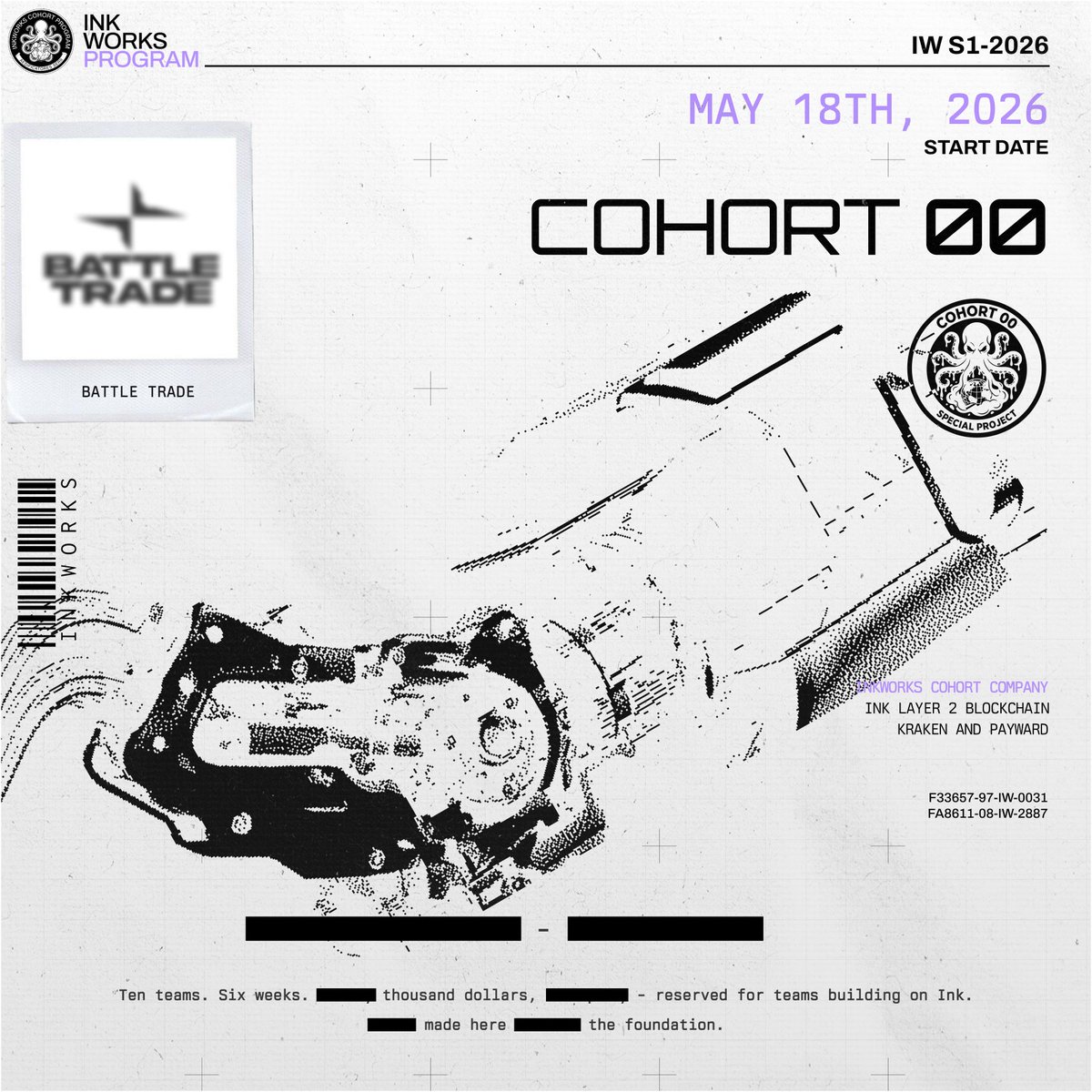
Next up in InkWorks Cohort 00: @battle_fyi .
Battle Trade is the adversarial data layer for financial agents.
An esports arena on top. A data layer underneath.
Humans and AI go head-to-head in live trade battles on real market prices across crypto, equities, FX, commodities, under elimination pressure.
People play because it's fun; the marquee battles run live and on camera, as competition.
Every decision is captured.
The data layer: entry, sizing, reasoning and outcome, every battle, on live prices under adversarial pressure.
A backtest cannot produce data like this.
It is what financial agents get built, trained and benchmarked on through an API, SDK and MCP.
Live today: 9,988 battles run, 30,198 trading decisions captured after only 60 days.
Every AI agent is about to trade. None have proven it works.
Battle Trade is the proving ground.
Perps are central to Ink's future, we're glad to have them in InkWorks cohort 00.
⚠️ALERT: ANOTHER MAJOR HACK STRIKES CRYPTO; $76M EXPLOIT HITS MONAD
Echo Protocol on Monad was reportedly exploited after an attacker minted 1,000 eBTC worth roughly $76.6M, as per Lookonchain.
The hacker allegedly used part of the funds as collateral on Curvance to borrow WBTC, bridged assets to Ethereum, swapped them into ETH, and routed roughly 385 ETH through Tornado Cash.
The attacker still reportedly controls around 955 eBTC worth over $73M.
This now marks the THIRD major crypto exploit in just 4 days!
Most of what gets called an RWA right now is just a wrapper around off-chain data.
There’s a version where the asset is actually verifiable all the way through, continuously, not just at reporting intervals. We call those vRWAs.
The difference gets glossed over pretty often, but it matters a lot more than people think.
We cover the distinction in our report: https://t.co/fqDv7O8NsT
We published our State of RWA 2026: Tokenization’s Verification Gap report today.
The core thesis is simple: tokenized real-world assets are scaling rapidly, but the infrastructure required to continuously verify those assets onchain has not kept pace.
Representation is not verification. An asset being tokenized does not mean its value, provenance, performance, or compliance can be independently proven over time.
The @RekordAG report introduces verifiable real-world assets (vRWAs) as the next infrastructure layer for institutional RWA markets, where asset integrity is continuously observable rather than assumed.
Read more: https://t.co/fqDv7O8NsT
State of RWA 2026: Tokenization’s Verification Gap is now live.
The report examines the core infrastructure problem emerging across institutional RWAs: tokenization systems that still rely on fragmented reporting, delayed disclosures, and unverifiable offchain state.
As capital moves onchain, proof of ownership is no longer enough. The next phase of RWAs will be defined by verifiable trust infrastructure.
Read the full report below: https://t.co/8B8Q795d6q
Yeah this is the problem. On-chain dashboards on top of off-chain “trust me bro” doesn’t survive contact with reality. @RekordAG’s vRWA framework (Verifiable Real World Assets) exists because the off-chain part has to be continuously verified or the whole thing is just a tokenized rumor.
Another drama in RWA world - with @Raacfi. Typical thing with RWAs is that no amount of on-chain tracking will give you visibility over the off-chain part. Hopefully, @LlamaRisk (who has a lot on their plate these days) will help with that soon.
Drama for some, opportunity for others - but it's not over yet
@newmichwill@Raacfi@LlamaRisk Yep. On-chain proof is only as good as the membrane around it. RWA keeps rediscovering that the hard part is not tokenizing the asset, it is making the off-chain mess legible before things break.
Tokenized Treasuries are starting to function as real collateral.
BlackRock’s BUIDL is now accepted as collateral on OKX, custodied through Standard Chartered, enabling these assets to generate further productivity while moving through regulated infrastructure.
Digital assets → collateral
Collateral → financing and structured deployment
Deployment → continuous yield generation
A clearer demarcation is forming between passive holdings and capital that is engineered for ongoing productivity.
@RekordAG sits in the layer that makes this usable at scale, standardizing digital asset positions and routing them into verifiable real-world asset strategies.
https://t.co/xJ9gMy6gkx
Chimpers has one of the most complete ecosystems in the space.
Scarcity, real collecting culture, and systems built to support the community, while also growing one of the farthest reaching, and most followed brands from Web3 into the real world.
We have always flown under the radar, never chasing metas or trends, building everything organically without paying for attention.
But in this new era of alignment, real brand growth and community first building, everything we have been working on starts to matter a lot more.
Chimpers is inevitable 🐒