Most companies still need the fundamentals.
They don't need to be impressed. They need to ship.
Sell the basics first. Win the trust. Then go deeper.
Simple beats sophisticated every time.
AI identifies patterns at a scale humans cannot match.
Humans decide which patterns matter and what to do about them.
That division of labour is not a threat. It is a clarification of where the real value sits.
#AI#Strategy#HumanJudgment
This means you can build a repeatable menu of services.
A customer picks what they need. You deliver it.
The complexity lives inside your workflow — not in your pitch.
None of this requires rebuilding Clay from scratch.
Or a flowchart connecting 20 tools.
The underlying motion is identical across all 10:
Sharper prompts. Tighter ICP. Better data providers.
That's the whole formula.
The 10 GTM plays high-growth tech companies are paying for:
① CRM enrichment ② TAM sourcing ③ Automated inbound ④ AI outbound ⑤ Account research & scoring ⑥ Intent-driven workflows ⑦ ABM ⑧ GTM co-pilots ⑨ JIT rep enablement ⑩ Closed-won signal analysis
I studied 100+ GTM motions over the last few months.
The companies winning aren't doing anything groundbreaking.
They're just doing the basics — faster, smarter, with AI under the hood.
Here's what they're all paying for:
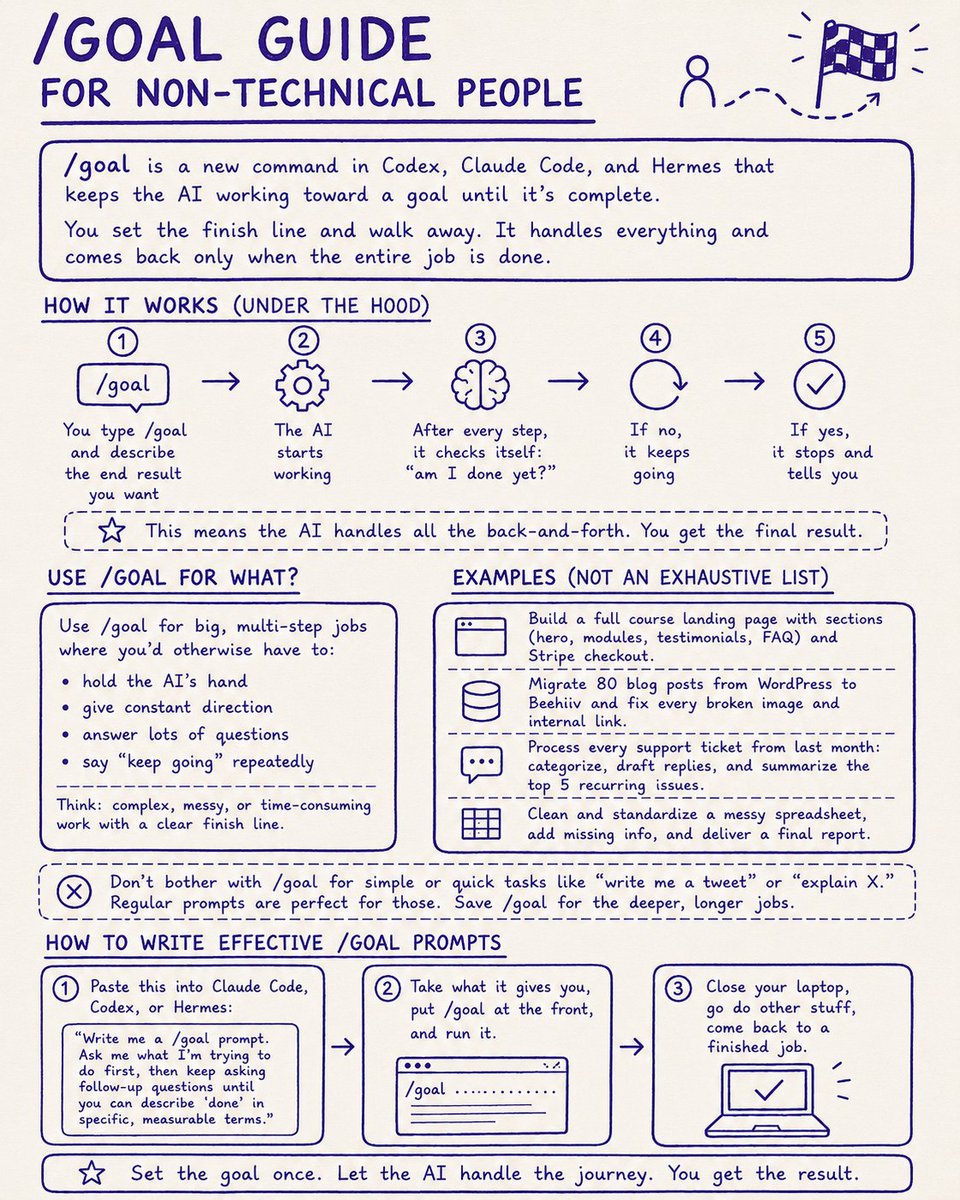
/GOAL GUIDE FOR NON-TECHNICAL PEOPLE
/goal is the most time-saving feature in all of AI right now.
It's a new command in Codex, Claude Code, and Hermes that keeps the LLM working towards a goal until it's complete.
Basically autopilot for complex AI tasks.
Here's how it works under the hood:
1. You type /goal and describe the end result you want
2. The AI starts working
3. After every step, it checks itself: "am I done yet?"
4. If no, it keeps going
5. If yes, it stops and tells you
Which means you never have to type "keep going" again.
When to actually use it:
Use /goal for big jobs where you'd otherwise have to go back-and-forth with it a lot. Stuff with a lot of steps and a clear finish line:
> "Build my course landing page: hero, 5 modules, 3 testimonials, FAQ, and Stripe checkout"
> "Migrate my 80 blog posts from WordPress to Beehiiv, fix every broken image and internal link along the way"
> "Process every customer support ticket from last month: categorize them, draft template replies, and document the top 5 recurring issues"
Don't bother with /goal for simple tasks like "write me a tweet" or "explain X to me." Regular prompts are fine for those.
Save /goal for the long, messy jobs.
The reason it's so awesome:
You set the destination once and the AI runs the whole job in the background.
Fire one off, close your laptop, go for a walk, work on something else, and come back to a finished result.
No babysitting or constant back-and-forth, because it doesn't need you in the loop anymore.
Here's how to write effective /goal prompts (so you don't waste time/tokens):
Paste this into Claude Code, Codex, or Hermes:
"Write me a /goal prompt. Ask me what I'm trying to do first, then keep asking follow-up questions until you can describe 'done' in specific, measurable terms."
Take what it gives you, type /goal at the front, and run it.
Then walk away and come back to a finished job.
I've dedicated 55 hours to creating a complete breakdown of the GTM Engineer's Full Stack and exactly how GTM engineers are running 125 skills across 6 layers for free.
A plain English guide you can use for lead enrichment, outbound sequencing, LinkedIn content, programmatic SEO, competitive intelligence, CRM hygiene, and channel selection - all mapped to a single connected project folder with install commands for every skill, tool, and agent template.
(You must follow me to receive it)
Like + Repost + follow me
Comment "STACK" and I'll send it to you via DM.
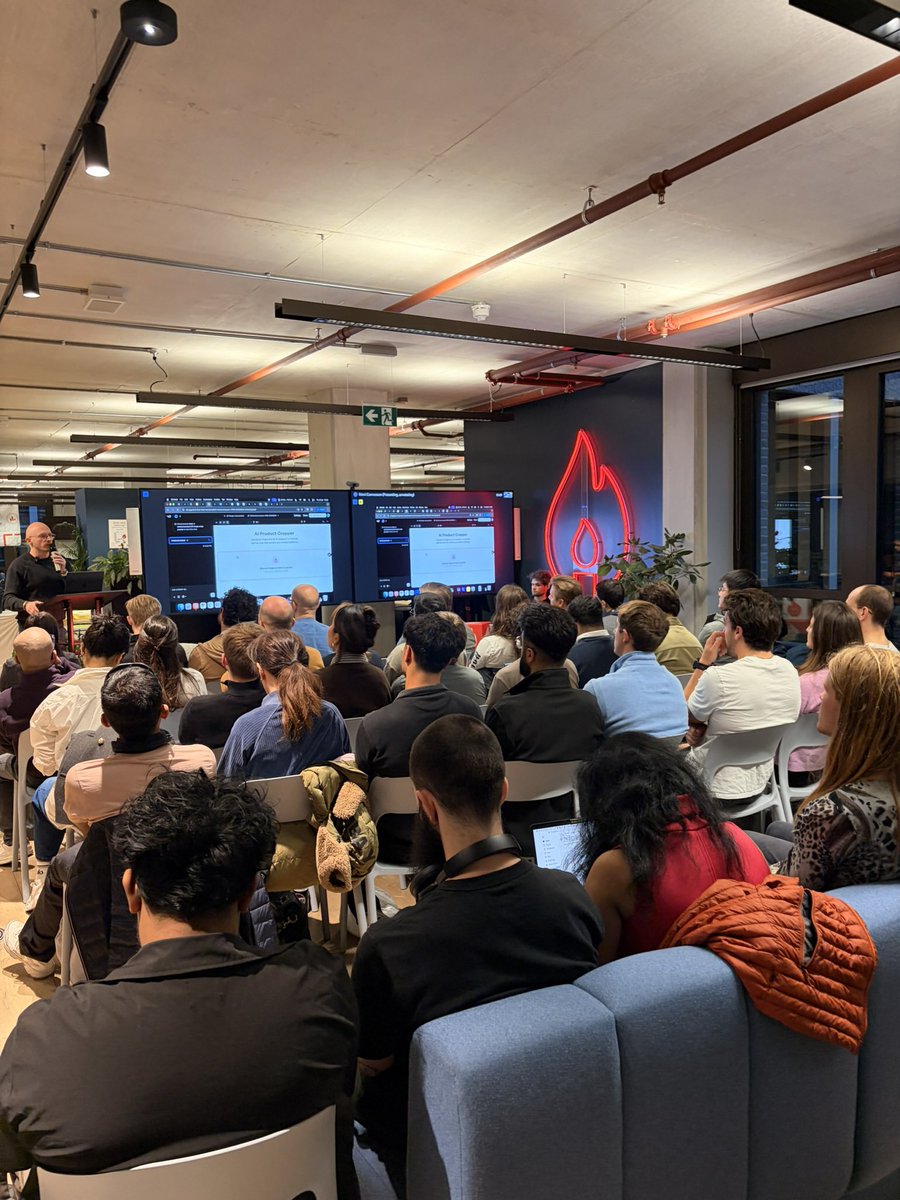
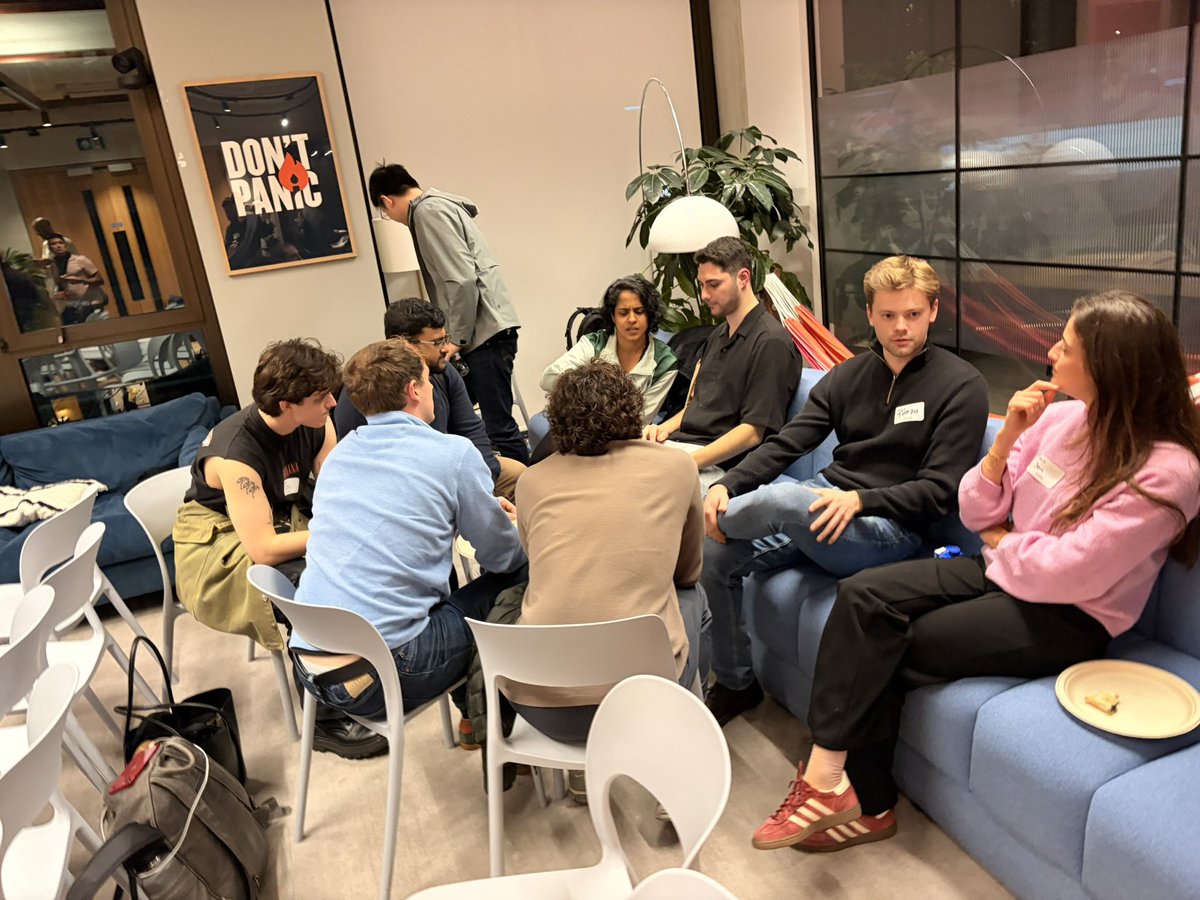
I’m now the OpenAI Codex Ambassador for London 🇬🇧
I am loving engineering with Codex & GPT-5.5
If you’re already using Codex or coding agents, building AI agents, or working on ambitious AI products in London
I’d love to connect & see you at the next event!
The UK Is going after the full AI stack.
We’re building frontier AI here (@IneffableLabs, @GoogleDeepMind), housing other labs (@OpenAI, @AnthropicAI).
We’re building world leading application/enterprise level companies (@ElevenLabs, @synthesiaIO).
And now we’re going after chips.
LETS GO
London is becoming one of the most important AI cities in the world.
$6.7B in AI funding in 2026 alone. Over 1,300 AI-focused companies. DeepMind is headquartered here, OpenAI and Anthropic are both expanding here. NVIDIA is putting £2B into the UK ecosystem.
The gravity is undeniable.
But here's what the numbers don't show: the right people still aren't finding each other fast enough. Researchers and founders are in the same city, sometimes the same postcode, yet never connecting.
That's the problem I built CR3W to solve.
CR3W is an AI-driven matchmaking network for builders, founders, researchers, and industry leaders — designed to create the right connections online so the real conversations can happen in person. Currently in beta, focusing on London.
No vanity metrics. No noise. Just the people and introductions that actually move things forward.
We're live in London and growing.
If you're building something worth paying attention to, come find your CR3W.
👉 https://t.co/lOF3D9NTQR
Common vibe coding build mistakes — all avoidable:
1. Not defining user roles before the first prompt — retrofitting permissions is expensive
2. Confusing mock data with live data — always verify what's real
3. Vague feature requests — "make it AI enhanced" isn't a spec
4. Not reading what the AI builder tells you — those messages contain what you need
5. Skipping the security scan — RLS rules are the most important security layer
Structure first. Features second. #VibeCoding #AIAppBuilder #AITools
The most common vibe coding build failure has nothing to do with prompts.
The real gaps:
- Not knowing which services exist to realise a feature
- Not knowing if the data you need is actually accessible
- Not reading what the AI builder is telling you
- Not defining structure (user roles, data types) before features
Prompting is the last step. Architectural clarity is the first.
#VibeCoding #AIAppBuilder #AITools #ProductManagement
Three reasons practitioners are building their own apps:
1. SaaS economics — $20/month × 200 customers = $4,000/month. Low costs. Scalable code. AI tools make the prototype fast.
2. Internal tooling — solve a specific workflow problem, no public launch required.
3. Personal use — if the app you need doesn't exist, build it.
The constraint was never the idea. It was the execution gap.
That gap is narrowing fast. #VibeCoding #IndieHacker #SaaS
Why vibe coding tools ask for API keys — and what they do with them:
API keys must never live in the front end. Users download front-end code. If the key is there, anyone can take it.
The correct pattern:
User action → edge function (server-side) → external API → result back to front end
The edge function is the proxy. The key stays hidden.
Native connectors remove even this — no key needed, integration handled automatically. #VibeCoding #APIIntegration #AITools