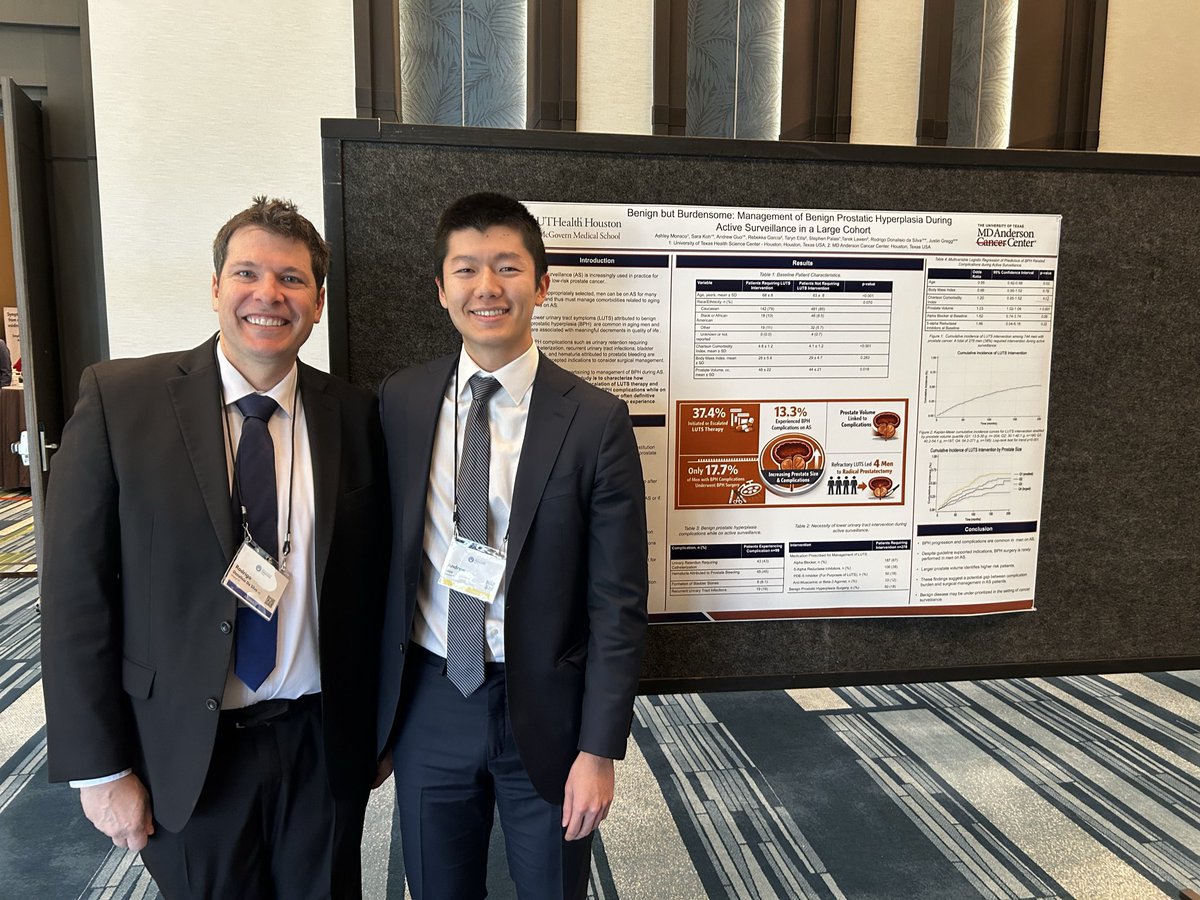
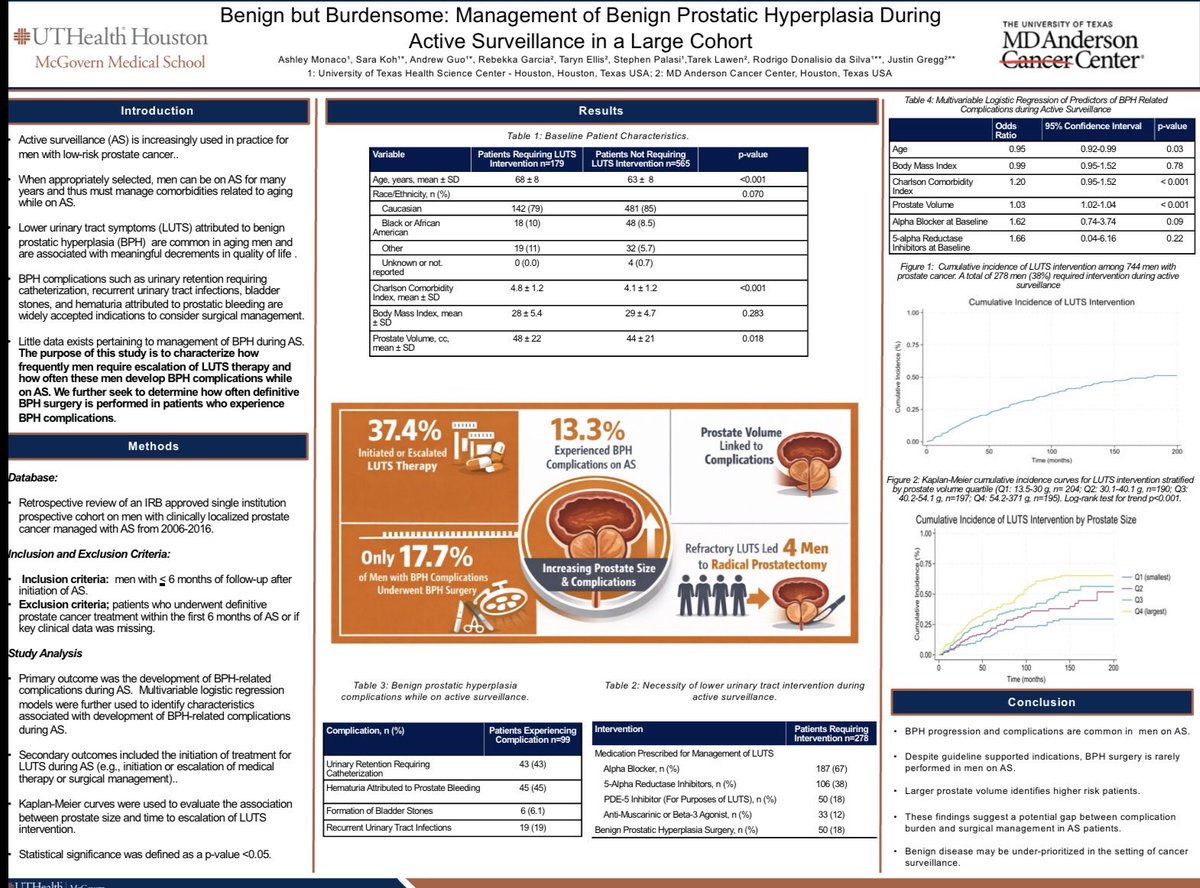
📣 happy to share our Collaborative Study @UTHUrology and MD Anderson discuss in the burden of BPH on quality of life on patients in active surveillance for prostate cancer. We should not ignore BPH symptoms. @ashley_monaco@JustinRGregg . Full study link https://t.co/dXEBUqnHID
PGY-3 @ashley_monaco LOCKED IN 🔐presenting research on Erectile Dysfunction 🍆 and Fertility 👶🏻 Knowledge Gaps in Men with Spina Bifida: Insights from a Transitional Urology Cohort #sufu26#sufu2026
Congratulations to @UTHUrology residents and medical students. Andrew did a great job presenting our research in conjunction with @MDAndersonNews and Dr. Justin Gregg. LUTS and BPH are a huge burden and often ignored in prostate cancer patients on active surveillance.
We have to do better to improve urinary symptoms for patients under active surveillance for prostate cancer.Quality of life is one of the main drivers for surveillance but BPH symptoms may not been well addressed @UTHUrology@MDAndersonNews@Endo_Society@CAU_URO@AmerUrological
Someone made a tasteless “joke” about our all-female team & then tried to use *girldad* as an insult
No problem
These incredible ladies make our team unstoppable. We stand together & embrace it. Their future is so bright
#GirlDad#Chief@AmCollSurgeons@AmerUrological@SWIUorg
While larger studies are necessary, this study demonstrates there may be a potential role for the dual role of focal cryoablation for both #prostatecancer and #BPH management.
Thanks @RadioDoctorKatz@UroOncologist @PJOSH23 for your help with this project!
We recently published in
@JEndourology on QOL outcomes following focal cryoablation vs. active surveillance for management of #prostatecancer and further evaluated the effect of prostate volume and tumor temperature on these outcomes 👇
https://t.co/37yD9DcvWH
Interestingly, patients with larger prostates (i.e., >50 cc) had better urinary and no difference in sexual function following treatment compared to active surveillance. The decrease in prostate size and destruction of alpha receptors as a result of FC may explain these findings.
Over a 4 year f/u period, men treated with SBRT for low-to-intermediate risk prostate cancer may have similar urinary, sexual, and bowel function as well as superior anxiety control compared to those managed with active surveillance. Read more below 👇
https://t.co/o3o2uRQxS7
In the age of COVID where morbidity is contingent on paracellular leak, understanding how to analyze permeability is particularly important.
Grateful to have the opportunity to publish this project!
https://t.co/hZcpTL1q7R