Warning, long tweet:
My head hurts. After today's update, I feel like @uniQure_NV $QURE management has been attempting to fit a square peg into a round hole all along with their comparison to a faulty natural history dataset. This is not totally their fault because with a single arm study, it was the only thing they had to compare the data to.
That said, I fault management in their messaging over the years about the datasets. Why didn't they explain to us in the past that these data are not truly comparable to the patients in our study as a result of the sicker patients dropping out of follow up in Enroll HD? They made it sound as if Enroll HD was the gold standard to compare our data, without ever informing us that there were significant issues with the data caused by the dropout rate as time goes by.
Today's data update proves to me that AMT130 works and is durable. While the messaging about the magnitude of actual efficacy is unclear due to lack of accurate comparator, it is working, I don't see how anyone can deny that. How can they have ever compared our patient data to an ever-increasing faulty database without better disclosure?
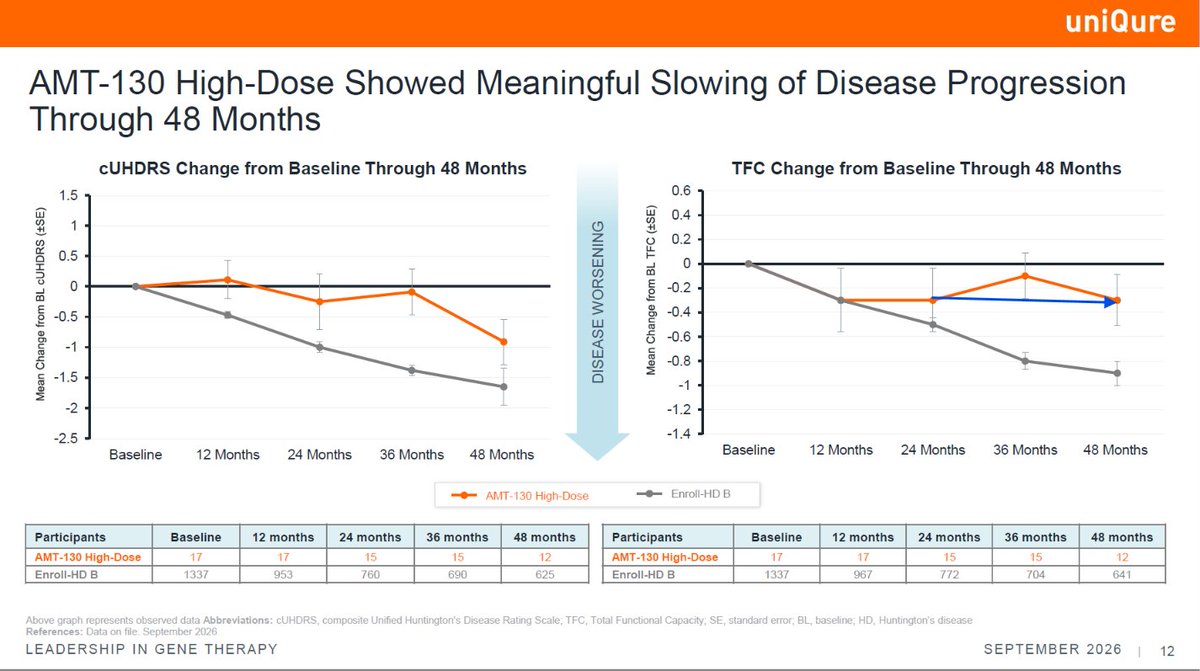
Here is a possible comparator, it is speculation; take the 1-year changes which includes the largest number of patients and multiply that change by the number of years to compare. Page 15 of today's presentation shows us what the 1-year decline is for the least amount of people who dropped out for cUHDRS. That came in at a decline of .91 in year 1. While HD patients don't decline in a straight line, it would probably be better than using as the denominator a figure we know to be flawed due to dropouts of the sickest of patients.
Using the above as the comparator, it would mean at 3-years, there would be a decline in NH of 2.73 compared to the number we used last year of 1.52. I question whether or not the 1.52 was accurate based on today's increased understanding. If we instead used 2.73 for the denominator of decline in cUHDRS compared to the decline from baseline in the 15 patients of .28 would have resulted in an almost halt of disease at the 3-year mark. I don't think a decline of 2.73 reflects accurately how the disease progresses, I bet the decline is actually higher than that.
Taking it a step further, our data during year 4 from baseline with the 12 patients went from a decline of .38 to a decline of .90 at month 48, a decline of .52 for just year 4. This is still a slower rate of decline than what the NH showed in year 1 of .91. My guess is in NH in year 4 declines much faster than the year 1 decline of .91. Either way, treated patients only declined by .52 points in year 4 compared to a first year decline of .91 in NH.
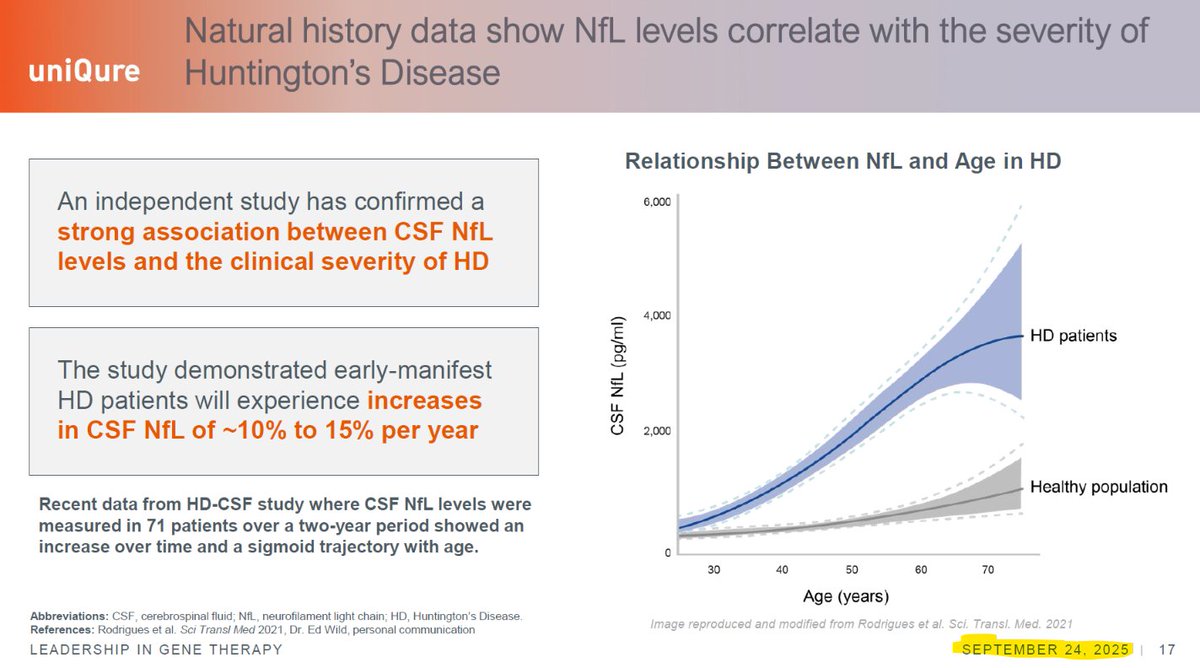
NFL data are not subject to bias in any way. It is a lab test and when you compare the data at year 4 of a cumulative increase of 4% to progression in healthy patients of 1-2%/year, the NFL of these HD patients is equal to what you would expect in a healthy population in year 4. I can't explain how data at year 3 reflected an 8-point decline compared to now a 4-point increase but on a cumulative basis, this was an incredible result. Look at slide from last year's presentation below.
Now on to TFC: What we know about TFC is that our data has not changed meaningfully since year 1. There was an initial decline from baseline at year 1 then it has basically been flat. That is the graph we need to look at, don't compare it to a faulty database. This means there is stability beginning 1 year after treatment in the thing that matters most, the patient's ability to live their lives working, driving a car, shopping and generally taking care of themselves without help. See adjusted snippet below for how it basically hasn't changed from year 1.
NFL data are not subject to bias in any way. It is a lab test and when you compare the data at year 4 of a cumulative increase of 4% to progression in healthy patients of 1-2%/year, the NFL of these HD patients is equal to what you would expect in a healthy population in year 4. I can't explain how data at year 3 reflected an 8 point decline compared to now a 4-point increase but on a cumulative basis, this was an incredible result. Look at slide from last year's presentation below.
Over time, the understanding of the data will become more evident that AMT130 is the only treatment to ever show this type of effect on the progression of this disease. It will be an education process that management should have engaged in during the past couple of years but that is water under the bridge. It is now time for them to get moving on this and educate all stakeholders about the true game changer that AMT130 is from HD community to investors to gov't officials to payers. The fact they screwed up by not educating everyone sooner will make the rollout a little more challenging, but they can rectify the situation.
This will be a blockbuster gene therapy, it may just take a little longer for that to materialize, but it will happen. Today was unbelievably disappointing from many aspects but after further review of the data, I am very pleased with the actual slowing of progression for the HD community. More time will continue to demonstrate how effective it truly is.
Time will tell whether or not this selloff in @uniQure_NV $QURE today proves to be the last great opportunity to get in cheap or a sign of things to come. No doubt in my mind, it is one of the last great buying opportunities. We are literally either minutes or days away from actual 4-year data, not an off the cuff answer to a question that may not be what she meant in terms of the upcoming data release.
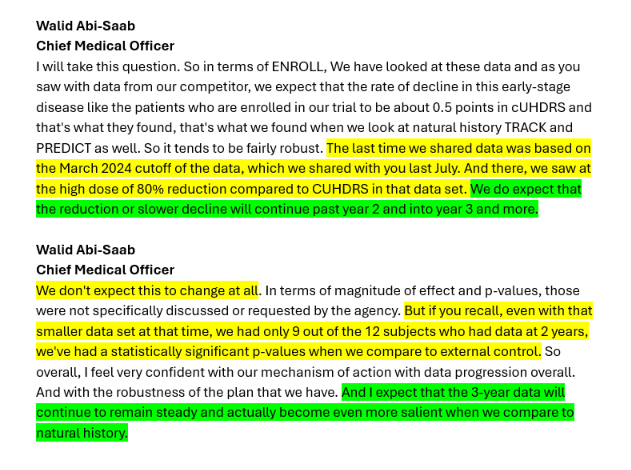
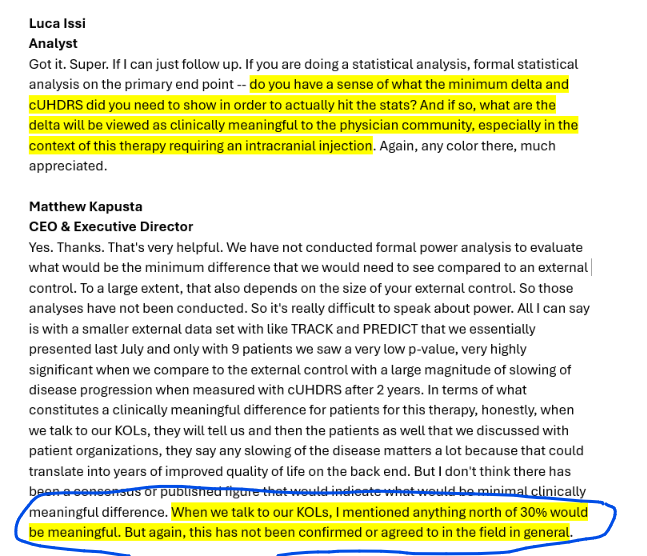
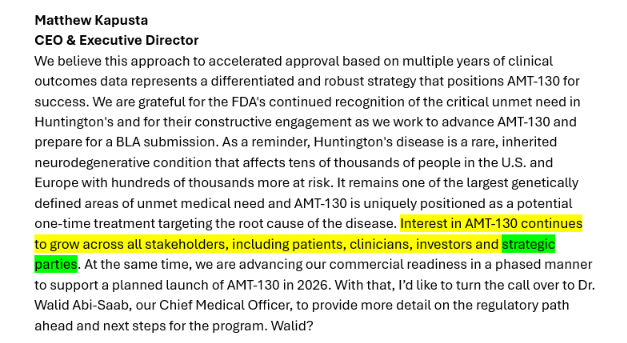
What I will share with you is some commentary from June 2, 2025 AMT130 update. Just 3 months prior to the actual release, Matt is on record as saying anything north of 30%, that's right, only 30% is clinically meaningful. 3 months later they released data showing slowing of 75% as measured by cUHDRS. Yesterday Dr Tabrizi was saying even if the actual effect with more patients is 40-50% slowing it will still be great since there is absolutely zero current disease modifying therapy available. My GUESS is that the data will be equal to or better than what was reported last year.
The comment made by Dr Tabrizi is being taken out of reality. We have Dr Sung saying just weeks ago that based on the experience of his patients, he wouldn't be surprised to see a slowing of 85-90%. He sees stability in his 6or 7 patients who were treated 4-5 years ago. I am certain Dr Tabrizi was describing something other than the 4-year data about to come out. She also only treated 2 patients.
All these snippets are from the June 2, 2025 update, prior to the travesty that occurred in November and onward. Know what you own and trust management of QURE.
After 18 Years of Excellence, our outstanding CEO is retiring. We ask for everyone to come out and join in the celebration of Ken! We look forward to seeing everyone there!
Community banks are open for business and actively lending to small businesses throughout the country, @KevinOlearyTV. Come and talk with us – we'd like to set the record straight, especially since community banks make 60 percent of small business loans. #banklocally
I enjoyed crossing paths with @ICBA Board Member @gussieboybanker at the airport in Washington D.C. today. It is always fun to see a fellow community banker!