An Indian lab just shipped an AI model that runs on a phone.
India has nearly 900 million people online, and more than half of them would rather use the internet in their own language. Most AI still isn't built for them.
Serving them from the cloud gets expensive fast at that scale.
FrontiersMind's NandiBERT goes the other way. It's small enough to run on the phone itself, trained from scratch on 11 Indian languages plus English. In my test, it answered in about 0.2 seconds a sentence without a GPU.
NandiBERT is state-of-the-art for Indian languages. On its benchmarks, the 150M version beats IndicBERT-v2, a model almost twice its size, on 5 of 7 Indian-language tasks, and the 450M wins all 7.
It holds up in English too. Both sizes rank second of nine encoders on average, ahead of ModernBERT and just behind UltraBERT.
So any app built for those users can now have search, support and moderation in their language, running on the device with no cloud bill.
It's open source under Apache 2.0, free for commercial use.
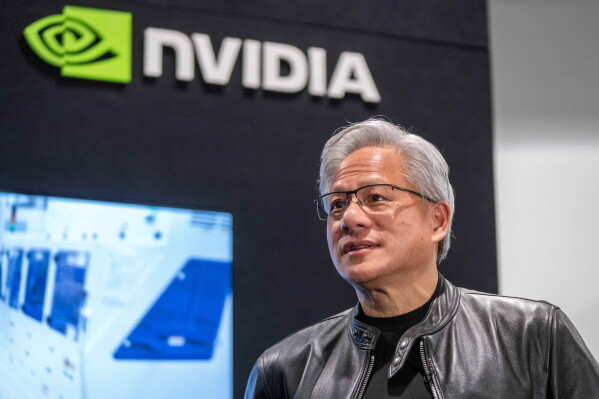
Breaking: NVIDIA just reported the biggest quarter in its history.
$115.8 billion in revenue, up 103% in a year. $65.3 billion of it was profit.
Q4 guidance is $130 billion, and it assumes zero data center compute revenue from China.
Vera Rubin NVL72 started shipping in the quarter that closed Oct 25. Racks are already running at CoreWeave, Google Cloud, Microsoft Azure, Oracle and Nebius, and NVIDIA calls it the fastest product ramp in its history.
Jensen Huang just resigned after 33 years as NVIDIA's only CEO.
He made more billionaires on his management team than any CEO in the world.
And it wasn't just executives. In a 2025 survey of 3,000+ NVIDIA employees, over 2,000 said they were already millionaires. Nearly half said they were worth over $25 million.
These aren't founders or VCs. They're engineers and staff who got paid in stock and stayed. Jensen said he personally reviews pay for every single employee.
His reason was simple: "You take care of people, everything else takes care of itself."
To understand why, go back to a 15-year-old kid washing dishes at Denny's.
Years later, at 30, he sat in a Denny's booth with two friends and decided to build a chip company. None of them really knew how.
Their first chip flopped. By 1996, NVIDIA was nearly bankrupt. Most companies die right there.
He didn't quit. For years he made bets nobody understood, and kept going anyway.
In 2016, he walked into the office of a then-new nonprofit called OpenAI and personally handed over the first DGX-1 AI supercomputer.
Today, much of the AI the world uses runs on NVIDIA chips.
The dishwasher didn't just build a chip company. He gave AI its power, and made thousands of ordinary employees rich along the way.
Honestly, this is very sad to see. He's leaving a company worth more than the annual GDP of more than 180 countries, and the impact he created will outlive any title.
Muhurat trading is tomorrow, Sunday 8 Nov.
This year, ask your AI instead of opening five broker apps:
"Show my Muhurat P&L across every account."
Quantplay connects your AI agent to your broker. Setup takes a few minutes.
https://t.co/ROkO2VZzZ7 is now officially listed in ChatGPT 🤩
You can tell ChatGPT what to post with a single prompt and it drafts your post for 9 platforms.
X, LinkedIn, Instagram, Threads, Bluesky, Facebook, TikTok, YouTube, Pinterest.
8. The Shawshank Redemption
A banker wrongly convicted of murder spends nearly two decades quietly working on one plan. The best lesson in patience on film.
A watchlist for founders. 8 picks.
Starting with the one every founder should see at least once:
1. The Founder
How Ray Kroc took McDonald's from the brothers who built it. Equal parts inspiring and uncomfortable.
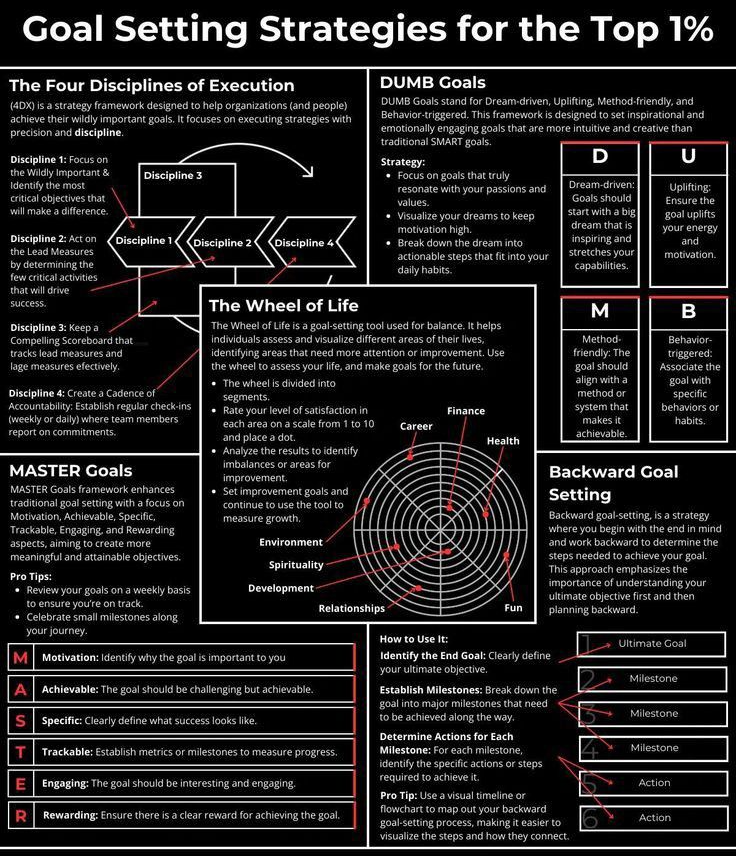
Five goal-setting frameworks on one page.
4DX, DUMB goals, the Wheel of Life, MASTER goals and backward goal setting.
The one most people skip is backward goal setting. Start from the end result, work back to the milestones, then the actions under each one.
US clocks fall back an hour today.
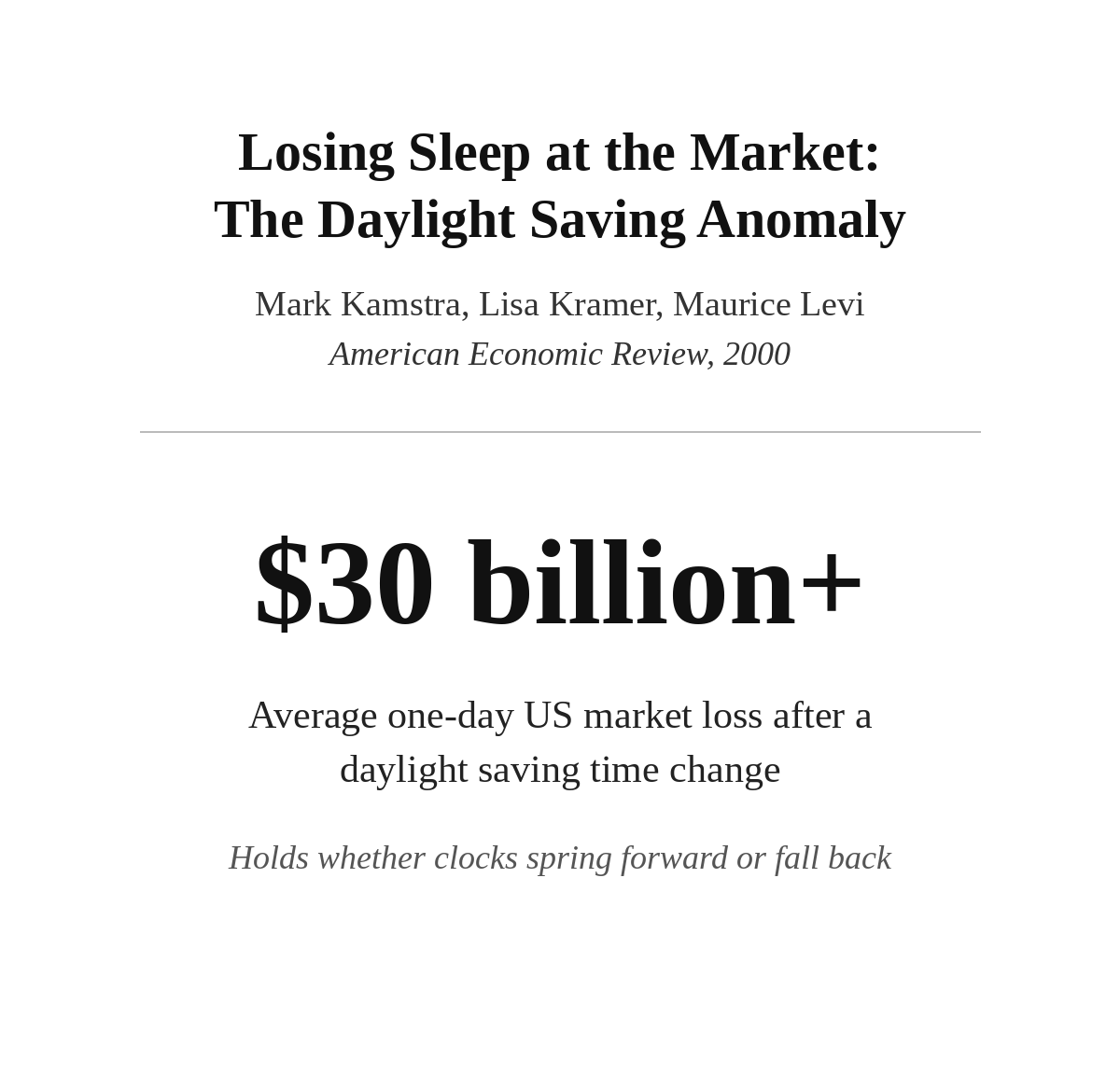
Researchers found stock markets tend to drop on the Monday after a daylight saving change, whether the clocks spring forward or fall back.
In the US alone, the average one-day loss worked out to more than $30 billion.
One hour of shifted sleep, priced into the whole market.
Any AI workflow a company wrote down three months ago is probably already out of date. That isn't my hot take. It's Aaron Levie, the CEO of Box, a company that sells software to some of the biggest enterprises out there.
His post has been read over 3 million times in about a day and a half, and I think that's because it names a feeling a lot of people have but can't quite put into words.
Here's his core point. Normally when a new technology shows up, it improves fast for a while and then the curve flattens. That flattening is what lets everyone else catch up. Companies standardize how they use it, the playbook spreads, and the advantage of being early slowly disappears.
Levie says AI is doing the opposite. The curve isn't flattening. In his words, it's "basically going vertical right now." So the gap between people working at the frontier and everyone else isn't closing. It's getting wider.
The part that hit me hardest is the timeline. If a company codified its AI processes 3 to 6 months ago, he says it's likely already behind again. And the companies that kicked into gear a year ago and thought they were done are even further back.
He also says he has never seen a technology improve at this rate in his life and career. Coming from someone who has spent about two decades building enterprise software, that line carries real weight.
My honest gut reaction: this is the most useful way I've seen anyone frame AI and jobs. The biggest risk for most people isn't one dramatic day where AI replaces them. It's the quiet drift of using the same tools in the same way while the frontier moves every few months.
Anyone who uses these tools daily has felt some version of this. Setups that felt cutting edge in the summer feel clunky now, and things that flat out failed a couple of months ago suddenly work.
His advice is simple. Keep re-testing the stuff that didn't work before, and upgrade your expectations at the same speed the tech upgrades itself. He thinks AI native companies have a strong edge right now, and the real question is whether the bigger companies can keep up.
Our brains weren't built for a tool that gets meaningfully better every quarter. Learning AI once is no longer the skill. Relearning it every few months is.
https://t.co/zKouOeZdCe
Happy Halloween. The stock market's good half of the year starts tomorrow.
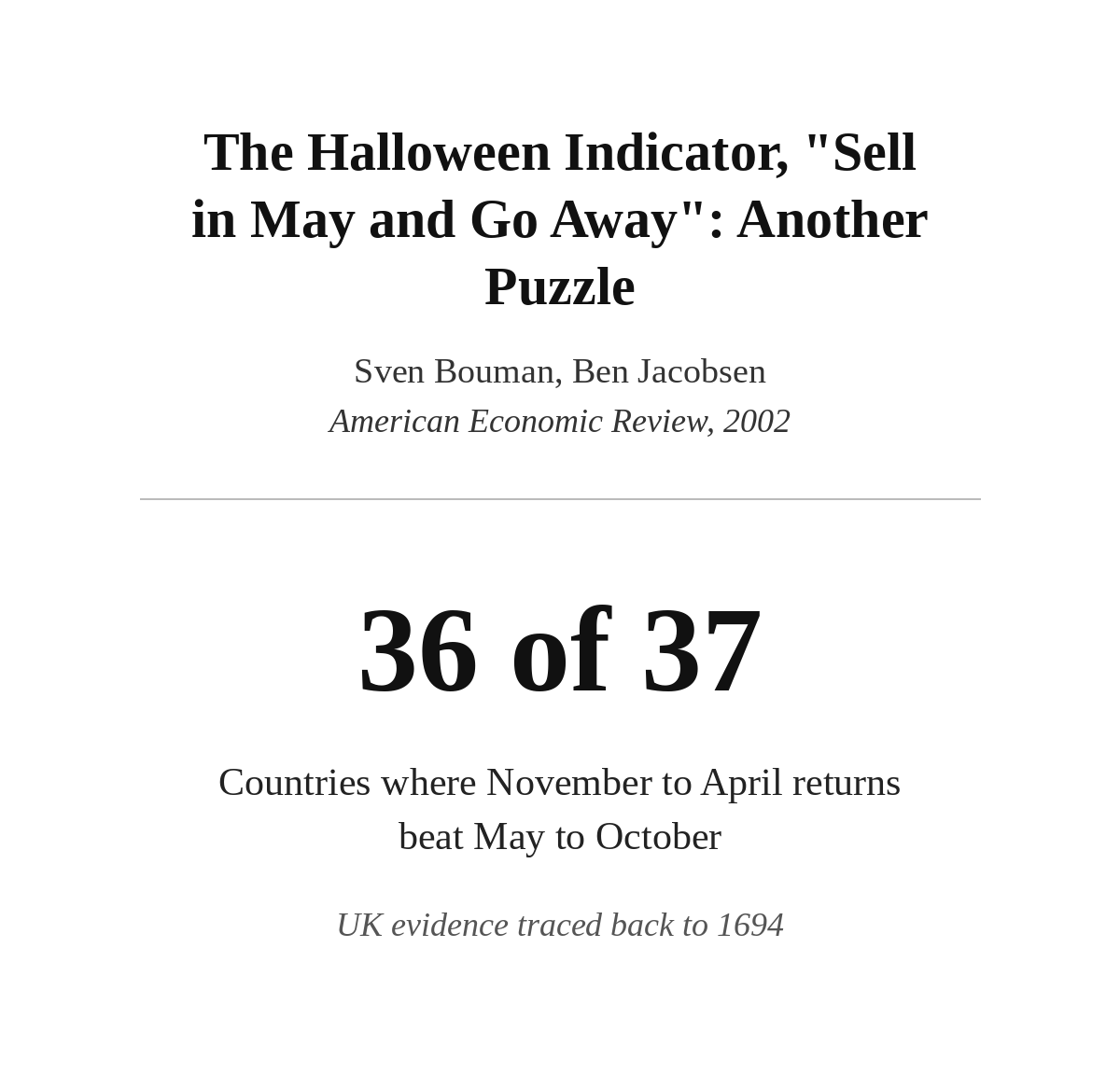
"Sell in May and go away" sounds like an old trader's superstition. Researchers tested it in 37 countries, and November to April beat May to October in 36 of them.
They found evidence of it in UK markets going back to 1694.