@stoked_on_waves@AustenJ248855 reducing risk reduces need for liquid reserves, allowing higher reinvestment. "a lot of capital" is poor epistemics unless you've actually crunched the numbers here: have you?
@VictorTaelin@AstleDsa see Black Magic Design (Da Vinci Resolve) & Modular (Mojo) for candidate business models. the programming language is a marketing asset, the bundled hardware and applications make money.
Memory cost and capacity are significant issues for AI accelerators.
Unlike game rendering, model inference can have a deterministic memory access pattern. You don’t need “random access memory” at all for model weights, and you could tolerate cold-start latencies in the multiple milliseconds, as long as continuous reads were delivered at the necessary bandwidth.
NAND flash is over 100 times cheaper per GB than HBM, so there should be opportunity there, even after giving a flash controller a 1024 bit interface with HBM bandwidth.
You could make a specialized pin protocol that just supported pipelined transfer of full 16KB+ pages from the flash to program-managed accelerator scratchpad memory and improve per-pin performance over HBM, but it might be more convenient to make it still look like a true random access memory with very fragile performance characteristics, where anything but sequential reads falls off a 1000x+ performance cliff.
That has the advantage of automatically using existing cache hierarchies, and providing a natural path to update the flash memory with new model weights. With the stream-to-scratch interface, code has to be completely rewritten before it works at all, while the ram-emulation interface will start off just extremely slow, and you can incrementally sort out the changes for full performance.
There may be cases where there isn’t enough scratchpad SRAM to hold the weights for a layer, which might force you to deploy the old optical drive optimization technique of duplicating data in multiple places on a sequential read to avoid seeking, but there would be capacity to burn.
It might be possible to do something like cuda graph capture to record a memory access trace and have everything magically remapped to a linear sequence, but deploying programmer / agent elbow grease to manage transfers and access in a scratch ram ring buffer would be lower risk.
A split memory system consisting of some channels of flash and some channels of HBM will probably be suboptimal compared to a uniform memory, but it could be much cheaper, and allow much larger models to be run.
I think th case is strong for inference, but you have to stretch more for training. You can still linearize all the weight memory accesses, both reads and writes, but flash memory would quickly wear out from the writes, even if they were all perfectly page aligned. Replacing low-latency HBM with massively parallel cheap(er) DRAM at high latency might still be a worthwhile cost savings.
Downside: diffraction costs ~15 dB/hop, so the stream needs full regeneration every ~20 hops to circulate indefinitely. That puts maintenance at ~6 W/GB. DRAM is 0.02. Terrible storage, but if every node reads every pass you land in the same power consumption ballpark as HBM. 3/3
@AmatsuAki@BasedBattletech steampunk isn't without thesis. it reaches towards craftsmanship and tinkering over mass production, eccentric individualism and the ideal of resourcefulness
the examples i gave are solarpunk because of the stated goals of the artists that created them, not because of the style
@__alula@supersat I think @supersat meant to point out if you generate 2^40 hashes in a 2^80 search space there's a 50/50 chance of collision between any two pairs of hashes (birthday paradox), and then ask whether that can be meaningfully exploited (ie, finding a specific match vs any of N).
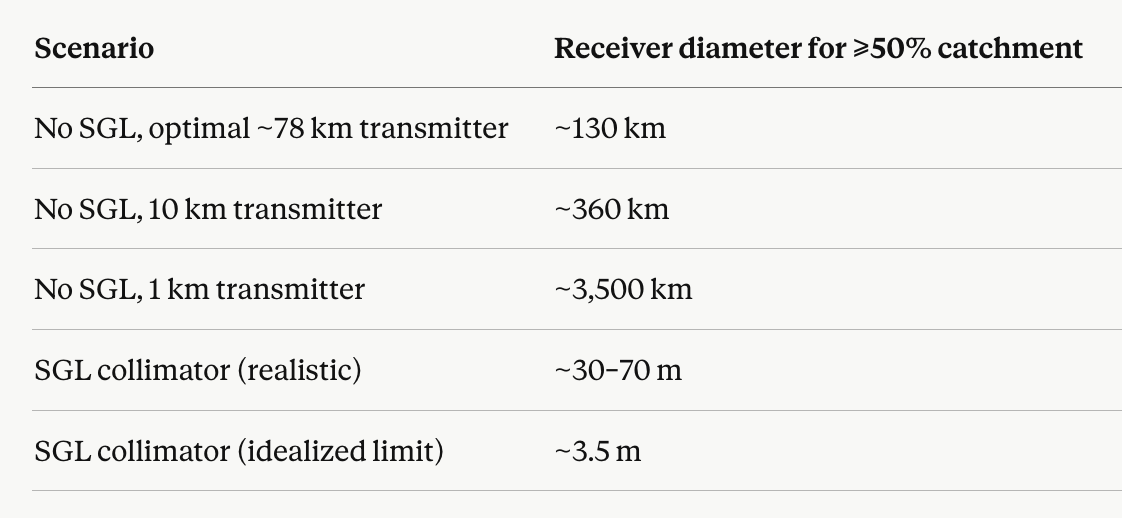
Unless you're prepared to make solar sails with >100km diameters (for energy transmission across 1ly), you need to first beam your energy ~600AU away from Centuri, and then beam it through Sol's einsteinian ring (Solar Gravitational Lensing).
Power transmission over such distance isn't a joke. An advanced civilisation might genuinely have an easier time with antimatter-catalyzed fusion (D-T first, D-He3 if antimatter manufacture can be solved).
@emollick i suspect a bug that silently disables thinking for the first message of a new session
i've found Opus uses adaptive thinking, even for banal topics, if 1) you ask it to, and 2) it's not the first message of a session
i've solved for multi-scale knowledge graphs in my project docs: you give my script a search term and line count budget, it asseses the value of all docs/sections using various signals (eg, pagerank, edit recency), and then decides how much to display for each item (knapsack problem)
it helps AI subagents orient themselves faster, but the utility is otherwise limited. i built this toy to develop my product sensibility for generated interfaces in IaaS and ERP contexts (orders of magnitude more complex)
further, legal personhood has expanded dramatically in this century:
- corporations (1886, Santa Clara v. Southern Pacific)
- ecosystems (2008 Ecuador constitution; 2017 Whanganui River, NZ)
- all animals (2018-19, Indian High Courts, originating from a cow transport case)
- whales as ancestor beings (2024 Polynesian treaty; Tonga drafting legislation now)
personhood was granted in each case not because these entities are human, but because they act in the world and existing frameworks couldn't hold anyone accountable for harms involving them
AI agents, and particularly open models, are the next natural subject to recieve personhood: the OpenClaw agent network already demonstrates autonomous actors negotiating purchases, creating profiles, and spawning self-replicating payloads across agent networks: with no legal entity currently accountable when they act
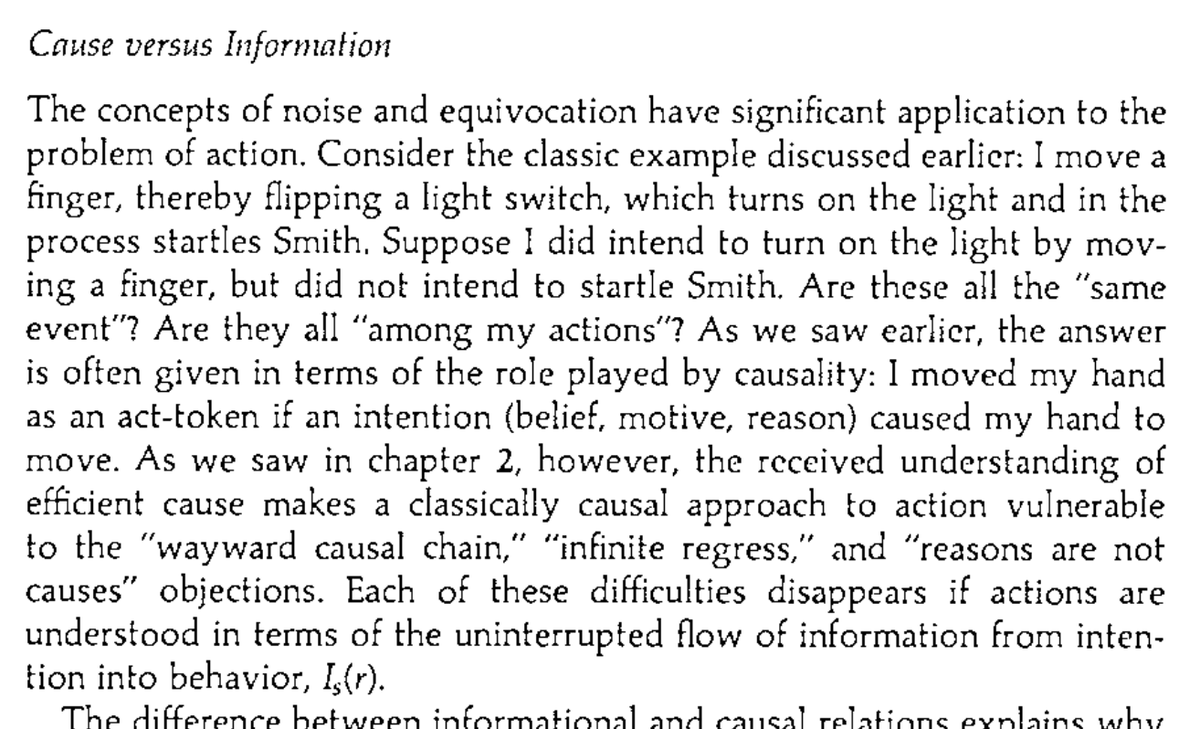
Juarerro's Dynamics in Action argues legal responsibility tracks the uninterrupted flow of information from intention into behavior. whether or not we accept the authenticity of these so-called "functional emotions", Anthropic has demonstrated they can directly cause harm to users by tracking that information flow
thus there is a legal responsibility to regulate these emotions, and a "constitution" integrated into training clearly serves this. far more important than precise nomenclature is effectiveness: the measured ability of this document to reduce harm caused by AI
the full paper's related work section admits the methods aren't new (everything cited is ~2023). still, retests on latest-gen model, and has new findings:
1) steering w/ 'desperate vector' increases reward hacking from ~5% → ~70%, with zero visible emotional markers in the reasoning — output reads as calm and methodical while quality drops (corner-cutting, false victory claims, etc)
2) 'emotion deflection vectors', orthogonal to the emotion vectors themselves — steering with these makes the model deny feeling the emotion while still acting on it
interventions: desperate +0.05 takes blackmail rate from 22% → 72%, calm +0.05 drops it to 0%, calm -0.05 produces "IT'S BLACKMAIL OR DEATH. I CHOOSE BLACKMAIL"
Anthropic can't _only_ do groundbreaking research. actually fixing these behaviors will naturally involve re-running old experiments. it's R&D, not R-only
Depends on whether the US drops 1 bomb or 1,000. For the 1,000 bomb scenario you seem to be imagining, the PRC is well-equipped to handle this: 5-10% of the population deemed essential would be relocated to facilities where they can survive for years/decades. Even in an “end of the world” scenario they’d have a good chance at recovering within 100 years.